Derby’s Dairy Barn C 1950

Derby’s Derry Barn C 1950
George and Marion Derby opened their dairy bar at the end of Ferry Street in March 1950; advertising the best food cooked and served the way you like it!! A few years back I talked with my cousin Ray Parker about Derby’s. Ray and some of his high school friends had a small band. One day this group stopped into Derby’s, got talking, and as a result Mr. Derby offered them a place to practice. After all, it might help his business! For the next few months this group practiced and played at Derby’s. Ray found some old derby hats in his attic; thence their name became “The Derby Hatters”. This group contained 5 guys: Ray Parker on the drums, Dave Thompson at the piano, Wilford Boucher on the base fiddle, Lewis Carter with his sax, and a friend from Nashua on the trumpet. According to Ray, they did not play very long, nor did the dairy bar remain in business for long.
According to Manning’s Hudson Directory, Derby’s Dairy Bar and Trailer Court remained in business until 1954. That location became Moore’s Trailer Park and more recently Merrifield Park. It was located at the end of Ferry Street just before the name changes to Burnham Road. Photo courtesy of Gerry Winslow and now a part of the Historical Society Collection.
Life Extension of Taylor Falls Concrete Bridge

Extending Life of Concrete Bridge
In 1960 the State of New Hampshire commissioned an engineering firm to conduct studies and make recommendations relative to the ever increasing east-west traffic flowing between Hudson and Nashua on the bridge. The resulting Campbell Report, issued in late 1960, stimulated discussion and controversy which required some 7 years to resolve. During that time traffic problems continued. Traffic continued to increase placing more and more stress on the existing, inadequate, and deteriorating concrete bridge. Almost unnoticed the bridge had slowly deteriorated to a point of real danger. Load limits were placed on vehicles crossing the bridge and emergency repairs were planned.
While these repairs were underway the bridge was closed to all but pedestrian traffic! Those commuting to/from Nashua would park one vehicle on the Hudson side, walk across the bridge, and continue to their job using a second vehicle on the other side.
This week’s photo, taken from the Nashua side of the river, showns the results of the emergancy repairs made to stabilize and shore up the bridge in an effort to prolong its use until the Veterans Memorial Bridge could be completed. Photo by Tom Muller and a part of the Historical Society Collection.
Steam Railroad Bridge Across Merrimack River

Steam Railroad Bridge Across The Merrimack
As you cross from Nashua into Hudson on the Taylor Falls Replacement Bridge you can see the abutments for this bridge down river on your right. This was the bridge used by the steam railroad as it crossed the river in to Hudson. The original wooden railroad bridge, built about 1874, burned in 1910 after being set afire from a locomotive. It was replaced by this iron bridge which stood until the metal was salvaged in 1944 during World War II.
The abutments can also be seen from the shoreline of Merrill Park, located at the end of Maple Avenue. The park entrance is built on a part of the old railroad bed.
After crossing the river, the steam railroad continued northeasterly, crossing over Lowell Road and the street railroad on a trestle just south of the junction with Central Street (near Hammond Park). The train continued on to the station at Hudson Center, off Greeley Street and behind Wattannick Hall. It then continued easterly to West Windham. In this C 1910 photo we are looking upriver at the railroad bridge and the newly constructed cement Taylor Falls Bridge which is visible under the bridge. Photo from the Historical Society Collection.
Concrete Taylor Falls Bridge

Concrete Taylor Falls Bridge
In 1909, after the iron bridge was found to be unsafe, a committee involving knowledgeable people from Hudson, Nashua, and managers of the street railroad company began plans for a replacement bridge. At first the plan was to replace the bridge with either an iron or a steel bridge. After consideration, this plan was tabled in favor of far more substantial structure of reinforced concrete. By June 1910 there was a contract to erect a reinforced concrete bridge with sufficient strength for a 50 ton electric train. This bridge was to have five arches, four piers in the river, and an abutment on each end. The roadway was to be 30 feet with a 6 foot sidewalk on the north side. There were problems during construction, especially with one of the piers on the Nashua side. A final inspection was made and the bridge accepted in November 1912.
During it’s lifetime the traffic from the eletric cars dimished and ended. The old concete bridge survived the flood of 1936. Over the years, travel from autos increased in both weight and volume. That increased usage, plus the demands from the trucking industry took its toll on the bridge. Discussions regarding a new bridge began in the early 1960’s and reached a milestone in 1970 when the Veterans Memoial Bridge was opened to the public. Emergency repairs were made to the concrete bridge in order to ‘shore it up’ for use during the construction period. Once the north span of the new bridge was opened the old concrete bridge was permanently closed and within a few years was replaced with the new Taylor Falls Bridge (southern span). Photo from the collection of the Hudson Historical Society.
Taylor Falls Iron Bridge

Taylor Falls Iron Bridge
Once the decision was made to replace the wooden bridge a contract in the amount of $19,500 was awarded in 1881 for the construction of this Taylor Falls Iron Bridge between Hudson and Nashua. The iron bridge was built in the same location as and using the same abutments as the old wooden bridge but with an increased grade of 2 feet. In addition to the new bridge this contract included raising the grade, removal of the old wooden structure, and the stone work under the bridge. The contractor kept the materials from the old bridge. This bridge was open for public travel in November 1881. In the end, after Hudson received money from Nashua, Litchfield, and Londonderry, the actual cost of this iron bridge to the town was about $7,300.
For 14 years this bridge needed little maintenance except for new planking, painting, and tightening of the rods. In 1895 the bridge was strengthened and provided with new floor beams so as to allow for electric cars (trolleys) between Nashua and Hudson. These improvements were paid for by the electric car company.
By 1909 safety issues again developed. This time the issue was related to the increased weight and frequency of the electric cars; more than doubled when first allowed on the bridge. Engineering experts were called in to review the bridge and found it to be unsafe. Only 28 years after completion plans were underway to replace this bridge. This photo from the collection of the Hudson Historical Society was taken from the Hudson side pf the river.
Taylor Falls Wooden Bridge

Taylor Falls Wooden Bridge
Up until 1826 there was no bridge across the Merrimack River from as far south as Lowell and north as Manchester. Reacting to this need some of the more prominent men of Hudson and Nashua petitioned the State Legislation for a charter to build a bridge. The wooden bridge shown in this picture was built by the Proprietors of the Taylor Falls Bridge and opened as a bridge in 1827. The characteristics of this bridge are quite interesting. It was 509 feet long with a 16 foot roadway and no sidewalks. The abutments had one tier of faced stone on the outside, filled with loose stone, all laid dry with no cement. A few years after completion ice jams and water pressed so hard against the abutments that an ice break was erected in 1834 to buffer the bridge from this danger. This ice break remained in use until it was removed during construction of the Veterans Memorial Bridge. It continued as a toll bridge until about 1855 when the county laid out a public highway over the bridge and it became a toll free bridge.
At a town meeting in 1881 a committee was chosen to examine the bridge and consider what was best: repair or replace. The committee recommended replacement as soon as practical. After conferring with a similar committee from Nashua the decision was made to replace this wooden bridge. Photo from the Hudson Historical Society collection.
Ferry Boats Across The Cross The Merrimack River
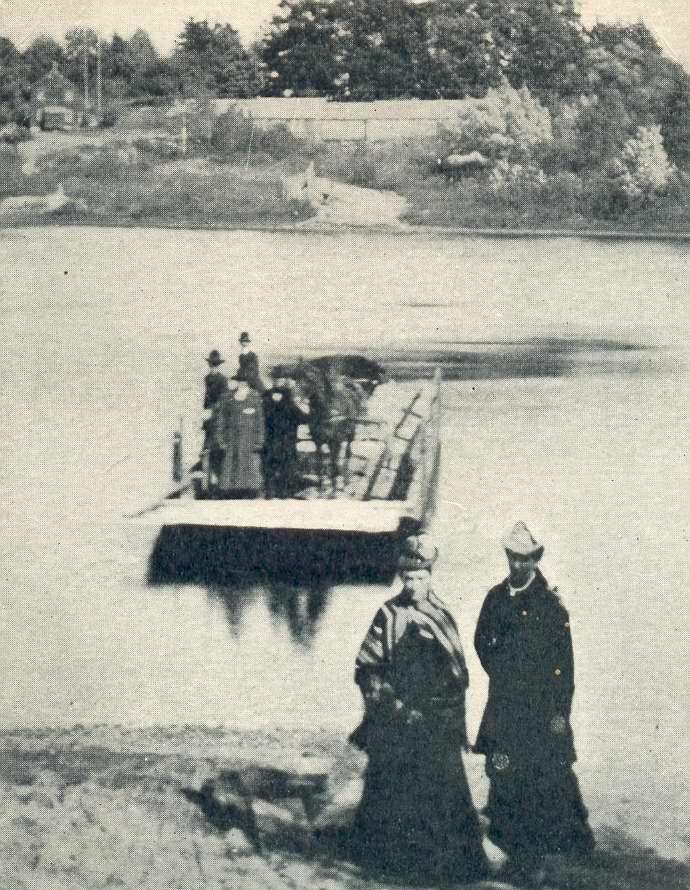
Ferry Boat across Merrimack
In the early history of our town, up until 1826, there were no bridges across the Merrimack River between Lowell and Manchester. River crossings between Hudson (then called Nottingham West) and Nashua were made by ferry boats similar to the one shown in this week’s photo. During these early years there were no less than three ferries operating between the two communities.
The earliest ferry was operated by Eleazor Cummings. His ferry left the east shore of the river a short distance north of the Veterans Memorial Bridge. It landed on the west side just south of the mouth of the Nashua River. Operation of this ferry continued until 1742, at which time Mr. Cummings relinquished his rights to another person who established Dutton’s Ferry just below the Taylor Falls Bridge.
A second ferry, called Hardy Ferry, operated from Lowell Road near the Hardy Farm. A Third ferry, Hills Ferry, was operated on Hills land just south of the town line into Litchfield. This was started by Nathaniel Hills and was continued by later generations of his family.
The first bridge between Nashua and Hudson was built in 1826. Even after it’s construction some of these ferries continued to operate. Photo from the Historical Society Collection.
Twin Span Bridge Across the Merrimack C1975

Twin Span Bridge C 1975
The challenge of crossing the river between the communities of Hudson and Nashua has been a re-occurring one since the beginning of our town’s history. The twin span bridge shown in this C 1975 photo, is the result of such a challenge which began in the early 1960’s and extended for a decade or more. This photo was taken from the Hudson side at Ferry Street. These spans, constructed at separate times, now provide for traffic between the communities of Hudson and Nashua.
First to be completed was The Veteran’s Memorial Bridge (northern span). This span was constructed along side and parallel to the aging concrete Taylor Falls Bridge. Following 15 months of construction this span was opened in September 1970. Emergency repairs had been necessary to “shore-up” the deteriorating Taylor Falls Bridge; load limits and height restrictions were imposed to postpone its demise. State officials made the decision to permanently close the old bridge once the new span opened in September 1970. This set the stage for the construction of the southern span shown in this photo.The old bridge was demolished in the spring of 1973 and The Taylor Falls Replacement bridge opened in December 1974.
First to be completed was The Veteran’s Memorial Bridge (northern span). This span was constructed along side and parallel to the aging concrete Taylor Falls Bridge. Following 15 months of construction this span was opened in September 1970. Emergency repairs had been necessary to “shore-up” the deteriorating Taylor Falls Bridge; load limits and height restrictions were imposed to postpone its demise. State officials made the decision to permanently close the old bridge once the new span opened in September 1970. This set the stage for the construction of the southern span shown in this photo.The old bridge was demolished in the spring of 1973 and The Taylor Falls Replacement bridge opened in December 1974.
As necessary as these bridges were, their construction and the access roads required for their use completely eliminated the general business area which had developed at the bridge near Central and Ferry Streets. Photo from the Historical Society collection.
Presentation of Mary C 1975
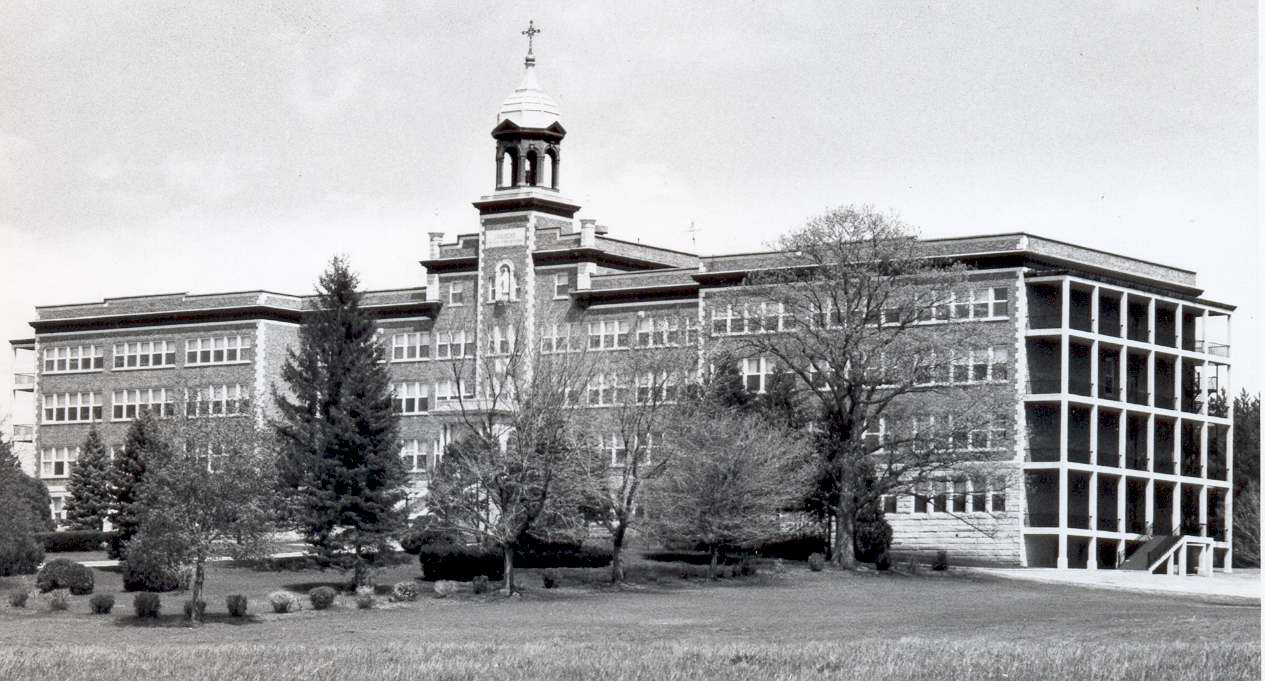
Presentation of Mary C 1975
In July 1924 representatives of The Congegation of the Presentation of Mary in Canada were invited by Bishop Guerton of Manchester to choose a site for this school. Bishop Guerton wished to have a bi-lingual boarding school in his diocese which served the franco-american population. By August of that year Alexander McDonald sold 128 acres to the community. The Presentation of Mary was incorporated by the State of New Hampshire and construction began. By September 1926 the building was blessed and the first school year began with 114 students – 70 of which were boarders.
In 1933 the first class of advanced studies began and by 1935 Governor Styles Bridges signed the charter authorizing Rivier College to grant bachelors degrees. Rivier remained at this Hudson location until 1941 when it moved to the former Shea property on South Main Street in Nashua.
Today’s photo was taken in 1975 in preparation for publication of “Town in Transition” the updated history of Hudson 1913 – 1977 and is a part of the photo collection at the Hudson Historical Society. Today The Presentation is a day school with students from pre-school through junior high school attending from Hudson, Nashua, and surrounding areas in both NH and Mass.
Baker Office Building and Nashua Trust
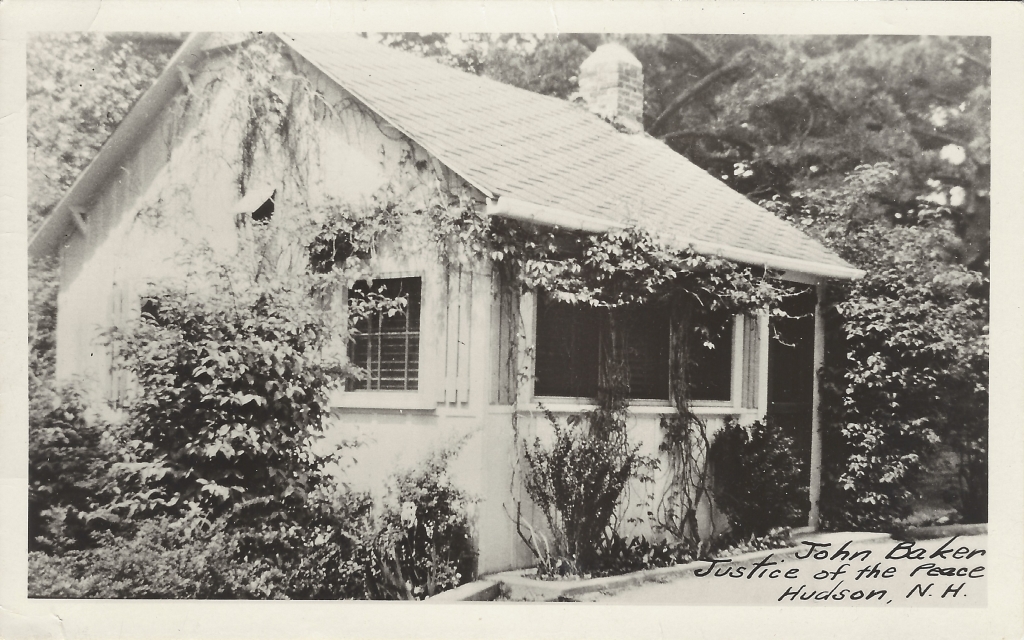
Baker Office Building
This popular photo of The Baker Office Building is on display in the Foyer at the Hills House on Derry Road. Visitors touring the Historical Society will often comment “This is where we got our marriage license”! John E. Baker served as Town Clerk and Treasurer from 1940-1965. At first he conducted his town business within the Baker Brothers’ Store on Central Street. By 1944 this privately owned office building was built on part of the old Kendrick property at the point of land between Derry Road and Baker Street. From this building Mr. Baker conducted his town responsibilities along with his private business as a John Hancock Insurance Agent and Justice of the Peace until the present Town Hall was completed in 1965. At that time the town office was moved to Town Hall on School Street.

Nashua Trust Building Derry Road
When the access to the newly constructed Veterans’ Memorial Bridge were designed Baker Street became a dead end street at Ferry Street. This small office building was moved to a private residence on Ledge Road.
The Nashua Trust Company had established a temporary branch office in the Morey Building on Ferry Street and opened for business by the end of August 1964. By March 1967 the bank moved into this brick building on Derry Road opposite Library Park and near the site of the earlier Baker Office Building. By August 1980 the Nashua Trust expanded it’s operation and relocated to 77 Lowell Road, occupying a portion of the former Piggly Wiggly Building. After a series of bank mergers and buy-outs the Lowell Road site is now occupied by Citizens Bank. This photo shows the Nashua Trust Derry Road building C1976. The building still stands and has been used by a real estate firm and a loan company. It is currently vacant. Photos from the Historical Society Collection.
 Remember Hudson NH When...