Revisit … Area Surrounding Library and Webster School C 1910

Area Surrounding Library and Webster School C 1910
This is one of the most popular post cards of Hudson.
From this early post card of Webster School, Hills Memorial Library, and the surrounding area we get an idea of what this section of town looked like about 1910. Kimball Webster School (right) had been in use since it’s completion in 1896. The new Hills Memorial Library (left) was completed in 1908. The photo for this post card was taken from an open field across the street from Webster School at the corner of School and Library Streets. In fact, what is now Library Street was barely a dirt road in this picture. One can locate the road by following the utility pole. An 1892 map of Hudson shows an ice house where the Hills Library is located and what is now Library Street was called Sanders Street.
Looking beyond these buildings and along Ferry Street we see very little construction. On Ferry Street and opposite the library is the home at what is now 42 Ferry Street; known by many as the Cunningham home and now owned by Kurt Smith. On the knoll behind the library and the school we see another early home; most likely the home at what is now 55 Ferry Street.
Today this open field is the site of the Leonard Smith Fire Station and the Town Office Building; built in the the 1950’s and 1960s respectively. Before these buildings this field was a popular playground; used during pre-school,recess, and after school activities for Webster School. During the spring and summer months this field was used by the Recreation Department for a ball field, basketball court, and playground for the younger kids. As a point of memory, Hudson resident Dan O’Brien has fond memories of little league games played here, as early as 1950 or 51,under the direction of Manager Brown. These may have been some of the earliest little league games in Hudson. The year construction was underway for the new fire station Dan recalls breaking a window in the station while throwing rocks. Yes! He was busted by Chief Andy Polak. In Andy’s way all he did was report Dan to his parents. But, that was enough! Photo from the Historical Society collection.
One Foot in Hudson and one in Nashua

Granite Plaque Identifying Joint Committee
Where could you stand and have one foot in Hudson and one in Nashua? Many folks remember walking along the sidewalk of the concrete bridge (north side of the bridge); halfway across we would see this pink granite marker commemorating the building of the bridge and identifying the principals from Nashua and Hudson who served on a joint committee to oversee the construction of the bridge in 1910. Turning to face the plaque one could easily stand so as to have one foot in each municipality!
Prior to 1910 the bridge between Nashua and Hudson was an iron bridge built in 1882. At that time there were no electric cars (trolleys) crossing between the two villages. In 1895 the bridge was strengthened in order to allow electric cars in addition to horse drawn vehicles to use this bridge. By 1909 safety of the bridge became an issue; especially in regard to the weight of the trolleys which was now twice the weight previously planned for. The bridge was deemed unsafe by two different engineers. An article in the 1910 town warrant to replace the iron bridge with a new steel bridge was indefinitely postponed. The recently elected Board of Selectmen, Jesse S. Wesson, George N. Dooley, and Guy A. Hopkins were authorized to confer with managers of the street railway and representatives from Nashua to decide what should be done.
By May 1910 the plans were revised to build a bridge of reinforced concrete, consisting of 5 arches with 4 piers in the river and abutments at each end. A special town meeting was called and this plan was voted on: 194 votes cast with 192 in favor!! The three recently elected selectmen along with Kimball Webster and Nathaniel Wentworth were authorized to serve on a joint committee with the Mayor of Nashua and members of the Nashua public works department. The committee acted promptly; by June a contract was signed with Fred T. Ley and Co. of Springfield, MA. The bridge was 36 feet wide plus a 6 foot raised sidewalk on the north side. Construction proceeded quickly and the first horse drawn vehicle crossed the new bridge on November 17. A few days later on November 23 the first electric car was able to cross into Hudson on the new bridge. Work was soon completed on the bridge except for the need of additional reinforcement of pier #4 which was completed in 1912. The final meeting of the joint committee was held at the Nashua City Hall October 13, 1912. The final payment was made to the construction company. The total cost was $74,480. The only remaining issue was how to apportion this cost between the two communities. The photo of an early trolley on the new concrete bridge into Hudson was taken from the roof of the Old Baker building. This photo is part of our Historical Society collection, complements of Don Himsel.
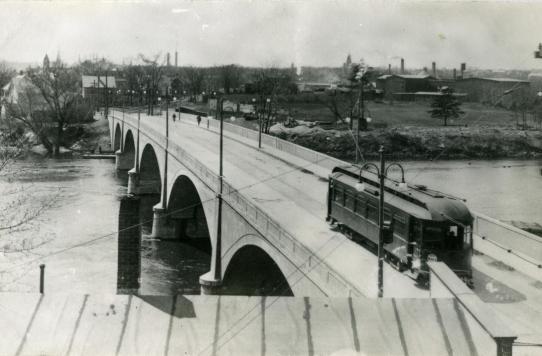
Electric Car Crossing into Hudson C 1910
This concrete bridge remained in service until 1971, despite repairs and work on the pilings to prolong it’s usefulness, when it was destroyed to allow for the construction of the present southern span. Just prior to the destruction of the bridge this granite marker was removed and placed on display at the Historical Society.
I have not heard or read of any particular dedication of this bridge; nor to I know exactly when the pink granite plaque identifying the names of the individuals on the joint bridge committee. Let’s look at who represented Hudson on this committee. First the three selectmen: Jesse Weston, George N. Dooley, and Guy A. Hopkins.
Jesse Weston was born February 1862 in Nashua; moving to Hudson about 1880. He married Agnes Willoughby in Nashua June 1891. While in Hudson he lived on Barretts Hill and worked as a mason. He served as a selectman and Representative to General Court. After the bridge was completed he returned to Nashua where he was employed as a foreman for Osgood Construction Co. and later engaged in the contracting business as Weston and Could. He passed in April 1941 and was buried in Nashua’s Woodlawn Cemetery.
George N Dooley was a Hudson native who owned and operated a farm on Old Derry Road previously owned by his father, Stephen. Father and son were active in town affairs. Each served as selectman and in the state legislature. George and his wife Ella (Hadley) Dooley had 4 sons. George N. passed in 1928 at the age of 57 from complications resulting from a farm accident.
Guy Hopkins, a bookkeeper, moved to Hudson from Nashua sometime between 1880 and 1909. He lived on the Lowell Road near Wason Road and continued to work as a bookkeeper in Nashua. While in Hudson he served as a selectman and on the joint bridge committee. He returned to Nashua about 1920.
Born in December 1843 in MA, Nathaniel Wentworth, enlisted with the 1st Mass Calvary in 1864 at the age of 21 and was discharged about a year later. He married Edwina Greeley in May 1870 and soon thereafter moved to Hudson. He spent most, if not all, of his remaining 53 years living in Hudson Center on Greeley street near the railroad depot. As a young man we was a mason, later he became the fish and game commissioner; a position he held for many years. He was active in town affairs; serving on the committee to build the D.O. Smith School in 1896. Later, after that school was destroyed by fire, he served on the committee to build it’s replacement. the Hudson Center School. In 1910 he was selected to serve on the joint committee between Nashua and Hudson to build the concrete Taylor Falls Bridge. He passed August 1923 and is burried in Westview Cemetery in Hudson Center.
Kimball Webster was born in Pelham November 1828; grow up on a farm he was used to hard work. In April 1849 at the age of 20 he left home and traveled to Independence, MO. There he joined a company of 28 men fitted out with pack mules and horses. He traveled over the trail to California in pursuit of the great gold discovery. He worked the mines for a while and then traveled to the territory of Oregon where he began a career as a land surveyor; first with public lands and later as an employee of the railroad. Mr. Webster married Abiah Cutter of Pelham and they settled on a portion of his grandfather’s farm in Hudson. Their adult family consisted of 5 daughters each of whom married and remained in the Hudson/Nashua area. Kimball had an extensive career as a surveyor, civil engineer, Justice of the Peace, writer, and historian. We are reminded daily of the contribution his ‘History of Hudson, NH’ has made to our knowledge of our past.
Researched and written by Ruth Parker. This article was published in the HLN on February 2, 2019 and as a revisit in the Nashua Telegraph on April 19, 2020
Revisit Hudson Schools…Hudson Center School Circa 1909
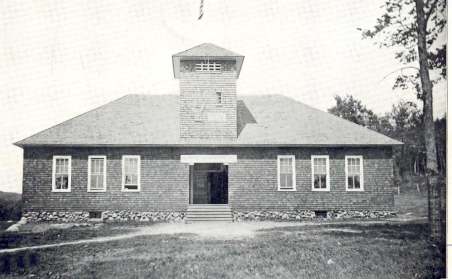
Hudson Center School circa 1909
Also known as the school on Kimball Hill Road. I attended this two-room school house for five years. Grades 1-3 with Mrs. Marguarite Gilman and grades 4 and 5 with Miss Florence Parker. After that the 6th grade at Webster then off to Alvirne!!
After the D.O. Smith School on Windham Road was destroyed by fire, the school district voted to build a new school of similar size. The sum of $900 plus the amount received from insurance was allocated for this purpose. A conscious decision was made to not re-build on the Windham Road location. The Hudson Center School, a two room house, was built on the east side of Pelham Road (now Kimball Hill Road) just a short distance from Hudson Center. This school remained in use until 1956 when it was closed. The students were combined with the classes at Webster School. Of the two teachers: Florence Parker became a reading supervisor and Mrs. Marguerite Gilman taught a second grade. This building remains today and is privately owned. Photo from Historical Society Collection.
The Mill and Home At Eayers Pond
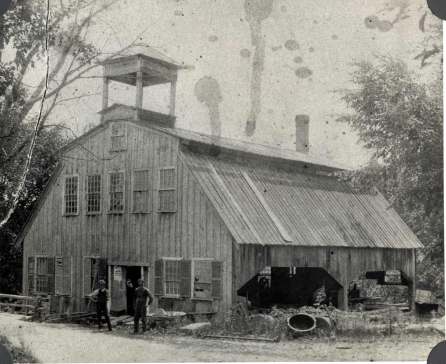
Old Mill at Eayrs Pond
It is not possible to determine where or at what time the early mills were established in Hudson. From early maps, deeds, and family history we do know that Edward Foster Eayrs operated a mill on Eayrs Pond near the intersection of River and Chalifoux Roads as early 1877. Edward maintained the dam on Eayrs brook to control the water level of the pond and to generate sufficient power for the mill. After his death in 1913 members of his family operated the mill for a while.
Edward Foster Eayrs was born March 1840 in Nashua, a son to John and Lucy (Hartwell) Eayrs. The history of the Hartwell family can be traced to the early 1700’s of NH and MA. Likewise the Eayrs (also spelled Ayers) has a history into the 1600’s. The Eayrs family, John and his brother James, operated a mill in northern Nashua, likely along the Pennichuck brook. Census records credit John as owning a ‘drug mill’ in Nashua; a name which has a different connotation from today. This mill was used to grind herbs and roots which were then used for medicine. Some of these were used by relatives in Lowell for Ayers Sasprillia and other medicines.
Edward worked as a ‘drug grinder’ until his father passed in 1861; after which he worked with his Uncle James. In September 1864 Edward enlisted in the Union Army, serving in Company F, New Hampshire 1st Heavy Artillery. He was mustered out on 15 June 1865 at Washington, DC. Returning to New Hampshire he returned work with his uncle in the mill and later later became a partner. After his uncle passed Edward moved the mill machinery to Hudson, between 1877 and 1880, and began operating the mill at Eayrs Pond.
By 1860 there was a coronet band of about 20 young men under the direction of Edwin T. Baldwin of Manchester and later of Nashua. The Republican Party hired his band during the 1860 presidential campaign for Abraham Lincoln. After the war broke out most members of this band enlisted for four months as musicians in the First NH Regiment. The name of this band was changed to the Nashua Coronet Band. At some point Edward Foster was a member of this band as he was chosen as their president in 1877.
The farm of James Cutter and Abigail (Putnam) Ford were neighbors to the mill at Eayrs pond; living west of River Road on Ford Road (now Chalifoux Road), Their daughter Charlotte Augusta (born June 1857) married Edward Foster Eayers and they built a home on the east side of the pond on River road. Their family consisted of four girls: Ida (born 1884), Lucy (born 1886), Cora Belle (born 1889), and Nellie (born 1890). Of these four daughters we will continue with the line through Cora Belle.
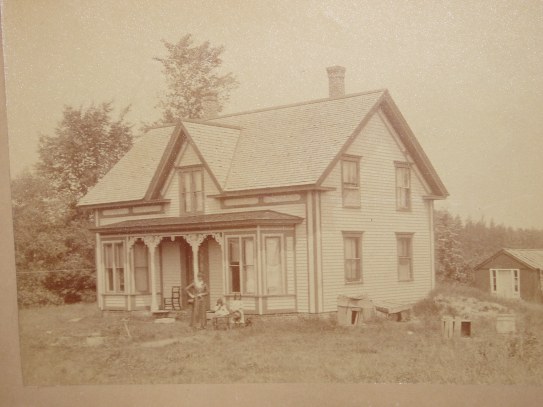
Eayers Homestead on River Road
At the age of 20, Cora Belle Eayrs married Walter F. Ducharme of Lowell in July 1909. They had one son, Walter Frederick, born April 1910. This was a short marriage which ended in divorce. In February 1919 Cora Belle married Orin Moody from Rhode Island. The Eayrs home on River Road became the childhood home of Walter Frederick, his mother Cora Belle, and his step-father Orin Moody. Orin worked at the mill until it was sold. The homestead was sold by Moody in April 1939 after living there more than 20 years.
To bring the descendants of Edward Foster Eayrs and Augusta Charlotte Ford up to the present time we find that Walter Frederick Ducharme married Eva Veronica Frenette, a native of Quebec Canada, on November 1927. Their family consisted of Lena, Walter (Sonny), Richard (who died while serving in the Korean War), Doris, H. Eugene, Sylvia, and Joan.
Getting back to the mill and Eayrs homestead. The Eayrs homestead located east of the pond on River Road remains today remodeled into three apartments. The photo of the Eayers Homestead if from the Historical Society collection complements of the Ducharme family.
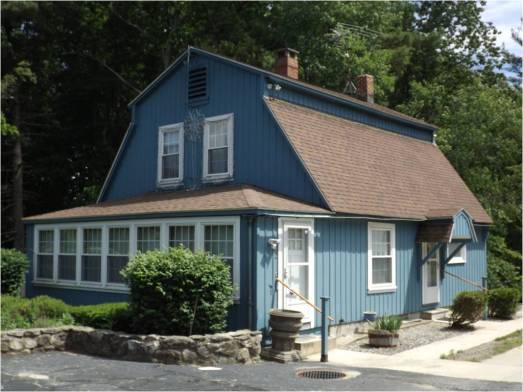
2 Stone Mill Drive 2018
The mill building at Eayrs Pond likely dates to about 1767. After operation by members of the Eayrs family there have been a number of owners. In August 1969 the mill and surrounding 4 plus acres was purchased by Nashua Optometrist Louis P. Guertin and his wife Shirley. During their ownership the State of NH claimed the pond as it exceeded 10 acres. Since then the state has regulated the dam to control water level of the pond. After Dr. Guertin passed Shirley subdivided the parcel into two lots on Stone Mill Drive. The old grist/saw mill is now a residence at 2 Stone Mill Drive. The early photo of the mill is also from the Historical Society collection complements of the Ducharme family. The current photo of 2 Stone Mill drive is from the town records.
Revisit Schools . D.O. Smith School on Windham Road

D.O. Smith School built 1896
In 1896 Hudson residents voted to erect two new school houses. This vote began the movement to a centralized school system; departing from the the district school system. The Smith School shown here was erected for the convenience of families in/near Hudson Center.
The Smith School house was erected in Hudson Center on what is now Windham Road. The building committee was authorized to spend up to $3,000 to build and equip this school; which was named in honor of Dr. David O. Smith. In his younger years David O. was a successful teacher, he then studied medicine and became a very skillful physician. After becoming a doctor he retained his interest in the schools of this town, doing more for our schools than any other person during his long lifetime. This school house was completely destroyed by fire and was replaced by the Hudson Center School on Kimball Hill Road in 1909. The Smith School was located on the north side of the road at or near the present address of 42 to 44 Windham Road. This picture is from an old sepia photograph from the Historical Society collection.
The Creamery at 26 Highland Street
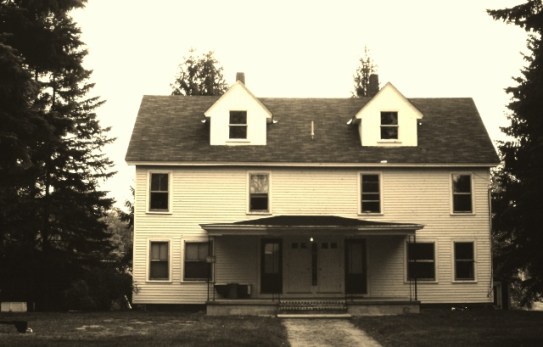
Creamery Building at 26 Highland C1975
Located on Highland Street the Merrimack Valley Co-operative Creamery existed from about September 1891 until September 1898. The co-op was started by members of the Hills family and other residents of Hudson and Nashua; most of whom had roots to homesteads along what is now Derry and Old Derry Roads. Some of the folks in Hudson know of the creamery’s existence but do not know the details. Today we will look into the story behind the creamery and the connection with the families of Alfred K. Hills, Justin E. Hill, and Charles E. Spalding.
Alfred K. Hills and his first cousin Justin E. Hill were natives of Hudson. Alfred was born in 1840 to Alden and Nancy (Kimball) Hills; he grew up on his ancestral farm which is now the Alvirne High School farm. Justin was born in 1844 to Warren and Mary (Chase) Hill; he grew up on his family’s farm located on what is now Old Derry Road. After the 1860’s Justin was a business man living in Nashua. It is noted that Warren had his name changed from Hills to Hill by act of NH Legislature in July 1846. Alfred married Martha Simmons and attended Harvard Medical school, after which he established a medical practice in New York. By 1887 Martha had passed and he was married a second time to Ida Virginia Creutzborg. Dr. Hills had a strong bond with his home town; a feeling his wife Ida Virginia soon shared. By 1890 they purchased the family homestead and built a summer home, which they called Alvirne, on the premise. In addition to his medical practice in New York he retained an interest in the family farm in Hudson; hiring a farm manager to oversee it’s operation.
Charles W. Spalding was born in Hudson to Willard and Sally (Marsh) in 1835; he grew up on his family’s farm located on the west side of Derry Road near Grand Avenue near the location of the present Continental Academia of Hair Design.
Between 1878 and 1886 there were three significant inventions in the dairy industry. The first of these was the continuous centrifugal cream separator invented in 1878. This machine was used to separate the cream from the whole milk; leaving cream for commercial use to make butter. This process left skimmed milk as a by-product. In the early years skimmed milk was not popular for human consumption and it was used as a supplement for growing and fattening pigs. The second invention occurred in 1884 with the invention of the milk bottle; the third occurred 2 years later when the automatic bottle filler and caper was patented. Together these three inventions would aid the formation of a co-op creamery.
By September of 1891 the Merrimack Valley Co-operative Creamery Association of Hudson was established and they had purchased land on Barrett Hill Road (now Highland Street) from Nellie and James Cummings of Nashua for $300. At the annual meeting of the co-op in September 1892 the outlook was encouraging and the creamery was ready for farmers to bring in their cream for processing. This established the build date of the 26 Highland Street property as 1982.
In September 1893 minutes of the next annual meeting of the creamery were reported in the Nashua Daily Telegraph. From these we learn of the success and challenges of the corporation. After being in business for two years they were beginning to see signs of progress. Local farmers were coming on board as patrons and the creamery was able to make butter on a paying basis and to the satisfaction of the consumer and with good profits for the creamery and the local farmers. They were confident of an increase in the supply of cream as more farmers wold come on board as patrons. Production of the creamery had increased and the board of directors was confident of continued growth. On the other hand there was concern that the dairy farmers were not supporting the co-operative as they should. Perhaps they lacked confidence in the organization. At this annual meeting we find the following local individuals as corporate officers: Justin E. Hill, President; Dr. Alfred k. Hills, Vice-President, Walter B. Chase, Secretary; Charles B. Spalding, Treasurer; Daniel Boyd, Auditor. The Board of Directors was Justin E. Hill, Alfred K. Hills, Walter B. Chase, Charles W. Spalding, Hon. W.N. Beasom, H.G. Bixby and Daniel Boyd.
Within a few years, by September 1897, at a meeting requested by a number of stockholders, it was clear that the creamery was having difficulty sustaining itself. The call to the meeting included a request to consider the advisability of selling and disposing of the property of the association and winding up its affairs. On September 15, 1898, by vote of the stockholders, the board of directors disposed of the property and equipment of the co-op. The creamery parcel and building was sold to Alfred K. Hills of New York. The deed was signed by Justin E. Hill and Charles W. Spalding on behalf of the creamery.
Dr. Hills converted the creamery into a tenement house and continued to own it until July 1919 at which time it was sold to Herbert L. Boynton. Mr. Boynton was a native of Maine then living in Hudson and employed by the Nashua Street Railway in the power house on Lowell Road. Mr. Boynton retained ownership of the property until October 1923 when he sold it to Raymond L. and his brother Frederick R. House of Hudson. Frederick (Fred) House passed in 1940 and his widow Helen House transferred her interest in the property to Raymond.
In January 1955 a subdivision plan was created by Ned Spaulding, Civil Engineer, resulting in a ‘creamery parcel’ and three additional land parcels. By November 1961 Ray House sold the creamery parcel to Elwin R. Moss of Nashua. Since 1961 ownership of the ‘creamery parcel’ has been transferred a few times. It is now owned by a Realty Trust; a 12 room building of 4 units on .455 acres.

26 Highland 2018
Among the artifacts in the collection of the Historical Society is a half-pint cream bottle embossed with the word ALVIRNE. I would like to think that this bottle was used in the creamery to contain cream from the cows at Alvirne Farm! The 1975 photo of the Creamery was taken by the author and is a part of the photo collection at the Historical Society. My thanks to Dick Crosby for his help with the deed research for 26 Highland Street.
Revisit Number 9 School House
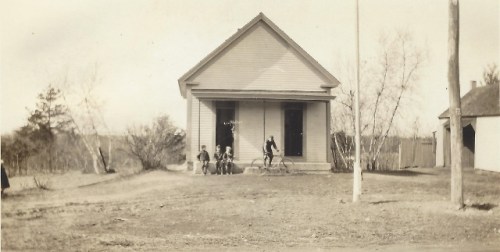
Number 9 School C 1921
Of the ten district schools number 9 is the only house remaining. Each of the others have been demolished and replaced with a dwelling or converted into a dwelling. Number 9 is privately owned by the Jasper Family and was restored by Shawn Jasper in the late 1970’s.
Before 1886 the No 9 house (Kidder District) house was located on what is now Robinson Road. The approximate location was on the left side of Robinson (as you turn up the hill from Old Derry Road) towards the top of the hill. The No 10 house (Hills Row District) was located on what is now Old Derry Road (earlier Derry Road) just north of the intersection with Greeley Street. These two districts were merged into a single district and this No 9 School House was built by the town of Hudson in 1886. It operated as a one-room school house until 1932. In the mid-1930’s Grant Jasper purchased the property from the town. The No 9 Schoolhouse is the only one which survives intact as a school house. In the late 1970’s it was renovated by Mr. Jasper’s grandson, Shawn. The school house is owned by Jasper Corporation.
Hills Homestead on Barretts Hill Road
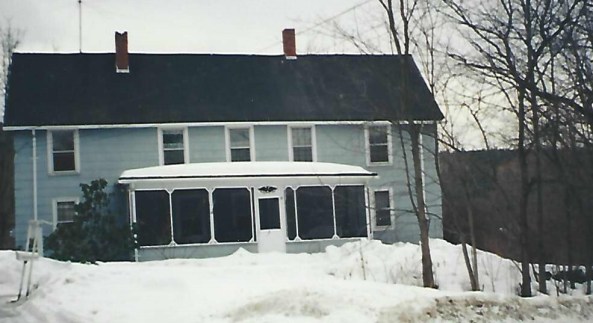
Farmhouse at 25 Barretts Hill Road C2003
Paul W. Hills is the last Hills descendant to live on Stoney Ridge Farm at 25 Barretts Hill Road. Paul was born in Marlborough, MA to Orlando Greenleaf and Lillian Hoffman. He grew up on a farm and was educated in schools local to that area. Paul proudly served our country in the Korean War and was discharged as a Corporal. Paul and his first wife Patricia had a family of one son, Paul W. Jr., and two daughters; Nancy and Cynthia; each of whom have families of their own and are living outside of NH. It is notable that in addition to Paul Sr. each of his children also served in the military. Patricia and Paul are divorced and Patricia lives elsewhere in NH. After returning home from the service Paul enjoyed a career as a truck driver until his retirement. He had a passion for farming; raising animals, birds, horses, cows, and pigs. About the time of his retirement Paul and his second wife Margaret moved to Hudson to live with his Aunt Sylvia (Hills) Flemming. He remained a resident of Hudson and Stoney Ridge Farm until his passing in April of this year. Those who knew Paul remember his garden, his peacocks, chickens, beef cows, and his love for the outdoors; traveling his acres on his ‘trike’ when walking became a challenge.
Silas Hills was the earliest ancestor in Paul’s direct line to settle on Barretts Hill. Silas was born 1813 in Windham. His parents were Jeremiah (b:1773 in Nottingham West) and Margaret Davidson (b:1781 in Windham). By 1837 Silas married Roxanna Farnum of Londonderry. Not sure when he actually began working his farm in Hudson but it was between 1841 and 1844. He operated a saw mill and grist mill on nearby Glover Brook whenever there was sufficient water flow to provide the necessary power. He did have some successful years but ultimately the mill fell into decline. Silas and Roxanna had 1 daughter, Addelisa; and 3 sons, John, George, and Orlando G.
Orlando G. (b:1855) remained on the family dairy farm and married Antoinette “Nettie” Young of Hudson in 1889. According to the 1892 map of Hudson and old deeds, Orlando G. and Nettie lived in the 25 Barretts Hill Road farmhouse. This map shows a cellar hole on the opposite side of the road which had been occupied by Silas. A part of the farm house dates to 1791.
Orlando and Nettie had 1 daughter (Sylvia B 1897) and 3 sons Orlano Greenleaf Jr. (b:1890) Harland (b:1891) and Lyman (b:1894). The 3 brothers served in France during World War I. Lyman had a 32 year career with the US Infantry beginning with the China Expedition and continuing to World War II. Orlando Greenleaf, Jr moved to Marlborough, MA where he and Lillian Hoffman raised their family of 3 daughters and 2 sons, the youngest being Paul W. Harland and Sylvia remained on the farm in Hudson. Over time ownership of the farm passed from Nettie to her daughter, Sylvia.
Sylvia Hills attended St. Josephs Hospital School of Nursing and was certified as a Registered Nurse in 1929. By July 1941 she married Alfred Flemming and they settled on the farm. Alfred conducted the farming operations and Sylvia continued her nursing career engaging in private duty work and later operating a nursing home at her residence. Alfred and Sylvia decided upon the name ‘Stoney Ridge Farm’ even applying to the State of NH for the use of that name. Sylvia was well known and respected in Hudson: a member and deacon of the Baptist Church, serving on the Historical Committee of Hudson Fortnightly Club, a founding member and director of the Historical Society, and a member of both the National Society Daughters of American Revolution and the Ladies of the Grand Army of the Republic. Alfred passed in 1965 and Sylvia continued to live on the farm, phasing out her retirement home over time. By 1980 Sylvia’s nephew, Paul, moved to the farm, thus keeping the farm in the Hills family.
Some readers may ask what the relationship is between Paul W. Hills and Dr. Alfred K. Hills. Their family lines merge at their common ancestor, James Hills (b:1697). James was the youngest of the three grandsons of Joseph Hills who built and settled the Hills Garrison.
In 1989 Stoney Ridge Farm received an award from the United States Department of Agriculture; recognized for being in the same family since the birth of the US Constitution. This award went to only two farms in Hudson and only a handful in the state of NH. From that day forward Paul proudly displayed his Bicentinial Farm sigh next to the Stoney Ridge Farm sign.
When Silas settled in Hudson this section of town was a wilderness dotted with a few farms. Today we find the Stoney Ridge Farm to be 45 acres of undeveloped farmland and woods. A haven and refuge for wildlife, surrounded by hundreds of acres of residential land and commercial development plus some acres waiting to be developed. In 2001 Paul Hills entered into an agreement with the town of Hudson which, in essence, was designed to protect this 45 acres from being development. Mr. Hill sold the development rights of his farm to the town of Hudson. This farm land is no longer owned by a member of the Hills family. It was recently sold by Paul’s estate to a local homeowner. This person owns and has use of the land for agricultural purposes. The photograph of the Hills farmhouse is from the collection of the Hudson Historical Society.
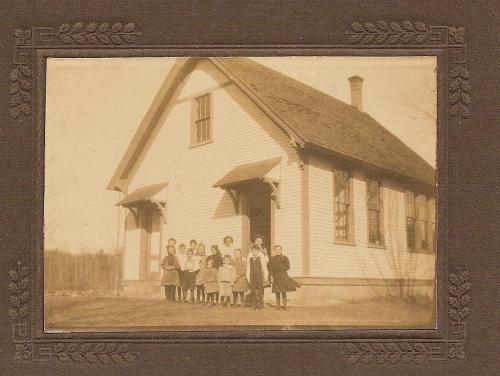
Revisit Hudson Schools …District School #1 at Musquash
District School #1 at Musquash
Holiday Decorations and Library Park

Standing Guard at Library Park 2018
Last week as I drove south on Derry Road and passed Library Park I noticed crew from our Highway Department placing the toy soldiers on the north corner of the park. As I continued on my way to my appointment in Nashua I recalled some of the history behind these and other decorations on the park. Perhaps it is no surprise how much these decorations are intermixed with Arthur Provencher and his vision to develop Benson’s Animal Park into a theme park,
Each of these painted wooden soldiers stand 12 feet tall and they delight the holiday spirit in each of us with their red and blue uniforms with yellow diamond-shaped buttons. With their white belts they stand at parade rest with their bayonet-tipped rifles at their side. Each has the same plumed hat and facial expression. They can stand in any order but the soldier holding the flag should be in the center.
So you ask: What does all this have to do with Bensons Park? During the Christmas seasons of 1980 and 1981 Arthur Provencher, then owner of Benson’s Animal Park, decorated his park with hundreds of thousands of lights and decorations for the holiday season. These wooden toy soldiers were a part of that display. Even though some 35,000 came to enjoy these sights and activities, that elusive break even point could not be reached. His “Christmas in New England” lasted for only a few years. The tradition of holiday decorations at Library Park was started by Mr. Provencher as a way of advertising the holiday events at Benson’s Animal Park. Over time this tradition was continued by the town. The five toy soldiers were purchased by the Chamber of Commerce and donated to Hudson with a plaque “Dedicated to people of Hudson by the Hudson Chamber of Commerce December 1995. Our first photo shows a brochure, complete with a coupon of 50 cents, used by Mr. Provencher to advertise his ‘Christmas in New England” tradition during the 1891 season.

Christmas in New England 1981
As time progressed the soldiers were in need of repairs and paint. In February 2004 the soldiers were delivered to the wood shop at Alvirne High School where, under the direction of John Conrad, the Building Trades class repaired and painted the soldiers. When completed they were stored by the Highway Department for use in many seasons to come. Our second photo shows the five toy soldiers standing guard over the 2018 holiday season at the north end of Library Park.
Another remnant of Benson’s is the traditional nativity scene tucked away behind Plexiglas in the old town trolley stop. This stop once provided a waiting place for travelers using the electric railroad from Nashua, through Hudson, to Hudson Center and on to Pelham. During the holiday season the stop is used to house the creche from Benson’s. The Christmas in New England brochure is a part of the Benson’s documentation at the Historical Society. The 2018 photo was taken by the author.
 Remember Hudson NH When...