Remembering Places to Eat … Andre’s Restaurant and Antoinne’s Catering
Conveniently located at 76 Central Street near Lowell Road was Andre’s Restaurant and Antoinnes Catering. A favorite spot for breakfast or lunch! Also a popular meeting place for various service organizations. It was been destroyed by fire and since replaced with a private home.

Andre’s and Antoinne’s on Central Street
Today we have many favorite places in town to enjoy breakfast or lunch: Cookies, Donna’s Place, North Side Grill, and Suzies to name a few. In the 1970’s one such favorite was Andre’s Restaurant located in the Hudson Grange Building at 76 Central Street, and shown in this photo.
Hudson Grange #11 was organized in December 1873 in the Number 6 Schoolhouse on Derry Road with Kimball Webster as the first Master. The grange, a ritualistic family fraternity originally based on rural and farm life, was one of the leading social organizations in town during the 1920’s. Meetings were quite late, beginning ‘after chores’ to permit farmers to attend to the evening milking and feeding before coming out for a meeting. A typical evening would include a crisply run business meeting, recognition of guests, a program, discussions for the good of the order and/or town, and a lunch. A program might be educational, some relevant agricultural topic, local events and/or politics, or entertaining. Often featuring local musical and/or literary talent.
Hudson Grange rented the Odd Fellows Hall (now the American Legion) for it’s meetings from 1903 to 1920. This arrangement proved satisfactory until the winter of 1920 when differences of opinion resulted between the tenants and landlord; as a result the grange looked into a change in meeting location. A large number of members were from the Hudson Center area and advocated using the Town Hall (now Wattannick Hall) in Hudson Center. The body agreed and meetings were moved to Hudson Center; an increase in membership mostly from the center area resulted almost immediately.
For the next 18 months meetings were held in the Town Hall with mixed success; depending upon your proximity to the meeting place. Members from The Bridge area did not want to travel to Hudson Center for meetings and visa versa. Meanwhile representatives from the grange were working to settle differences with the proprietors of the Odd Fellows Hall. Again the matter again came to a vote; and the body voted to return to the bridge area for their meetings.
At about the same time many members from the Center area requested withdrawal cards. This group soon obtained their own charter and Wattannick Grange #327 was organized. A smaller Hudson Grange returned to The Bridge and the Odd Fellows Building until 1935 when the building shown in this weeks photo, the former Hudson Congregational Church Building, became available due to a merger between the Congregational and the Methodist Congregations. Hudson Grange purchased the building from the newly formed Hudson Community Church. Soon after purchase the steeple was removed, the carpet was removed, and the grange held meetings and danced in what had been a church sanctuary.
In 1963 the grange entered into a lease agreement with Andrew Kinsville to establish a restaurant and a catering center; the grange retained ownership and use of the hall as a meeting place. This arrangement continued and Andre’s Restaurant and Antoinne’s Catering grew in popularity with many service organizations holding their regular meetings here. Then, in the early morning hours of May 9, 1977 the building known as Hudson Grange (formerly the ‘White Church’ was destroyed by fire. A small group of young intruders were held responsible for the fire as an act to cover up a robbery. At the time of the fire the premises were used for regular meetings by Hudson Rotary, Hudson Lions, chamber of Commerce, Kiwanis Club, and United Commercial Travel. Each of these organizations quickly had to make arrangements to meet elsewhere.
Hudson Grange also made arrangements to meet elsewhere in town and the building was never replaced. By the mid 1980’s the property was sold. A private residence is now located at 76 Central Street. A few years ago, in 2001 members of Hudson Grange and Wattannick Grange merged back into the charter of Hudson Grange. Meetings are now held in Wattannick Hall in Hudson Center.
Presentation of Mary Gates Lowell Road
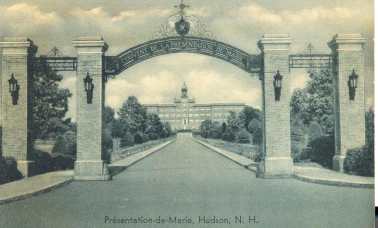
Early Image of Presentation Gates
In 2004 a large portion of Lowell Road, including that section near the Presentation of Mary (PMA), was widened to accommodate the increase in traffic. Prior to this project the historic gates embraced the driveway which lead from Lowell Road to the oval in front of the PMA building. Once the right of way for the reconstructed Lowell Road was laid out these gates were found to be in the way and had to be moved. When the project first started it was estimated the gates could be moved for about $50,000. The early image of the PMA gates is from a post card compliments of Gerald Winslow.
When plans were finalized the historic gates would be moved approximately 75 feet back from Lowell Road. Once moved the gates would grace the front of the property but they would no longer embace the driveway to the Presentation. A new and safer driveway entrance to was planned opposite the Executive Drive intersection with Lowell Road. This change in the driveway would also permit safer access of fire equipment to PMA as the modern vehicles were too large to pass under the gate. According to a July 2004 article in the Hudson Litchfield News, once the bid specs for moving the gates were prepared nine bid packages were sent out, but only two actual bids were returned. Both of these had prices far in excess of the planned $50,000.
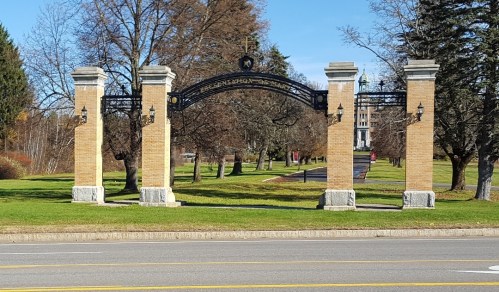
Presentation Gates 2018
The gates were not on the National Historic Register but they could be eligible to be on the register and the project to move the gates could not endanger this eligibility. The exterior bricks on the gates had been replaced in 1980. The granite blocks used in the foundation and the wrought iron work on the top of the gate were deemed as the important pieces. In actuality parts of the gate, such as the wrought iron fixtures and the sections on the top and bottom were salvaged and new gates were built back from the widened roadway by about 75 feet. This work was completed in September and October of 2004. The modified driveway was completed in 2003. The recent photo of the gates was taken by the author this past week. I wish to acknowledge an article “Presentation of Mary Gates to be Moved” authored by Lynne Ober which appeared in a July 2004 edition of the HLN.
Revisit Places to Eat …Steak Barn and Topspin on Lowell Road
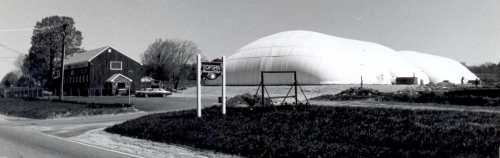
Topspin Racquet and Tennis Club C1976
Popular at the time was The Steak Barn on Lowell Road was located on a part of the Benton Morgan farm. By 1976 a part of his farm where Ben raised cattle, hens, and vegetables was transformed into a modern restaurant and racquet club. The large plastic bubbles housed the racquet (tennis) club. His old chicken house was modernized and converted into the Steak Ban.
The Steak Barn Restaurant and Topspin Racquet and Tennis Club located on Lowell Road c1976. This photo was taken by the Historical Society while preparing for The Town in Transition. The location of the Steak Barn Restaurant The Monroe Muffler Shop (250 Lowell) and the Tennis Club was located in what is now the parking lot for the Walmart Store at 254 Lowell Road.
Revitalization of Central Street at P.O. Square

P.O. Square at Central Street early 1900’s
The revitalization of the business center at the bridge which occurred during the decade of the 1960’s impacted Central Street as well as Ferry and Webster Streets. Demolition of buildings occurred by both private and public enterprises; this week we look at the significant changes along Central Street near Post Office Square.
Our early 1900’s photo of P.O. Square at Central Street shows two landmark buildings which were still present in 1960; the old Baker Block (originally Carnes Block) on the right and the Martin House opposite and on the left at the corner with Ferry Street.
James Carnes came to Hudson about 1840 from his native Vermont. In 1844 he bought the old south meeting house near Blodgett Cemetery for $100. He took it down and proceeded to build a house from the resulting lumber and material in 1845. This house he built on a small triangular lot of land which was conveyed to him by the proprietors of Taylors Falls Bridge. The date 1798 was plainly seen carved upon the stone underpinning of the front of the house indicating the date of the building of the meeting house. This is the same house later owned by Elisha A. and Susan (Steele) Martin. After the death of Elisha his widow Susan and daughter Etta continued to reside here. It was later the home of Etta’s sister Anna Woodbury. Etta sold notions, newspapers, ice cream, etc. Nearby children were delighted by her glass candy case and penny ice cream cones.
At the time of his arrival to Hudson James Carnes wasl a wheelwright and blacksmith by trade. He gave up smithing and turned to the more lucrative business of manufacturing “Paddy” wheelbarrows for the growing railroad business during the pre-civil war days; a business he operated successfully for several years. He then converted to the general wheelwright business which he was operating when he constructed his combined store and assembly hall. He ran his business and rented his hall to various town organizations until his death in 1883. From 1874 to 1876 the newly organize Hudson Grange No 11 held meetings here. In 1879 after the Methodist Church was destroyed by fire the congregation held services in “Carnes Hall” until the new brick church was built in 1890.
After Carnes death in 1883 the store was occupied for short intervals by Francis Marden, Waldo Waldon, and Willard Webster. in 1890 Nathan Webster, a brother to Willard, enlarged and remodeled the building and the Baker brothers, John J.and William, took over the building and operated the store for many years until three sons of William, John E, Sidney, and Wallace took over the store and continued the business until just before World War II. From the Bakers Store one could purchase meats, groceries, feed, hay, and hard goods. Upon occasion, depending who was appointed postmaster, this served as the town post office. When the building was enlarged a third floor auditorium was added. A number of interesting events occurred in this auditorium including silent movies, magicians and strong men of traveling medicine shows. This third floor even served as the town library before the Hills Memorial library was built in 1909.
The revitalization of the area began with the destruction of the Baker Block in 1964. Originally known as the Carnes Block built in the early 1860’s. Some of the principal owners of this building were James Carnes, Nathan Webster, the Baker Brothers for two generations, and finally at the time of demolition the Rodgers Family. By 1964 when this building was demolished it was considered by many as a firetrap and an eyesore as one entered the town.

Old Martin House prior to Demolition
By 1969 the State of NH identified those properties needed for access roads. This included the Martin House, then owned by the Rodgers Family, and land frontage up to and including the Community Church. Our second photo shows the Martin Home in the late 1960’s shortly before it was demolished. Both photos are from the collection of the Hudson Historical Society.
One additional landmark building which disappeared in this time frame was the old transfer station for the three electric railway lines which met at Post Office Square. It was later the site of Joe Temple’s drug stone and, according to the memory of some residents, used as a residential dwelling before leaving our landscape alongside the concrete Taylor Falls Bridge. It is not clear to me when and how this building disappeared.
Revisit Places to Eat in Hudson … Derby’s Dairy Bar C1950
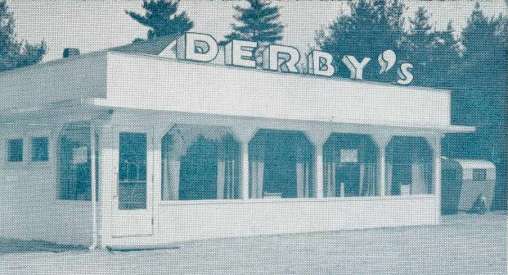
Derby’s Dairy Bar on Ferry Street C1950
Derby’s was tucked away at the end of Ferry Street just before the bend in the road where Burnham Road begins. Probably remembered by just a handful of Hudson residents!!
George and Marion Derby opened their dairy bar at the end of Ferry Street in March 1950; advertising the best food cooked and served the way you like it!! A few years back I talked with my cousin Ray Parker about Derby’s. Ray and some of his high school friends had a small band. One day this group stopped into Derby’s, got talking, and as a result Mr. Derby offered them a place to practice. After all, it might help his business! For the next few months this group practiced and played at Derby’s. Ray found some old derby hats in his attic; thence their name became “The Derby Hatters”. This group contained 5 guys: Ray Parker on the drums, Dave Thompson at the piano, Wilford Boucher on the base fiddle, Lewis Carter with his sax, and a friend from Nashua on the trumpet. According to Ray, they did not play very long, nor did the dairy bar remain in business for long.
According to Manning’s Hudson Directory, Derby’s Dairy Bar and Trailer Court remained in business until 1954. That location became Moore’s Trailer Park and more recently Merrifield Park. It was located at the end of Ferry Street just before the name changes to Burnham Road. Photo courtesy of Gerry Winslow and now a part of the Historical Society Collection.
Further Destruction of Ferry Street

Memorial Day Parade at Hudson’s Business Center C 1945

Chicken ‘n’ Chips on Ferry Street C 1970
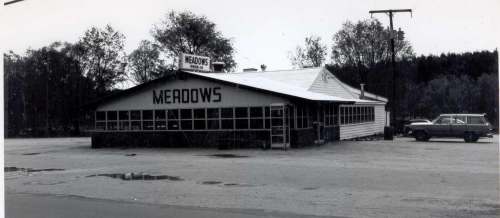
Places To Eat … The Meadows on Central Street
Places To Eat … The Meadows on Central Street
White Cross Store Complex

Roland’s White Cross Early
The plan to address the heavy traffic and congestion which had developed on the Taylor Falls Bridge between Hudson and Nashua by the early 1960’s was to have two bridges with one way traffic on each. A new bridge, The Veterans Memorial Bridge, north of the concrete Taylor Falls Bridge would handle west bound traffic from Hudson to Nashua. The existing concrete bridge would handle the east bound traffic from Nashua to Hudson. By July 1969 the bid process was completed and construction had began. The Veterans Memorial Bridge was dedicated and opened for traffic by September 1970.
During the five plus years before the opening of The Veterans Memorial Bridge, traffic increased further to the point that this became one of the busiest, if not the heaviest traveled bridge in the state. As early as March 1969 the search was on for funding to replace the ailing concrete bridge and in January 1970 the state announced it would be necessary to close the concrete bridge permanently once the new bridge was completed. The new bridge would be used for two-way traffic until plans were completed for a replacement to the Taylor Falls concrete bridge. There was competition for funding as plans were also being made to build the southern bridge connecting route 3A (Lowell Road) with route 3 in Nashua as part of the circumferential highway plans.
Even though the initial plan called for two bridges with one way traffic on each the design of the access roads were adaptable so that the new bridge could handle traffic in both directions should it become necessary; which it did! By March 1970 the state identified additional properties in both Hudson and the Nashua which were required for bridge access. On the Hudson side this included properties on Chase and Central Streets as well as on both sides of Ferry Street; including some frontage and the removal of trees on Library Park. The future of the old trolley stop was even in question!! The traffic pattern included the extension of Chase Street, which previously ended at School Street, through to Ferry Street. This week we will see the impact on the east side of Ferry Street and on the complex known as The White Cross Super Store.
We have two photos of the White Cross Store to share with you; one taken during the early years of the business and the second in 1968 during the last years of the business just prior to the state announcing that the building would be razed in order to accommodate access to and from the bridge(s).

White Cross Super Store as seen from Webster Street 1968
The earliest reference to Roland’s White Cross appears in the 1948 Hudson Directory. According to an earlier directory Roland it is possible that Roland assumed operation of an earlier store on this site, Friendly Market with Raymond L. Jolley as Propietor. The store building was an existing Martin house which was renovated with a store front and signage. Apartments were available on the second floor.
By the early 1960’s Roland Levesque had partnered with Leo Noel and the business complex enlarged to include Hudson Pharmacy, Sherburne’s Restaurant, and Hudson Flower Shop. Leo Noel’s daughter was one of the early pharmacists and later Roland’s son, Richard was the pharmacist. Richard was the pharmacist when the business was closed. He later served as pharmacist at CVS on Derry Road. Robert Lynch, a Hudson resident and florist, opened his shop in the White Cross Super Store.
The state announced plans to purchase this complex in October 1970 and soon thereafter the building was razed. The 1970 Hudson Directory listed no buildings from the bridge to Campbell Avenue. The White Cross Super Store Complex was gone. Residents living in apartments were relocated elsewhere in town or to neighboring communities. The Pharmacy did relocate to Derry Road 20th Century Shopping Center.
The bid process for the Taylor Falls replacement bridge was completed by December 1972; construction began with a target completion date of November 1974. The Taylor Falls bridge replacement was in operation by January 1975. Today, as you travel from Nashua into Hudson you are greeted by the welcome to Hudson signage and plantings. There are few if any reminders of the White Cross Store.
Places to Eat Lowell Road … Blue Whale and now T-Bones!!
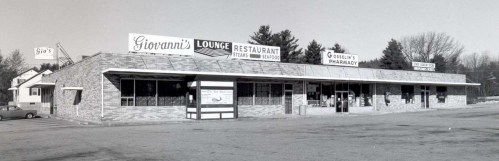
Hudson Shopping Center C1977
This site is known for it’s popular restaurants … Gio’s Pizza, Blue Whale, and now T-Bones.
By the mid 1960’s business at the Hudson Shopping Center and their main store, The Hudson Super Market, was expanding and the Provencal Family would soon be expanding yet another time. In early 1968 the State of New Hampshire was searching for a site in Hudson for a State Liquor Store and this shopping center was soon selected as the site. By July of that year the ground breaking ceremony was held. Construction of a multi-unit building was started immediately and completed in November. By the first week in December what was slated as the most modern self service facility operated by the state was opened at the corner of Birch Street and Lowell Road and part of the Hudson Shopping Center. Our first photo shows the building as it appeared In 1977. At that time the building was the site of Gio’s Pizza on the Birch Street side with Giovanni’s Blue Whale Restaurant, Gosselin’s Pharmacy, and the NH State Liquor Store facing Lowell Road.
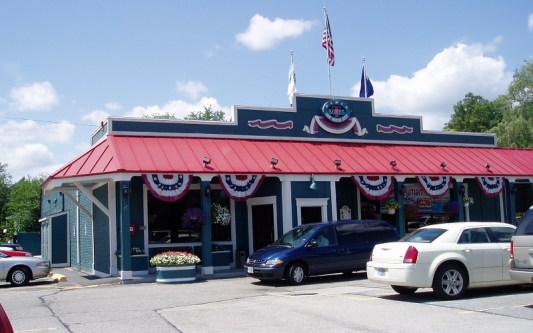
TBones Plaza 2006
Today this is known as T-Bones Plaza. T-Bones moved into Hudson in 1991 and soon became a popular place for lunch and/or dinner. In 2006, when our second photo was taken, this was the location of T-Bones as well as Postal Center, Supercuts, Subway, a dance academy, tanning spa, and a dry cleaners. Both photos are from the Historical Society Collection.
The 20th Century Building

20th Century Building C 1965
The construction of the Veterans Memorial bridge in the late 1960’s and the Taylor Falls Replacement bridge in the early 1970’s completely altered the landscape of and virtually ‘wiped out’ what many Hudson residents knew of as the business center of Hudson. This week we look at how this construction affected one of Hudson’s landmarks, the 20th Century Store.
The 20th Century Building “at the bridge” on the corner of Ferry and Webster Streets dated to 1877. Mr. Elisha Z. Martin purchased the property (land and building) about 1876. Shortly after that the building was destroyed by fire and he rebuilt it the following year. After he passed in 1879, Mrs Martin married a Mr Sherman from Connecticut. Together they continued to make changes and improvements to the building.This site has a long history of being occupied by a grocery or general store. At the time of the fire in 1876 it was the location of Nathan Webster’s store, and following reconstruction his business returned and continued until about 1892. George Andrews succeeded Mr. Webster and continued the business until his death in 1903. Mr Elijah Reed ran the business for about 1 year after which Mr Charles Daniels in partnership with Charles B. Gilbert took it over and continued until about 1925.
Changes occurred through the years. By 1928 it was owned by Mrs. Jennie Connell and known as the Connell Block. The left side was washed away during the 1936 flood. The livery and barn were removed from the right side and remodeled into a grocery store. As early as 1926 the right side of the Connell Block was home to Sal’s Cash Market; with Harry Salvail as proprietor. By 1940 this was the location of the 20th Century Store and building which was owned by Phil Lamoy of Nashua.
The problem of adequate and safe travel over the Merrimack River between Hudson and Nashua came to a head in 1960. Hudson’s population was approaching 6,000 and expected to be near 11,000 by 1970! A comparable increase in Nashua’s growth was also expected. The State of New Hampshire commissioned the consulting engineering firm of Bruce Campbell of Boston to study the already heavy traffic situation and make recommendations. The resulting report, published at the end of 1960, kicked off a controversy which would span more than 10 years. This report made two recommendations. The first that a new, two lane bridge be built about 350 feet north of the Taylor Falls Bridge. This bridge would be used for traffic traveling westward into Nashua. The concrete Taylor Falls bridge would be retained for eastward bound traffic from Nashua. The second recommendation was that in the 1975-1980 time frame a circumferential belt highway be built be built to further ease the flow of traffic!!
This report stimulated much discussion between the two communities and the state. We could not agree on where to place the new bridge and the corresponding access roads. The initial plan was rejected. Another idea was a new span to the south, crossing the river about where the B+M bridge abutments exist. A third was to place the new bridge just north of the Taylor Falls bridge with traffic ovals on each side of the bridge for access/egress. 1966 became the year of compromise.

State Map of Proposed Bridge 1967
In March 1967 voters of Hudson agreed on a plan. This was followed by agreement by the Board of Aldermen in Nashua. By October 1967 the State issued this map showing the proposed bridge and approaches at Taylor’s Falls between Nashua and Hudson as shown. Access to the proposed bridge would go through the 20th Century Building and eliminate part of Webster Street. This plan did include a rotary on the Hudson side; which was later eliminated with plans to extend Chase Street from School Street to Ferry. With all of these discussions taking so long to resolve; traffic flow on the existing concrete bridge was increasing and the bridge was deteriorating.
In September 1968 it became necessary to make repairs to the concrete bridge to shore it up and prolong it’s life. The bridge was closed to vehicular traffic. Foot traffic (and bicycle) were permitted. Vehicle traffic was detoured to the bridge at Tyngsborough or Manchester to the north. Residents on both sides of the river would team up with neighbors and have two cars; one on each side of the bridge.
In the spring of 1969 the state relocation assistant expressed concern over the re-location of some 37 Hudson falmilies resulting from bridge construction. Many of these were families of 1 or 2 people living in apartments in the 20th Century Complex. The average rent paid by these families for a three room apartment was $16 per week. Comparable housing for a comparable amount of money did not exist in Hudson. The closest they could get for decent and safe conditions were going for $25 per week; over a 50% increase. The zoning ordinances of Hudson encouraged the construction of better homes without considering the needs of low cost housing.
By June 1969 the state offered $158,000 for the 20th building including the 20th century market. $38,000 for the purchase of a building on Webster Street, adjacent to the 20th Century which was used as a laundromat.
Construction was awarded to Cianchette Brothers of Maine and work on the new bridge began in July 1969 with forms for the first pier on the Nashua side by the construction The bridge was slated for completion September 1970. Meanwhile the Taylor Falls bridge to the south continues to be the work horse for traffic between the two communities.
In October 1969 we would see the end of the 20th Century store at the bridge in Hudson. On October 8 there was the ‘Sale of the Century”; designed to empty the store of all items as the building was scheduled for demolision within a few days. A new store at the 20th Century Shopping Center (now 102 Plaza) on the Derry Road was being readied. The “Welcome to Hudson, NH” sign which sat atop the building was removed. In less than two weeks the 20th Century building was gone.
September 1970 the Veterans Memorial Bridge opened for two-way traffic. State and local officials were present on September 16 for a ribbon cutting ceremony. Mrs. Georgianna Manter, a 99 year old resident of Londonderry was given the honor of cutting the ribbon. She had outlived all previous bridges. She had driven a horse and buggy over the wooden bridge and driven an auto over each of the later bridges. Finally our traffic needs no long depended on the old, crumbling concrete bridge.
 Remember Hudson NH When...