Revisit Lowell Road – The Power House at 48 Lowell Road
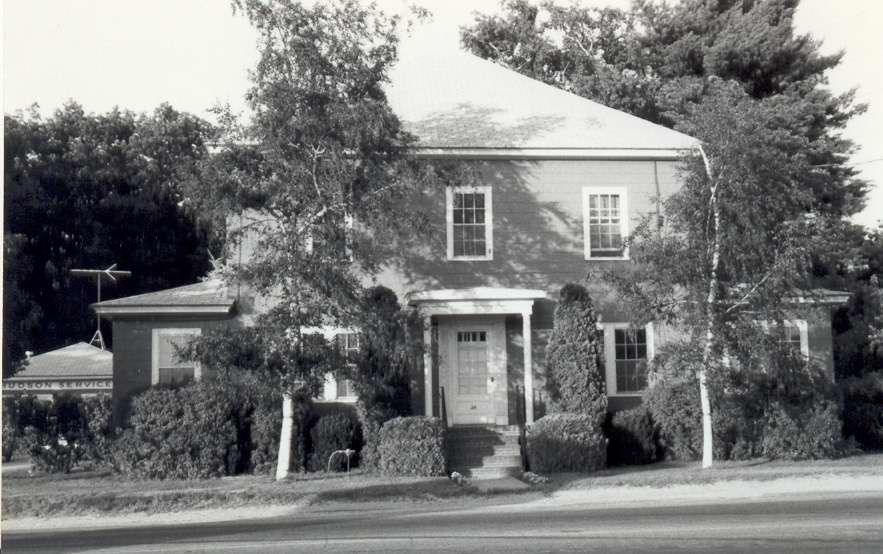
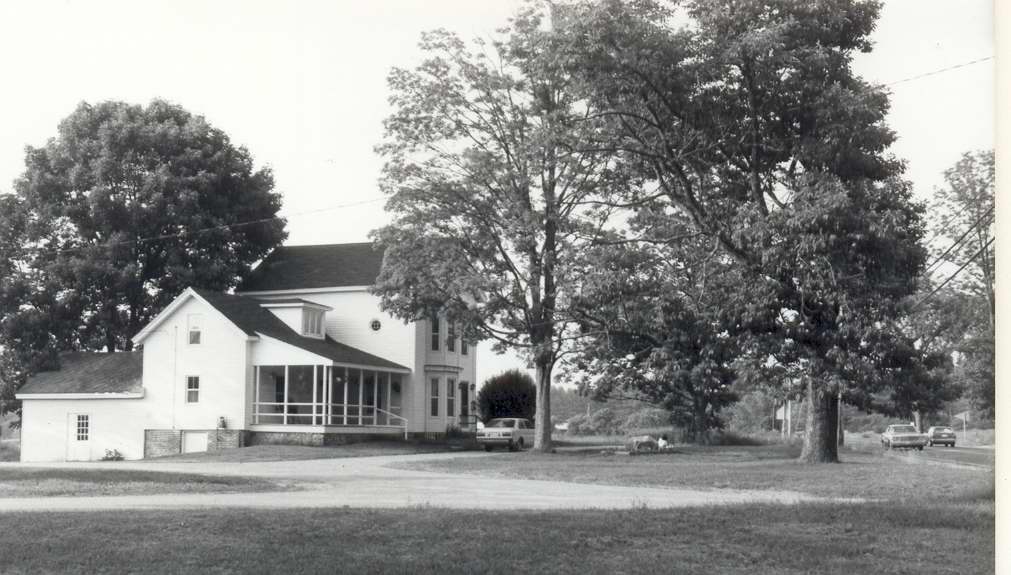
Zelonis Family Home at 48 Lowell Road C 1983


As we continue to travel down Lowell Road and revisit historical sites we come to the power house; used to convert electricity for use by the Nashua Street Railway Company. Electric car service on Lowell Road was discontinued by 1931. A short time after that 48 Lowell Road was repurposed into a private dwelling. This article was first published in August 2016. Since that time the dwelling house remains and the surrounding area re-configured for commercial usage, including a barber shop/salon.

The trolley or electric street cars provided a cheap, pleasant, and relatively rapid form of public transportation in Hudson from 1895-1931. There was a trolley line from Nashua’s Tremont Square (corner of Main and Pearl Street) that proceeded east over the Taylor Falls Bridge thru Hudson via Central Street, Lowell Road, and on to Lakeview and Lowell, MA. The New Hampshire portion of this line was owned by the Nashua Street Railway, but operated under a lease by the Lowell and Suburban Street Railway Company (later known as Bay State Street Railway Company). The power to operate this line was provided by a Bay State owned substation on what is now River Road adjacent to Aeyers Pond.

In 1918 the Bay State Company discontinued service and turned the line back to Nashua Street Railway Company. The Nashua Company chose to operate the line and picked up the previously discontinued service down Lowell Road to Stewerts Corner (junction of Lowell with Dracut and River Roads) making 2-3 trips a day to accommodate workers, students, and week-end picnickers. The needed electric service was no longer provided by the Bay State powerhouse; it was supplied by the Nashua Light, Heat, and Power Company and converted to DC type at 600 volts in Nashua and Hudson. In Hudson, a powerhouse was constructed for this purpose at what is now 48 Lowell Road. This building was of sturdy construction as evidenced by the large beams and crossbeams used in the basement to shore up the main floor of the building.

The end of the electric cars occurred gradually as the auto became more and more affordable and popular. By 1924 they were operating at a loss and by 1931 they were discontinued in Hudson. Soon thereafter, the Powerhouse on Lowell Road was re-purposed into a private residence.

For nearly 50 years, beginning in 1956, this was home to Vincent J. Zelonis and his wife Mary (Wisneski) and their large family. Vincent was a man of many interests and talents – a devoted gardner and accordian player. He worked in the culinary field at a number of resort hotels. He attended technical school and received his diploma in refrigeration and air conditioning. During WWII he served in the Army and maintained HVAC-R equipment at a base in Puerto Rico. After the war he worked for J. Lawrence Hall Co. of Nashua and in 1953 started his own HVAC-R business, Hudson Service Company, where he worked with his sons William, Charles, and Daniel and his brother Richard. Vincent passed in 2005. Son Daniel and his wife Gayle and family continued to reside at 48 Lowell Road until a few years ago when the property was offered for sale. Daniel was a CPA and established his accounting and bookkeeping services here about 1979 until his retirement. Daniel and Gayle continue to live in Hudson and are active in various church and community organizations.

Within the past 2 weeks this property has been sold. After almost 85 years as a private residence, nearly 60 of them with the same family, we are about to witness a new era for this property. Will it be used for residential or will it be re-purposed again?


48 Lowell 2016

We share two photos of this property. The first shows the house and business of Vincent Zelonis C 1983 as seen from Lowell Road. The second shows the house as seen from the south side, looking north about two weeks ago. Both photos are from the Historical Society Collection.

Hudson Center Revisited

This series on Hudson History began in August 2014 as a joint project between the Historical Society and the HLN as a way of sharing some of Hudson’s history with our readers.  To date there have been some 170 weekly articles and accompanying photos published in the paper and on RememberHudsonNHWhen.com.  I enjoy writing these articles and the research necessary to prepare for them.
 
Going forward there are still many sites and topics to write about. But, more time is now needed to do this research.  My plan going forward is to submit  Remember Hudson When articles every other week.  And, on the alternative weeks we will Revisit parts of town by re-printing articles from the past on a theme basis:  for example a Pre 1970 trip down Lowell Road or Restaurants in town, etc.  This week we begin a Revisit series on Hudson Center.
 
As always if there is  some historical site or photo you would like me to consider writing about, please contact Ruth via the HLN or the Hudson Historical Society by sending email to HudsonHistorical@live.com or a phone message at 603-880-2020.
2004007001 comp
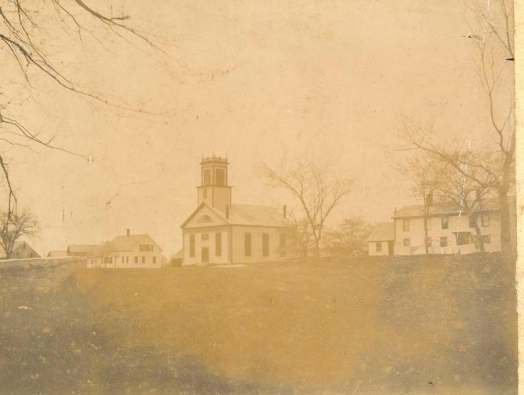
Prior to 1834 the only village in town was a small one around the Hudson Center Common.  This  consisted of three stores, a tavern, the north meeting house, one practicing doctor, the post office, and 8 or 9 residences. By 1888 the  Baptist Church sanctuary was built; the north meeting house was replaced by the town hall, and the only railroad station in town existed behind the town hall and off Greeley Street.  This C1888  photo of the Hudson Center Common shows the view from the home of Eli Hamblet  on Hamblet Avenue.
 
Straight ahead is the Baptist Church. The church where he was elected as deacon just a few years earlier in 1882.  The large vestry at the rear of the church had not been built, but I am certain the need for it had been discussed among the members.  To the right of the church is the home of Mrs. Mahalia Greeley; the widow of John Greeley, MD. Further to the right, not shown on this photo, is the town hall.   To the left of the church is the former home of Reuben Greeley, postmaster from 1818 until 1829; now occupied by his son Daniel Greeley.  Daniel was known to have a good nature and was well liked within the community.  
 
In the foreground and on the left of the photo is the Old Hudson Center Cemetery.  Up until a few years prior to this photo the cemetery was in disrepair and the town considered moving the remains from this site so that the size of the common could be increased.  This proposal did NOT meet with public sentiment and, as it turned out, a former resident of Hudson, John Foster, made a proposal to the town that he would build a stone fence and clean up the cemetery if the town would maintain it.  Immediately beyond the cemetery is a roof of a barn; possible from the barn connected to the Paul Tenney/Henry Brown House on the opposite side of the common.  Photo from the Historical Society Collection.
 

The Farm at ALVIRNE High School

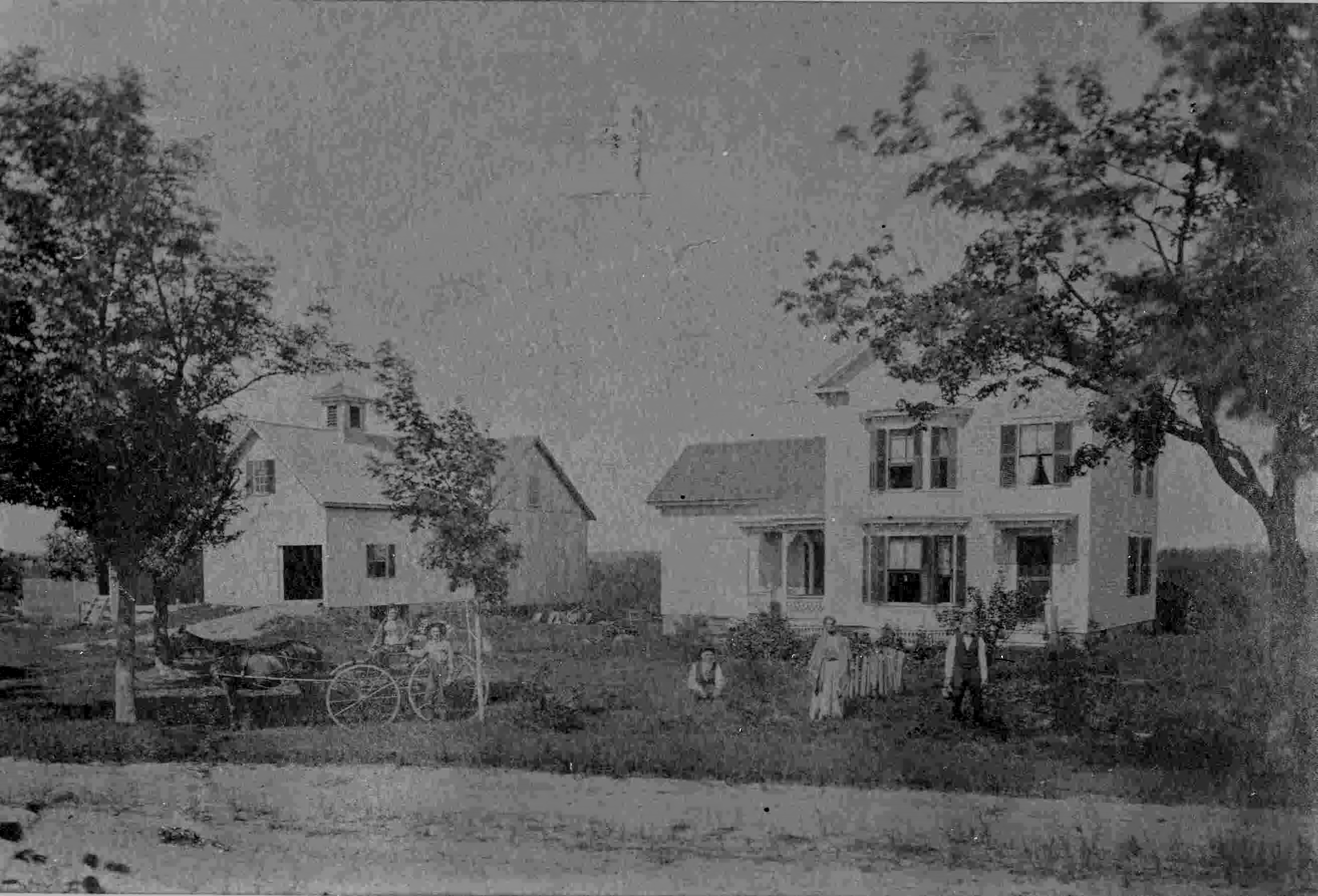
Hills’ Farm house and barn in the early 1900’s
The story of the ALVIRNE High School farm is linked to the birth of the high school and before that time to the Hills family of Hudson.  The 180 acres +/-  which make up our high school and school farm were a part of a 900 acre parcel  purchased by Nathaniel Hills from Jonathan Tyng prior to 1733.    In 1733 this land was a part of Nottingham, MA and according to the tax list the only resident was Nathaniel Hills.  He had left the garrison and settled on the northern portion of his land near the river where the Hills’ Ferry was later established.
The parcel where the high school and farm reside was transferred from Nathaniel to Elijah Hills, a descendant of James, the youngest brother of Nathaniel.  From there it passed to Elijah’s son Elijah, Alden, and Alfred Kimball. Today the farm is known as the ALVIRNE High School farm; but previously it was known as the Alfred K. Hills Estate, the Alden Hills Farm, or the Old Hills Farm.
This farm was the birthplace and childhood home of Alfred K. Hills.  He was born October 1840, a 7th generation descendant of the immigrant Joseph Hills.  After local education he attended and graduated  Harvard College about 1862.  In 1865 he married Martha Simmons in Boston.  Within a few years they moved to New York City and he had graduated medical school and he began his medical profession of 40 years.  In June 1885 Martha (Simmons) Hills passed away.
A few years later in June 1887 Alfred and Ida Virginia Creutzborg of Philadelphia were married.  Soon after they  purchased the old homestead from his family.  To keep the farm working, Dr Hills hired a resident farm manager.  Alfred and Virginia built a spectacular summer home (called ALVIRNE) upon a knoll and across the street from the farmhouse.
They had two daughters (Gladys and Mary) who died as infants.  Virginia herself passed suddenly in 1907.  As a memorial to his wife Dr. Hills built ALVIRNE Memorial Chapel by 1908.  When the chapel was completed and consecrated the remains of his wife, Virginia, and their two daughters were laid to rest within the chapel.
By 1911 Alfred married a third time to Jessie Norwell of Nashua.  Dr Hills, his third wife Jesse, and second mother-in-law Mary Creutzborg continued to frequent the summer home. He passed in 1920 and his will was filed for probate in 1928. By his will he left funds to the town of Hudson for the construction of a high school to be named ALVIRNE.  In order to secure these funds for the town, a school must have been established within 20 years.  To meet this requirement a six week summer session was held on the grounds of the Alfred K. Hills Estate.  Classes in agriculture and forestry for the boys using the farm and classes in sewing for the girls were held in the meeting room of the summer home.  By August 1947 the courts ruled that the remaining assets of his estate be released to the town for the construction of ALVIRNE High School.  Thus, his farm and summer home became property of the Hudson School District.  Design and construction were begun soon thereafter.  
 
The current farm house was built C1875 after the previous, and perhaps the original, set of farm buildings were destroyed by fire in 1874.  The earlier buildings were typical to New England; a large square two story home with an ell from which a shed was connected.  The large barn was connected to the other end of the shed.  This barn was the first to burn as flames broke out in the hay at the end of the barn furthest from the house.  It was impossible to check these flames and save the cattle.  With the buildings so connected, and without adequate water supply and fire fighting equipment, little could be done to save any of the buildings.  Many priceless heirlooms, handed down from generation to generation in the Hills family were lost.  Damage was estimated at $5,000 including 10 head of cattle, 2 horses,and farm equipment,  The loss was partially covered by insurance.  

             ALVIRNE Farm house C 1980

 
We have two photos of the ALVIRNE farm house to share with you.  The first dates to  the early 1900’s.  We see the two story farm house and an early view of the barn.  The identity of the people in front of the farmhouse are not known.  The farm house received extensive renovations in the 1960’s under the supervision of the school board.  Our second photo shows the farm house C 1980.
The ALVIRNE barn has also been victim to fire.  After the 1874 fire the farm buildings were rebuilt; but, the barn and out buildings were not connected to the  residence.  A second fire in 1911 destroyed the barn and all out buildings except for one shed.  Again, the fire began in the barn and quickly sent up flames which could be seen from Nashua.  Two pieces of Fire fighting equipment were  quickly dispatched from Nashua.  One of these arrived at the scene in time to help the local bucket brigade to save the residence and farm animals; but, not in time to save the buildings.
A third fire which destroyed the barn of the Wilbur H. Palmer Vocational Center occured in 1993.  The barn we see there today was built following that fire.  The photos are from the collection of the Historical Society.  Description of the ancient farm buildings and of the 1874 and 1911 fires were found in September 11 and 15, 1911 editions of the Nashua Telegraph.

Pizza Hut and Derry Road Car Wash

Pizza Hut and Derry Road Car Wash

For the past few years we have seen changes take place from 62 -68 Derry Road.  First with the conversion of the long time idle property of the former Hogan’s Garden Center into the Dollar Tree and O’Reilly Auto Part stores;  now with the Pizza Hut property, 62 Derry Road,  on the market more changes are in the works.
60 years ago, in 1961, this section of Derry Rad consisted of the home of Roy and Flora  L. Griffin at 62 Derry plus undeveloped land at 64 – 68.  The Griffins operated Banner Photo of Nashua.  Roy passed about 1966 and Flora continued  as President and Treasurer of Banner Photo and retained  her residence in Hudson.
The first change toward development came about 1959 with the opening of Hogan’s Garden Center and Flower Shoppe at 68 Derry Road.  Hogan’s was a popular place for trees, shrubs, garden supplied, and flowers.  They remained in business until the early 1980’s.  From that time until a few years ago the land and buildings remained idle; including the large green house used by both the garden center and flower shoppe.
In 1978 the site of the Griffin home was purchased by Pizza Hut of America and by 1981 the Pizza Hut Restaurant in Hudson was in operation.  Although changes did occur in the corporate ownership and structure of Pizza Hut this restaurant remained in business some 35 years; closing for business within the last year.  The property is for sale, so ‘stay tuned’ for further change.
About the same time, 1981, and adjacent to Pizza Hut  the Derry Road Car Wash opened for business.  Although operating under different names a car wash remains at this location to the present day,
More recently, in 2014, the site of Hogan’s was sold for new development.  The first to emerge was the new, stand alone, Dollar Tree in 2015.  That was followed soon thereafter by O’Reiley Auto Body in 2016.
As we pull back the layers of time we see the time line of development.  Our photo for this week is an aerial of 62 and 64 Derry Road  soon after 1981.  We see Pizza Hut and Derry Road Car Wash.  To the right, and off the photo, was Hogan’s Garden Center and Flower Shoppe.  Upon the sale and re-use of the pizza Hut facility we will have the opportunity to watch further changes.

Westview Cemetery on Burnham Road

OLYMPUS DIGITAL CAMERA

Westview Cemetery Burnham Road


When the Old Hudson Center Cemetery, located on the Common, became nearly covered with graves, the need for additional  cemetery  space in that part of town became apparent.  The Hudson Center Cemetery Association published their intentions on the Oasis, a newspaper published in Nashua for three weeks in a row, in accordance with the laws of the State of New Hampshire.  An initial meeting was held at the town house in Hudson Center, now Wattannick Hall, on December 4, 1849.  At this meeting a set of by-laws and a slate of officers were elected.  Elected as Directors were Jefferson Smith, Joseph Dane, James Smith, 2nd, Dustin B. Smith, and Daniel W. Robinson,  Eli Hamblet was elected Clerk and Amory Burnham as Treasurer.


The initial acreage for the cemetery was donated by Reuben Greeley.  This parcel is located to the right as you enter the cemetery gate from Burnham Road.  The cemetery was laid out into large lots, most of which would allow for 12 burials so as to accommodate large families and multiple generations.  Between each lot space was allocated for walkways.  The layout also included streets wide enough so that  horse and wagons, and  later vehicles could enter the cemetery.  All of this was located less than one half mile from Hudson Center.


After the Nashua and Rochester Railroad was constructed, a substantial addition of land was made to the cemetery.  All the land between the initial parcel and the southerly line of the railroad land was acquired, making a total of nearly three acres.  After the railroad ceased to operate, the cemetery purchased  the right of way from the railroad.  This right of way is clearly visible today and is used as a short cut from Burnham Road to Hudson Center.


So as not to confuse this new cemetery with the Old Hudson Center Cemetery it was called Clement Cemetery.  I am not sure why this name was associated with this yard; but, it is often referred as such in the old records.  The name Westview has since been adopted and it is known by that name today.


Within this cemetery one will find the final resting place for many Hudson families of the last 167 years.  One will also find a number of lots with beautiful and expensive monuments; as well many of the more common markings.  Records of the cemetery also indicate burials in some of the lots where no visual monuments were placed by the surviving families.  But, thankfully, knowledge of their burials has been preserved by the written records.


I find the most elaborate monuments within Westview to be along the back wall of the old section.  These belong to the families of Dr. David O. Smith, Dr. Henry O. Smith, and the Haselton family from Bush Hill.  The oldest burial is that of Betsey Beard who died June 1850 at the age of 80.


The most  interesting burial site is the unmarked grave of Rev. Benjamin Dean, a minister serving the Baptist Church from April 1828 to June 1830; at which time he left the ministry but remained a resident of Hudson Center and continued to live in  his home on Hamblet Avenue.  When he passed in 1856 he was buried in the Potters Field section of the cemetery.  Many years later when additional lots were laid out, the Potters Field and his burial site was included within one of the new lots.  But, the location of Rev. Dean’s burial site has not been lost to history.  It remains unmarked; but, has been included within the written record of this newer lot.


The photo showing the entrance to Westview Cemetery at 20 Burnam Road was taken by the author and is a part of the Historical Society Collection.

Senter Cemetery at Potash Corner
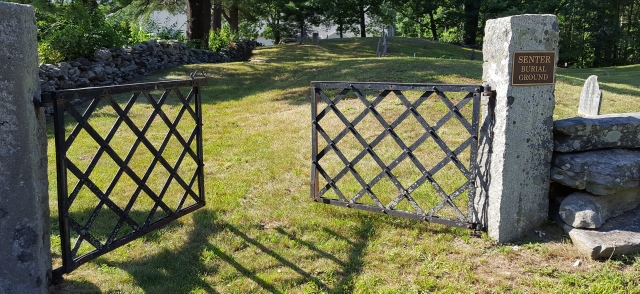
Senter Burial Ground at Potash Corner

First a few words about Potash Corner and how it may have received its name.  The term Potash refers to a variety of minerals which contain  the element potassium in a water soluble form.  The early settlers recognized the benefits of potassium both in gardening and as an ingredient  for making soap.  Its presence in the soil is a contributor to healthy plants and larger yields.  Potash can be found in natural deposits; it is also a by-product of burning plant material such as wood.  Thinking about it, every early New England home  with their  huge chimneys and fireplaces in each room had a ready source of potash.
Back to the naming of Potash Corner. The name may have been the result of natural deposits of potash and the early farmers had developed  a method of removing the potassium by soaking in water.  It is also possible that the corner had become a central location to deposit excess wood ash and thus sharing the potash with others – like a community compost pile for potassium.  It is also possible that some combination of both these events lead to the naming of potash corner.  Whatever the origin, the name survived and still remains on many of the maps of Hudson.
A small burying place, containing almost 3/4 acre, called Senter Cemetery or Senter Yard,  was first located in the south west corner of Londonderry at Potash Corner.  Likely set off from the Senter Farm from which it was named.  Lookng at the names and dates on the inscriptions one can see it was used a burying place for Londonderry residents several years before the annexation to Nottingham West (now Hudson) in 1778.
We do not know the date this yard was first used for burials.  From the inscriptions recorded by Kimball Webster in 1908 the oldest date found was upon a rough stone marked E.L. K.I.D. Feb. 24, 1759 which probably stands for Kidder.  The next to the oldest is the marker for Jean Senter, wife of John Senter, died Jul 10, 1765.  John and Jean Senter were the grand-parents of Deacon Thomas Senter.  If John Senter was laid to rest along side his wife his marker, along with many other, have long since been destroyed or disappeared.  In 1995 the descendants of John and Jean Senter placed a memorial marker at the cemetery in their memory.

John Senter Memorial

At some early point in time the yard was enclosed within a respectable stone wall.   As time passed and interest in the upkeep of the cemetery waned, the wall fell to disrepair and fell down is some places.  Cattle could enter at will from adjoining pastures and the grounds became so covered with brush that the cemetery’s appearance  was not a credit to the Town of Hudson.  In 1897 the selectmen of Hudson caused the walls to be repaired and an iron gate erected.  About the same time the brush was removed and the appearance of the yard was improved.
Within this cemetery the surnames most frequently found are Andrews, Farley, Greeley, Hobbs, Kidder, and Senter.  A large number of grave sites in this cemetery are not marked with head stones and inscriptions.  Some of these sites may have never been marked; for the others the markers have long since been removed or destroyed.
For the past several years the Senter Cemetery has been maintained in excellent condition by the Hudson Highway Department.  A few years back the  original iron gate  was replaced  by the Town Cemetery Trustees and Anger Welding.  These photos  ware taken by the author in August 2017.

Celebration of the Fourth of July 1829

Join me for a celebration of the fourth of July 1829 style!
The date is July 4, 1829 the place is Nottingham West, NH.  The occasion is the celebration of the fifty third anniversary of American Independence.  This celebration occurred near and around the town common at what is now Hudson Center.   I  will share a (partial) transcription of a news item from he New Hampshire Patriot & Gazette  July 20, 1829 (Vol 1 Issue 3 Page 3).
2004007001

Town Common at Hudson Center 1888

But first a sense of what the common and it’s surroundings might have been like in 1829. The common was a 3 1/2 acre triangular piece  from the farm of Deacon Henry Hale.  This 3 1/2 acre parcel had become cut off from the rest of his farm because of roadways.  It was surrounded by what is now Windham Road, Kimball Hill Road, and Hamblett Avenue.  It looked more like a  public pasture than the evenly mowed and landscaped  area of today.  It did include the cemetery but  if there was a wall  around it; it was a loose stone wall. The common and cemetery date back to about 1771.   There were no fir trees; no mill stones, no cannon, no flagpole, and no minuteman marker as seen today.  The earliest photo we have of the common is shown here; taken 1888.
The Baptist church had been organized for 24 years; but they held services in the North  Meeting House (located near the site of the present Wattannick Hall)   This meeting house had been used for town meetings since about 1771   The Baptist Society had owned the north meeting house since 1811;  their  pastor was Rev. Benjamin Deane.  As there was no parsonage house  he provided his own dwelling place; a house  across from the meeting house on Hamblett Avenue facing the common on the eastern side.
 Where the Baptist Church is located  today there was a dwelling and a store – Marshall’s store.  To the left of Marshall’s store was the home and barn  of Reuben Greeley.  In 1829 this was the site of the Post Office.  This house remains today and is the parsonage house of the First Baptist Church.
 Opposite Marshall’s store on the other side of the common  and across Kimball Hill Road was Tenney’s Inn.  The present site of this Inn is kept mowed by the Hudson Highway Department.  Dr. Dustin Barrett was the resident physician and he lived nearby on Windham Road.
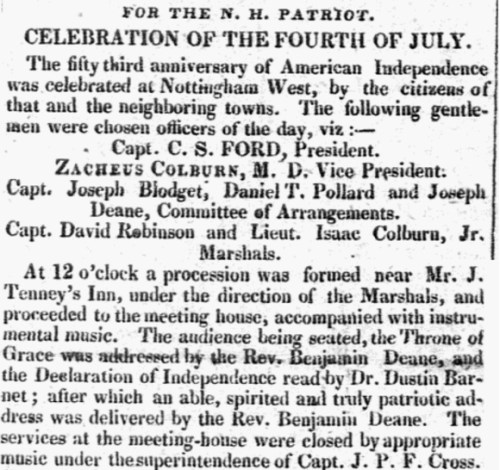
A replica (in part)  of the newspaper account of the Fourth of July Celebration of 1829 as printed in NH Patriot & Gazette and as archived by genealogybank.com  is our second photo.  Now for the transcript..
July 20 1829

NH Patriot & Gazette July 20, 1829

                                                         CELEBRATION OF THE FOURTH OF JULY
     The fifty third anniversary of American Independence was celebrated at Nottingham West, by the citizens of that and the neighboring towns.  The following gentlemen were chosen officers of the day, viz:- Capt. C. S. Ford, President;  Zacheus Colburn, M.D. Vice President; Capt. Joseph Blodgett, Daniel T. Pollard and Joseph Deane, Committee of Arrangements; Capt. David Robinson and Lieut. Isaac Colburn, Jr. Marshals.
     At 12 o’clock a procession was formed near Mr. J. Tenney’s Inn, under the direction of the Marshals, and proceeded to the meeting house, accompanied with instrumental music.  The audience being seated, the Throne of Grace was addressed by Rev. Benjamin Deane, and the Declaration of Independence read by Dr. Dustin Barret; after which an able, spirited and truly patriotic address was delivered by the Rev. Benjamin Deane.  The services at the meeting-house were closed by appropriate music under the superintendence of Capt. J.P.F. Cross.  The procession again fomed and marched across the common, where about seventy partook of a sumptuous and splendid dinner, prepared by Mr. James Tenney. —  The cloth being removed, a series of sentiments were given by Thomas B. Wason, Esq. and Dea. Robert Bartley, toast masters, accompanied with music, and the discharge of artillery.  No accident or irregularity occured during the day, and the people retired at an early hour.
The remainder of the article lists various toasts given by  some of the citizens  in attendance.  Here are a few of them:
The Fourth of July –  When Americans shall cease to celebrate the birth day of their Independence, and forget those sages who proclaimed it – then will men have become degenerate and unworthy to be called the sons of Freemen.
 
The Constitution of the United States – A cloud by day and a pillar of fire by night to every true American.
The Revolutionary Heroes, who planted the tree of liberty and watered it with their blood. – We pledge our own to cultivate and defend it.

Hudson Center School Bell

Bell at Hills House (640x480)

School Bell at Hills House

Each year as part of the Hudson History Tour students delight in ringing the bell located on the front lawn of the Hills House.  This bell once hung high above Hudson Center in the tower of the old two room school house on Kimball Hill Road.  A few rings from this bell would announce to all the beginning of classes or the end of recess or lunch period.
The Hudson Center School was built in 1908 as a replacement for the Smith School on Windham Road which had burned.  Why this alternate site was selected rather than rebuilding on the original site is not entirely clear; but I suspect it had to to with the need for a reliable and safe water source.  By the beginning of the school year 1908 this bell had been placed in the school  tower  where it would remain for over 65 years. The bell was given to the town by Henry C. Brown, a well known resident of Hudson Center.  Mr. Brown served as Postmaster of the Hudson Center Post Office located in the train station which sat along side the tracks off Greeley Street and behind the Town Hall (not Wattannick Hall). His residence was on Kimball Hill Road opposite the Hudson Center Common and the Baptist Church.  His house became part of the Benson Farm property and was demolished by the state prior to the town’s ownership.
From 1908 until 1956 students from the Hudson Center and even West Windham attended this two room school house for grades 1 thru 6.  I myself remember attending grades 1-3 with Mrs. Marguarite Gilman as teacher; and then grades 4 and 5 with Miss Florence Parker.  By my 6th year we were seeing the possibility of closing this school house due to small enrollment at Hudson Center and available space in the schools in the bridge area.  I attended Webster School for the 6th grade and then on to Alvirne for grades 7 -12.
Charlie and Eric with bell

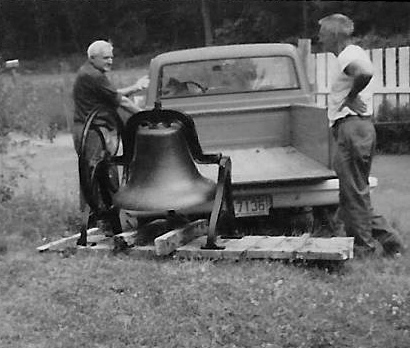
Charlie and Eric Parker Transporting Bell

The old school closed in 1956 and remained unoccupied until mid 1970’s.  By that time the property and school building were owned by Mr and Mrs Robert Thompson.  In 1974 with the help of the Hudson Fire Department the bell was removed from the tower and placed in the bed of “Charlie” Parker’s pick-up truck.  It was then transported by “Charlie”  and his brother Eric to the Historical Society.  The Society contracted with Adrien Labrie  to construct the bell stand for $485.00.  There the bell remains awaiting the occasional ringing by students or visitors to the grounds — especially during Old Home Days.

Congregational Church at 76 Central Street

Congregational Church Proir to 1909

Congregational Church Prior to 1909

Early Church Prior To 1842

The origin of the Congregational Church in Hudson, NH dates back to November 1737. Rev. Nathaniel Merrill was settled by the town and been ordained as the first minister of Nottingham, Mass.  The town was responsible for hiring a minister, paying his salary, and providing a Meeting House.  The site of the first meeting house on what is now Musquash Road is marked by an historic tablet.
After the boundary was settled between Mass and NH and the town of Nottingham West, NH received it’s charter, many acres of the earlier town had been left in Mass.  The town voted to move the preaching to a more central location just a short distance from the present Blodgett Cemetery.
Rev Merrill’s contract with the town continued until 1774; however he continued to preach in town until shortly before his death.  The last baptism recorded by Rev Merrill was in July 1792; and the last marriage in December 1795.  Although his contract with the town had expired in 1774, the town did vote various sums of money for his support from time to time; including $7.82 plus a coffin for his funeral in 1796.
A short time before 1750 a number of families of the Presbyterian faith settled in the eastern part of town and attended meetings of their own denomination in either Londonderry or Windham and helped to support their own minister.  Naturally these families protested against being taxed in support a minister of a different faith.  It was not until 1770 that the Presbyterians, by vote of the town, were released from these taxes.  By 1771 they built their own place of worship, the North Meeting House, in Hudson Center near the site of the present Wattannick Hall.  The Rev John Strickland was their pastor until 1785.
Meanwhile the Rev Jabez Pond Fisher was called by the town in 1795 amid protests.  By 1802 the town owed him over $1,000 in back salary; he resigned his position and brought a suit against the town for his salary.  For the next 15 years or so the Congregational Church was inactive; by about 1816 there were signs of a union between the previously conflicting sects.  The Congregational church united with the Presbyterians.  This merger lasted until 1841 when the Presbyterian organization was dissolved and 26 of its members formed the Congregational Church of Hudson.

Church at 76 Central Street

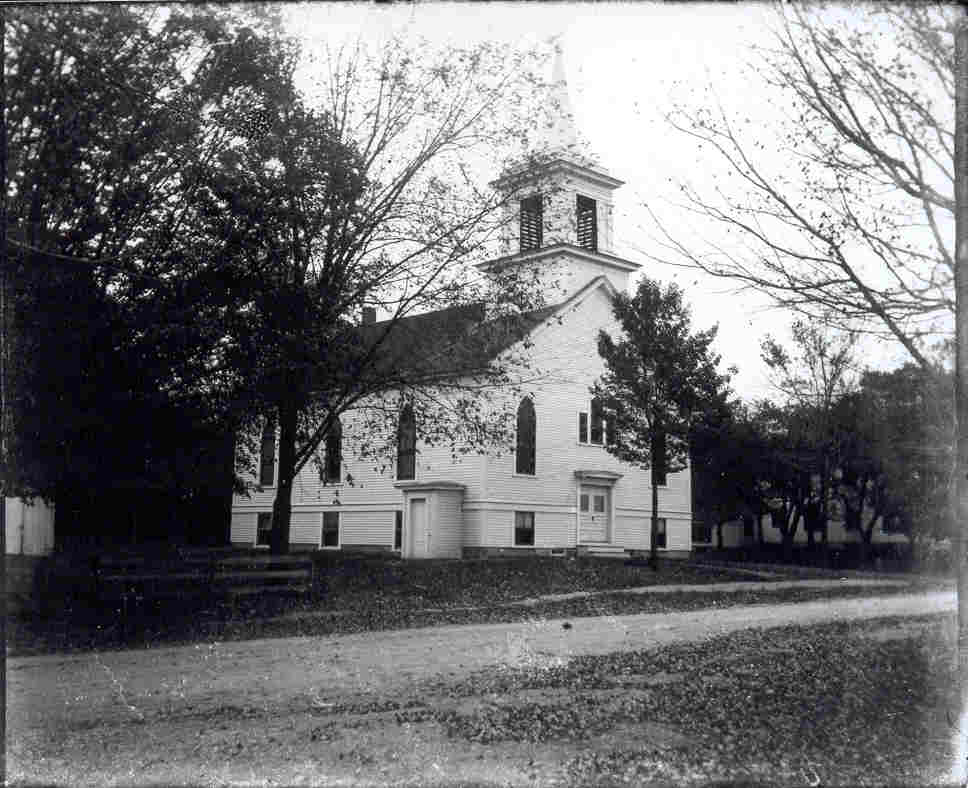
By 1842, under the Pastorate of Rev Willard Holbrook, the church building as shown in our first photo, was built at what is now 76 Central Street.  Periods of growth and periods of inactivity continued until 1876 when the church became active with a spirit of growth and union.
 

Congregational Church C 1925

Congregational Church C 1925

By 1906, during the Pastorate of the much beloved  Rev Franklin Perry Chapin the church building was remodeled as shown in our second photo.  Stained glass windows and a basement area were added, and the front entry was modernized.  In 1912 the Congregational Church of Hudson celebrated its 175th anniversary.
As time passed questions were being raised over the need for two Protestant churches (Congregational and Methodist) in the Hudson Bridge Area.  In 1930 these two congregations united to form the Community Church of Hudson.  At the time of the merger, each of the congregations had their own place of worship and their own parsonage for the pastor.  Through the merger, the Congregational Parsonage and the Methodist place of worship were retained.  By 1935 the Congregational Church building was sold to Hudson Grange #11.
In November 1937, the recently organized Hudson Community Church celebrated it’s 200th Anniversary!!  These photos are from the Historical Society collection.  Much of this historical information was prepared by Dr. H.O. Smith and presented by him at the 200th Anniversary in 1937.

99 Dracut Road

99 Dracut Road C2004

99 Dracut Road C2004

Oginskis/Karos Homestead

Our Remember Hudson… travels this week take us to the south end of Hudson and 99 Dracut Road; for many years home to the Oginskis/Karos Family. The family of Joseph and Barbara (Martin) Oginskis purchased a farm of 57 acres plus house and barn from John Balandis on Old Lowell Road (now Dracut Road) in 1927. Their daughter Vera was about 22 years of age at the time. By 1940, Barbara was widowed; Vera was employed as a mill operator in Nashua. John Karos was residing at the farm and working as a farmhand. Four years later, in 1944, Vera and John were married.

This farmhouse at 99 Dracut Road remained home to Vera and John as well as to Barbara, Vera’s mom, who passed in December 1950. John worked as a machinist in Nashua, his last employment was with Sanders Associates. John passed in August 1966. Vera passed in 2004 at the age of 98. She lived all of her remaining live, except last few months, in this house; having been a Hudson resident for 75 years. I did not know Vera; but in talking with folks who did know her, she was a generous and respected neighbor. One neighbor remembers Vera’s kindness as she passed this home on her way to to catch the school bus a mile from her own home. Another person remembers Vera’s artistic talents and was able to save one of Vera’s paintings before the house was demolished. That painting is now at the Historical Society.

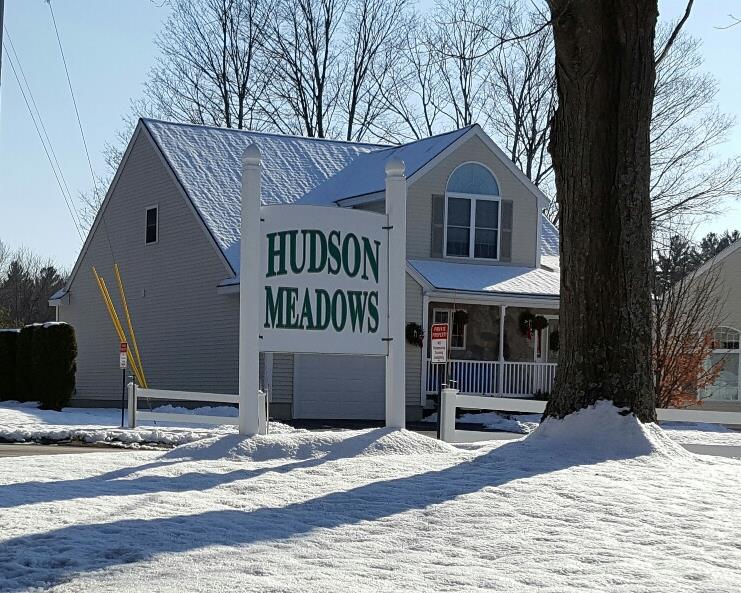
Hudson Meadows

By 2004 all but 14 plus acres including dwelling and barns had been subdivided and sold. As part of her estate the remaining acres were sold to a developer and Hudson Meadows Condominium Association was soon established.
99 Dracut Road 2016

99 Dracut Road 2016

In the 13 years prior to 1927 this 57 acre farm with buildings had changed hands about 5 times. Going back to the early 1800’s this farm was purchased in 1824 by a Paul Hardy from Pelham, NH and it remained in the Hardy family until about 1913 when it was sold by his daughter Susan (Hardy) Cutter. From the age and style of the farmhouse I estimate it was built about 1850 by the Hardy Family.

The photo of the Karos Farmhouse is in the collection at the Historical Society compliments of Hudson Meadows Association. The photo of Hudson Meadows was taken just this week.

Catagories