Steam Railroad Tracks at Greeley Street
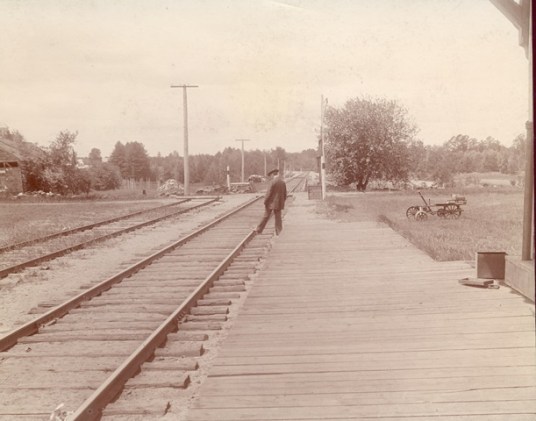
Greeley Street Crossing Looking West
The steam railroad crossed the Merrimack River into Hudson just south of what is now Veterans Memorial Bridge as you cross from Nashua into Hudson. It then made a path easterly and slightly north through Hudson. The tracks crossed Lowell Road at Central Street and then on to Hudson Center and West Windham. The one railroad station in town was at Hudson Center just off Greeley Street and behind the Town Hall (now Wattannick Hall). In this 1896 photo we are standing on the tracks near the station looking west along the tracks and the Greeley Street crossing. The corner of the station house can just be seen in the right of the photo. Greeley Street is a narrow dirt road and the area on the opposite side of Greeley appears as a wooded area or field. Today there are few reminders of the railroad bed. The area on the left is now the parking lot of the Baptist Church and the area on the right is the Greeley Street playground. Photo from the Society collection and courtesy of Len Lathrop.
192 Central Street – The McCoy Home

The McCoy Home on Central Street
This house which stood at 192 Central Street was home to as many as 5 generations of McCoys. The earliest McCoy we find that lived here was James Otis McCoy, born 1788 in Windham, NH. He purchased this location and a corresponding site on the opposite side of the road from Abigail Chase in 1859 when he was 71. Ownership of this homestead passed from James Otis to his grandson James (B:1846), then to Herman Richards (B: 1878) and then to Herman’s daughter and son-in-law,Thelma McCoy Ives and Merrill ‘Joe’ Ives, Herman’s widow, Ethel Augusta Woodward, continued to reside there until she passed in 1968.
The younger James McCoy was born in Boston, MA in 1846 and came to Hudson with his parents, Daniel Gregg and Harriet (Barrett) McCoy, at the age of 6 weeks. By 1856 his father Daniel Gregg passed at the age of 41. James was 10 years old. By 1863, when James was 17, his mother Harriet passed at the age of 51. When he was 19 James enlisted in Company I First NH Heavy Artillery volunteers. Returning to Hudson after his service in the Civil War he purchased the McCoy homestead on Central Street from his grandfather, James Otis, in 1867.
On December 2, 1868 at the age of 21 James and Emma Cinderella Richards were married in Hudson. They lived their 26 years of marriage in this McCoy home. During this time they raised a large family. James passed in January 1915 after a period of poor health. He was survived by six children: James Otis of Manchester; Mary Haselton of Hudson, Herbert W. of Shirley, MA, Herman Richards, Daniel Gregg, and Elgin Leon all of Hudson. He had been predeceased by his wife Emma Cinderella Richards. James was known as a quiet man who was well liked by his fellow townspeople. Of his surviving children Herman, Daniel, and Elgin are significant to the history of 192 Central.
Herman received title to this Central Street home in 1915; 1/3 by will from his father James; 1/3 from his brother Elgin; and 1/3 from his brother Daniel. In October 1916 at the age of 37 Herman and Ethel Augusta Woodward were married in Nashua. Herman and Ethel made their home in the house where he was born. They raised a family of 2 daughters, Mildred (b:1918) and Thelma (b: 1925) and 1 son, Robert (b:1922). Mildred married and moved to Nashua. Robert moved to Illinois. Thelma married Merrill “Joe” Ives and they remained local.
Herman was employed with B&M Railroad, Maine Manufacturing, and later with Beede Ruber Co. For many years he served as superintendent and secretary of Westview Cemetery which was located adjacent to the rear of his house. His widow, Ethel, continued to reside here until she passed in February 1968. Thelma and “Joe” Ives purchased the McCoy home and resided there until the time of their divorce when it was sold to John C. Graichen who resided there for several years. Following the passing of Mr. Graichen it was sold to the family of Michael Dumont and later to his son Donald. Our photo of the house was taken by the author in 2010, following several years where the house was unoccupied. Soon after this photo was taken the building was razed. The lot at 192 remains vacant to this day. Thelma (McCoy) Ives remarried to Al Carroll. Thelma Carroll passed in 2017.
It is difficult to determine when this house was built. We do know there was a dwelling on the property when it was purchased by the McCoy family in 1859 from Abigail Chase. Prior ownership has been traced through various owners to Paul Tenney in 1834 at which time there was also a dwelling on the property.
Revisit Hudson’s Railroad Station in the Center
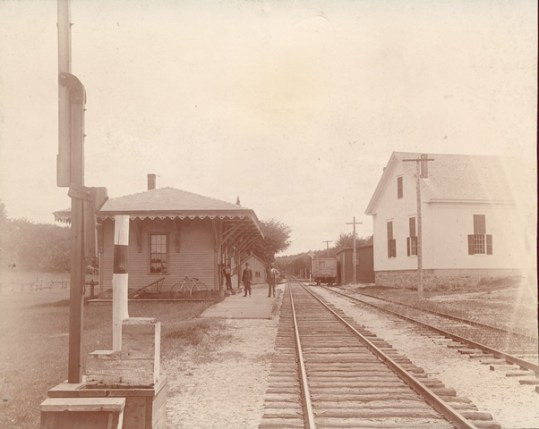
Hudson’s Busy Railroad Station
Here we see Hudson’s railroad station in it;s original position slightly off Greeley Street and behind the Town Hall (now Wattannick Hall). This station was used as a dwelling and later moved onto the Benson’s property. After many years of no use the station exterior has been restored and can be seen just inside the entrance to Bensons Park.
In this 1896 photo, we are looking east from the Greeley Street crossing at the Hudson Center Station (left) and the rear of the Town Hall (now Wattannick Hall) on the right. From this point the tracks are headed towards the crossing at Windham Road, on to the crossing at Clement Road and then to West Windham. A Post Office was established in this station in 1876 and Eli Hamblet was the Postmaster; a position he held until his death in 1896. It was at this station that animals and patrons arrived to go to Benson’s. Animals were shipped here and some were walked along the road to the farm. The Jungle Train from Boston brought people on excursions. There was a freight house (center right) and siding for handling goods. At the height of railroad traffic there were as many as 13 passenger trains plus freight activity each day on this line. Considering a single track line, this made for a very busy and dangerous section of the line. The railroad station was later made into a dwelling, but when it was no longer in use it was moved to Benson Park and can still be seen there. Photograph from the Historical Society Collection.
Baptist Church Sanctuary
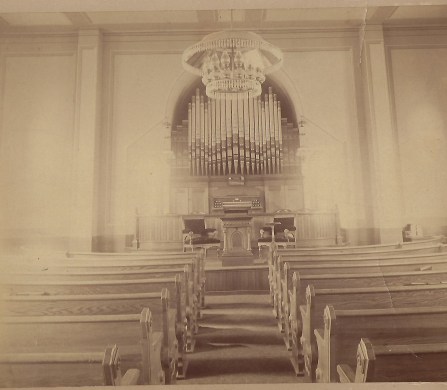
Sanctuary C 1888

Proposed Platform 2018
Revisit Hudson Center …Town House Hudson Center

Town House Hudson Center
This Town House was the second building on this site. The first was the North Meeting House used by the Presbyterians as early as 1771; later shared with the Baptists. By 1811 ownership of the land and buildings were conveyed to the Baptist Society. The pews were not involved in the transaction as they were privately owned. After the Baptist Meeting House was built in 1841 this property was transferred to the Town of Hudson.
In 1857 Hudson contracted with William Anderson of Windham to erect this Town House on the site of the Old North Meeting House in Hudson Center. The North Meeting House was deeded to the town by the Baptist Society after The Baptist Church was completed in 1841. Town meetings were held here until the mid 1930’s when there was a desire among the town people to hold meetings at the bridge area. Wattannick Grange held their meetings here from its organization. In 1963 the town authorized the sale of the building to Wattannick Grange. To the right of the Town House is Harvey Lewis’ Coal Grain and Grocery; on the left and rear is the B&M Railroad Depot. Today, now that Hudson and Wattannick Granges have merged, this building is known as Wattannick Hall the home of Hudson Grange No 11. Photo from the Historical Society collection.
200 Central Street – The Parker House
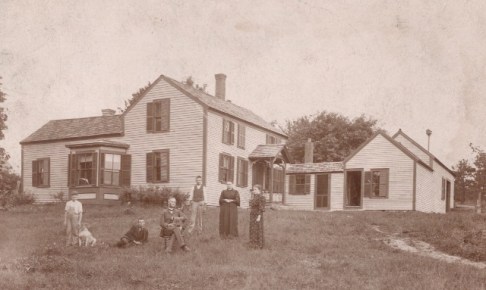
200 Central St C 1895
The house at 200 Central Street in Hudson Center is known to many as the home of Florence Parker, her sister Ernestine, and Ernestine’s son Raymond Parker. They were the oldest daughters of Rev. Clarence Charles and Hattie (Robinson) Parker. As a pastor Rev Parker served in Nottingham, NH, East Hampton, MA, Bolton, CN, and Post Mills, VT. Their mother, Hattie, passed in April 1912 at the age of 42 while they were serving a church in VT. In addition to her husband she was survived by eight children ranging in age from 3 to 15 years. There were 6 daughters (Florence, Ernestine, Ruby, Mildred, Helen, and Alice) and 2 sons (Charles and Lehsten who was also known as Erich. After Hattie passed her eight children returned to Hudson to reside with either their Parker or their Robinson family. Florence, Ernestine, Ruby, and Erich lived with their Parker grandparents, Lydia (Batchelder) and Charles Clarence Parker in this very house. Mildred lived with a neighbor and aunt, Lillian (Parker) Smith. Charles, Helen, and Alice went to live with their Robinson grandparents on Robinson Road.
So, this house was home to Florence and Ernestine from 1912 until they passed. Florence passed in 1977 just short of her 80th birthday; Ernestine in 1990 at the age of 91. Of the other siblings who also lived here Ruby died at the age of 20 and Erich married Almina Bassett and they moved elsewhere in the area.
Professionally Florence was a school teacher in Hudson for more than 40 years, mostly at the Center School on Kimball Hill Road. She received her training from Nashua High School and Keene Normal School. Florence had a natural aptitude for teaching and received many awards and recognitions. The photo shows Florence as she received the Teacher of the Year Award just prior to her retirement.
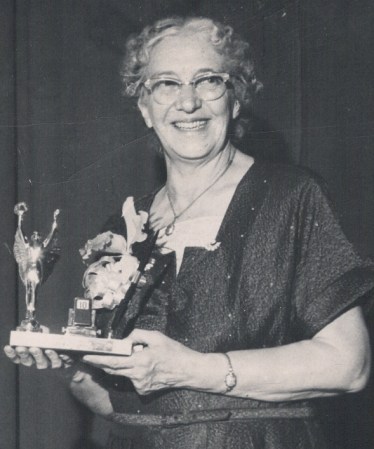
Florence With Award
Ernestine commuted to Nashua and was employed for many years in the mills in Nashua. As a young adult Ernestine enjoyed visiting with her brother Charlie on the Robinson Farm. This photo shows Ernestine and Charlie C 1920.

Ernestine and Charlie C1920
By the middle 1950’s the Parkers had reconfigured their home to include a gift shop on the front of their house facing Central Street. From this shop they sold some very fine pieces of glassware as well as souvenirs of Benson’s and Hudson. This shop continued to operate into the early 1970’s.
Both sisters had a talent for the arts and crafts. An untold number of scarfs, sweaters, and mittens were distributed to Hudson children that originated from the needles and hands of Florence or Ernestine. Florence caned chair seats, even into her later years with failing eyesight. Ernestine’s specialty, especially in her younger years, was quilting. I have seen some phenomenal original quilt patterns which she has designed and made.
They were both active with the Baptist Church at the Center. Ernestine served for many years as a financial officer and teacher in the Sunday school. Florence served as the church organist for years.
Before opening their home in 1912 to their grandchildren, Charles Clarence Parker and his wife Lydia Lowe Batchelder had already raised their own family. He was born in Warren, NH in May 1852 a son of Rev. Lafayette and Hannah Wyman Parker. He came to Nashua as a student in the Crosby school. For 30 years he worked diligently compiling and publishing a dictionary of the English language. While engaged in this work he had a book store on Main Street in Nashua.
He married Lydia Lowe Batchelder August 1873. She was born in Hudson May 1852 a daughter to Mark Batchelder and Lydia Steele. Charles and Lydia settled and raised their family in Hudson; spending most if not all of their married life in this house on Central Street. Their oldest Clarence Charles was born April 1874. He was 38 years old when his wife Hattie passed leaving him with 8 children between the ages of 3 and 15. Their second child and only daughter, Lillie Jane,was born July 1877. She married a neighbor, Herbert Newton Smith and resided next door to her parents. Their second son George Henry was born October 1879. He married Edith Snow of Hudson. Their third son Ernest Josiah was born August 1883 and died young at the age of 15. The 1895 photo of the house includes the family of Charles C. and Lydia. From left to right we have Ernest with his dog, Clarence in the grass, Charles seated, Lydia, and Lillie Jane.
Members of the Parker family owned this house at 200 Central Street as early as March 1870 when Daniel Marshall, administrator for the estate of Moses Griffin, sold it at public auction to Josephine Parker in order to settle claims against the estate. A few years later it was transferred to Lafayette Washington Parker, the father of Charles Clarence. It is probable that Charles Clarence and Lydia moved into this house soon after their marriage even though some other member of the Parker family owned it. He did take title to the house in January 1887 after the death of his father Lafayette. Charles retained title until his death in November 1936.
By the will of Charles Clarence the title of this house was transferred to Florence and Ernestine. By 1989 Ernestine entered a local nursing home. Her son Raymond acting as her power of attorney sold the property to Randy Turmel and Kevin Slattery. Soon after thereafter fire destroyed the building. The property remains idle and is available for sale.
It is difficult to determine the age of the house. We do know that in 1858 it was the home of Moses and Dolly Griffin. In 1856, Moses Griffin of Somerville, MA purchased an acre parcel with building from Olivia Tenney. No clues who may have lived here. Moses passed at the age of 69 in July 1858 and was survived by his widow, Dolly, a son, George, and three daughters; Francis, Rachel, and Louisa Ann. He was predeceased by a daughter also named Louisa Ann who passed at the age of 2 prior to their move to Hudson. Dolly continued to reside in the home. After her death it was sold at public auction to settle the estate. Moses and Dolly are interned in their family plot in Westview Cemetery near their Hudson home.
Baptist Church at Hudson Center

1912 Home of George and Hattie Skeels
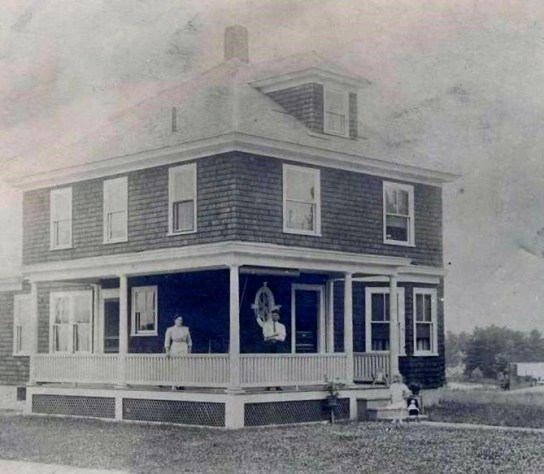
57 Ferry Street C 1912
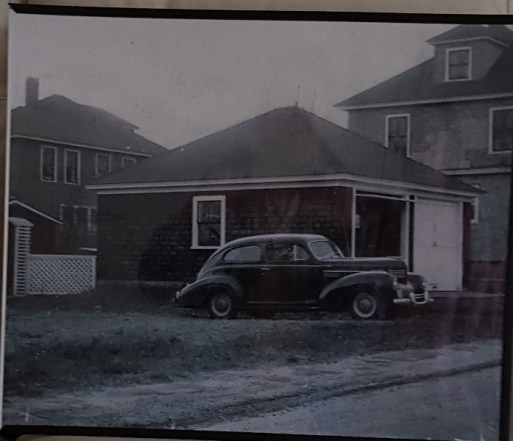
Garage and House at 57 Ferry C 1945
Revisit To Hudson Center … House at 238 Central Street

238 Central Street C1976
Hudson Furniture and Home Fashions

214 Central (Formerly Hudson Furniture)
Do your memories of Central Street along Route 111 in Hudson Center include Hudson Furniture and Home Fashions operated by Joseph and Ann Gagnon? Shopping for a dining room set, a sofa for your living room, or a comfortable chair for the den? Hudson Furniture offered a display of options with the convenience of local shopping.
Joseph (Joe) Gagnon purchased the Lester Gove residence in May 1969 and was soon operating Hudson Furniture. A few years later, as the adjacent residential property of Berkley Swinertin at 216 Central became available, Ann and Joe Gagnon made that purchase along with a smaller parcel from a local real estate agent. Gagnon then consolidated the three parcels and subdivided into two parcels. The first contained two plus acres and the preexisting buildings; Hudson Furniture and the dwelling from the Swinertin home. This dwelling would soon become Home Fashions. The second parcel was a small lot adjacent to Merrill Brook; over time this retail lot was used for Parent Farm Stand and other sellers.
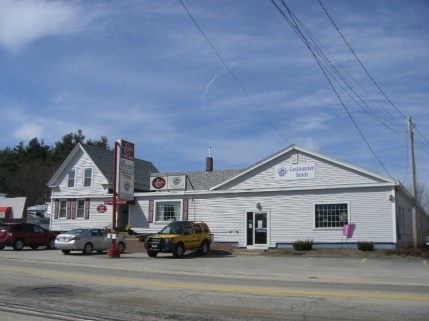
216 Central (Formerly Home Fashions)

216 Central C1955
 Remember Hudson NH When...