Home of Reuben Greeley now the Parsonage of Baptist Church


As we continue to revisit the homes around the Hudson Center Common we come to the  home of  Reuben Greeley.  One of the more influential  families in Nottingham West (now Hudson) was that of Moses Greeley.  Reuben  (born 1794) was the oldest son of Moses  and his second wife Mary Derby.

Parsonage c1980 S

Baptist Parsonage C1980

Historians date this house to about 1790 when it, and much of Hudson Center,  was a part of the farm of Henry Hale. This became the home of Reuben Greeley about the time of his marriage to Joanna Merrill in 1817.  From that time  until 1962 this home was occupied by Reuben or a member of his family.  After Reuben’s death in 1863 his son Daniel continued to live here with his wife, Joanna, and daughter Edwina.  Edwina married John Wentworth and in time ownership was passed to their son Nathaniel.  Nathaniel married Jesse Gilbert of Windham who resided here until her death in 1962; after which the Baptist Church purchased and remodeled the home  to be used as a parsonage for their pastor and family.  The parsonage has been located here at 234 Central Street some 53 years.  In this c1980 photo church members are washing windows and cleaning exterior of the parsonage.  Photo courtesy of Hudson Baptist Church.

The Walker/Campbell/Crooker Home at 13 Webster

2013043002

Campbell House front view undated

James Gerry “JG” Walker was born in New York, NY October 1842.  He served with Company K, 12th NY Regiment during the Civil War.  By 1870 “JG”, his wife Mary and 5 year old son Gerry, had  moved to Hudson.  Possibly joining them on this move were his parents and a brother.  By 1873 “JG” had purchased a building lot from Kimball Webster and built a single story home on the east side of Webster Street.  “JG” had a long career in the lumber industry as a sawyer and surveyor of lumber.
During their marriage “JG” and Mary had three children.  Gerry born about 1865 in NY and two daughters born in Hudson;  Sadie (born about 1872)  and Grace (born about 1879).
“JG” participated in the affairs of town and of the Methodist Episcopal (M-E) Church.  He served as Town Clerk in the mid 1870’s and as selectman in the mid 1880’s.  For his church he served on various committees; including the parsonage building committee where he served  with the pastor, Rev. Farnsworth, Augustus Blodgett, and Kimball Webster  This is the committee which contracted with Isaac Newton Smith to build the church parsonage at the corner of Highland and Baker Streets.
By 1898 “JG” had enlarged his Webster Street home by adding  second story.  This was done by jacking up the existing home and adding a story underneath.  The previous first floor and porch became the second floor and porch.  This helps to explain why there are identical porches on each story of the house.
“JG” passed in December 1916 at the age of 74 after a 46 year residency on Webster Street.  His funeral  was held  from his home by the Rev. Roy Honneywell of the M-E church.  He was survived by Mary, his wife of 50 years and by Mr and Mrs Jerry Walker, and a daughter Mrs. Grace Schurman.
His widow, Mary continued to live in the Webster Street home until July 1919 when she sold the homestead to Charles Edward Campbell.  Mary rented a home on Pelham Road until she passed in 1928.  She was laid to rest with her husband in the family plot of Hills Farm Cemetery behind the Alvirne Chapel.
Our first photo (undated) shows the Walker/Campbell Home front view.  We get a clear picture of the two story porch and of the barn on the south side of the house.
The history of the Charles Edward Campbell family begins in Bass River, Nova Scotia, Canada with his birth in September 1866.  In 1885 at the age of 19 Charles immigrated to the United States and became a naturalized citizen by 1910.  In June 1893 he married Anne Maria Knight a native of the Boston area.   Soon after their marriage they moved to Nashua and began their large family. They remained in Nashua until about 1904 when they moved to Hudson, possible on or near Lowell Road.  The family moved into their Webster Street home in 1919 after Charles Edward purchased it from Mary Walker.   He was employed clerk in a railroad freight office.  During their marriage I can identify 10 children; 5 of whom were born while they lived in Nashua and 5 after they moved to Hudson.  The children born to Charles Edwad and Anne Maria in Nashua are:  Oscar Joseph (b:1893), Madaline Viola (b:1895), Erma Francis (b:1900), Velma Onaita (b:1901), and Genevieve (b:1904).  Those born after moving to Hudson are Ruth Marion and Ruby Merriam (twins born and died in 1905), Marjorie (b:1907), Everett Cecil (b:1908) and Virginia (b:1913).
Of the 8 surviving children Oscar, Erma Frances, Velma, and Genevieve are the most significant to the ongoing history of the Campbell Home on Webster Street as they lived most, if not all, of their adult life at 13 Webster.
As a 23 year old single man Oscar J. registered for the World War draft in 1917.  At that time he was employed as a machinist in Worcester, MA.  After discharge from the service he continued to work in the mechanical engineering field; often commuting to employment out of the state.  By 1940 Oscar, his wife Mary Kathleen Warton, and 2 children were residing on the second floor of Campbell homestead.  Oscar J passed in December 1970 while a patient at the Veterans Hospital in Manchester.  He was survived by his wife, a son, Charles Bernard, and 2 daughters, Marilyn Louise Lindwell and Judy Fisher.  Charles Bernard resided in China Lake, Ca; Marilyn Louise resided in Fullerton, Ca; and Judy resided in Toledo, OR.
Erma Francis  resided at the Webster Street home from the time of purchase in 1919 until she passed in December 1978 at the age of 78.  After attending schools in Hudson and Nashua High, she was employed for many years as a clerk for an insurance office.  Likewise, Genevieve resided on Webster Street from purchase in 1919 until she passed in 1978 at age 74.  After attending school she worked for years as a school secretary at Nashua High.
Velma Onaita likewise attended Hudson schools and Nashua High.  She worked as a clerk for the street railway as early as age 18.  Velma was a sociable young lady; attending and participating in plays and attending theaters in Nashua.  She used the street railroad for transportation to Nashua and Manchester for both work and pleasure.  By 1925 she had met and became engaged to Jonathan MacIntyre of Nashua.  They were married August 31, 1925 by clergy David MacIntyre, father of the groom.  Following their marriage they lived at or near Arlington Street in Nashua.  They had a son Donald (b:1927), and two daughters; Onaita (b:1929) and Genevieve (b:1930).  Jonathan and Velma Onaita were divorced in 1933.  Following the divorce Velma and her family returned to live at the Campbell house on Webster Street. As time progressed Donald MacIntye married Arlene Gagnon of Hudson and Onaita Macintyre married Hayden Tibbets.
2013043001

Campbell House side view 1920’s

Our second photo shows a side view, looking south, of the Campbell House in the 1920’s.  Webster Street is a dirt road and in the lower right corner we see the street railway tracks for the Manchester Line. Both photos are from the Historical Society collection.
Charles Edward passed March 1938 at the age of 71 following a 45 year career as a railroad worker and 53 years in the  United States.  For the  last 19 years he resided at 13 Webster,   His funeral took place at the Pilgrim Church in Nashua.  He was laid to rest in Woodlawn Cemetery along with his twin daughters Ruth and Ruby.
As administrator of her father’s estate Erma Francis transferred title of all property owned by Charles Edward to her mother, Annie.  In addition to the homestead he purchased from Mary Walker  this included two additional land parcels which Charles had purchased.  Annie retained title of all the real estate until February 1951 when she transferred ownership to her daughter Erma Francis.
Sisters Erma Francs, Velma Onaita  MacIntyre, and Genevieve continued to reside in their Webster Street home.  In 1978, Erma transferred title to the next generation of Campbell’s:  the son and daughter of Velma Onaita:  Donald MacIntye and Onaita Tibbets along with their respective spouses.  Erma and Genevieve passed at different times in 1978; Velma passed in 1979.
In February 1988 ownership of the Campbell home was transferred away from the family.  Following periods of short time ownerships, vacancies,  and mortgage foreclosures the 13 Webster Street home was purchased by the Crooker Family in 1993.  It is presently home to Ann, Jim, and Sam Crooker.  They love their home and cannot imagine living elsewhere at this time even though the maintenance and upkeep on an old house becomes a labor of love.
In 2017 the Historical Society was contacted by Hayden Tibbetts in regard to diaries kept by Velma Campbell and Jonathan MacIntyre for the years 1922 – 1925.  It is interesting that we have a “his” and a “her” diary for the year 1925, the year of their marriage.

The Paul Tenny/Henry Brown House C1895

1987005017

Henry Brown House C 1895

This home was located on Kimball Hill Road adjacent to the Tenny Tomb where members of the Tenny family are laid to rest.  Being a part of Benson’s Wild Animal Farm the site was owned by the State of New Hampshire.  This home was demolished by the state prior the purchase of Benson Park by the town of Hudson.
 This house was a landmark in Hudson Center for many years; standing at  Kimball Hill Road opposite the Hudson Center Common and directly across from the front steps of the Baptist Church.    The first occupant was Dr. Paul Tenny who moved to town about 1791 and later settled here.  The property was sold to Dr James Emery in 1849.  When Dr. Emery retired it was purchased by Henry C. Brown; in 1935 it was purchased by John T. Benson and became part of the Benson’s Wild Animal Farm property.  Vera Lovejoy and her family lived here while she was managing the Benson Farm.  This c1895 photo shows, left to right, Henry C. Brown; Ina Louise Brown, daughter; Clara Bryant Brown, his wife; and John and Eliza Brown the adoptive parents of Henry.  Photo from the Historical Society Collection.

Memories of the 1936 Flood

1978050004

West Hollis and Bridge Streets 1936

The great flood of 1936 struck both the Nashua and the Hudson side of the Taylor Falls Bridge. By mid March the accumulation of winter snow to the north and west along with warmer weather and heavy rains caused the Nashua and Merrimack Rivers to peak beyond flood stage. The rivers were rising fast and carrying large ice cakes. Flood stage on the Nashua side was reached by Sunday, March 15 including flooding along East Hollis and Bridge Streets. For a short time the water receded and the danger seemed to have passed; but by Wednesday, March 18, there were threats of more heavy rain and warmer weather. The Merrimack River was again rising fast at a foot an hour. During the next few days flood conditions existed along Litchfield Road, Webster Street, Post Office Square at the bridge, and south of the square to Maple Avenue and parts of Riverside near Lowell Road. By Saturday, March 21, flooding had peaked, water began to recede and the worst was over. It wold take months to clean up and recover from the damage and debris left behind.

From her home at 1 School Street, atop Campbell Avenue, Hazel Buxton (Mrs. Paul) was able to observe much of the flood activity in Post Office Square and Webster Street. Hazel kept a diary during the three worst days of the flood. This diary was later transcribed and placed on file at the Historical Society. Paul worked for the Public Service Company in Nashua and was stranded on the Nashua side during most of the flood.

On Thursday morning, March 19, the Telegraph reported the bridge was closed to traffic. Bridge and East Hollis Streets (Nashua) had 5 feet of water. On the Hudson side, Paradise Park (aka Paradise on the Merrimack) was flooded and families were being rescued from their homes in boats. The gas supply into Hudson was shut off and the red Cross was “at the ready” to offer help. Hudson pupils were unable to attend Nashua High. There was no gas with which to prepare breakfast. Hazel and her children (Elizabeth age 16 and Robert C age 8) walked from their home, down Campbell Avenue to and across the bridge. They watch as boats were carrying residents from East Hollis Street to dry land. Water had reached the tops of front door steps and beyond. Water was rising rapidly and the reports on the radio were alarming. Families along the Litchfield Road and Webster Street were being evacuated. Our first photo shows West Hollis and Bridge Streets at this time.

When they returned home Hazel placed some potatoes in the coal furnace to bake. By 2:00 pm the power was off. Neighbors were helping each other; sharing extra kerosene and lamps. The power plant off Bridge Street in Nashua was abandoned. The Nashua River was overflowed. Families in Hudson ate supper by lamps or candles. The Hudson fire trucks were used to barricade access to the bridge on Ferry and Central Streets.
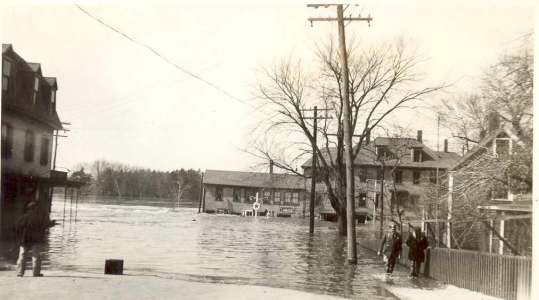
2013038017

Flooding at Post Square from Central Street

On Friday morning she learned from neighbors that the bread truck had arrived at Baker’s Store on Central Street. The delivery was made by men wading through water in their rubber boots. By this time the water is pouring over the railings on the bridge. Our second photo was taken from Central Street near Baker’s Store looking down onto the flooding over the bridge and in the square. We see men in the streets wearing rubber boots; perhaps delivering bread and food to Bakers Store.

As Hazel looked down Campbell Avenue she saw a barn sailing from East Hollis Street down river and soon heard a crash as the barn hit the Rochester railroad bridge. Hazel and the children walked around Central Street to Reed Street and could see water had flooded the lower end of Maple Avenue. Water was pouring through the coal cars on the bridge. The old toll house from the Nashua side of the bridge had also gone down river and came to rest near the barn.

There was no phone service. Water from Webster Street was now connected with the flood water in the square. Ferry Street was roped off at Library Street and Central Street was closed at the Odd Fellows Building. Hazel was able to use the police phone to learn that her husband, Paul, was safe in the second floor of the Belvedere School in Nashua (now a small park on Bridge Street). He would be removed as soon as possible; but, as of now the school was surrounded by water from both rivers.

By noon water was rushing across the square from Webster Street and all houses on Webster were flooded, including that of Kimball Webster. Many people were out and about. They watched a large barn come down river, rise and crash into the bridge, splintering in seconds. Debris popped up on the other side of the bridge. All kinds of debris hit the bridge, sucked under by the current and later popped up on the south side of the bridge in pieces. A small building with a stove pipe resembling a person hits. A bunch of railroad ties come down with thuds and loud reports as they hit the bridge.

By early afternoon news arrives that her husband Paul, and other Public Service Company employees are safe at an uptown office. The Hudson Community Church open for shelter, warmth, and food. Meals were served all day. Women used wood fires in the ranges. Donations were accepted for flood relief.

1977002012

Flooding of River onto Litchfield Road

By 5:00pm water was receding. Friends drove them up to Elm Avenue and they found the water up to the front door of the Hardy farm, now home to Bernard and Elaine Brody. The Garrison farm was also flooded. Soon people were beginning to relax as the worst was over. Our third photo shows the flooding of homes along Litchfield Road.

Come Saturday there were many hours and weeks of cleanup before normalcy could be restored. All canned goods and preserved were thrown out after the cellars were pumped out and disinfected. Floors were warped, furniture ruined. Electricity, gas service, and telephone had to be restored. All photos are from the Historical Society Collection.


Eli Hamblet House

Eli Hamblet House
Our next stop on our revisit to Hudson Center is at the home of Eli Hamblet.  Eli and Benjamin Dean were neighbors, both homes facing the common on the east side.  The Historical Society is fortunate to have three original documents written by Eli; a work ledger for years 1840 to 1878; his 1855 and 1857 diaries; and a manuscript detailing Hudson’s contributions to the Civil War.  This was kept by Eli during his tenure as Town Clerk.
Born in 1810 to Tamar and Thomas Hamblet, Eli lived most, if not all, of his adult life in Hudson Center.  Eli’s home and farm was located on Hamblet Avenue facing the Hudson Center Common on the east side. This house was previously owned by John Foster who operated a grocery store there for about 19 years.  Eli married Rebecca Butler of Pelham in 1844.  Their daughters Rebecca Souvina and Arvilla continued to reside in the house after Eli’s death in 1896.  In addition to farming, Eli served his town in many ways; town clerk, selectman, overseer of the poor, and representative to the general court.  He was one of the organizers of the Hudson Center Library and he acted as the librarian when this small library was housed in his home.  He was a member and Deacon of the Baptist Church.  In 1876, when the Hudson Center Post Office was established at the Railroad Station behind the Town Hall, he was appointed postmaster.  He held this office until his death in 1896.  Eli’s entire family, including his parents, are buried in Westview Cemetery.  This house was the home of Robert Thompson, Sr and his family for many years.  After being vacant for an extended time it was demolished a few years ago.

Hudson’s Nick Connell, East of Echo


This week’s Remember Hudson When … article is by Stephen Kopiski.  He has an interest in our town’s history and personalities like Nick Connell.  

 
Nick Connell 1989 S

Nick Connell 1989

Hudson’s Nick Connell, East of Echo

 
          Consider around 1900, the Merrimack River would freeze over and permit winter recreation from NH to MA. Forty years later, with industrial and municipal development, the water warmed and the freeze was only a memory. True except for a nineteen year-old Hudson boy who decided on January 31, 1940, to lace up and skate to Lowell. Despite some harrowing watery encounters, he made it to Pawtucket Falls, 14 miles in a little over two hours. Not to be outdone, six days later, he skated another 14 miles from the Hudson bridge to Manchester. Too tired to skate back, he attempted hitchhiking, but ended up walking 9 of the miles in borrowed galoshes. The young man’s name was David Wesley “Maurice” “Nick” Connell, and he was just getting warmed up.
 
          That’s a lot of names and nicknames. A favored choice was “Nick,” so this story moves forward as such. Born September 21, 1921, Nick Connell was a man who saw goals and drove towards them his way, and with focus. A lot of claims are hard to verify; married 4 times, Nick maintained he’d had over 40 jobs; trapeze artist, elephant handler, policeman, railroad man, stone mason, vaudevillian and more. Fortunately, there’s no shortage of newspaper accounts and first-hand recollections of his exploits, for a glimpse into his extraordinary life.
          Nick joined the Navy in 1943 and served as a corpsman in WWII. Always a fitness enthusiast, the Nashua Telegraph archives offer multiple mentions of weightlifting meets and matches, many featuring his breaking numerous city and state records. One such meet had him breaking every record in the competition for his weight class (181 pounds in this case.) He even bested some of the heavyweights on that particular night. Along the way, Nick won the title of Mr. New Hampshire in 1948. This dominant heyday lasted from the early 1940’s until the mid 1950’s, but he maintained his bodybuilding and strength training discipline all of his life.
 
          A high school dropout, Connell was self-educated with a lifelong interest in the religions of the world. A heavy reader, he wrote and spoke with natural intelligence. In the mid 1950s, he dedicated himself spiritually and joined The Church of Latter Day Saints, The Mormons, and became the church’s State Commander (NH) in 1956. He remained a Mormon for life. Into the 1960s, his vocation had him living in Arizona and Salt Lake City, Utah where he performed his missionary service. Newspaper accounts from this period describe Nick as a researcher, a writer, even a lecturer for the church. But as this decade of cultural change and upheaval began to unfold, not being one to follow any crowd, Nick was headed for his own real-life revolution.
           As the 1970s dawned, Nick took to commuting between Hudson and San Diego, CA with the change of seasons. San Diego’s Torrey Pines State Natural Reserve is a protected environment for rare flora. Hikers and nature lovers are welcome, but only on the permitted trails. Predictably, Connell was far afield when he encountered a sandstone indentation in the cliffs, well off the trails. Here, allegedly in a vision, a white-haired man invited him to dig into the cliff, all the encouragement he needed. So with a Bowie knife and a screwdriver, and later a pickax and hatchet, he fashioned a tidy, comfortable two-room cave complete with carved-in bookshelves, window and sleeping platform. It was here, sheltered from New Hampshire winters, that Nick continued his studies of the world’s religions with the intention to write a book of life’s philosophy. Nick called his excavated refuge “East of Echo.”
          Here, two accounts collide, Nick had claimed that, even as a young boy, he felt the allure of solitary living. Much later, a soon-to-be-former wife suggested he go live in a cave…
          Unfortunately, he was dubbed “The Torrey Pines Hermit” (Nick always welcomed and entertained any visitor who could find him.) Over the years, he adorned the cave interior with impressive paintings and relief sculpture of religious and ancient symbolism. His visitors ventured off the permitted trails in the protected reserve to see the hermit in his unlikely lair. And even though it took 17 years, the park rangers eventually found the cave, and the hermit. There was reluctance on all sides concerning what to do. The cave and the artwork were splendid but even Nick agreed that a lot of laws had been and were being broken. His support reached all the way back to friends and well-wishers in Hudson, but in the end, 1991, East of Echo was filled with concrete and permanently sealed. Characteristically undeterred, Connell pursued various legal and physical means to resurrect his cave and his art. He even started new, more secret cave-carving in the reserve. For a while, the 70 year-old was hard to catch on the sandstone cliffs, but the rangers never gave up and he was repeatedly shooed off. Of note, towards the end of this period, Nick would write an occasional article in what was then known as “The Hudson News” entitled “View from the Cave.”
          Meanwhile back home, apparently restless while away from his cave, we have “1987 – Connell VS. Town of Hudson.” Nick risked arrest for photographing police activity at an automobile accident outside his home. He protested formally and finally received a written apology from the Chief of Police for his treatment at the scene. He sued anyway, and won (One Dollar, plus court costs.)
          With the cave adventure done, and confronting the relentless onslaught of old age, Nick stayed primarily at home in Hudson, but still visited the West Coast when he could. Not driven by material wealth, or notoriety, Nick Connell was an example of singular individuality and effort, even with occasionally dubious accomplishment. It was while in California that David Wesley Connell passed away on December 5, 1994. His remains were returned, here, to his hometown, where he rests. No doubt his gaze and his reach are finally infinite, like the imagination of the boy who braved the ice.  


Revisit To Hudson Center … Benjamin Dean House – A House Twice Moved
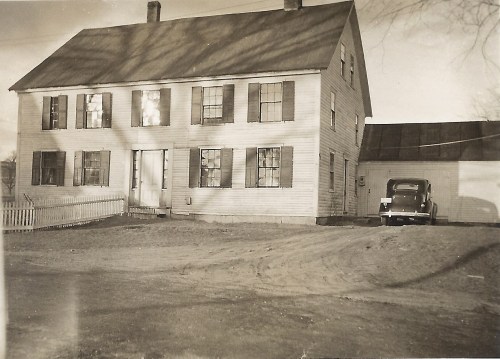
Benj Dean c1942

Benjamin Dean House on Hamblet Avenue C 1942

Continuing to revisit Hudson Center we stop at the Benjamin Dean House.  This 270 plus year old house is among the oldest, if not the oldest house in Hudson.  But I can state for certain that it is the ‘best traveled’ house in town.  For the first 91 years this house was located on Bush Hill Road as part of the Haselton Farm.  In 1838 the home was moved to Hamblet Avenue and remodeled by the owner, Rev. Benjamin Dean.  Here it remained for another 126 years until moving a second time about 1964 to  it’s location on Windham Road.
This house was built by Abraham Page about 1747 on Bush Hill Road on part of the old Haselton Farm.  Between 1747 and about 1838 this house was likely occupied by Abraham Page, Jr and early members of the Haselton family whom he helped to raise. In 1838 the owner, Rev. Benjamin Dean, moved and remodeled the house to a location on Hamblet Avenue just north of the Eli Hamblet house and facing the east side of the Hudson Center Common.  The second floor contained a large room with an arched ceiling, referred to as “Dean’s Hall”.  This room was used as a school and a place for public gatherings.  Rev. Dean occupied the home until about 1850.  The home had various owners until being purchased by the family of Claudia and Richard Boucher.  In the early 1960’s when the State of New Hampshire planned out the new route 111 through Hudson Center, this house was simply ‘in the way’.  The Boucher family sold the property to the state and later re-purchased the house and had it moved to its present (and third) location on Windham Road.  This 1942 photo from the Historical Society Collection shows the house at its second location on Hamblet Avenue.

The Cross Homestead on Barrett’s Hill Road

1977008001

Cross Farm on Barrett’s Hill Road

This undated photo of the Cross home on Barrett’s Hill Road came to the Historical Society from the estate of Jessie Gilbert and was later identified as being the home Arden Cross. None of the individuals in the photo were identified.

27 year old Hiram Cross purchased land on Barretts Hill Road from William T. Baldwin in 1846. By the end of 1847 Hiram and Sarah Savage were married in Hudson. The 1850 census shows Hiram and Sarah as supervisors of the poor farm (Alms House) along with nine clients ranging in age from 90 to as young as 9. Perhaps this position provided living space while they prepared to build their home or even provided some financial assistance. By 1860 Hiram and Sarah were living in their own farmhouse on Barretts Hill Road along with three sons; William (age 8), Addison (age 4), and Arden (age 2).

Hiram was a fifth generation descendant of Nathan Cross (B:1703 in England). Nathan settled in Dunstable and in 1724, while our town was still a part of Dunstable, MA, purchased a part of the Joseph Hills Farm along what is now Derry Road.

For 125 years or so, the Cross farm on Barretts Hill Road was operated first by Hiram, then by his son Arden (B:1855 D:1927), then by his grandson Nathan Erwin (B:1894 D:1991). Hiram passed in 1892, at which time he was survived by four sons. In addition to William, Addison, and Arden, there was a younger son Herbert some 9 years younger that Arden. Ownership of the farm passed to Arden as each of the other sons had moved to neighboring towns.

The second family to operate the Cross farm was that of Mary Willoughby and Arden Cross. Mary was native to Hollis and they were married in 1893. Their family consisted of a son, Nathan Erwin (B:1894) and a daughter Ruth Vivian (B:1898). We do have some ideas about the farming activities on the Cross Farm. Arden had a productive dairy herd. In 1906 he added two Jersey cows to this herd. The less stony fields surrounding the homestead were used to grow and harvest hay for the winter use. The stony fields were used to pasture the herd during the warmer months. The family garden and orchard was the source of most food supplies: potatoes, carrots and other root crops. apples and pears from the orchards. Neighboring farmers would often assist each other with work which required more than one person: haying, picking apples, digging and storing potatoes to name a few. One major winter activity was harvesting ice blocks from nearby Robinson Pond and stacking then in the ice house using sawdust for insulation.

The third generation was that of Emma Lane, from Claremont, and Nathan Erwin Cross (B:1894). They were married about 1920. There are indications that Nathan Erwin, often known of as Erwin, lived near Clarement prior to their marriage. About 1921 Erwin and Emma returned to Hudson to assist his father who was having difficulty with advanced age and poor eyesight. Erwin and Emma had one daughter, Helen, born about 1932. She attended Hudson Schools and then Nashua High School. After high school graduation she attended Colby College in ME. In March 1955 she married Edward Stabler of New York and made that state her home. Erwin continued with the farming operation until advancing age and poor eyesight required he retire. He continued to reside at the homestead on Barretts Hill as long as possible; spending his last few years with his daughter and her family in New York. The home in Hudson was vacant for many years and has since been demolished. The land which was the Cross Farm is located at the corner of Barretts Hill and Tiger Roads.

Let’s return to the photo for a few moments. It was taken by “Eaton Photographer Oppo. City Hall, Nashua, N.H.” according to the information on the back of the original photo. Thanks to research by Jim Hogan of Nashua we are able to isolate the date of this photo to be circa summer of 1870. Eaton Photographer was listed as a business in the Nashua City Directory but only once, and that was in the 1870-1871 edition. In the same edition, the residential section had a listing for “Eaton, Asa B., photographer, 91 Main St, opp City Hall, house at Hollis” This has also been supported by the 1870 census for Hollis.

Given the Cross family history this is a photo of the home of Hiram Cross, father of Arden. The man on the right would be Hiram (age about 51) and the younger man on the left would be his older son William (age about 18). Arden (age about 8) is not in the picture. Back next to and almost hidden by the shrub between the windows is a woman, likely Hiram’s wife, Sarah. The “photographic artist” placed the men away from the shade of the trees and had them remove their hats so as to make their faces more visible. Possibly Sarah shied away from being in the photo because she does not have on her fancy clothes.

The man and the horse and carriage might be a neighbor passing by who stopped to watch as the photo was taken. It may also be the transportation the photographer used that particular afternoon to drive through the country taking photographs. Notice that he seems to be holding the reins tight so as to control the horse. Also, the carriage is taking up most of the width of the dirt, narrow, Barretts Hill Road. Thanks to Jim Hogan, a historic writer and researcher from Nashua for sharing his work with the Society.

Hudson Center Revisited

This series on Hudson History began in August 2014 as a joint project between the Historical Society and the HLN as a way of sharing some of Hudson’s history with our readers.  To date there have been some 170 weekly articles and accompanying photos published in the paper and on RememberHudsonNHWhen.com.  I enjoy writing these articles and the research necessary to prepare for them.
 
Going forward there are still many sites and topics to write about. But, more time is now needed to do this research.  My plan going forward is to submit  Remember Hudson When articles every other week.  And, on the alternative weeks we will Revisit parts of town by re-printing articles from the past on a theme basis:  for example a Pre 1970 trip down Lowell Road or Restaurants in town, etc.  This week we begin a Revisit series on Hudson Center.
 
As always if there is  some historical site or photo you would like me to consider writing about, please contact Ruth via the HLN or the Hudson Historical Society by sending email to HudsonHistorical@live.com or a phone message at 603-880-2020.
2004007001 comp
Prior to 1834 the only village in town was a small one around the Hudson Center Common.  This  consisted of three stores, a tavern, the north meeting house, one practicing doctor, the post office, and 8 or 9 residences. By 1888 the  Baptist Church sanctuary was built; the north meeting house was replaced by the town hall, and the only railroad station in town existed behind the town hall and off Greeley Street.  This C1888  photo of the Hudson Center Common shows the view from the home of Eli Hamblet  on Hamblet Avenue.
 
Straight ahead is the Baptist Church. The church where he was elected as deacon just a few years earlier in 1882.  The large vestry at the rear of the church had not been built, but I am certain the need for it had been discussed among the members.  To the right of the church is the home of Mrs. Mahalia Greeley; the widow of John Greeley, MD. Further to the right, not shown on this photo, is the town hall.   To the left of the church is the former home of Reuben Greeley, postmaster from 1818 until 1829; now occupied by his son Daniel Greeley.  Daniel was known to have a good nature and was well liked within the community.  
 
In the foreground and on the left of the photo is the Old Hudson Center Cemetery.  Up until a few years prior to this photo the cemetery was in disrepair and the town considered moving the remains from this site so that the size of the common could be increased.  This proposal did NOT meet with public sentiment and, as it turned out, a former resident of Hudson, John Foster, made a proposal to the town that he would build a stone fence and clean up the cemetery if the town would maintain it.  Immediately beyond the cemetery is a roof of a barn; possible from the barn connected to the Paul Tenney/Henry Brown House on the opposite side of the common.  Photo from the Historical Society Collection.
 

Water Towers on Highland Street

Standpipe On Highland Street
The first water storage and delivery system in Hudson was this wooden standpipe at the height of land at what is now 30 Highland Street.  The concept is fairly simple.  Water is pumped  into this vertical standpipe, stored; as needed the water  flows by gravity to the home or buildings in the area. This standpipe was constructed by George O. Sanders as early as 1891 to supply water to his buildings in Hudson and Nashua.
     Sanders was born in Hudson and at age 6, moved to Nashua with his parents.  His dad was a well known contractor in Nashua from whom he learned the trade by serving as an apprentice at the age of 17.  In 1873 he selected a prominent site in Hudson and proceeded to build what is known, even today, as one of the finest residences in Hudson.  It remains today; the elegant Victorian overlooking Library Park at the corner of Derry and Highland Streets.
      In 1882 he established himself in business in Nashua.  He purchased a parcel of land near the junction of the Nashua and Merrimack Rivers and soon had a sawmill and box factory.
     At first, Sanders supplied water to his residence from a well with a windmill operating along side his home.  In need of water for his factory as well as his residence he built the standpipe and power station on Highland Street.  He then pumped water from Little Tarnic Pond (aka Swamp Pond) into the standpipe to provide this water. He laid pipes from the standpipe under Highland and Derry to reach his residence.   To reach his buildings in Nashua pipes were laid in the river. He also extended the pipes to provide water to a few of his neighbors.  The first distribution of water through these pipes was in 1891.  Our first photo was taken as you proceed up Highland from Derry street.  The standpipe, on your left, is located on what is now 30 Haverhill Street.  Note that Highland is a dirt road and there are but a few homes in the area.
     The Hudson Water Works Company (HWWC) was organized in he spring of 1893.  After a short time the water from Little Tarnic contained sediment and was unsatisfactory for domestic use.  About this same time Sanders purchased a number of acres and  water rights along Tarnic Brook and what is  now Melendy Road. He transferred a part of this land to HWWC for a large well  and a pumping station.  Pipes were laid under Central Street and connected with the former system of pipes.  Water from this new well was pumped into the standpipe by a circuitous route.
   About 1901 the HWWC was sold to parties in Boston.  They failed to make the business successful and Sanders again became principle owner.  By 1903 all, or nearly all stock was transferred to parties in Portland, ME and by 1905 the Hudson Water Company(HWC) was incorporated.

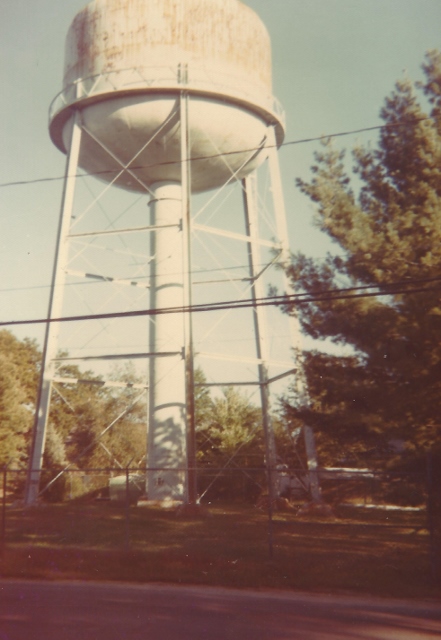
Steel Water Tower from Highland C1978
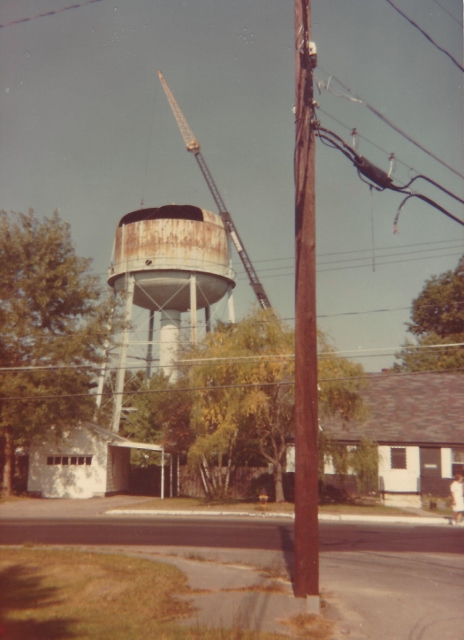
     The vertical standpipe at the corner of Highland and Haverhill continued to operate by Hudson Water Company until a  water tower was planned and built in 1939.    This replacement was located across Highland from the standpipe.  According to a February 6, 1939 article in the Nashua Telegraph this new water tower was made of welded steel, stood 85 feet above it’s footings, weighed 65 tons, and had a storage capacity of 240,000 gallons!  This provided a 10 lb increase in pressure to  existing customers and extended to potential service area to 1/2 mile beyond the Hudson Town Hall at Hudson Center, now Wattannick Hall.   This tower was equipped with a gauge on it’s south side, making it possible to determine the amount of water in the tank from Ferry Street.  We have two photos of this steel tower.  The first shows the 85 foot tower and was taken from across Highland Street.  The second shows the tower from the intersection of Ferry and  Second Streets, looking between 66 and 68 Ferry at the tower.

Steel Water Tower from Ferry C1978

     Once the new tower was planned the land parcel upon which the standpipe sat was sold by HWC to Helen and Ray House, with the understanding that the old standpipe was to be removed before May 1939.  This new tower remained in use by HWC into the late 1970’s, perhaps as late as 1978; at which time it was demolished.  The photos of the tower shown here were actually taken by the author a the time of demolition.  Before this demolition a third water tower was built on a hill above Belknap Road at Gordon Heights.
     As time went on the HWC morphed into Consumer NH Water Company.  Then, in January 1998 at a special town meeting, the voters of Hudson authorized the acquisition of the water system from Consumer NH.  As a result of this action Hudson has it’s own water utility and Water Utility Department.
     My thanks to Gerald Winslow and Lionel Boucher for adding insight to this story. Jerry moved, with his parents, into his house on Highland Street, adjacent to the steel tower, in 1940.  I was curious if the younger generation rose to the challenge of climbing the tower or decorating it for Halloween. He replied, “not too often”.  However, he did remember that “Nick” Connell had an annual practice when he returned home to Hudson after wintering in California.  He climbed the tower and proceeded to do hand stands on the top.  What a site that must have been!!  Lionel worked a a building contractor in Hudson; he worked on the removal of the old standpipe and the construction of the home at 30 Highland Street for Mr. and Mrs. House.


Catagories