Home » 2016 (Page 3)
Yearly Archives: 2016
Haselton Farm on Bush Hill Road C 1920

Haselton Farm on Bush Hill Road C 1920
Including the present family, the Haselton Farm on Bush Hill Road has been home to 6 generations of Haselton’s. The first generation was Nathaniel; born 1762 in Nottingham West (now Hudson). By 1795 Nathaniel had purchased the farm and buildings from Abraham Page, Jr. Mr Page had no known children of his own; but history tells us that he helped raise Nathaniel Haseltine. As part of the sale agreement Mr. Page and his wife secured a life lease on the property; thus assuring themselves of a dwelling place for the duration of their lives. Mr. Page was a farmer and a builder; a trade he learned from his father. A number of 1700 vintage homes in Hudson have been traced back to these builders. Nathaniel married Rachel Smith in 1795 and soon thereafter changed their name to Haselton.
This week’s photo was taken C 1920 from a hillside above and slightly south of the home of Arthur Haselton built about 1895; now the home of Don and Beverly (Gates) Jackson at 25 Bush Hill Road. Their home is on the right side of the photo and faces Bush Hill Road. Opposite this is the Haselton Barn and an older Haselton family home to the right of the barn. In the background is a view of the hillside with Benson’s Animal Farm to the right.
Throughout history the Haselton Farm is known to have 3 different houses; often two at any one time. The first home was located on the same side of Bush Hill Road and slightly south of the present Jackson home. This home was built by and lived in by Abraham Page,Jr. The second home is the house adjacent to the barn. Exact date for the construction of this house is unclear but could be as early as 1793.We do know that by 1826 the first house was moved from it’s Bush Hill location to Hamblett Avenue facing the Hudson Center Common and was the home of Rev. Benjamin Dean, then pastor of the Baptist Church. This house ultimately became the home of Richard and Claudia Boucher and their family; and when Route 111 was built through the Town Common, the house was again moved from Hamblett Avenue to it current location on Windham Road.
This second house became the family home to 4 generations of Haseltons: Nathaniel, Luther, George, and Arthur. The home on the opposite side of the road was likely built by or for Arthur Haselton C 1895. This barn and the adjacent house remained in the Haselton Family until 1943 at which time it was sold to Ben Brintnal. By 1944 the barn and property on that side of Bush Hill Road was sold to The Laphan Group, the second owners of Benson’s Animal Farm. It was about this time frame that the house was dismantled and the materials used to construct a smaller house on Ferry Street.
Of all the buildings which were part of the Haselton farm, the most noteworthy is the 3 story barn with cupola. Perhaps initial construction as early as 1761, this barn was used in each of three centuries. Changes and additions have been made over this period of time, evolving the architecture and construction to match the changing use to which the building was put. Additions made to the barn between 1889 and 1910 included the addition of the cupola; now removed from the barn and in storage for future restoration. Analysis of the barn structure shows a 3 story barn, set into a bank (hillside) so there are entrances to each story at grade level. Today this barn on one of the historic buildings in Benson Park.
The family of Arthur Haselton included his wife Mary McCoy, 2 sons (Merton and Page) and a daughter, Lillian. Lillian married Joseph Gates and their family included Joseph, Jr, Beverly, and George. Some of us have personal memories of Joe and Lillian. Joe Gates had a natural ear for music and served as the church organist at the Baptist Church. During his organ postlude at the conclusion of a service I have known him to break into a rendition of Happy Birthday in honor of his wife, Lillian, or other family member. The present occupants are Don Jackson and his wife, Beverly Jackson; Beverly being the 6th generation in the Haselton line.
48 Lowell Road
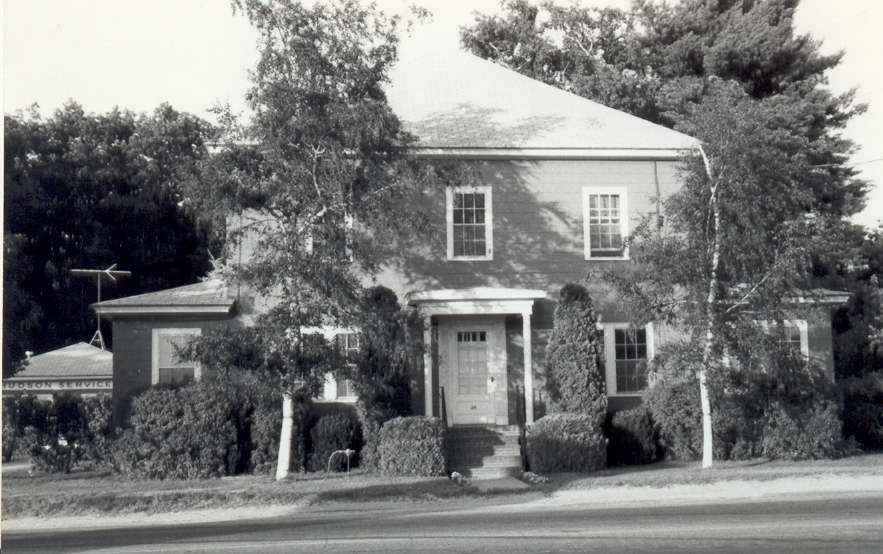
48 Lowell Road C 1983
The trolley or electric street cars provided a cheap, pleasant, and relatively rapid form of public transportation in Hudson from 1895-1931. There was a trolley line from Nashua’s Tremont Square (corner of Main and Pearl Street) that proceeded east over the Taylor Falls Bridge thru Hudson via Central Street, Lowell Road, and on to Lakeview and Lowell, MA. The New Hampshire portion of this line was owned by the Nashua Street Railway, but operated under a lease by the Lowell and Suburban Street Railway Company (later known as Bay State Street Railway Company). The power to operate this line was provided by a Bay State owned substation on what is now River Road adjacent to Aeyers Pond.
In 1918 the Bay State Company discontinued service and turned the line back to Nashua Street Railway Company. The Nashua Company chose to operate the line and picked up the previously discontinued service down Lowell Road to Stewerts Corner (junction of Lowell with Dracut and River Roads) making 2-3 trips a day to accommodate workers, students, and week-end picnickers. The needed electric service was no longer provided by the Bay State powerhouse; it was supplied by the Nashua Light, Heat, and Power Company and converted to DC type at 600 volts in Nashua and Hudson. In Hudson, a powerhouse was constructed for this purpose at what is now 48 Lowell Road. This building was of sturdy construction as evidenced by the large beams and crossbeams used in the basement to shore up the main floor of the building.
The end of the electric cars occurred gradually as the auto became more and more affordable and popular. By 1924 they were operating at a loss and by 1931 they were discontinued in Hudson. Soon thereafter, the Powerhouse on Lowell Road was re-purposed into a private residence.
For nearly 50 years, beginning in 1956, this was home to Vincent J. Zelonis and his wife Mary (Wisneski) and their large family. Vincent was a man of many interests and talents – a devoted gardner and accordian player. He worked in the culinary field at a number of resort hotels. He attended technical school and received his diploma in refrigeration and air conditioning. During WWII he served in the Army and maintained HVAC-R equipment at a base in Puerto Rico. After the war he worked for J. Lawrence Hall Co. of Nashua and in 1953 started his own HVAC-R business, Hudson Service Company, where he worked with his sons William, Charles, and Daniel and his brother Richard. Vincent passed in 2005. Son Daniel and his wife Gayle and family continued to reside at 48 Lowell Road until a few years ago when the property was offered for sale. Daniel was a CPA and established his accounting and bookkeeping services here about 1979 until his retirement. Daniel and Gayle continue to live in Hudson and are active in various church and community organizations.
Within the past 2 weeks this property has been sold. After almost 85 years as a private residence, nearly 60 of them with the same family, we are about to witness a new era for this property. Will it be used for residential or will it be re-purposed again?
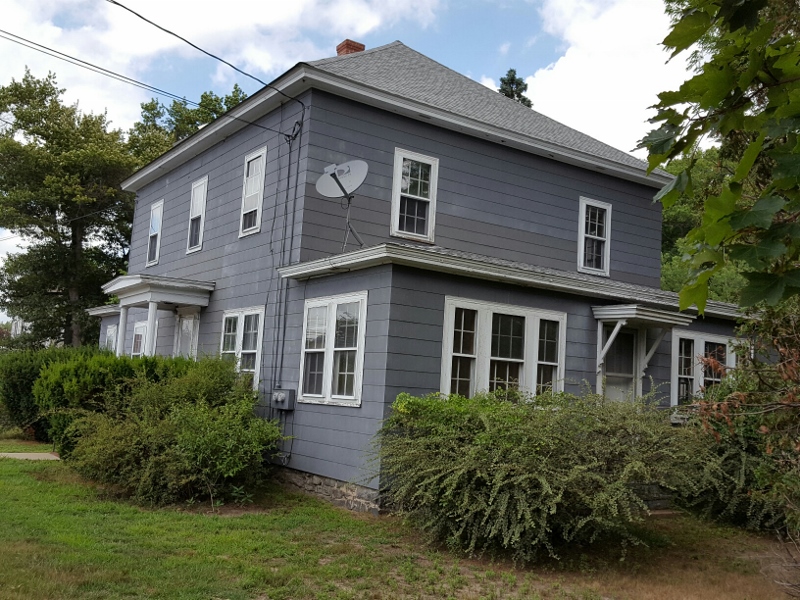
48 Lowell Road 2016
We share two photos of this property. The first shows the house and business of Vincent Zelonis C 1983 as seen from Lowell Road. The second shows the house as seen from the south side, looking north about two weeks ago. Both photos are from the Historical Society Collection.
20 Musquash Road

20 Musquash Road C 1966
From Lowell Road take a left onto Wason Road which is between Market Basket and Goodwill. Stay on Wason and then take a right onto Musquash Road. In less than 1/4 mile, the observent traveler will see a relic of Hudson’s history – a cellar hole on the left at 20 Musquash Road; a reminder of an ancient homestead for many Hudson families.
The last family to live here was that of Leslie and Florence (Chadwick) Barrett. They moved to Hudson from Bowdoinham, Maine in 1938 with their family of 2 boys and 2 girls. By 1941 the family moved to “Happy Hills Farm” at 20 Musquash Road. Mr Barrett was employed at Bensons Animal Farm and later as a maintenance person in Nashua. After moving to Hudson the family grew to include 7 sons, one of whom died young; and 3 daughters. They all attended Hudson Schools. Mrs. Barrett passed in 1951 at the age of 40. In 1965 Mr Barrett retired and by July of that year had sold the farm. Members of his family were living elsewhere, working or attending college at UNH, or serving in the armed forces.
Today’s photo shows the charred remains of this landmark home after the unoccupied house was destroyed by fire in April 1966. The Hudson Fire Department used 5 pieces of equipment under the direction of Chief Campbell to fight the fire over a 3 hour period. This building had been a landmark in town for over 170 years. Local legend says this house was a stagecoach stop during the early days — entirely possible when you consider that before 1746 Musquash Road (then called Back Road) was the main road through the center of town!
From this photo and memories offered by family members we can imagine the homestead. The barn was on the opposite side of the unpaved road from the house, with a faded painted sign over the barn door “HAPPY HILLS FARM”. Mr Barrett used a team of work horses around the place. The farm included a few fruit trees, apple, pears, peaches; cows, a few goats, a sheep, pigs, and chickens. The barn was large with a central aisle and stanchions for cows on one side and pigs, sheep, and goats on the other. The Barrett children would play in the hay and on the barn floor during cold and rainy days.
It was a 3 story house with 4 large rooms on each floor, 2 massive chimneys and 8 fireplaces. Looking at the photo, you can see the details of the fireplaces and the separation of each of the floors. There were secret places to hide in the house with large closets accessible from the bedrooms. On the first floor, between the kitchen and living room, there was a small room with an 8 foot dutch oven built into the base of the large chimney, all brick faced, with iron doors for 2 large ovens. This dutch oven was not used by the Barrett family but it was the centerpiece of the house. The house was wired for electricity in the 1940’s and the family had a radio in the living room and an electric washer with a ringer for the laundry. The children helped with the household and farm chores; baking bread, pies, cakes, canning vegetables and fruits, jams and pickles. All these were stored in the cellar along with potatoes, squash, and cabbage for the winter. After helping with the chores the children would explore and play in the woods nearby.
Attached to the front and side of the house was a large porch about 8 feet deep. There were at least 6 pillars in the front of the house and 3 along the side. The lawn contained a large tree and a circular driveway.
The earliest family to occupy this house that we know much about was that of Zaccheus Colburn, born 1765 the youngest son of Thomas and Mary Colburn. He married Rachel Hills in 1788 and they purchased this home from Ebenezer Dakin. Little is known of Ebenezer except that he was on the tax list from 1745 to 1793. Zaccheus and Rachel has a family of three sons and two daughters. One son died young. The other two sons, Elijah and Zaccheus, studied for and became medical doctors. Dr Elijah began his medical career in Hudson about 1823 and by 1825 had settled in Nashua where he had a long and useful career. Dr. Zaccheus began his career with his brother Elijah in Nashua until 1831; then returned to Hudson and practiced until 1838 at which time he moved to Manchester. The youngest daughter, Molly, married Thomas B. Wason and they remained on the farm with her parents. Thomas was active in town affairs; serving as a selectman and representative to state legislature. In fact, it was Thomas who presented the motion to the NH Lesiglature in 1830 to change the name of Nottingham West to Hudson.
Title of the Thomas B. Wason place passed to their son-in-law Obadiah F. Smith who married their youngest daughter, Philena. In June 1891, James F(ranklin) Wilson purchased the farm of 190 acres. James Wilson was a farmer, in fact his father Franklin had owned a farm at the very southern end of Dracut Road. By 1909 James transfered title of his homestead farm to his son, Frank A. Wilson. By June 1917 the farm was sold to Matilda Parker. Ownership remained with this Parker family until 1941 when it was purchased by Leslie Barrett.
In 1988 a tax lien was placed on the property and in 1990 it was conveyed to the Town of Hudson and is near or part of the Musquash Conservation Area. Photo from the Historical Society Collection.
188 Central Street – Hudson Professional Center
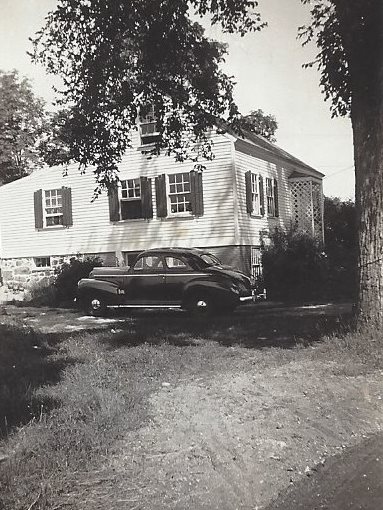
188 Central Street C1942
188 Central Street at the corner with Burnham Road was home to Ivan Robinson Smith and his family of Mary (Manning) and their son Donald. Ivan was employed as a molder in Nashua; retiring from White Mountain Freezer Company. This Smith family homestead was a family farm on about 3 acres of land. Ivan was born in Hudson in 1897 and lived the better part of his life on this farm. Our first photo shows the Smith home in 1942 shortly after it was reconstructed and reduced in size following a fire. The fire started in the house and destroyed about 50% of the house and the entire barn. The house, white with shutters, had a doorway and driveway onto Central Street. After Ivan’s death in 1966, Mary and Donald continued to live here until the property was sold to the Cloutier Brothers for commercial purposes in 1972. A few years prior to this final sale two other parcels had been sold. The first was sold as a residential lot to Mr and Mrs George Tetler who became good and faithful neighbors to the Smiths, living at what is now 21 Burnham Road until 1979. The second parcel was for commercial purposes and gave rise to the commercial building at 23 Burnham Road. After the sale of their home Mary and son Donald moved to a house on Tessier Street here in Hudson. Mary passed in 1990; known for her gentle disposition despite being bed ridden for over 20 years with arthritis. Donald attended Hudson schools, graduated Alvirne and Andover Institute of Business. He retired from The Telegraph as Business Manager after 45 years of service. He remains in Hudson, living on Glasgow Circle.
Prior to Ivan this was home to his father Marcel and his grandfather William. William moved here from Massachusets with his family in the 1800’s. Hudson has a number of Smith families; and as far as we know, there is no known connection between this Smith line and the others in our town.

Hudson Professional Center C 1977
Our second photo shows the corner of Central and Burnham C 1977 as photographed for the “Town in Transition”. In the foreground is Hudson Professional Building built by Cloutier Brothers; now the location of Family Vision Care, Sapphire Salon, Julies, Merry Maids, and Electrolysys. At the time traffic flow at the corner was controlled by a stop sign – no traffic light!
Further along on Burnhad Road we see the private residence at 21 Burnham; originally home to Mr and Mrs George Tetler. In between is the commercial building at 23 Burnham; the location of Hudson Hair Design and Veteran Chimney. Two other commercial sites, not shown on this photo,were built on the Smith Homestead. They are Hudson Endodontic and Clean Monster Car Wash at 182 and 184 Central Street.
Thanks to Don Smith for the early photo and information about his family home. The 1977 photo is from the Historical Society collection.
Centronics Data Computer C1977

Centronics C1977
Any story about Centronics Data Computer begins with Robert Howard. Earlier in his career Howard worked with An Wang (Wang Laboratories) on computer systems for the casino industry. This led Howard to invent the dot-matrix printer, and soon after he started Centronics Data Computer with 7 employees in Hudson, NH about 1968. Centronics commercialized the small dot-matrix printer which helped fuel the explosion and popularity of personal computers. From this small start-up the company grew to more than 6,000 workers worldwide, including 3,000 in NH. Robert Howard passed in 2014 and is remembered for his curiosity and his generosity. He is credited with the invention and popularity of the dot-matrix printer and the parallel interface. During his lifetime he formed more than two dozen companies. After Centronics he later founded Presstek and Howtek in Hudson during the 1980’s.
Centronics purchased a 3 acre land parcel from Clement Industrial Park on Route 111 in 1969 with an agreement to begin construction of a commercial building costing no less that $70,000 within 6 months. Clement Industrial Associates was formed in the 1960’s by a group of Hudson residents desiring to foster the growth of industry within town. This park was built on a portion of the farmland of Harry and Mildred Clement. The old Clement Farmhouse which burned in 1935, was located on the corner of what is now Clement Road and Route #111, about where Tip Top Tree Service is now located.
By 1971 Centronics was operating from this building on Route #111, The company reached a prime about 1979 with annual revenues over $100 million. The business of small printers became very competitive; plus there were product problems and lawsuits. By 1982 Control Data Corporation (CDC) merged their printer business into Centronics; invested $25 million in the company and took the business control away from Howard. By 1987 Control Data sold the printer business to GENICON. Using the proceeds from this sale, Centronics purchassed EKCO Housewares in 1988 and the company was renamed EKCO.
This commercial property is located at 1 Wall Street in Hudson and shown in this C 1977 photo from the Historical Society Collection. This building is now a part of Century Park, LLC and is home to Nutfield Technology, Princeton Technical Corporation, American Infrared Solutions, and possibly others.
Looking North at 74 and 76 Lowell Road C 1977
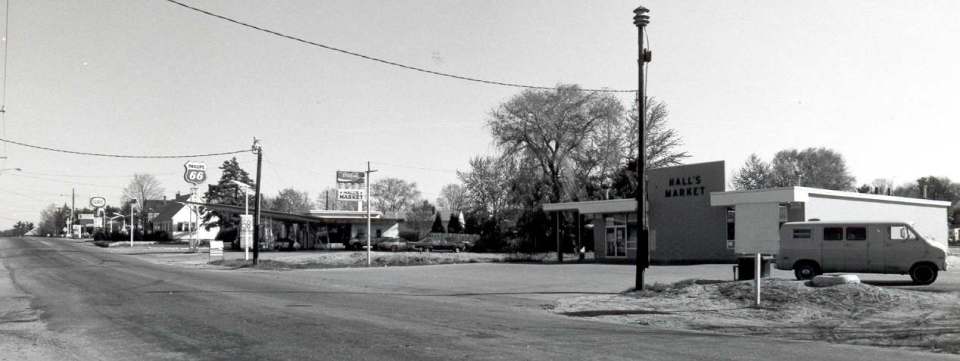
74 and 76 Lowell Looking North C1977
This week we look north from Birch and Lowell onto 74 and 76 Lowell Road. Prior to 1966 74 Lowell Road was home to Xavier and Exillia Gagnon and their family. At that time they moved to a house on B Street in Hudson. Xavier was employed and later retired from Johns Manville Products Corp of Nashua. He passed in 1969 after living in Hudson for 43 years. His family included his wife, Exillia, 2 sons, 2 daughters, and 4 grandchildren. By 1966 the house at 74 Lowell was removed and soon replaced with The Hudson ’66’ Service Station; it is now a Sunoco Station.
By 1970 76 Lowell was under construction and it became the home of Star Dry Cleaners, later Anton’s Cleaners. By 1977, as shown in this weeks photo, it was the location of Halls Market. By 1980 the site expanded to include Halls Market, Prime Graphics, Superior Floor Company, and Suzies Donut and Coffee Shop. Over time Halls Market transitioned to Palmer’s Market, Suzies Diner became Kay’s, and other business transitioned to Shear Paradise and Kay’s Laundry, more recently D+D Laundry.
Contrast this photo with the busy intersection at Birch Street we see today and the filled parking lot across the way. Photo taken for publication in the Town in Transition and is part of the Historical Society Collection.
87 Lowell Road C 1977

87 Lowell Road C 1977
For years 87 Lowell Road was the home of Etienne J. and Rose Levesque. This couple raised a family of 2 boys (Leo Paul and Robert) and 3 girls (Marie Anne, Eva, and Cecil). He was employed at and later retired from John Mansville in Nashua. Mr. Levesque passed in November 1968 with a family of some 17 grandchildren and 5 great grandchildren. During these years the family saw many changes along Lowell Road. Prior to 1962 Birch Street did not exist; by 1962 Birch Street connected Lowell Road with Winnhaven Drive.
Soon after his passing this “fine commercial site” at the southern corner of Birch and Lowell was cleared for development. A stately willow tree was sectioned and hauled away. The former Levesque home was raised off its foundation and moved 1/4 mile down Birch Street by local contractor, John Lester. This home remains today at 13 Birch Street as a private residence and the home of Richard and Shirley Nason and their family.
By 1970 a 3-store front building was constructed on this corner and occupied by Cumberland Farms, Anton’s Cleaners, and Russel and Son’s Carpets. Within a few years Anton’s relocated and Cumberland expanded into their space. The carpet place was replaced by Cardinal Reality and later by Hudson House of Pizza. This week’s photo, from the collection of the Historical Society, was taken about 1977 for publication in the history update, Town In Transition. Cumberland Farms and Hudson House of Pizza remained at this location until just a few years ago. This location is now occupied by Veria Pizza and Hudson Mini Mart.
Pre-Civil War Cannon at Library Park

Cannon at Library Park C 1942
This US Navy Cannon at Library Park and an identical one at The Hudson Center Common, sat for years on their respective concrete moorings. Children would play on then, walk up the steps of the mooring and sit horse-back on the barrel of the cannon. Many family and group photos have been taken on or around them through the years. Occasionally on Halloween, teens would decorate the cannons by pouring random colors of paint over the barrel. The cannons were soon repainted in black by the wandering teens at the request of the Police Department or else by the Highway Department or some service organization.
It is my understanding that these two 3-ton cannons were brought from the New Hampshire Armory on Canal Street in Nashua to Hudson in May 1929 through the efforts of Harry Emerson. One of them was placed on Library Park and the other at the Hudson Center Common. These cannons were cast in 1848 in a foundry near Boston and their serial numbers are within 2 digits of each other. The Library Park Cannon was fired but we are not sure if it was actually used in battle and if so, which battle. Harry Emerson was a long time resident of Central Street and at the time a custodian at the armory. He served the town of Hudson for over 50 years as a member of the Fire Department. Serving as Chief from 1946 to 1952.
The Library Park cannon remained silently on the park until September 2, 2015 when it was involved in a collision with a school bus which was the victim of faulty brakes. Fortunately there were no students on the bus and the driver was not injured. Realizing the brakes were faulty the driver steered the bus onto the park, grazed a tree, hit the cannon and stopped! The cannon itself was not harmed but the concrete mooring was pulverized. The cannon and debris were removed by the Highway Department.

Library Park Cannon 2016
For several months the cannon was at the town garage being sand blasted, restored, repainted, and a new mooring constructed. Earlier, in May of this year it was returned to Library Park; thanks to the efforts of our award winning Highway department; the recipient of the First Annual Community and Cultural Heritage Excellence Award sponsored by the Hudson Historical Society. Photos from the Society’s collection.
First World War Monument at Library Park

First World War Monument 2016
The First World War began in Europe during July 1914 and for the first years the United States had a policy of non-involvement. After the sinking of the Lusitania and the killing of some 190 Americans and later attacks on US ships, the United Stated declared war on Germany April 1917. The Armistice which lead to the end of conflicts was signed November 11, 1918.
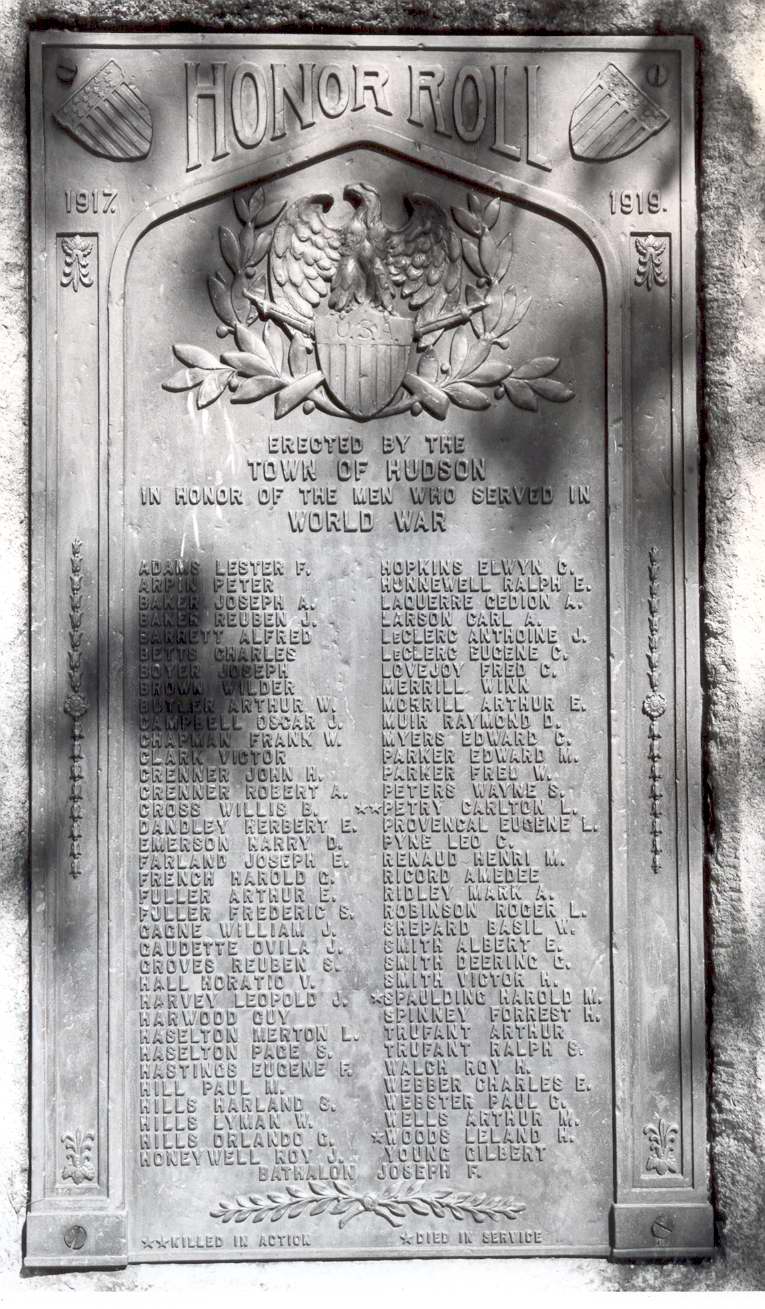
Bronze Tablet Listing Servicemen
Between 1917 and 1919 some 71 young men from Hudson were engaged in the Armed Forces. A listing of these servicemen was maintained by historian Julia (Webster) Robinson. At the town meeting in March 1920 the town voted to raise a tablet to honor these men and by early 1922 this granite boulder and attached bronze tablet was placed on Library Park by the Town of Hudson at a cost of $977.65. Of these young men 3 of then lost their lives during the conflict. On June 25, 1921 members oft he local Grand Army of the Republic (GAR) Chapter planted 3 maple trees nearby on Library Park near this monument as a memorial to Carlton Petry, Merrill Spaulding, and Leland Woods. Photos from the Historical Society Collection.
Railroad Overpass at Lowell and Central C1910
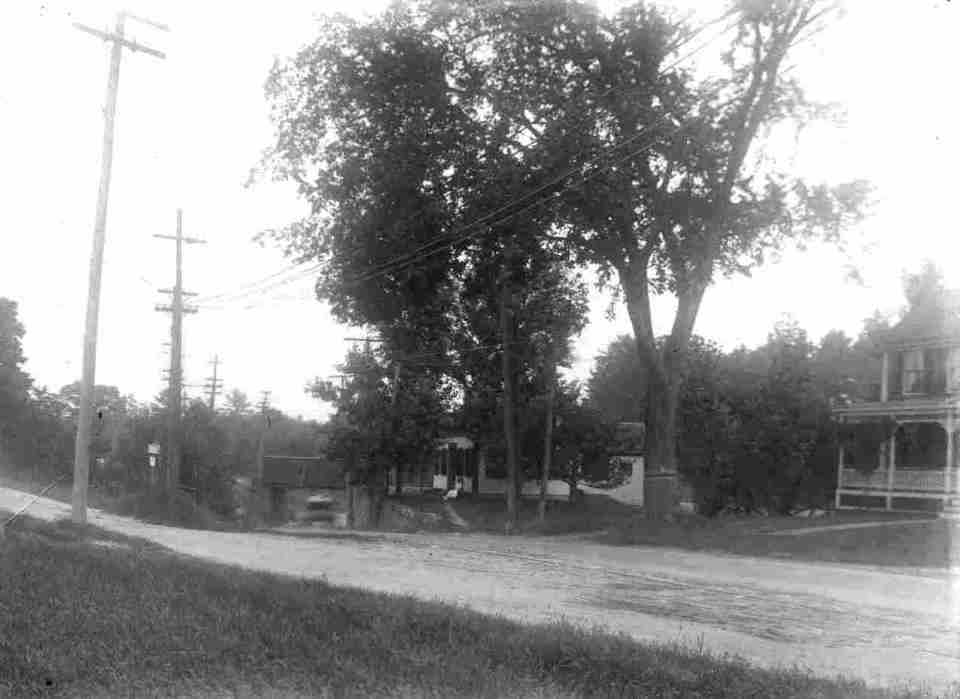
Railroad Overpass at Lowell and Central C1910
Taken from one of the glass negatives in our photo collection this is one of those amazing photos which tells its own story! The photo is from the photography of Walter Peavey who lived at 74 Central Street; later the home of Leon and Gerri Hammond.
The dirt road you see across the picture is Central Street near the beginning of Lowell Road. Of the two homes we see, the one on our left is currently 1 Lowell Road. The one on our right is 65 Central Street. Both Central Street and Lowell Road are dirt roadways. The steam railroad crossed the Merrimack River just below the Taylor Falls Bridge where the abutments can still be seem. On the Hudson side the tracks went north easterly and behind these homes and emerged at about the location of the former Hetzer’s Bike Shop. The train ran on the overpass you see in this photo and on to Hudson Center.
The trolley line crossed from Nashua on the Taylor Falls Bridge and ran on or along side Central Street and then down Lowell Road. The lower level of this overpass was used by the trolley line and vehicle/horse drawn traffic. Look closely and you can see the trolley tracks along Central Street.
Although both the train and trolley tracks had been removed by the 1940’s, the overpass and stone abutments remained into the 1950’s when they were also removed in order to improve what had become a dangerous intersection.
 Remember Hudson NH When...