Home » Uncategorized (Page 16)

Category Archives: Uncategorized

Railroad Overpass at Hudson Center

1983012019

Railroad Overpass at Hudson Center

After crossing from Nashua into Hudson on the Taylor Falls Bridge, the street railway (trolley) branched in 3 directions.  The first made a sharp turn down Webster Street and north to Litchfield and Manchester.  The second proceeded up Central Street and on to and then down Lowell Road.  The third, and the route of interest to us today, came up Ferry Street past Library Park.  The trolley tracks remained on or alongside Ferry Street until the street ended at Burnham Road (near what is now Merrifield Park).  At this point the trolley continued in a more or less straight line through the wooded and marsh area around Tarnic Pond.  A relic of these tracks can be seen to the right of C.J. Chasers.   The trolley line ultimately made a sharp right turn toward Central Street (route 111) emerging onto Central Street between Burger King and 7-11.  It then crossed Central, onto the Benson’s property, and towards Bush Hill Road and the Haselton Barn.
The steam railroad crossed from Nashua into Hudson just a few rods south of the Taylor Falls Bridge, proceeded on a NorthEast path converging with Central Street near it’s intersection with Lowell Road ( site of Hammond Park).  The railroad proceeded eastward towards Hudson Center crossing Burnham Road (called Betsey Cutter Crossing) on to part of Westview Cemetery and to the Station at Hudson Center at Greeley Street.
These 2 lines met behind what is now Burger King and to the right of The White Birch.  At this junction the railroad went on the overpass and the trolley on the lower level.  The overpass itself and the tracks for both the railroad and the trolley have been removed; leaving the huge granite blocks or abutments.  This photo was taken C 1980 and is part of the Historical Society collection.

Town Seal and Flag

TOWN SEAL 1961 COMP

Town Seal 1965

We see the town seal prominently displayed on various town vehicles, in town literature, on the web site, and even used (with permission) by some town organizations.  The seal, as show here, was first displayed on the back cover of The Hudson Annual Report for 1960.  At the town meeting in March 1961 the voters adopted this seal as the official seal.Just prior to this Henry A. Fraser, a Hudson resident designed this seal at the request of Ned Spaulding, long time moderator of Hudson.  He used a sketch of a typical garrison house from Webster’s History of Hudson as a basis for the center.  The letters encircling identifies the incorporation date of 1746; when the town of Nottingham West (now Hudson) was chartered by New Hampshire.  The original charter signed by then governor Benning Wentworth is preserved in the archives of Rodgers Memorial Library.
Mr. Fraser and his wife Gloria built their home and raised a family after he purchased land from the Merrill family on Maple Avenue.  Professionally he was a wood worker and artist; employed by various companies in NH and Mass.
After adoption as the official seal a full color rendition was converted to a decal/print for use by and by permission of the Town of Hudson.
town flag 1975 comp

Town Flag 1975

The official town flag shown here was created as part of Hudson’s celebration of the US Bicentennial which began in 1975.  A contest was held by the art department of Alvirne High School and a number of entries resulted.  This particular design was selected as the winner and later adopted for the official town flag at the Town meeting of March 1975.  The winning entry was by Terry Battey, then a senior at Alvirne.  The design is simple but nice:  the center being the same garrison house used in the town seal, surrounded by 9 stars signifying that New Hampshire was the 9th state to ratify the US Constitution.  These were then placed in the center of a light blue flag.  After the winner was chosen, some number of flags were made and displayed at commemorative events during the US bicentennial  celebration,  one is now on display in the corridor of the main floor in the Hudson Town Building. After graduating from Alvirne Terry attended Keene State College.  She now lives in Auburn,NH and is busy with a full time job,and as a mother, and grandmother.
The rendition of the town seal shown here is from the 1960 Town Report; the photo of the flag is from 1975 Town Report

Minuteman Marker at Hudson Center Common 1975

1977030014

Minute Man Marker Hudson Center Common

Shortly before midnight on April 18, 1775 a detachment of 800 British troops began their march from Boston to Lexington and Concord.  The word of the impending battle was immediately sent by mounted messengers throughout the country; including the Merrimack Valley and Nottingham West, a distance of about 40 miles.  Tradition says the news reached Nottingham West before noon of April 19 and mounted messengers again sent the word out to the various sections of our  town.  The message and the response was so quick that by that very same afternoon, 65 men equipped for war with muskets and ammunition had gathered at the Hudson Center Common ready to march to Lexington.  These men were organized under the command of Captain Samuel Greeley and awaited his orders.  The old military records are lost or destroyed but we do have the muster roll of this company of 65 men – all from Nottingham West.  These men  left for Lexington on the evening of April 19.

Before reaching their destination they were met by a courier who informed them of the retreat of the enemy.  The command returned to Nottingham West.  After this, many of these men enlisted in the army at Cambridge and at least 16 of them later fought at Bunker Hill in June of the same year.

Samuel Greeley was the oldest son of Samuel and Rachel Greeley.  In 1740, at the age of 19, he came to Nottingham West from Haverhill and settled with his father on the Greeley Farm.  This was a 200 acre farm just north of the Joseph Blodgett Garrison place on Lowell Road.  Samuel married Abigail Blodgett, daughter of Joseph and Dorothy (Perham) Blodgett of the Blodgett Garrison in May 1744.  He lived here until 1777, when at the age of 56, he and Abigail moved to Wilton; leaving the farm to his sons Joseph and Samuel.  He died in Wilton.  After his passing, his wife Abigail returned to town where she lived until the age of 95.  While in Nottingham West Samuel was Town Clerk for about 28 years and on the Board of Selectmen for 14 years.  He is remembered in our history as the Captain of the company of militia from Nottingham West who turned out 65 men as volunteers at the time of the Battle of Lexington April 19, 1775.

The Town Common at Hudson Center, originally about 2 acres of land, was used for many events including  training for the town militia, Old Home Day activities, Chautauqua Programs, and recreation. In the early 1960’s the State of New Hampshire built the present route 111 through the center of the Common and eastward to West Windham.  In 1962, the Board of Selectmen received a letter from the Hudson Fortnightly Club recommending that an historic marker commemorating the town’s minutemen be placed on that part of the Common which was not taken by the state for the highway.  This was done by the town in 1963.

On April 19, 1975, some 200 years after the Battle of Lexington and as part of the United States bi-centennial activities a wreath was placed at this monument.  For this event the carillon bells of the Baptist Church were played, and a floral wreath was placed by Phyllis Keeney, Selectman and a Past President of Fortnightly.  The floral wreath was made by club member Mrs. Florence Bogan.  Following the raising of the American Flag with color guards from Veteran’s Auxiliary and  Girl Scouts and  the singing of the National Anthem by Mrs. Bruce Cole, the Muster Roll of the 65 men was read by John Beaumont.  A benediction  and playing of God Bless America on the carillon bells closed the activities.  This marker is located at the point of land on the common near Kimball Hill Road  at the intersection with Central Street.  Photo from the Historical Society collection.

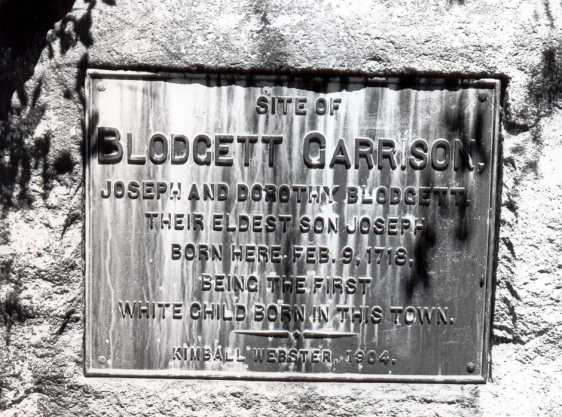
Blodgett Garrison Marker
1977030015

                                                                          Blodgett Garrison Marker

Of the four garrisons constructed for the protection of early settlers in Nottingham, Mass, we have discussed the Hills Garrison.    Moving south from the Hills garrison was the Taylor Garrison built on land which was originally part of the Joseph Hills grant, passed to a family member and then sold to John Taylor.  Very little is known about John Taylor except that the Taylor Falls and thus the Taylor Falls Bridge  bear his name.  The location of his garrison was not marked by Kimball Webster but was identified by him as  behind the Spaulding Farm on Derry Road  (now Continental Beauty School)  and along side Grand Avenue in the direction of the river.
Moving south the next garrison is the Blodgett Garrison.  Kimball Webster placed the site 2.5 miles south of the mouth of the Nashua River and 1/2 the distance between Lowell Road and the river.  The marker was placed on the Philip J. Connell Farm in 1905.  The Connell Farm was a part of the original 200 acre farm of Joseph Blodgett.  Today this is the general area around Fairview Health Care on Hampshire Drive.  The granite boulder with a bronze tablet now resides on the lawn of 14-16 Hampshire Drive just east of Fairview.
After Joseph and Dorothy Blodgett settled here their oldest son Joseph was born in Feb 1718; he was the first white child (as opposed to Native American) child born in our town.  Both Joseph and Dorothy were born in Chelmsford.  Most likely the family traveled up the Merrimack River by canoe to settle their farm.  Their descendants became very numerous and includes many distinguished men and women in NH, Mass, and other states.
The last garrison, was located on Fletcher land and was in that part of Nottingham which remained in Massachusetts when the provincial boundary was established.  The location is a short distance south of the state in Tyngsborough.  The photo of the Blodgett marker is from the Historical Society Collection.

Town Pound on Pelham Road C 1975

1983012003

Town Pound on Pelham Road C 1975

Early towns were required to build and maintain a pound.  Any person within the town could impound domestic animals (swine, cattle, horses, sheep…) which were creating damage or running loose on the roadway, the common, or was in violation of local laws.  A pound keeper was chosen each year as one of the town officers.  Owners of the impounded animals would claim them and  pay for any damages, board, or fines.
Our early town records mention pounds as early as 1737 in Nottingham, Mass; then again in 1744 in the District of Nottingham, NH; in 1747 in Nottingham west.  The earliest of these was likely built in that part of Nottingham which ended up in Pelham.  The others were either not built or constructed of wood and did not last.
In 1759 the town of Nottingham West voted to have a pound built on common land near the house.  This was likely on the common near the Blodgett Cemetery.  Yes, there was a meeting house and town common in that area; it is now the location of Blodgett Cemetery and the intersection of Lowell and Pelham Roads, at Meineke Car Care.
The pound shown in this weeks photo was erected in 1772 after a vote at the annual town meeting.  It was voted to erect a pound on high land between land owned by Nehemiah Hadley and Timothy Smith.  Today this location is at the intersection of Pelham and Melendy Roads, on your left after the stop sign as you proceed down Pelham Road toward Bush Hill Road.
A committee of 3 was elected to build it with stone, 33 feet within the walls to a height of 6 feet plus one foot of wood.  The pound was completed by September 1772, its date was carved on the gate post.  At the next town meeting Timothy Smith was elected keeper of this new pound.  This pound was continually used for over 100 years.  In 1887, since the pound had not been used for some years the town considered selling it.  At the town meeting this was rejected and the voters instead decided to keep it as one of our town’s ancient relics.
This pound stands today, a relic of early times; maintained by our faithful Highway Department.  Photo from the Historical Society Collection.

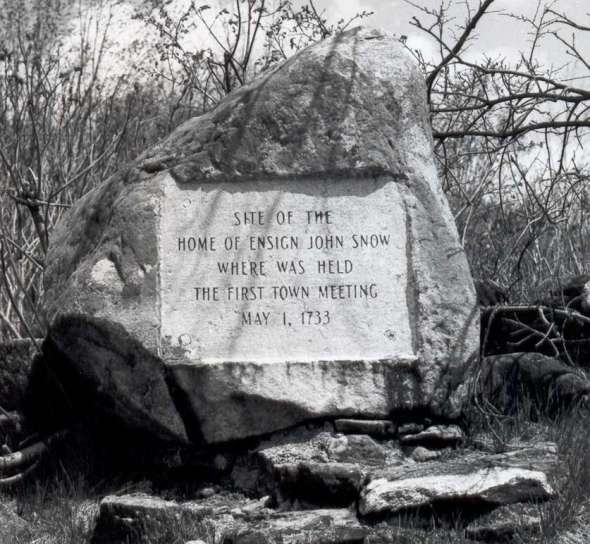
Site of First Town Meeting
1977032004

Site of First Town Meeting of Nottingham in 1733

In this week’s photo we travel to the south end of Hudson and visit the historic marker for the home of Ensign John Snow and the first town meeting for the town of Nottingham, Mass held May 1, 1733.  This marker was placed  in 1934 by the town Bi-centennial Committee using funds remaining in their accounts after the celebration was completed.  The committee searched the area for a suitable boulder and one was found close to the highway on land then owned by Charles Shunaman near 103 Musquash Road, not far from the site of the Snow homestead.  The original marker consisted of a bronze tablet attached to the boulder.  Later, after vandals removed the tablet, the inscription was made directly into the stone.
On April 4, 1733 some 3 months after the charter of Nottingham, Mass was issued, an order was directed to Mr Robert Fletcher, a principal inhabitant, giving him the authority to assemble and convene the town for the purpose of choosing town officers to hold until the following March.  Mr. Fletcher issues the call for the  meeting to be held May 1, 1733 at 10:00 am at the home of Ensign John Snow.  At this meeting the inhabitants chose a moderator, clerk, treasurer, 5 selectmen, surveyors, fence viewers (in charge of boundaries and disputes), and hog reeves (warden in charge of wandering swine and appraisal of damages they cause).  The 1733 tax list contained 55 men. This may seem like a large population but we must remember, many residents of Nottingham lived outside the area which later became Nottingham West and Hudson.  Of these 55, only 18 resided within the boundaries of the present day Hudson.
Ensign John Snow, born about 1667 in Woburn,  married Sarah Stevens in 1693.  They had 3 children; Elizabeth who died young, Joseph who also resided in Nottingham, and Mary. Little else is known about Ensign John except he was elected the first town treasurer, and a few years after this first town meeting he passed at he age of 68.  He is buried in Ford Cemetery not far from his home.
The cellar where his house stood was pointed our to Kimball Webster by Timothy S. Ford many years prior to 1912 and the publication by Webster of the town history. Today this marker can be found on Musquash Road just south of its intersection with Gowing Road and on your left.  Look for it along the side of the road near a stone wall.  Photo from the Historical Society Collection.

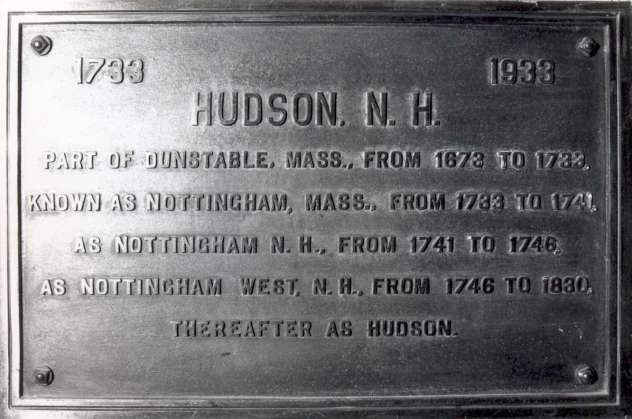
Bronze Tablet Donated by Webster School Students in 1933
1977032006

Bronze Tablet Donated by Webster School Students in 1933

While giving tours and talking town history we at the Historical Society frequently hear the question “When was our town established?  The bronze tablet  pictured here  identifies the five birthdays, or founding dates, for our town.
Dunstable, Mass was founded in 1673.  Most of the land contained within the present boundaries of Hudson was included within that town, with the exception of about 4,600 acres in  the northeast part of Hudson which was then a part of Londonderry.  The geography of Dunstable included land on both sides of the river including all or parts of some 14 towns in present day Mass and NH.  In the early days of Dunstable land had been granted on the east side of the river but no real settlements occurred until about 1710.  We remained a part of Dunstable, Mass until 1733.
As the number of settlers on this side of the river increased  they petitioned Mass to be set off as a separate town.  This petition was answered on January 4, 1733 when the  charter for Nottingham, Mass was granted  This town included  all Dunstable lands on the east side of the river.  The General Court ordered that a Town Meeting be held within 3 months and a minister be settled within 3 years.    After survey and much debate the center of the town of Nottingham, Mass  was agreed upon and a meeting house built on what is now Musquash Road.  The town of Nottingham, Mass remained as such for only 9 years, until 1741.
The ancient  boundary between the provinces of NH and Mass was based upon the Merrimack River and the misconception that the river flowed from west to east;  with no  idea of the abrupt bend northward the river made near Chelmsford.  This resulted in some dual grants by the rival provinces of NH and Mass and a boundary dispute which was not settled until 1741.  At that time the line was established to run 3 miles north  of the Merrimack River from the ocean until reaching a specific point north of Pawtuckett Falls; after that the line ran due west to the Connecticut River.  All land south of this line was in Mass.  Land to the  north was in Nottingham,NH;  called by many historians as the District of Nottingham as towns had not yet been incorporated under the laws of The State of NH.
During the time after 1741 a number of smaller New Hampshire towns were spun off from Nottingham and were incorporated within NH.  One of these, Nottingham West was incorporated in 1746 and a charter issued July 5, 1746.  Nottingham West contained most of the lands of the present town of Hudson, except for those  acres  in Londonderry and minor adjustments to the boundaries with Windham and Pelham.
We remained as Nottingham West until 1830.  At the annual town meeting of 1830 the voters of Nottingham West adopted an article to petition the General Court of NH to alter the name to Auburn  or to designate some other name.  The name was changed to Hudson July 1, 1830.
Our town has 5 founding dates or birthdays.  In 1672 we were established as Dunstable, MA; 1733 as  Nottingham, MASS; 1741 as Nottingham, NH; 1740 as Nottingham West, NH; and in 1830 as Hudson, NH.  This confuses our celebrations!   In 1933 we celebrated the 200th birthday of incorporation of Nottingham, Mass; in 1972, some 39 years later, we celebrated the 300 birthday of the founding of Dunstable!  To my knowledge there was never a centennial or bi-centennial celebration for Nottingham West and no centennial celebration for changing name to Hudson in 1830.  So, when will our next celebration be?  perhaps in the year 2022, some six years from now, when we celebrate the 250th anniversary of Nottingham West?
 This tablet is located within the School Administration Building,  aka Kimball Webster School, and was donated to the Town by the students of Webster School as part of our 1933 bi-centennial celebration. Photo taken for publication of Town in Transition and is part of the Historical Society collection.


Organ Concert

 Organ Concert
on 19th Century Mason & Hamlin Organ
Presented by the Hudson Historical Society


When: Sunday, April 10

Time:  Doors open at 3 p.m.                                          1850 organ comp

 Where: Alvirne Hills House 

                   211 Derry Road


The Hudson Historical Society is proud to present an afternoon of music on the recently restored Mason and Hamlin Organ. Bruce Stevens, of Ryegate, Vermont, who completed the restoration, will perform selections from a variety of composers – Bach, Joplin, Gershwin and more- as well as some musical surprises to demonstrate the versatility of the organ. The historic organ was the organ at the Hudson Baptist Church for many years.

Doors will open at 3:00 p.m. and concert will begin at 3:30 p.m. Refreshments will be served. Admission is free, but donations will be gratefully accepted.

www.hudsonhistorical.com

Ferry Street Fire Station C 1926

Ferry st fire station  c 1926 comp

Ferry Street Station and Crew C 1926

The Hudson Fire Department takes its origin back to 1892 when the Hudson Hose Company was founded by a group of volunteers.  This independent company raised their own funds for equipment and expenses.  Individuals paid dues, were fined for missed meetings, and engaged in fund raisers.  Their first project was the building of the Old Hose House on Central Street just above the Methodist (now Community) Church.  Individuals pledged time in order to supply the necessary labor.  This building was sufficient to house early equipment and provide a place for volunteers to meet.
In 1913 this group purchased the Kelly Springfield truck by public subscription at a cost of $1,030.  Individuals signed a note at The Nashua Trust Company.  This vehicle is said to be the first piece of motorized fire equipment used in New Hampshire.  The next year this truck and the balance of payments was turned over to the town with the understanding that the truck would be housed near the bridge.  Prior to this time the town had not formerly helped the department.  Through this action and payment of a small salary our early firefighters were able to join the State’s Firemen’s Relief Association.  The Kelly was housed in a  garage on Campbell Avenue donated by Charles Norton.  As the department expanded and more equipment purchased, the move was made to to the House Brothers’ Garage on Ferry Street.
In April 20, 1926 The Osgood Construction company of Nashua was awarded the contract for a new fire house for the Hudson Department; built for Raymond House.  Details were finalized and work started .immediately.  The press release in the local paper April 20, 1926 stated that part of the old garage was moved to make room for the new engine house.  The Town of Hudson had signed a five year lease with Mr House for this new station which had two vehicle stalls, an office and lounging room for members of the department as well as a sleeping room.  It was a bungalow style building made of brick and  concrete blocks.  Brick on the front and concrete blocks on the sides.  The new building was expected to be ready for occupancy in a few months. This station was located on Ferry Street, opposite and slightly north of the intersection with Campbell Avenue; about where the Gulf Station is now located.
A vote was recorded to have a photograph of department members in front of the newly completed station in the mid 1920’s.  The photo of the Ferry Street Station C 1926 seen here could be the result of that motion.  The photo shows the two stall station, the Reo firetrucks used at the time, along with drivers and members of the department.  Charles Reynonds and Ray House are in the driver;s seat of the left engine.  Harry Emerson and Fred House are in the right engine.  Standing between the engines from left to right are:  Ornam Campbell, Bill Edgley, Charles Farmer, Edward Robinson, Sidney Baker, Earl Alexander, Chief Harry Connell, John Pearson, Allen Andrews, Joseph Fuller, Walace Baker, Paul Buxton (arrow), and Roland Abbott.
This Ferry Street station served the department and the community until some time after World War II when it was expanded to a four stall station.  Then, as town growth occurred  in the early 1950’s the Central Fire station (now Leonard Smith station) was built on corner of Library and School Streets.  In time the Ferry Street building was razed to make way for the access roads leading to and from the bridges. Photo from the Historical Society collection.

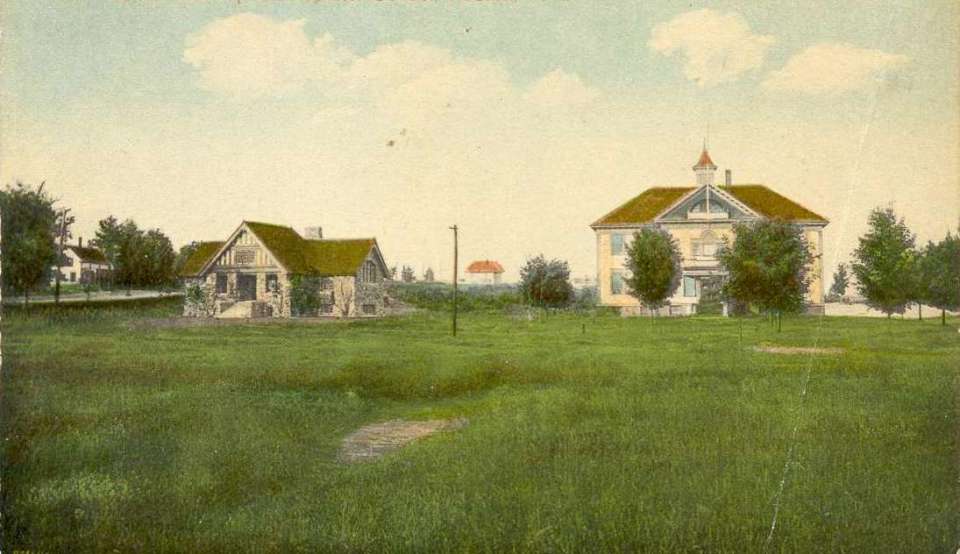
Area Surrounding Library and Webster School C 1910
2013006004

Area Surrounding Library and Webster School C 1910

From this early post card of Webster School, Hills Memorial Library, and the surrounding area we get an idea of what this section of town looked like about 1910.   Kimball Webster School (right) had been in use since it’s completion in 1896.  The new Hills Memorial Library (left) was  completed in 1908.  The photo  for this post card was taken from an open field across the street from Webster School at the corner of School and Library Streets.  In fact, what is now Library Street was barely a dirt road in this picture.  One can locate the road by following the utility pole.  An 1892 map of Hudson shows an ice house where the Hills Library is located and what is now Library Street was called Sanders Street.
Looking beyond these buildings and along Ferry Street we see very little construction.  On Ferry Street and opposite the library is the home at what is now 42 Ferry Street; known by many as the Cunningham home and now owned by Kurt Smith.  On the knoll behind the library and the school we see another early home;  most likely the home at what is now 55 Ferry Street.
Today this open field is the site of the Leonard Smith Fire Station and the Town Office Building; built in the  the 1950’s and 1960s respectively.  Before these buildings this field was a popular playground; used during pre-school,recess, and after school activities for Webster School.  During the spring and summer months this field was used by the Recreation Department for a ball field, basketball court, and playground for the younger kids.  As a point of memory, Hudson resident Dan O’Brien has fond memories of little league games played here, as early as 1950 or 51,under the direction of Manager Brown.  These may have been some of the earliest little league games in Hudson.  The year construction was underway for the new fire station Dan recalls breaking a window in the station while throwing rocks.  Yes! He was busted by Chief Andy Polak.  In Andy’s  way all he did was report Dan to his parents.  But, that was enough!  Photo from the Historical Society collection.