Home » Derry Rd (Page 2)

Category Archives: Derry Rd

Elm Avenue Industrial Park

2007099004

Industrial Park at Elm Avenue C 1977

Coming into the 1950’s the tax base in our town was primarily rural, farming, and residential.   In an effort to balance this base and provide a venue to attract industry into Hudson, the Hudson Industrial Associates was organized in the early 1950’s.  Their purpose was simple:  attract industry, improve the tax base, and make Hudson a better community.  This association consisted of some 16 public-spirited individuals including selectmen Edwin Steckevicz, George Tetler, and Frank Nutting.  Arthur Kashulines  was the first president, Ned Spaulding the clerk, and Paul Buxton the treasurer.  A brochure advertising the merits of our town was distributed and inquiries were received from various states.  In these and other ads Hudson was pictures as an alert New Hampshire community with a blend of traditional New England qualities with a forward look. We offered to industry level acreage with city facilities, room to grow, central location, and local government.  Write or call for full details.
 l
This group arranged for the purchase of land in different parts of town including previous farm land between Derry and Litchfield Roads along Elm Avenue. The result was a 26 acre industrial park.  The first industry to build here was The Newton Manufacturing Company in 1959.  Others followed, and by the late 1960’s the park was at full capacity.  Prior to this development the land parcels involved were owned by the family of Elijah Reed and the family of Carl Oliver.  Mr Oliver is remembered by many as a public school bus driver.
This C 1977 aerial photo of the Elm Avenue Park was taken from Webster Street looking north and east towards Derry Road.  At the top of the photo we see Derry Road and the Kopinski Homestead at 147 Derry Road.  The United Pentecostal Church (The Sanctuary) is just off the photo to the right.  At the time of this photo  this park was home to  five  industries:  North American Angenieus, Inc (Optical Laboratories), Contact, Inc. (Soldering Equipment, Wire Strippers), New Era Industries, Daw Tire and Supply Co., RDF Corporation (Temperature Control Systems).  RDF Corporation occupied two buildings.
As you approach this park today from Webster/Litchfield Road you will find the following industries on the left side of Elm Avenue:  A J Mac Contracting Electrician in a building  which did not exist in the photo; RDF Corporation which now occupies four buildings, Able Air (Compression Air Systems).  The final building before the intersection with Derry Road is being demolished.  That part of the Elm Avenue Park including the stretch along Derry Road awaits the next chapter in its industrial/commercial life.  And, we all get to watch as it develops.
The C 1977 photo of the Elm Avenue Park is from the collection of the Historical Society.  Much of the information re: the Hudson Industrial Associates and these industries was found in Town in Transition and Nashua/Hudson City Directories.

The Farm at ALVIRNE High School

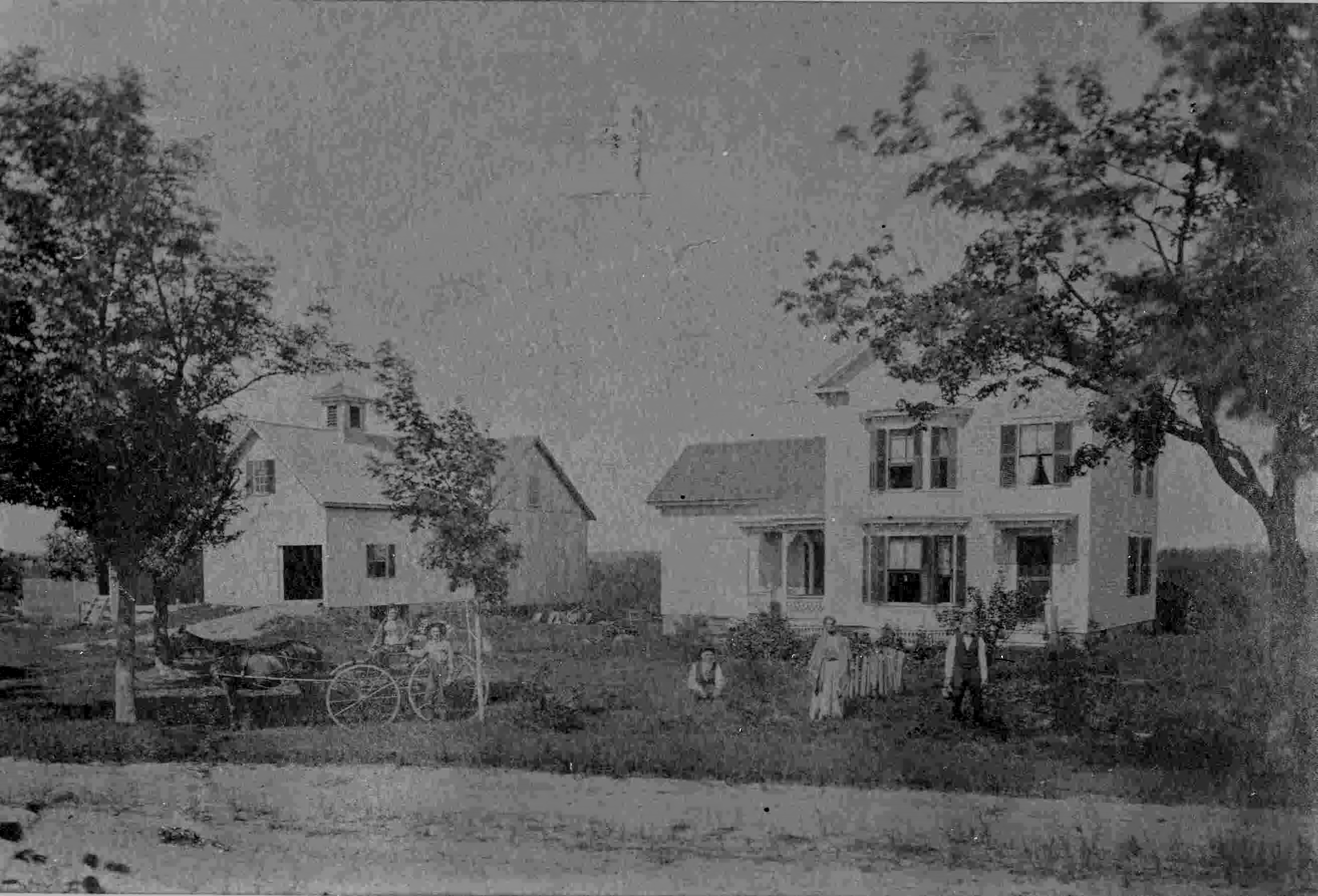
Hills’ Farm house and barn in the early 1900’s
The story of the ALVIRNE High School farm is linked to the birth of the high school and before that time to the Hills family of Hudson.  The 180 acres +/-  which make up our high school and school farm were a part of a 900 acre parcel  purchased by Nathaniel Hills from Jonathan Tyng prior to 1733.    In 1733 this land was a part of Nottingham, MA and according to the tax list the only resident was Nathaniel Hills.  He had left the garrison and settled on the northern portion of his land near the river where the Hills’ Ferry was later established.
The parcel where the high school and farm reside was transferred from Nathaniel to Elijah Hills, a descendant of James, the youngest brother of Nathaniel.  From there it passed to Elijah’s son Elijah, Alden, and Alfred Kimball. Today the farm is known as the ALVIRNE High School farm; but previously it was known as the Alfred K. Hills Estate, the Alden Hills Farm, or the Old Hills Farm.
This farm was the birthplace and childhood home of Alfred K. Hills.  He was born October 1840, a 7th generation descendant of the immigrant Joseph Hills.  After local education he attended and graduated  Harvard College about 1862.  In 1865 he married Martha Simmons in Boston.  Within a few years they moved to New York City and he had graduated medical school and he began his medical profession of 40 years.  In June 1885 Martha (Simmons) Hills passed away.
A few years later in June 1887 Alfred and Ida Virginia Creutzborg of Philadelphia were married.  Soon after they  purchased the old homestead from his family.  To keep the farm working, Dr Hills hired a resident farm manager.  Alfred and Virginia built a spectacular summer home (called ALVIRNE) upon a knoll and across the street from the farmhouse.
They had two daughters (Gladys and Mary) who died as infants.  Virginia herself passed suddenly in 1907.  As a memorial to his wife Dr. Hills built ALVIRNE Memorial Chapel by 1908.  When the chapel was completed and consecrated the remains of his wife, Virginia, and their two daughters were laid to rest within the chapel.
By 1911 Alfred married a third time to Jessie Norwell of Nashua.  Dr Hills, his third wife Jesse, and second mother-in-law Mary Creutzborg continued to frequent the summer home. He passed in 1920 and his will was filed for probate in 1928. By his will he left funds to the town of Hudson for the construction of a high school to be named ALVIRNE.  In order to secure these funds for the town, a school must have been established within 20 years.  To meet this requirement a six week summer session was held on the grounds of the Alfred K. Hills Estate.  Classes in agriculture and forestry for the boys using the farm and classes in sewing for the girls were held in the meeting room of the summer home.  By August 1947 the courts ruled that the remaining assets of his estate be released to the town for the construction of ALVIRNE High School.  Thus, his farm and summer home became property of the Hudson School District.  Design and construction were begun soon thereafter.  
 
The current farm house was built C1875 after the previous, and perhaps the original, set of farm buildings were destroyed by fire in 1874.  The earlier buildings were typical to New England; a large square two story home with an ell from which a shed was connected.  The large barn was connected to the other end of the shed.  This barn was the first to burn as flames broke out in the hay at the end of the barn furthest from the house.  It was impossible to check these flames and save the cattle.  With the buildings so connected, and without adequate water supply and fire fighting equipment, little could be done to save any of the buildings.  Many priceless heirlooms, handed down from generation to generation in the Hills family were lost.  Damage was estimated at $5,000 including 10 head of cattle, 2 horses,and farm equipment,  The loss was partially covered by insurance.  

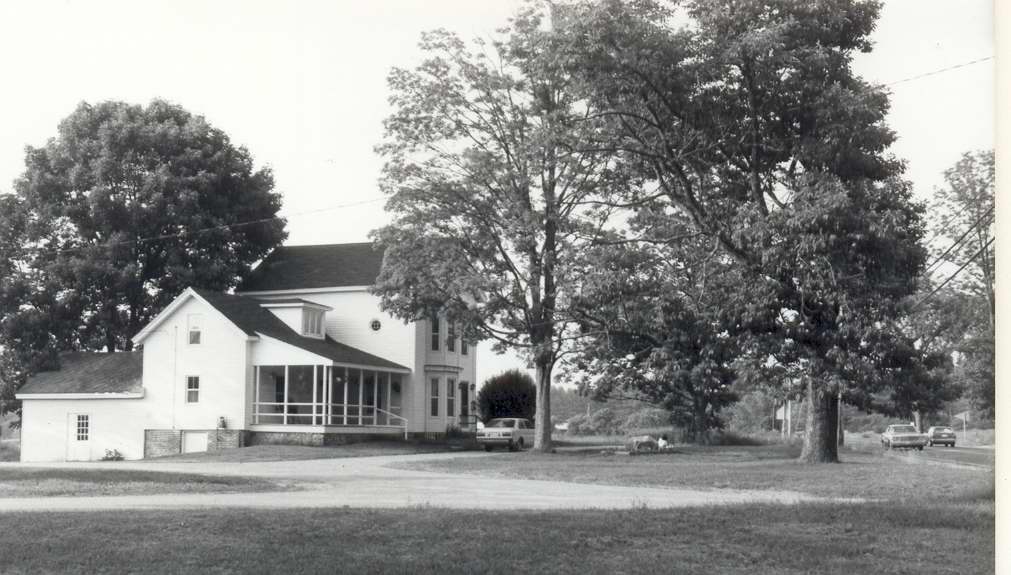
             ALVIRNE Farm house C 1980

 
We have two photos of the ALVIRNE farm house to share with you.  The first dates to  the early 1900’s.  We see the two story farm house and an early view of the barn.  The identity of the people in front of the farmhouse are not known.  The farm house received extensive renovations in the 1960’s under the supervision of the school board.  Our second photo shows the farm house C 1980.
The ALVIRNE barn has also been victim to fire.  After the 1874 fire the farm buildings were rebuilt; but, the barn and out buildings were not connected to the  residence.  A second fire in 1911 destroyed the barn and all out buildings except for one shed.  Again, the fire began in the barn and quickly sent up flames which could be seen from Nashua.  Two pieces of Fire fighting equipment were  quickly dispatched from Nashua.  One of these arrived at the scene in time to help the local bucket brigade to save the residence and farm animals; but, not in time to save the buildings.
A third fire which destroyed the barn of the Wilbur H. Palmer Vocational Center occured in 1993.  The barn we see there today was built following that fire.  The photos are from the collection of the Historical Society.  Description of the ancient farm buildings and of the 1874 and 1911 fires were found in September 11 and 15, 1911 editions of the Nashua Telegraph.

Pizza Hut and Derry Road Car Wash

Pizza Hut and Derry Road Car Wash

For the past few years we have seen changes take place from 62 -68 Derry Road.  First with the conversion of the long time idle property of the former Hogan’s Garden Center into the Dollar Tree and O’Reilly Auto Part stores;  now with the Pizza Hut property, 62 Derry Road,  on the market more changes are in the works.
60 years ago, in 1961, this section of Derry Rad consisted of the home of Roy and Flora  L. Griffin at 62 Derry plus undeveloped land at 64 – 68.  The Griffins operated Banner Photo of Nashua.  Roy passed about 1966 and Flora continued  as President and Treasurer of Banner Photo and retained  her residence in Hudson.
The first change toward development came about 1959 with the opening of Hogan’s Garden Center and Flower Shoppe at 68 Derry Road.  Hogan’s was a popular place for trees, shrubs, garden supplied, and flowers.  They remained in business until the early 1980’s.  From that time until a few years ago the land and buildings remained idle; including the large green house used by both the garden center and flower shoppe.
In 1978 the site of the Griffin home was purchased by Pizza Hut of America and by 1981 the Pizza Hut Restaurant in Hudson was in operation.  Although changes did occur in the corporate ownership and structure of Pizza Hut this restaurant remained in business some 35 years; closing for business within the last year.  The property is for sale, so ‘stay tuned’ for further change.
About the same time, 1981, and adjacent to Pizza Hut  the Derry Road Car Wash opened for business.  Although operating under different names a car wash remains at this location to the present day,
More recently, in 2014, the site of Hogan’s was sold for new development.  The first to emerge was the new, stand alone, Dollar Tree in 2015.  That was followed soon thereafter by O’Reiley Auto Body in 2016.
As we pull back the layers of time we see the time line of development.  Our photo for this week is an aerial of 62 and 64 Derry Road  soon after 1981.  We see Pizza Hut and Derry Road Car Wash.  To the right, and off the photo, was Hogan’s Garden Center and Flower Shoppe.  Upon the sale and re-use of the pizza Hut facility we will have the opportunity to watch further changes.

The Catholic Cemetery (Saint Patrick’s) on Derry Road
St Patricks Cemetery Entry S

St Patricks Cemetery Derry Road

The availability of jobs resulting from industry and factories coming to Nashua resulted in an increase in the immigrant population of Nashua.  The Catholic Church quickly recognized the need to have pastors and congregations available for these communities.  In the 1850’s Nashua experienced a great influx of Irish families, pushing the construction of The Church of the Immaculate Conception on Temple Street.  At the time of it’s consecration in  1857,  2,000 communicants were added to the church rolls. 

By the early 1900’s the Lithuanian Community was likewise on the increase and a pastor was added to The Church of the Immaculate Conception  to minister to them.  As both communities continued to grow it became evident that a new church was needed.  In March 1891 the church purchased the Hosmer Estate on Spring Street and by 1909  services were being held for the Irish Catholic Community at Saint Patrick’s Church on Spring Street.    
 
Soon after 1909 The  Church of the Immaculate Conception  was turned over to the Lithuanian Community and the name of the church changed to Saint Casimir’s.
 
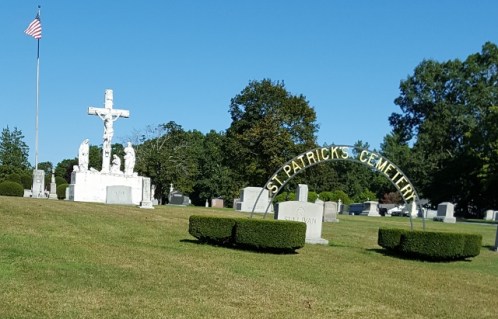
 On or about 1857 ten acres of land on Derry Road in Hudson was purchased  by The Church of the Immaculate Conception and consecrated for the purpose of a cemetery for the Irish community.   The original land was conveyed by the Pierce Family of, James L, John P, and Edgar B, residents of Nashua.  With the exception of about one acre on the east side which was swampy and unfit for use as a cemetery, lots were laid out. In 1907, a strip of land was purchased on the north side and an enlargement made to the cemetery. By 1912, at the time of the writing of Webster’s History of Hudson, nearly all the lots had been taken up.  The vast majority of the interments within this cemetery were for families residing outside of Hudson. Our first photo shows the hillside as you enter the cemetery.  After the archway with the name of the cemetery is the sacred cross followed by the War Memorial and the American Flag.
Celtic Cross St Patricks

Celtic Cross at St Patricks

 
Acting as a sentinel and gateway to the newer section of the cemetery behind Hannaford’s Super Market is this Celtic Cross, in memory of  R. T.  Rev. Monsignor Matthew J.B.Creamer, the Pastor of St. Patrick’s Church from 1906 – 1939.  
 
Initially this cemetery was to offer cemetery space to members of the Irish community.  By 1895, the Catholic cemetery contained about 4,000 graves sites; the vast majority were for the Irish Catholic community, but a few hundred French Catholics were also interred here.  After St. Patrick’s  Church on Spring Street was built the name of this cemetery was changed to Saint Patrick’s.  Until recently the policy of this cemetery was to offer burial space to members of the Catholic community.  This has changed and space within Saint Patrick’s is available to any member of the Christian community.  With the recent expansion there are lots available.  The contact person is Elaine Poulin at 881-8131.  


Hills Farm Cemetery

Cemetery Roadway S

Cemetery and Chapel Gate

There are  eleven cemeteries or burial places in Hudson.  They are Hills Farm, Ford, Blodgett, Hudson Center, Senter, Sunnyside, Westview, St. Pattrick, Holy Cross, Cemetery of the Unknown, and the Presentation of Mary’s cemetery.  Last week we looked at the Senter Burying Ground at Potash Corner.  This week we will visit the  Hills Farm Cemetery.
Early settlements of Dunstable, MA (now Hudson) clustered around the Hills Garrison in the north and the Blodgett Garrison in the south end of town.  The earliest of these  occurred about 1710 when three sons of Samuel  Hills (Nathaniel, Henry, and James) erected and settled in the Hills Garrison. The original part of the Hills Farm cemetery was located on level, sandy land about half way between what is now the Derry and Litchfield Roads and adjacent to Derry Lane.  This was the south-east corner of the Hills farm where Nathaniel and his brothers settled.  The exact date when this cemetery was first used as a burial place is not known but must have been some years after the Hills brothers settled at the garrison, and probably not earlier than about 1730.  It is known that Nathaniel Hills buried two or three of his children in the in the ancient burial ground in South Nashua near the entrance to Royal Ridge Mall.   The early settlers seldom erected head stones to identify the graves of their deceased loved ones; so, the markings we do find do not indicate the earliest interments.
The earliest  date found in this cemetery is 1738, crudely cut into a common stone with no inscription to indicate the individual interred there.  The next date found is that found in the inscription found on a headstone for  Joseph Greele , who departed this life March 7, 1745, in his 95th year.
Even though this cemetery was on the Hills property  and likely laid out by Nathaniel Hills it was it was used as a public burial place.  The early families of Hudson found among the headstones include Hills, Greeley, Spalding, Marsh, Marshall, Pierce, Cross, and Sprake.
About 1872 small additions of adjacent land were added to the cemetery.  These additions with some other vacant land in the yard were laid out into lots, streets were graded, the brush removed, and other improvements were made thus improving the overall appearance of the cemetery.  The cemetery contained a little less than one and one half acres.  In 1885, as permitted by state laws, the yard was incorperated as “The Farms Cemetery’  The charter was amended in 1905, changing the name to “Hills Farms Cemetery”.  About this time Dr. Alfred K. Hills, realizing the need for expansion of the cemetery, purchased a large tract of land adjacent to the cemetery and extending to the Derry Road.  He then had six acres of this parcel surveyed for an addition to the cemetery.  Upon part of the remaining land Dr. Hills built Alvirne Memorial Chapel in 1908 as a memorial for his wife Virginia.
Cemetery and Chapel Gate S

Roadway to Hills Farm

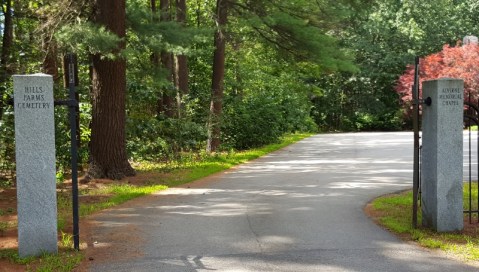
At the present time the Alvirne Chapel and the main entrance to Hills Farm Cemetery share access  from 160 Derry Road.  There is a secondary entry to the cemetery from Derry Lane.  The entrance from Derry Road is through an iron gate between two granite posts  inscribed  with Hills Farm Cemetery on one and Alvirne Memorial Chapel on the other.  Access to the cemetery is then through a right of way through  the parking lot to a shaded, wooden drive which takes you to the cemetery.  Hills Farm Cemetery is incorporated and under the management and direction of a Board of Trustees. This cemetery is open for new burials and there are lots available for purchase.  The contact person for the cemetery is George LaRocque.   The photos were taken by the author.

The Senter Homestead on Old Derry Road
Thomas Senter Home S

Senter Farmhouse Old Derry Road

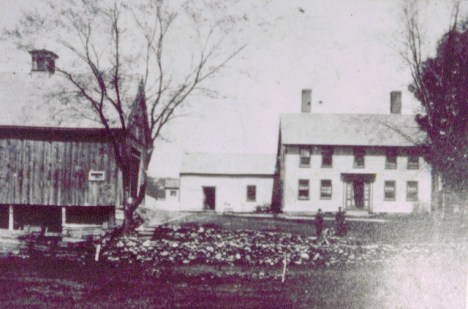
Best known as the home of Deacon Thomas Senter this  farm was home to five generations of the Senter Family, beginning with Samuel the father of Thomas.  The farm were settled in the South West part of Londonderry near “Potash” Corner.  This was the part of Londonderry annexed to Nottingham West in 1778.  We know the location today as the intersection of Old Derry Road with Robinson Road and a bit north of the Senter Cemetery.
Deacon Thomas was born May 1753 in Londonderry, NH the son of Susan Taylor and Samuel Senter.  Thomas married Esther Greeley, daughter of Ezekiel Greeley, circa 1775.  Their family consisted of 7 daughters (Kate, Bridget, Susan, Charlotte, Esther, Rebecca, and Nancy) and 2 sons (Thomas, Jr and Charles).  His wife, Esther passed at the age of 51 in 1800.  Thomas married a second time to Mercy Jackson and a third time to Eunice White.  There is no record of children born to these later marriages.  Thomas was a farmer and he enlisted in the spring of 1775 for 8 months and served at the Battle of Bunker Hill.
On May 1, 1805 the  Baptist Church of Christ of Nottingham West (now the First Baptist Church of Hudson) was organized in this home by a  council called for that purpose.  The new  church consisted of 65 members who had been “sett Off” from the Baptist Church in Londonderry.   That very same  council held an ordination for  The Reverend Thomas Paul.  For several years following the new church did not have a settled pastor.  The pulpit was supplied by various pastors, one of whom was the Reverend Thomas Paul.  The early church had two deacons.  Thomas Senter was chosen as one of the deacons, the other was Moses Greeley.  The anniversary of the organization of the Baptist Church (now at 236 Central Street) is recognized annually on or near May 1 as a Roll Call.  Members meet, enjoy a meal, fellowship, and call the roll.  When a member’s name is called they respond with a verse of scripture.
 This homestead remained with the Senter family until May 1889 when it was sold to Jeremiah Heath and  his son George M. Heath.  The Heath family owned the place until about 1921 when it was sold by Cora Heath, wife of George.  Either just before or soon after being sold by the Heath family the ancient home was destroyed by fire.  It is not clear if this was an intentional burn or not.  From the June 30, 1921 article in the Nashua Telegraph we get a description of the house.  The centerpiece of the house were two large brick chimneys probably made from Litchfield bricks.  These massive structures remained standing after the fire; showing the huge arches in the  cellar which supported 8 fireplaces.  One for each of the rooms in the house.  Cooking was done in an open fireplace.  The house had a front and a back door which led into a hallway from which one you access any of the four rooms downstairs.  The roof timbers were unusually strong and could have supported the extra weight of a slate roof.  To my knowledge, all evidence of this house has been replaced by more recent developments.
While researching Moses Greeley for last week’s article and Thomas Senter for this week, I began to understand the significant role each of these gentlemen had  to our town’s history; and the similarities of their lives.  Let me share:  They were farmers and neighbors, settling on the Derry Road.  They had adjacent farms and their houses were within 1/2 mile of each other.   They were both charter members of the First Baptist Church and both were elected as one of the two deacons for the church; a position held for life or until one resigned.  They were not related but their lives and the lives of their families were interwoven.  You see, Moses and Thomas married sisters.  Moses’ first wife was Hannah Greeley.  Thomas’ first wife was Esther Greeley.  These ladies were the daughters of Ezekiel Greeley.  The relationship between these two families continued beyond Moses and Thomas.
This photo of the Senter Homestead is courtesy of John Senter of Nashua; a direct descendant of Deacon Thomas Senter.

Jasper Poultry Farm Stand C 1962

296 Derry Road Jasper Farm Stand C 1962

Jasper Farm Stand C1962

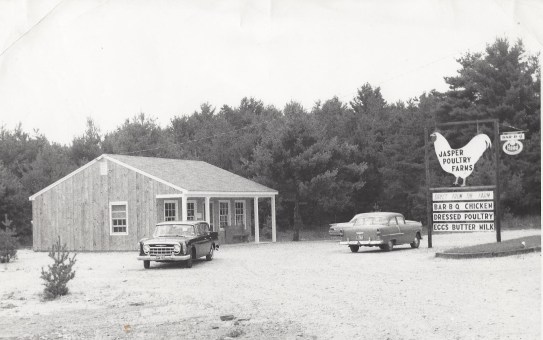
By the late 1950’s the State of New Hampshire had re-routed Route 102 (Derry Road)  just north of the Hills House to proceed north through parts of Litchfield, then back into Hudson, then forward to Londonderry and Derry.  Before that time Route 102 followed what is now Old Derry Road; past Jasper Farms, Nadeau Farm, the Hudson speedway and on to Londonderry and Derry.  This new highway removed much of the traffic from Old Derry Road; at the same time the new highway created business and retail opportunities on previously undeveloped land.
 
In March 1960 Jasper Farms under the management of Robert Jasper purchased 5 1/4 acres of land on the new highway  opposite what is now Connie’s Plaza.  Shortly after, in an effort to expand local retail presence and take advantage of the new highway, Jasper Farms open their farm stand at what is now 296 Derry Road.  By looking at our first photo we see one could purchase farm fresh eggs, Bar B Q chicken, ready to cook chicken, as well as some Hoods dairy products. 
 
 This retail store did not survive for long.  By June 1968 the 5 1/4 acre parcel was sold to Bernie and Phyllis McArdle.  Bernie established his Home Decorating Center where he sold wallpaper, paint, and provided paint contracting services.  
296 Derry Road D Auto Body S
 
As time went on the property was subdivided and  the building expanded to accommodate two businesses.  The  building has been used for R + S Supply by Bob St Onge,  K + M Trailer Sales by The Kierstead Family,  and One Stop Auto Parts.  By February 1981 it was purchased by Gerald Desrocher for D’s Auto Body; a business which continues to this day under the management of his son, Scott.
 
Our first photo is compliments of the Jasper Family and the second was taken by the author.  Both photos are part of the Historical Society Collection.

Nathaniel Hills, Jr Farm at 64 Old Derry Road
64 Old Derry pre 1947 S

C1830 Farmhouse on the Nathaniel Hills Farm C1945

Nathaniel Hills, Jr, a young man of 23 years, settled on this farm about 1739 when his father transferred some 50 acres of land to him. These acres were part of the 900 acres of unsettled land that Nathaniel Hills,Sr had purchased from Jonathan Tyng. References vary as to the size of Nathaniel,Jr’s family. Kimball Webster in his History of Hudson in indicates that Susan (Baldwin) and Nathaniel Hills, Jr raised a family of 7 girls and 5 boys. When Nathaniel, Jr passed ownership was transferred to his third son, Samuel (born 1769). Likewise, with the passing of Samuel in 1843 ownership passed to Abijah (born 1806) and later to his son Franklin Augustus (born 1846). It is interesting to note that Abijah Hills in 1846, by an act of Legislature, had the family name changed to Hill. Franklin Augustus was a dairy farmer. He and his wife Luelle had one child; a daughter Helen who passed at age 14. In 1926 Franklin’s widow sold the farm to their neighbor, Grant Jasper.

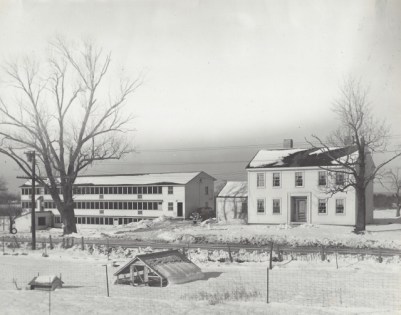
This farm had been home to 4 generations Hill(s); passing from father to son beginning with Nathaniel, Jr. The original dwelling place was replaced C1830; likely while the farm was owned by Samuel or Abijah. The earliest photo we have of this C1830 Farmhouse was taken by the Jasper Family C 1945.

This farm became Annex #1 of Jasper Poultry Farms. Poultry man Jasper expanded the business into this new space. The dairy barn was remodeled into a three-deck poultry barn only to be burned in 1933. A new poultry barn was added as well as other improvements including a breeding/brooding house. From 1935 to 1939 operations at Annex #1 increased rapidly. The C 1830 farmhouse was used as living quarters for the employees of Jasper Farms.

Disaster struck the farmhouse during the early morning of January 17, 1947 when a fire started from the flooding and explosion of an oil burner near the kitchen. The flames from this explosion destroyed the entire house. The family in residence lost all their belongings; but, fortunately escaped without injury. The fire spread so quickly that the telephone could not be reached. The family fled on foot for about 1/4 mile to a neighbor in sub-zero January weather. Our second photo show the 1830 farmhouse as a result of the fire. There is no way of knowing what Hills family records were destroyed with this fire.

64 Old Derry aft fire S

Results of Fire Which Destroyed Farmhouse Jan 1947

Little if any time was lost before rebuilding. The current house, as shown in our third photo, was immediately built using the old foundation.

64 Old Derry rebuilt 1948 S

Farmhouse as Rebuilt C 1948

By 1972, under the management of Robert Jasper, Jasper Poultry Farms ceased operations. However his son, Shawn, reopened a small poultry business at the Annex #1 location from 1979 to 1983. The property remains a part of the Jasper Corporation. The buildings at 62-64 Old Derry Road have been transitioned to retail space for light industrial uses and storage units; this mostly under the management and hard work of Shawn Jasper.

This farm was located on or near the end of Nathaniel Hill’s 900 acres (which proved to be closer to 1600 when finally surveyed). Until 1733 it was within the boundaries of Dunstable, MA; then it was part of Nottingham, MA. In 1734 the town of Litchfield, MA was chartered and this property was within it’s bounds. When the state line between MA and NH was settled this parcel became a part of Londonderry, NH. It finally was annexed to Nottingham West (later Hudson) , NH in 1788. This brief history gives you an idea behind the difficulty one has when researching historical records. All photos are part of the Historical Society Collection; complements of the Jasper Family.

Jasper Family Homestead at 83 Old Derry Road

83 Old Derry Road has been home to five generations of the Jasper family.  It all began back in August 1916 when Grant Jasper, then a young man of 26, purchased a small poultry farm from Carlton C. Brain and moved here with his parents, Arthur and Sarah Jasper.
Grant was born in Amsterdam, NY

83 Old Derry 1919

Mapleside Poultry Farm 1919

and while a young child the family moved to Lowell, MA where he attended school and graduated from Lowell Textile School in 1912.  He worked as an apprentice in the textile industry and then as a weaver for 3 years.  His dad, Arthur, was also a weaver and known for his skilled craftsmanship.  Preferring to work out doors, Grant went to work at Lord Farm, a poultry farm in Methuen, MA.  He spent 20 months there, working and learning the basics of poultry farming.

From 1909 to 1916 Carlton Brain operated Mapleside Poultry Farm on Derry Road (now Old Derry Road) in Hudson.  With failing health he sold his home, out buildings, a truck, 300 leg horns, and a row of Maple trees in front of the house to Grant Jasper for $6,000 and moved to California.   By 1917 Grant and Bernice Louise Fall, a former secretary at Lord Farm, were married.  Our first photo shows the house and barn with the wood and carriage sheds which connect them.  Along what was then a dirt Derry Road is a  beautiful stone wall. This photo was taken in 1919 by Carlton Brain.  Prior to 1909 and ownership by Carlton Brain this property was owned by a number of individuals.  The earliest known being Fredrick Peabody a blacksmith from Pelham who purchased from Nathan and Abigail Andrews in 1829.  It is likely that prior to that this property was a part of Londonderry which was annexed to Nottingham West in 1778.
Establishing himself in the poultry business Grant steadily expanded his flock, developed more efficient methods of production and built better houses for the poultry.  This success continued over the next 30 years and his became the third largest poultry operation in New Hampshire.  All the while retaining the reputation as a friendly and honest business man.
By 1922 he expanded by purchasing the adjacent farm, now 62-66 Old Derry Road.  Over the next 22 years two additional farms were purchased.  The first at what is now 34-36 Old Derry Road and the next at 53 Old Derry.  Jasper Poultry Farms continued to operate for two additional generations.  First with the leadership of Grant’s son Robert “Bob” assisted by his brother-in-law David Crockett; and later by grandson Shawn who continues the management of The Jasper Properties to the current time.  Our second photo shows the home farmhouse C1950 as home to Grant and Bernice Jasper.
1976031001 S

Home of Grant and Bernice Jasper C 1950

The photos shown here are courtesy of the Jasper Family and a part of the collection of the Historical Society.  In the up coming weeks  we will be sharing the history of other properties along Old Derry Road, including those annexed by Grant Jasper as he enlarged  Jasper Poultry farms.

Some Ancient History of the Hill Family of Hudson

2006070005comp

Aerial View of Garrison Marker

The immigrant ancestor for the Hills Family of Hudson was Joseph Hills; born in England in 1602 he sailed in 1638 on the “Susan & Ellen” and settled in Charleston, MA (later set off as Malden) where he became active in town affairs.  He was a lawyer, leader of the militia, and held many important officers.  He later moved to Newbury.  In 1645, he served on a committee to set off lots in Nashaway Plantation and  In 1648 he wrote the first laws for the colony of Massachusetts.  In return for his services to the colony, he received a grant of some 500 acres in what is now Hudson in 1661.  Of these acres, 450  ran from a few rods north of the Taylor Falls Bridge, north along the east side of the river  beyond Derry Lane to include the site of Hills Garrison.  When the Town of Dunstable, MA was chartered all 450 acres were within the boundaries of that town.
Joseph passed away in 1688.  By his will he divided the 450 acres into 9 parcels  and passed ownership to members of his family.  With one exception no settlement occurred on any of these parcels until ownership passed at least one more time and outside the Hills Family.  The one exception was the northern most parcel of 89 acres he passed to his son Samuel.  By 1710, Nathaniel, Henry, and James, three of Samuel’s sons, built and occupied a garrison house on their father’s land.   Nathaniel was about 27, Henry about 22, and James about 13 years old.
By 1721 Samuel deeded the northern half of his land to Henry and the southern half to son James.  In 1723 James married Abigail Merrill and a few days later he sold to Samuel Whiting and they moved to Newbury.  Some time before 1732 Nathaniel purchased a 900 acre parcel of unsettled land from Jonathan Tyng.  This parcel also bordered on the river and was adjacent to and north of what had been his father’s 89 acres.  Samuel passed away in 1732.
Some time before 1733 Nathanial and his family moved from the garrison onto his 900 acres.  He set up a dwelling about 1/2 mile north of the garrison and near the bank of the river.  He later established and operated a ferry across the river, known as Hills Ferry.  This was operated by him or one of his descendants until 1827 when the first Taylor Falls Bridge was built.
In 1733 the town of Nottingham, MA was chartered to include all Dunstable land east of the river.  In 1734 the town of Litchfield, MA was chartered.  This charter established the southern boundary of Litchfield at the northern most part of the Joseph Hills grant.  Thus, the acres owned by Henry were in Nottingham, MA.  The acres Nathaniel had just purchased were in Litchfield.  About 1739 or 1740 Henry sold his land and the garrison to Deacon Roger Chase.  Henry then moved 1/4 mile east and established a farm on his brother’s land.  By that time none of the Hills Family had any ownership interest in the garrison or the Hills Grant. The families of Nathaniel and Henry were residing on the western part of Nathaniel’s 900 acres.  James, his wife and 4 small children had returned to Nottingham, MA and settled on a farm (now 20 Old Derry Road) which he acquired from his brother.
In 1740 the boundary between NH and MA was established and by 1746 Nottingham West, NH and Litchfield, NH were chartered.  These charters established the boundary between those two towns as we know it today.  During this period of uncertainty over state and town boundaries there were a number of residents  in nearby Londonderry which were of the opinion their homes would become a part of Nottingham West.  When this did not happen these residents petitioned to be annexed.  This became final in 1778 when some 4600 acres of Londonderry became a part of Nottingham West.
Henry Hills remained on his farm until he passed in 1757.  A few years later it was conveyed to his nephew, Elijah Hills.  Elijah was the grandfather of Alden and the great-grandfather of Dr Alfred K. Hills.  Alvirne High School and the surrounding grounds, including the Hills House, are on land which was a  part of this farm.  As time progressed Henry Hills Jr purchased the  farm  which is now 34-36 Old Derry Road.  Also, Nathaniel Hill Jr established a farm (now 62-64  Old Derry Road) upon part of his father’s land.
From 1661 to 1780 the one constant was the land and the location of the land that Nathaniel, Henry, and James and some of their descendants lived on.  Around this many things changed:  What state are you in?  What town do you live in?  Are we being taxed by more that one town?  What county seat do we use to record land purchases?  In the next few weeks we will be Remembering … some of these properties along and near Old Derry Road. This weeks photo, an aerial view of Garrison Farm, shows the original location of the historic marker  for the Hills Garrison.    The marker is in the open field behind the barn left of the roadway through the field.