Home » Center (Page 3)
Category Archives: Center
Railroad Overpass at Hudson Center

Railroad Overpass at Hudson Center
Minuteman Marker at Hudson Center Common 1975

Minute Man Marker Hudson Center Common
Shortly before midnight on April 18, 1775 a detachment of 800 British troops began their march from Boston to Lexington and Concord. The word of the impending battle was immediately sent by mounted messengers throughout the country; including the Merrimack Valley and Nottingham West, a distance of about 40 miles. Tradition says the news reached Nottingham West before noon of April 19 and mounted messengers again sent the word out to the various sections of our town. The message and the response was so quick that by that very same afternoon, 65 men equipped for war with muskets and ammunition had gathered at the Hudson Center Common ready to march to Lexington. These men were organized under the command of Captain Samuel Greeley and awaited his orders. The old military records are lost or destroyed but we do have the muster roll of this company of 65 men – all from Nottingham West. These men left for Lexington on the evening of April 19.
Before reaching their destination they were met by a courier who informed them of the retreat of the enemy. The command returned to Nottingham West. After this, many of these men enlisted in the army at Cambridge and at least 16 of them later fought at Bunker Hill in June of the same year.
Samuel Greeley was the oldest son of Samuel and Rachel Greeley. In 1740, at the age of 19, he came to Nottingham West from Haverhill and settled with his father on the Greeley Farm. This was a 200 acre farm just north of the Joseph Blodgett Garrison place on Lowell Road. Samuel married Abigail Blodgett, daughter of Joseph and Dorothy (Perham) Blodgett of the Blodgett Garrison in May 1744. He lived here until 1777, when at the age of 56, he and Abigail moved to Wilton; leaving the farm to his sons Joseph and Samuel. He died in Wilton. After his passing, his wife Abigail returned to town where she lived until the age of 95. While in Nottingham West Samuel was Town Clerk for about 28 years and on the Board of Selectmen for 14 years. He is remembered in our history as the Captain of the company of militia from Nottingham West who turned out 65 men as volunteers at the time of the Battle of Lexington April 19, 1775.
The Town Common at Hudson Center, originally about 2 acres of land, was used for many events including training for the town militia, Old Home Day activities, Chautauqua Programs, and recreation. In the early 1960’s the State of New Hampshire built the present route 111 through the center of the Common and eastward to West Windham. In 1962, the Board of Selectmen received a letter from the Hudson Fortnightly Club recommending that an historic marker commemorating the town’s minutemen be placed on that part of the Common which was not taken by the state for the highway. This was done by the town in 1963.
On April 19, 1975, some 200 years after the Battle of Lexington and as part of the United States bi-centennial activities a wreath was placed at this monument. For this event the carillon bells of the Baptist Church were played, and a floral wreath was placed by Phyllis Keeney, Selectman and a Past President of Fortnightly. The floral wreath was made by club member Mrs. Florence Bogan. Following the raising of the American Flag with color guards from Veteran’s Auxiliary and Girl Scouts and the singing of the National Anthem by Mrs. Bruce Cole, the Muster Roll of the 65 men was read by John Beaumont. A benediction and playing of God Bless America on the carillon bells closed the activities. This marker is located at the point of land on the common near Kimball Hill Road at the intersection with Central Street. Photo from the Historical Society collection.
Barretts Hill Road and Greeley Street C1908
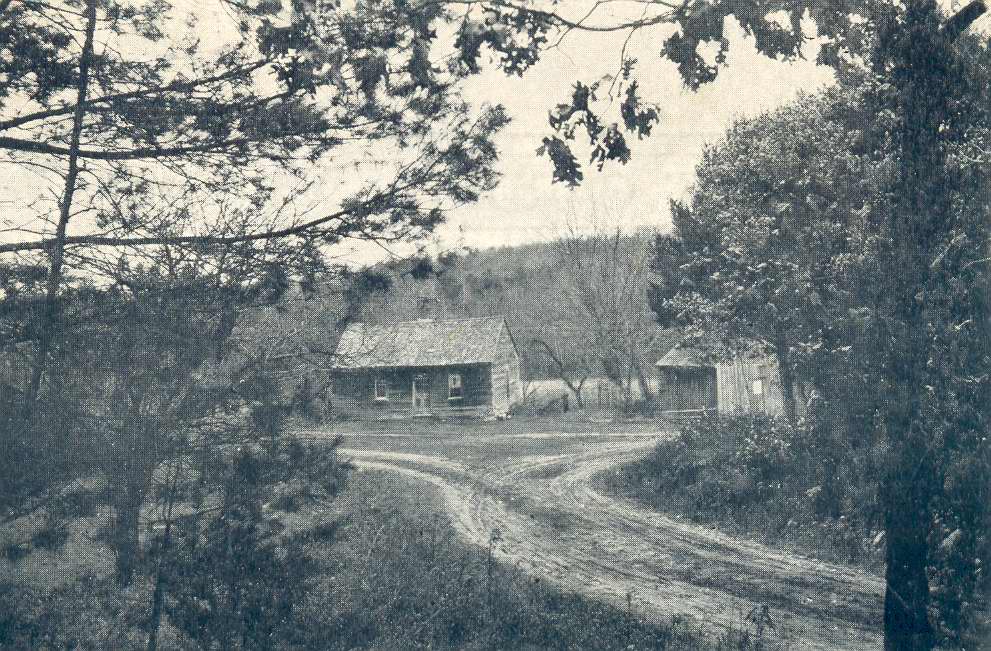
Barretts Hill Road and Greeley Street C1908
In this C1908 Post Card we are on Barretts Hill Road looking west and down onto Greeley Street; which runs horizontal in the picture. At this intersection a left turn onto Greeley takes you to Hudson Center; with a right turn you are headed towards Old Derry Road. Straight ahead you are looking at what is now 68 Greeley Street. In the center of the intersection notice the grassy triangular piece. This is called a “heater piece”. This peculiar shape is formed from the flow of traffic; by continually going left, right, or straight this part of the intersection receives little or no traffic. It is given the name “heater piece” as the resulting shape resembles that of a flat iron. At the time of this photo the house shown here belonged to the estate and family of David Glover. Photo from the Historical Society Collection.
Thompson’s Market on Central Street c1977

Moore’s General Store c1949

Perhaps as early as 1888 Harvey Lewis began a long standing tradition of a grocery store in Hudson Center. Moore’s General Store at the corner of Kimball Hill Road and Hamblet Avenue began about 1925 when Earl “Dinty” Moore purchased the business from Harvey Lewis. Moore was a rural mailman in town but his family assisted with operating the store. Ownership remained with the family; passing from Earl to his son Kenneth. Later Kenneth’s brother-in-law Morillo Post entered the business. At that time they enlarged the business and added a barber shop and second floor apartments. After the death of Morillo in 1963 the business was sold to David and Robert Thompson; both of whom had worked for the Moore Family in earlier years. The Thompson Brothers operated the store at this location until November 1969 when fire badly damaged the building. Rather than rebuild on this site the Thompsons relocated their business to Central Street. This 1940’s photo shows the business before the building was enlarged by Kenneth and Morillo. This site is now the location of the ever popular Kahil’s sub and sandwich shop. Photo courtesy of Post/Granger Family and now a part of the Historical Society Collection.
Hudson Center Common From Eli’s Front Door 1888
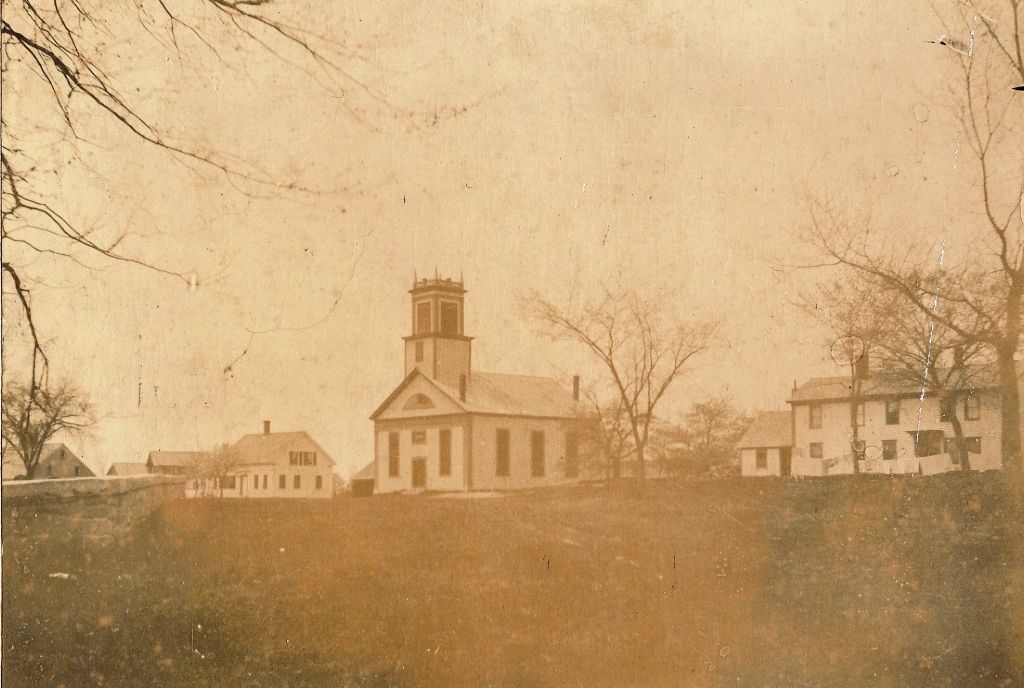
This C1888 photo of the Hudson Center Common shows the view from the home of Eli Hamblet on Hamblet Avenue. Straight ahead is the Baptist Church, the church where he was elected as deacon just a few years earlier in 1882. The large vestry has not been built, but I am certain the need for it has been discussed among the members. To the right of the church is the home of Mrs. Mahalia Greeley; the widow of John Greeley, MD. To the left of the church is the home of Daniel Greeley. Daniel was known to have a good nature and he was well liked within the community. In the foreground and on the left of the photo is the Old Hudson Center Cemetery. Up until a few years prior to this photo the cemetery was in disrepair and the town was considering moving the remains from this site so that the size of the common could be increased. This proposal did NOT meet with public sentiment and, as it turned out, a former resident of Hudson , John Foster, made a proposal to the town that he would build a stone fence and clean up the cemetery if the town would maintain it. Imediately beyond the cemetery is a roof of a barn; possible from the barn connected to the Henry Brown House on the opposite side of the common. Photo from the Historical Society Collection.
The Paul Tenny/Henry Brown House c1895
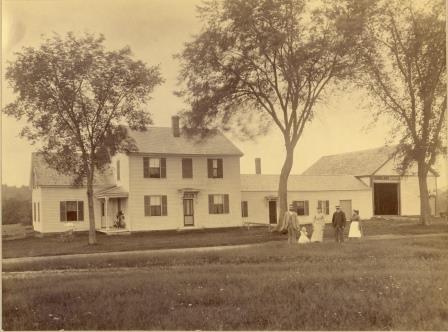
This house was a landmark in Hudson Center for many years; standing at Kimball Hill Road opposite the Hudson Center Common and directly across from the front steps of the Baptist Church. The first occupant was Dr. Paul Tenny who moved to town about 1791 and later settled here. The property was sold to Dr James Emery in 1849. When Dr. Emery retired it was purchased by Henry C. Brown; in 1935 it was purchased by John T. Benson and became part of the Benson’s Wild Animal Farm property. Vera Lovejoy and her family lived here while she was managing the Benson Farm. This c1895 photo shows, left to right, Henry C. Brown; Ina Louise Brown, daughter; Clara Bryant Brown, his wife; and John and Eliza Brown the adoptive parents of Henry. Photo from the Historical Society Collection.
Post Offices at Hudson Center
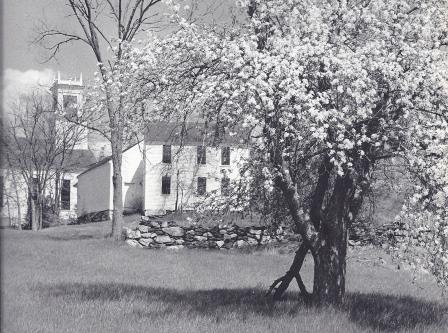
The first established post office in Hudson was at Hudson Center. The Postmaster, Reuben Greeley, used this ell attached to the west side of his house for the Post Office. This 1960 photo shows the back side of the ell from the field located at what is now 230 Central Street; the 7-11 Convenience Store. Reuben served as postmaster from 1818 until 1829 and then again from 1849 until 1853 after which the Hudson Post Office was moved to the bridge area. This ell was a part of the Greeley/Wentworth property when purchased by the Baptist Church in 1962. A few years later the large section was removed for safety reasons and the remainder configured into a garage. This garage has since been removed also. From 1876 until 1910 the Hudson Center Post Office was located in the Railroad Depot. So, for a period of 34 years the town of Hudson had two post offices; one at the bridge ad one at the center. This photograph is used here by permission of Hastings House Publisher the publisher of “The New England Image” by Samuel Chamberlain.
The Parsonage at 234 Central Street c1980

Baptist Church at Hudson Center C1905
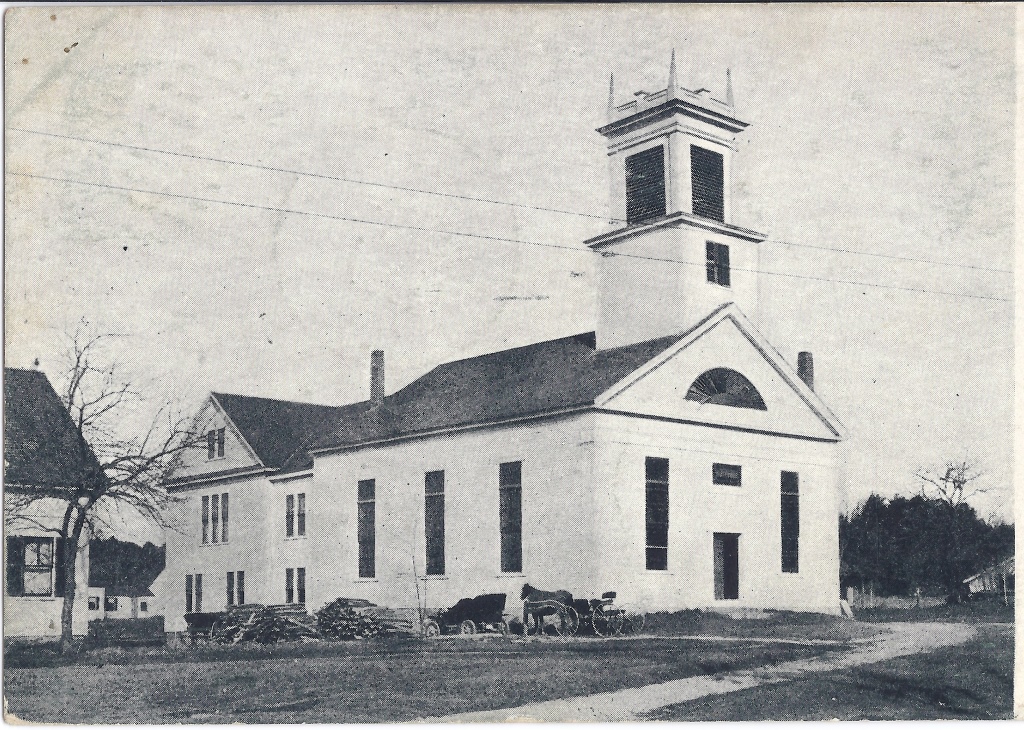
The First Baptist Church of Hudson was organized in 1805 at the home of Thomas Senter on at what is now the Old Derry Road near the Londonderry Line. For the first 37 years services were held in members’ homes or at the North Meeting House located just east of the Town House. The sanctuary of this church at the corner of Central and Greeley Streets was constructed in 1842. In 1888 a short alcove was added to house the new organ; then, in 1897 the large vestry was added. This photo was probably taken at the time of the centennial celebration of the church in 1905. Over these years the exterior of the building has not changed significantly except for replacing the original steeple which was completed in 2007. To the left of the church we see part of the Greeley/Wentworth home, now the church parsonage. The stacks of wood seen here were used to heat the building. The dirt roadway in front of the church is either Central Street or a short cut from Central Street to Greeley Street. Photo from the collection of the Hudson Historical Society.
 Remember Hudson NH When...