Home » Bridge Area (Page 4)

Category Archives: Bridge Area

Martin Block at PO Square 1913

po-square-1913-1024x697

Martin Block at PO Square 1913

By 1913 a business center was developing near the Taylor Falls Bridge at the intersection of Central and Main Streets, called Post Office Square.  The Martin Block, as shown in today’s photo, was at the center of  the activity.  As one came across the bridge from Nashua the roadway branched: right took you up Central Street and past the Methodist/Episcopal Church (now The Community Church).  If you kept to the left you were on Main Street; the Martin Block was at 1 Main Street.  In 1913 Main Street was a short street extending from the bridge to the intersection with Derry Road where it’s name changed to Ferry Street.
The Martin Block and the building shown here dates  to 1877.  Mr. Elisha Z. Martin purchased the property and building about 1876.  Shortly after the building was destroyed by fire and rebuilt by Mr. Martin the following year.  After Mr. Martin’s passing in 1879, Mrs Martin married a Mr Sherman from Connecticut.  Together they continued to make changes and improvements to the building.This site has a long history of being occupied by a grocery or general store.  At the time of the fire it was the location of Nathan Webster’s store, and following reconstruction his business returned and continued until about 1892.  George Andrews succeeded Mr. Webster and continued the business until his death in 1903.  Mr Elijah Reed ran the business for about 1 year after which Mr Charles Daniels in partnership with Charles B. Gilbert took it over and continued until about 1925.

From the information on the reverse of this photo we know the following:  In the left el was a barber shop along with Daniels and Gilbert  Flour, Grain, and Grocery.  Charles  Daniels was the Postmaster at that time so the Post Office occupied a corner of the local grocery.  On the extreme right was a blacksmith shop and horse barn, or livery.  In the main building there were apartments.  In 1913 property taxes were $98 and it cost $50 for insurance!
In the foreground we see the tracks for the  street railway and overhead the electric wires which provided t power to the cars.  On the right is an early street lamp.
This building remained until it was demolished in the 1960’s to make way for the Veterans Memorial Bridge and the access route onto that bridge.  Changes occurred through  the years.  By 1928 it was owned by a Mrs. Jennie Connell and known as the Connell Block. The left side was washed away during the 1936 flood.  The double dormers on the third floor were replaced with a single dormer.  The livery and barn were removed from the right side and remodeled into a grocery store.  As early as 1926 this side of the Connell Block was home to Sal’s Cash Market; with Harry Salvail as proprietor. By 1940 this was the location of the every popular 20th Century Store and owned by Phil Lamoy of Nashua.  Business continued here until demolition when Mr. Lamoy moved his grocery in Hudson to the 20th Century Shopping Center on Derry Road.
My best guess for a present location of this site would be on Ferry Street just as you entered the northern span (Veterans Memorial Bridge) and part of the green space which lied between the access to that and the southern span (Taylor Falls Replacement Bridge).  This photo is a recent addition to our collection at the Historical Society.

Trolley Line on Central Street C 1907

Central St West 1907 (640x428)

Central Street West C 1907

A  trolley traveling along Central near Library Street has exposed the rail lines after a recent snow storm as shown in this C 1907 post card. By 1907 the Bridge section of town, including this part of Central Street, was developing as a residential and business center. This was facilitated by the public transportation between Hudson and Nashua on the trolley.
 
The Methodist Church and parsonage previously located on Central Street near Melandy Road had burned in 1879 and the parish made the decision to relocate closer to the bridge and the trolley stop. The steeple of the new brick church,  built in 1880, can be seen towards the center of the photo on the left side of Central.
Another new building at that time, the IOOF building (also called Association Hall), is visible just this side of the church.  The IOOF building was completed by 1905 and it soon became their  meeting place plus meeting space for  the Rebekah Lodge, and Hudson Grange.   Association Hall has a long history of usage for Hudson; once owned by the town and used as a school class room, it is now owned by the American Legion.
The house on the right, now 39 Library Street, was home to Helen and  Hannah Georgina Gillis, daughters of the late Jennie (Fulton) and John Gillis.  John Gillis purchased the colonial home on this site from Zachariah Hardy and just a few years before this post card  replaced it with this house which was modern for that time.    John Gillis and later his estate owned much of the land in the area of Central, Gillis, and Fulton Streets.   Following the passing of their parents Georgina and Helen continued to live here.  Helen passed at the age of 78 and Hanna Georgina at the age of 77; both passing on the same day in 1925 as they became victims in a double murder which occurred in their home.    Their funeral service was held at the Congregational Church on Central Street with an atmosphere of simplicity, reverence, and sadness.
By 1934 this was home to  Michael and Sophie Stanapedos.  Michael passed in the late 1960’s and Sophie continued to live here until the 1980’s.  In 1983 it was purchased from her estate by John Sarris and remodeled into an office building appropriately called “Sophie’s Place”.
The house on the left of Central at the corner with Gillis Street has been a Connell Family home for over 75 years.  Occupied by Frank and Mary Connell it is now owned by the family of his son, Philip J. and his wife Lucille.
This post card is from my private collection, being mailed to my great-grandmother in 1907.  It will soon be on file at the Historical Society.

Pre-Civil War Cannon at Library Park

Cannon at Library Park C 1942

                  Cannon at Library Park C 1942

This US Navy Cannon at Library Park and an identical one at The Hudson Center Common, sat for years on their respective concrete moorings.  Children would play on then, walk up the  steps of the mooring and sit horse-back on the barrel of the cannon.  Many family and group photos have been taken on or around them through the years.  Occasionally on Halloween, teens would decorate the cannons by pouring random colors of paint over the barrel.  The cannons were soon repainted in black by the wandering teens at the request of the Police Department or else  by the Highway Department or some service organization.
It is my understanding that these two 3-ton cannons were brought from the New Hampshire Armory on Canal Street in Nashua to Hudson in May 1929  through the efforts of Harry Emerson.  One of them was placed on Library Park and the other at the Hudson Center Common.  These cannons were cast in 1848 in a foundry near Boston  and their serial numbers are within 2 digits of each other.  The Library Park Cannon was fired but we are not sure if it was actually used in battle and if so, which battle.  Harry Emerson was a long time resident of Central Street and at the time a custodian at the armory.  He served the town of Hudson for over 50 years as a member of the Fire Department.  Serving as Chief from 1946 to 1952.
The Library Park cannon remained silently on the park until September 2, 2015 when it was involved in a collision with a school bus which was the victim of faulty brakes.  Fortunately there were no students on the bus and the driver was not injured. Realizing the brakes were faulty the driver steered the bus onto the park, grazed a tree, hit the cannon and stopped!  The cannon itself was not harmed but the concrete mooring was pulverized.  The cannon and debris were removed by the Highway Department.
Library Park Cannon 2016

                              Library Park Cannon 2016

For several months the cannon was at the town garage being sand blasted, restored, repainted, and a new mooring constructed.  Earlier,  in May of this year it was returned to Library Park; thanks to the efforts of our award winning Highway department; the recipient of the First Annual Community and Cultural Heritage Excellence Award sponsored by the Hudson Historical Society.  Photos from the Society’s collection.

First World War Monument at Library Park

WWI Monument Library Park 2016

First World War Monument 2016

The First World War began in Europe during July 1914 and for the first years the United States had a policy of non-involvement.  After the sinking of the Lusitania and the killing of some 190 Americans and later attacks on US ships, the United Stated declared war on Germany April 1917. The Armistice which lead to the end of conflicts was signed November 11, 1918.
1977036004

Bronze Tablet Listing Servicemen

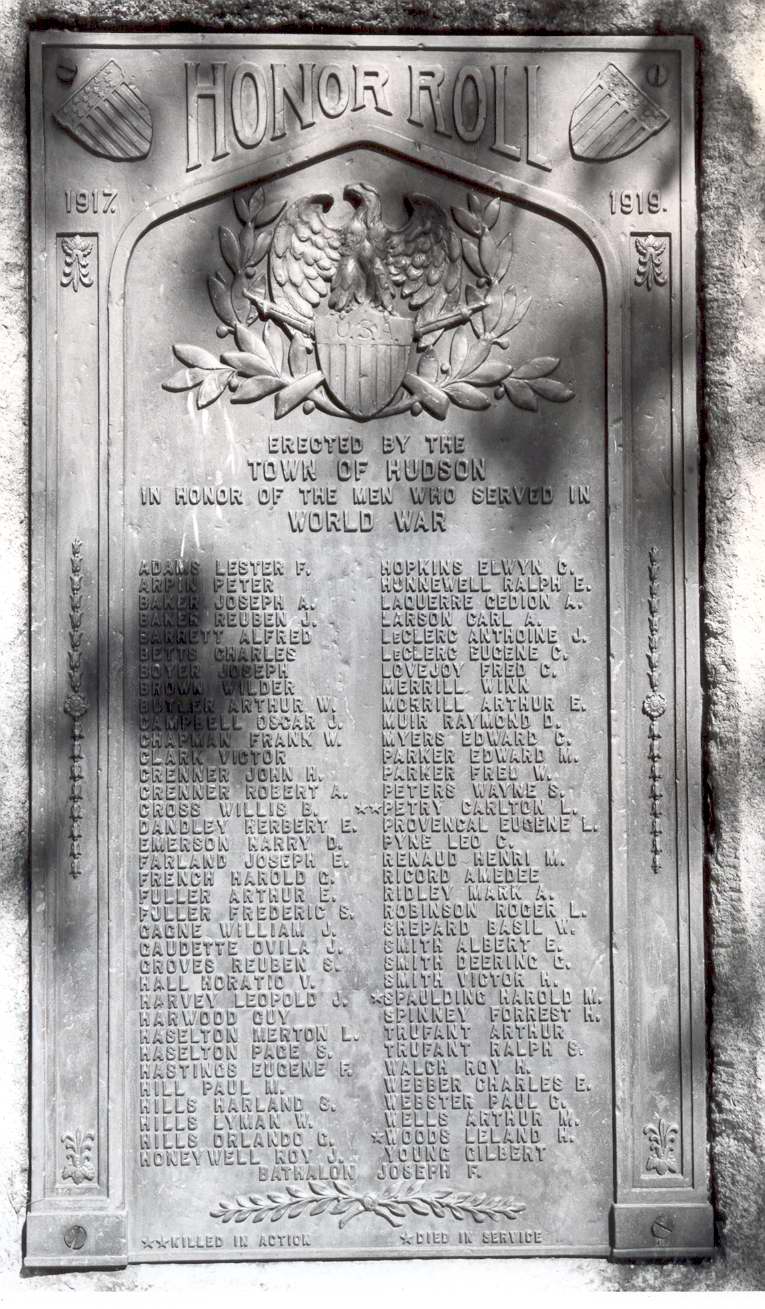
Between 1917 and 1919 some 71 young men from Hudson were engaged in the Armed Forces.  A listing of these servicemen was maintained by historian Julia (Webster) Robinson. At the town meeting in March 1920 the town voted to raise a tablet to honor these men and by early 1922 this granite boulder and attached bronze tablet was placed on Library Park by the Town of Hudson at a cost of $977.65.  Of these young men 3 of then lost their lives during the conflict.  On June 25, 1921 members oft he local Grand Army of the Republic (GAR) Chapter planted 3 maple trees nearby on Library Park near this monument as a memorial to Carlton  Petry, Merrill Spaulding, and Leland Woods.  Photos from the Historical Society Collection.

Bronze Tablet Donated by Webster School Students in 1933
1977032006

Bronze Tablet Donated by Webster School Students in 1933

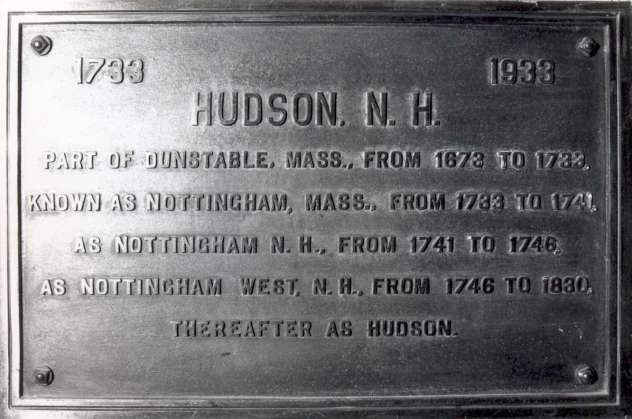
While giving tours and talking town history we at the Historical Society frequently hear the question “When was our town established?  The bronze tablet  pictured here  identifies the five birthdays, or founding dates, for our town.
Dunstable, Mass was founded in 1673.  Most of the land contained within the present boundaries of Hudson was included within that town, with the exception of about 4,600 acres in  the northeast part of Hudson which was then a part of Londonderry.  The geography of Dunstable included land on both sides of the river including all or parts of some 14 towns in present day Mass and NH.  In the early days of Dunstable land had been granted on the east side of the river but no real settlements occurred until about 1710.  We remained a part of Dunstable, Mass until 1733.
As the number of settlers on this side of the river increased  they petitioned Mass to be set off as a separate town.  This petition was answered on January 4, 1733 when the  charter for Nottingham, Mass was granted  This town included  all Dunstable lands on the east side of the river.  The General Court ordered that a Town Meeting be held within 3 months and a minister be settled within 3 years.    After survey and much debate the center of the town of Nottingham, Mass  was agreed upon and a meeting house built on what is now Musquash Road.  The town of Nottingham, Mass remained as such for only 9 years, until 1741.
The ancient  boundary between the provinces of NH and Mass was based upon the Merrimack River and the misconception that the river flowed from west to east;  with no  idea of the abrupt bend northward the river made near Chelmsford.  This resulted in some dual grants by the rival provinces of NH and Mass and a boundary dispute which was not settled until 1741.  At that time the line was established to run 3 miles north  of the Merrimack River from the ocean until reaching a specific point north of Pawtuckett Falls; after that the line ran due west to the Connecticut River.  All land south of this line was in Mass.  Land to the  north was in Nottingham,NH;  called by many historians as the District of Nottingham as towns had not yet been incorporated under the laws of The State of NH.
During the time after 1741 a number of smaller New Hampshire towns were spun off from Nottingham and were incorporated within NH.  One of these, Nottingham West was incorporated in 1746 and a charter issued July 5, 1746.  Nottingham West contained most of the lands of the present town of Hudson, except for those  acres  in Londonderry and minor adjustments to the boundaries with Windham and Pelham.
We remained as Nottingham West until 1830.  At the annual town meeting of 1830 the voters of Nottingham West adopted an article to petition the General Court of NH to alter the name to Auburn  or to designate some other name.  The name was changed to Hudson July 1, 1830.
Our town has 5 founding dates or birthdays.  In 1672 we were established as Dunstable, MA; 1733 as  Nottingham, MASS; 1741 as Nottingham, NH; 1740 as Nottingham West, NH; and in 1830 as Hudson, NH.  This confuses our celebrations!   In 1933 we celebrated the 200th birthday of incorporation of Nottingham, Mass; in 1972, some 39 years later, we celebrated the 300 birthday of the founding of Dunstable!  To my knowledge there was never a centennial or bi-centennial celebration for Nottingham West and no centennial celebration for changing name to Hudson in 1830.  So, when will our next celebration be?  perhaps in the year 2022, some six years from now, when we celebrate the 250th anniversary of Nottingham West?
 This tablet is located within the School Administration Building,  aka Kimball Webster School, and was donated to the Town by the students of Webster School as part of our 1933 bi-centennial celebration. Photo taken for publication of Town in Transition and is part of the Historical Society collection.


Town Office Building C 1965

1965002001

Breaking Ground for Town Office March 1965

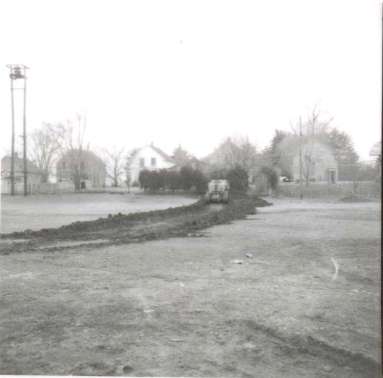
At the Annual Town Meeting in March 1964 we appropriated $50,000 for a Town Office Building.  Soon thereafter Leonard Smith was selected as the designer.  Plans and specifications moved forward and the required public hearing was scheduled for December 8, 1964 at the  H.O. Smith School.   The plans provided about 4,800 square feet of floor space which  would accommodate the Selectmen’s office, Police Department, Town Clerk and Tax collector, Planning Board, Board of Adjustment. the Building Inspector, as well as a meeting hall for officials and civic groups.   The School Street site was selected because the town owned the property and the playground facilities located there could be transferred to the H O Smith playground.   Bids were asked for and all  bids received were above the appropriation.  This resulted in negotiations between the Board of Selectmen and the lowest bidder.   The contract was signed and ground was broken in early spring 1965.  Our first photo shows the first ‘swipe’ of ground taken by the bulldozer to prepare the former playground on School Street for the foundation for this office building. In the background we see the old fire alarm and the rear of the  row houses along Ferry Street.
Adrien Labrie of Nashua was the General Contractor for the project.  This company was also the contractor for the Alvirne High School addition, in process at the same time.    Because of  pressures to have the school addition ready for September, construction of the Office Building received several setbacks. Originally the  schedule hoped for occupancy during summer of 1965; actual occupancy was delayed until late December of that year.At that time the Police Department and town officers mentioned above moved into this new facility.
1977032013

Town Office Building C 1970

In 1974 a 30 x 60 foot addition was made; and in 1985 a second addition was approved by the town.  This latter addition included the addition of a porch-style life and ramps for handicap accessibility.  Photos from Historical Society Collection.

Ferry Street Fire Station C 1926

Ferry st fire station  c 1926 comp

Ferry Street Station and Crew C 1926

The Hudson Fire Department takes its origin back to 1892 when the Hudson Hose Company was founded by a group of volunteers.  This independent company raised their own funds for equipment and expenses.  Individuals paid dues, were fined for missed meetings, and engaged in fund raisers.  Their first project was the building of the Old Hose House on Central Street just above the Methodist (now Community) Church.  Individuals pledged time in order to supply the necessary labor.  This building was sufficient to house early equipment and provide a place for volunteers to meet.
In 1913 this group purchased the Kelly Springfield truck by public subscription at a cost of $1,030.  Individuals signed a note at The Nashua Trust Company.  This vehicle is said to be the first piece of motorized fire equipment used in New Hampshire.  The next year this truck and the balance of payments was turned over to the town with the understanding that the truck would be housed near the bridge.  Prior to this time the town had not formerly helped the department.  Through this action and payment of a small salary our early firefighters were able to join the State’s Firemen’s Relief Association.  The Kelly was housed in a  garage on Campbell Avenue donated by Charles Norton.  As the department expanded and more equipment purchased, the move was made to to the House Brothers’ Garage on Ferry Street.
In April 20, 1926 The Osgood Construction company of Nashua was awarded the contract for a new fire house for the Hudson Department; built for Raymond House.  Details were finalized and work started .immediately.  The press release in the local paper April 20, 1926 stated that part of the old garage was moved to make room for the new engine house.  The Town of Hudson had signed a five year lease with Mr House for this new station which had two vehicle stalls, an office and lounging room for members of the department as well as a sleeping room.  It was a bungalow style building made of brick and  concrete blocks.  Brick on the front and concrete blocks on the sides.  The new building was expected to be ready for occupancy in a few months. This station was located on Ferry Street, opposite and slightly north of the intersection with Campbell Avenue; about where the Gulf Station is now located.
A vote was recorded to have a photograph of department members in front of the newly completed station in the mid 1920’s.  The photo of the Ferry Street Station C 1926 seen here could be the result of that motion.  The photo shows the two stall station, the Reo firetrucks used at the time, along with drivers and members of the department.  Charles Reynonds and Ray House are in the driver;s seat of the left engine.  Harry Emerson and Fred House are in the right engine.  Standing between the engines from left to right are:  Ornam Campbell, Bill Edgley, Charles Farmer, Edward Robinson, Sidney Baker, Earl Alexander, Chief Harry Connell, John Pearson, Allen Andrews, Joseph Fuller, Walace Baker, Paul Buxton (arrow), and Roland Abbott.
This Ferry Street station served the department and the community until some time after World War II when it was expanded to a four stall station.  Then, as town growth occurred  in the early 1950’s the Central Fire station (now Leonard Smith station) was built on corner of Library and School Streets.  In time the Ferry Street building was razed to make way for the access roads leading to and from the bridges. Photo from the Historical Society collection.

Central Fire Station C 1955

1989002007

Central Fire Station C 1955

The year was 1951 and Hudson’s population was rapidly growing.  The Town’s four-stalled rented fire station on Ferry Street was already overcrowded.  The problem was simple:  how could the town build a larger fire station without raising the already high tax rate?  The Selectmen, the then volunteer fire department, and Frank Nutting had a plan.  They would borrow $40,000.  The  yearly cost to repay  this loan would be about the same as what the town was already paying for the rented station.  This money would be used for materials; the labor to build the station would come from volunteers.  At the town meeting in March 1952, the town voted to build a firehouse at a cost not exceeding $40,000.
The planning and architectural work was done by Leonard Smith, a local builder and member of the volunteer fire department.  Ground was broken May 1, 1952 on town owned land at the corner of Library and School Streets, opposite Webster School;  utilizing about one-half of the approximately 1.3 acres of the old ball field. Community spirit was high; volunteers came from within the department, the town, town organizations, and even from surrounding towns.  Engineers, builders, merchants, and laborers came forward to help.  The result was this fire station of typical New England architecture with housing for nine trucks, offices, rest rooms, kitchen, future sleeping area, and an assembly hall.  There was also room for expansion.  By fall of 1952 the building was enclosed for winter work and by summer of 1953 the new station was put into service.  One work session occurred on April 3, 1953 with 24 men and 16 members of the fire department.  Following work they were rewarded by a ham and bean supper prepared by Leon Hammond, Norman Crosby, and Lewis Reynolds.
This facility housed the fire and police departments.  Later the upstairs was used for temporary classrooms, then for meetings and classes for both departments with space for supplies.  The Board of Selectmen moved their office from the basement of the Hills Library into the fire station, remaining here until the town office building was built next door  on the corner of School and what is now Chase Street.  At that time Chase Street ended at School Street and did not extend to Ferry Street.
As town growth  and needs of the fire department continued an addition to this station has occurred as well as the addition of satellite stations on Burns Hill and Robinson Roads.  Shortly after the passing of Leonard Smith in  2002, the Central Fire station was renamed The Leonard  E. Smith Fire Station” in his memory.  Photo from the Historical Society collection.

Area Surrounding Library and Webster School C 1910
2013006004

Area Surrounding Library and Webster School C 1910

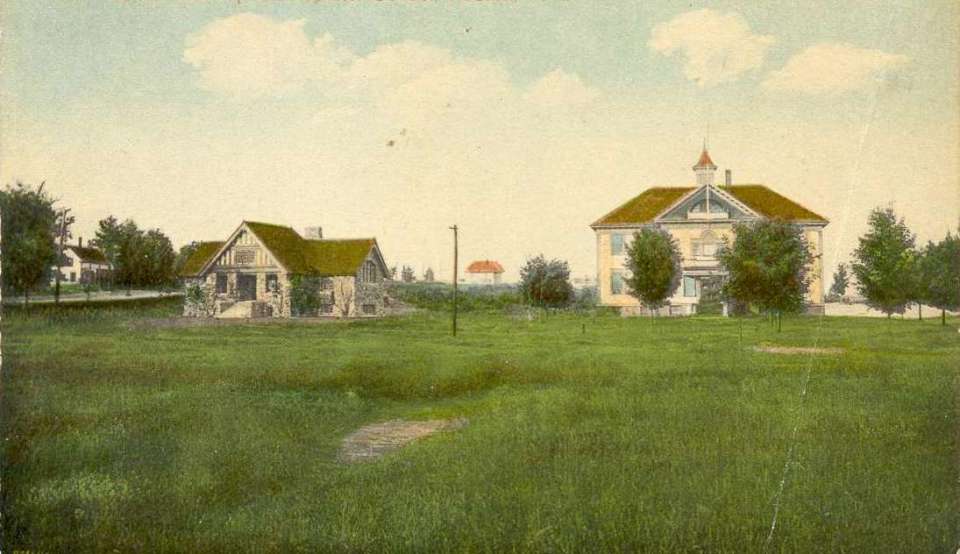
From this early post card of Webster School, Hills Memorial Library, and the surrounding area we get an idea of what this section of town looked like about 1910.   Kimball Webster School (right) had been in use since it’s completion in 1896.  The new Hills Memorial Library (left) was  completed in 1908.  The photo  for this post card was taken from an open field across the street from Webster School at the corner of School and Library Streets.  In fact, what is now Library Street was barely a dirt road in this picture.  One can locate the road by following the utility pole.  An 1892 map of Hudson shows an ice house where the Hills Library is located and what is now Library Street was called Sanders Street.
Looking beyond these buildings and along Ferry Street we see very little construction.  On Ferry Street and opposite the library is the home at what is now 42 Ferry Street; known by many as the Cunningham home and now owned by Kurt Smith.  On the knoll behind the library and the school we see another early home;  most likely the home at what is now 55 Ferry Street.
Today this open field is the site of the Leonard Smith Fire Station and the Town Office Building; built in the  the 1950’s and 1960s respectively.  Before these buildings this field was a popular playground; used during pre-school,recess, and after school activities for Webster School.  During the spring and summer months this field was used by the Recreation Department for a ball field, basketball court, and playground for the younger kids.  As a point of memory, Hudson resident Dan O’Brien has fond memories of little league games played here, as early as 1950 or 51,under the direction of Manager Brown.  These may have been some of the earliest little league games in Hudson.  The year construction was underway for the new fire station Dan recalls breaking a window in the station while throwing rocks.  Yes! He was busted by Chief Andy Polak.  In Andy’s  way all he did was report Dan to his parents.  But, that was enough!  Photo from the Historical Society collection.

The Sanders/Smith House Derry Street

This fine Victorian home was built by Hudson native George O. Sanders between 1873 and 1875.  He was born in 1850 and at the age of 17  began an apprenticeship with his father, Abi Sanders, a respected carpenter and contractor in this area.  This young man designed and built his own house; as such the dwelling represents the exuberance of youth and is an example of New Hampshire’s finest French Empire style of the Victorian Period.

10 Derry 1887 comp

Sanders/Smith House 1897

The main house is a two-and-a-half story dwelling on a granite foundation and covered by a Mansard roof with strongly flaring eaves.  Today  the exterior walls are sheathed with grey aluminum siding; applied over the original rusticated wood exterior. This work was done in the 1970’s by Leonard Smith.  Mr. Smith worked diligently to retain as much of the original detail as possible. The front corner, facing Derry Street, has an elaborate three story tower capped with wrought iron railings and canopy  terminated with scroll work and a weather vane bearing the letter “S”.

The L-shaped one-story wing extending from the main house originally had a hayloft door for access to the stable.   This has been modified over the years.  Above this hayloft door was a dormer, and on the roof stood a tall shingled spire rising from a cupola.  The cupola remains today, but the spire has been replaced by a hipped roof.
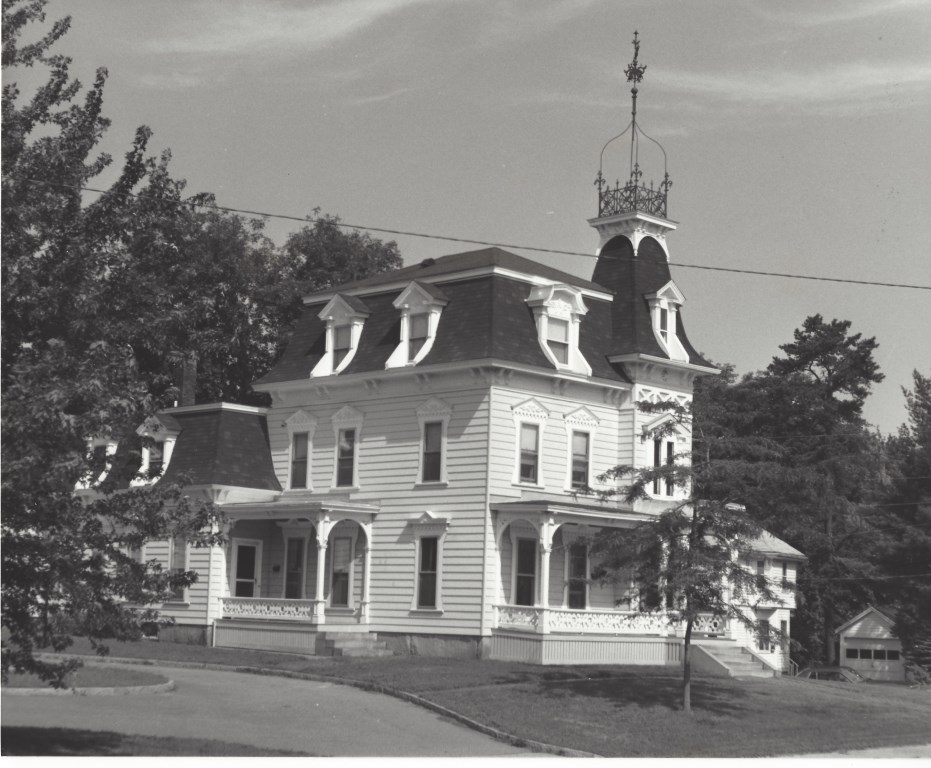
10 Derry 1985 comp

Sanders/Smith House 1985

The lot on which the house stands has been enclosed by several varieties of fencing over the years.  When the house was first built, it was supplied by water from a deep well which was pumped up by a tall windmill in the front yard.  Later, probably by 1893, when Mr. Sanders became principal stockholder of Hudson Water Works, the well and windmill were replaced by town water mains.  The tower and weather vane over the main entry, the hayloft door and shingled spire on the wing, the windmill, and fencing can be seen in the 1887 photo of the George O. Sanders house.

The life of George O. Sanders is also of interest.  He was an accomplished builder by his early 20’s.  He left Hudson in 1878 to work as an engineer in Kansas, returning four years later to begin a business which would grow to become NH’s largest wooden box factory, employing nearly 190 men in three separate mills. In later years he also engaged in a number of civic interests.  This included establishing, surveying, and construction of the Hudson Water Works Company: the construction of  the multi-unit housing block and a row of single family houses around what is now Library Park; and the initiation of the Nashua Street railway Company.

In its 142 years, this fine Victorian has had just three owners. In 1904 Harry Kendrick. an employee for Sanders, acquired this home.  It was owned by the Kendrick’s until purchased from Mrs. Kendrick in 1943 by Leonard Smith.  From 1943 to the present, the home remains in the Smith Family. While the G. O. Sanders house retains its original configuration, certain details have been altered or lost over the years.  This is particularly true in the 1940’s when the house was changed from a single-family to a seven-apartment complex by Leonard Smith.    In 1986 the George O. Sanders house was proudly entered onto The National Register of Historic Places by Leonard Smith. Our thanks to the imagination of George O. Sanders and to Leonard Smith’s avid interest in maintaining the character and beauty of this house.  Photos from the Smith family and the Hudson Historical Society Collection.