Home » Uncategorized (Page 13)

Category Archives: Uncategorized

Church Parsonage at 31 Library Street
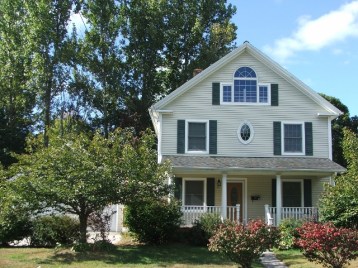
31-library-2016

31 Library Street 2016

In 1892 there was but one house on the western side of Sanders Street (now Library Street) between Ferry Street and what is now Central Street.  That house belonged to Joseph Fuller.  The Hills Memorial Library had not been built and that corner lot was the location of an Ice House.  In May 1910 Fred Blodgett transferred a parcel of land containing about 11,975 square feet on the west side of Sanders Street to The Congregational Society.  This parcel was part of land previously owned by Joseph Fuller.  The very next month the church  contracted with  Nashua Building Company to construct a parsonage house.  Work began July 1 and was completed by October 1 of that same year.  This was a major accomplishment for this Hudson Church and their new Pastor, the Reverend Lewis E. Perry formerly from Ayer, Mass.  Rev. Perry delivered his first sermon in Hudson in July 1910 and was the first pastor to reside in the new parsonage on Library Street.
This residence at 31 Library  served as parsonage for the Congregational pastors  until the merger between that congregation and the Methodist church in  1930.  It then served a parsonage of the Hudson Community Church until October 1970. The last pastor to reside there was Rev. J. Vernon Whittenburg who served the church from 1963 to 1970.   At that time a decision was
 made and the property was sold as a private dwelling.  From 1970 to the present this home has had 4 owners, including the present owner, Mr. Walid Alhgoul, owner of Wally’s Pizza in Hudson Center.
The accompanying photo shows 31 Library as of the summer of 2016.  The Historical Society does not have a good photo of  the early parsonage; ff any of our readers can help locate such a photo; please send an email to Ruth at HudsonHistorical@Live.com.  Also, special thanks to David Morin for helping with the research for this article.

Hudson Community Church C 1975

1977030004

Community Church C 1975

Resulting from the merger of two historic churches , the Congregational and the Methodist-Episcopal, the Hudson Community Church was registered with the State of New Hampshire in April 1930.  Prior to this date meetings were held by each of the two churches in order to discuss and approve the plan to merge as set forth by a joint committee.  The newly formed Hudson Community Church selected the church building of the Methodist-Episcopal (aka the brick church) on Central Street  and the parsonage house of the Congregational Church located at 31 Library Street.  The Congregational Building (aka the white church) was sold t to Hudson Grange; the Methodist-Episcopal parsonage on Baker Street was sold to members of the Baker Family.  The Community Church continued to use the organ from the Methodist-Episcopal church which had been  recently installed and dedicated in 1924.  Later, in 1950, a new Skinner 2-manual organ was installed and dedicated.  At the same time, renovations were made to the sanctuary and the chancel in order to accommodate the organ.  This occurred during the pastorate of Rev Arnold Tozer.
     In 1937, under the Pastorate of Rev Stanley Anderson, the Community Church organized and hosted the 200th anniversary of the formation of the first church in Hudson.  This was a joint celebration between the Baptist Church and the Community Church:  Celebrating 200 years of established religious services in town through the Congregationalists, Baptists, and Methodists.  Dr. Henry O. Smith presented an historical sketch at this anniversary.  A copy of this speech, in his original handwriting, is on file at the Historical Society.
     Hudson Players, the dramatic club of the Hudson Community Church, was organized by a group of church members interested in producing and presenting stage plays.  During the years to come this group prepared and presented at least 8 different productions.  The first was “Ghost Train”.   At one time this group had as many as 63 members.  Initially an auditorium with a stage was rented offsite for these presentations.  The group looked forward to an opportunity to have a parish house where these plays could be presented in-house.  Such an opportunity started to become reality in December 1953 when the church voted to start a financial campaign to raise $60,000 for a new parish house.  A Building Committee under the chairmanship of Grant Jasper was established.

Parish House Completed

     By April of the following year the goal was met and the construction phase for the parish house began.  Plans called for a chapel, assembly room with a stage, 7 class rooms, and a kitchen.  By December of 1955 work was completed and the new parish house, as shown in this week’s photo, was dedicated.  The project was begun under the pastorate of Rev Norman Jimerson and completed under pastorate of Rev Lawrence Vincent. Later, in May of 1961 the chapel was dedicated tot he memory of long time organist Marion Joy.
     The exterior of the church building  remained much the same until 2012 when  a handicap ramp was constructed and dedicated to the memory of John Goes by his friends and family.  Again, early in January 2016 the front and interior of the parish house was extensively damaged when a car crashed into and through the plate glass window.  The driver of the car was not insured; the church and community met the challenge of repairing this damage.

Celebration Service February 12

     As of this writing, the new window(s) and associated renovations to the parish hall have been completed.  The church, under the leadership of their current Pastor, Rev Patti Gerry-Karajames,  will hold a Celebration Service on Sunday February 12, 2017 at 11:00am  with an Open House immediately following.  Many historical items and documents from these historic churches  will be on display.  You are all invited to attend.
parish-house-window-2017-c

Parish House Window 2017

     These photos are from the Historical Society collection.  The first shows the ‘brick church’ with the Parish House.  This photo was taken about 1975 in preparation for the Town in Transition.  The second shown the redesigned and recently completed Parish House window.

Ferry Street May 30, 1949

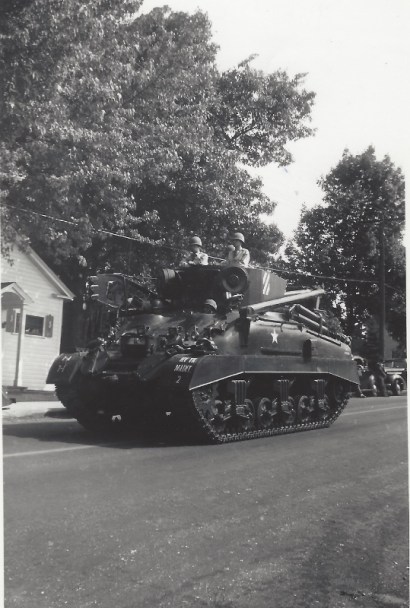
Behind this week’s photos we find not one story but two!  The first being the Sherman Tank and army vehicles heading down Ferry Street.  The second is the story behind the houses along Ferry Street we see in the background.

Memorial Day May 30, 1949 Ferry Street

These photos were taken May 30, 1949.  In that year Memorial Day observations for Hudson were  held over a two day period.  The activities were under the direction of American Legion Post #48 with Roger L. Boucher as Chairman of the Memorial Day Committee.  On Sunday, May 29th the Legion and Auxilliary attended Mass at St. John The Evangelist Church.  In the afternoon Post members joined with veterans’ organizations from Nashua and parishioners of St. Patrick’s Church Parish in the dedication of The War Memorial at St. Patrick’s Cemetery in Hudson.
2016024001a-499x800

Memorial Day 1949

On Monday Morning, May 30, a parade assembled on First Street with the line of march proceeding to Ferry Street and down the hill to Library Park assembling for the activities to be conducted there.  This  parade included a police escort, parade marshall and representatives from veteran’s and service organizations from Hudson and Nashua.  In these photos we see one modified Sherman tank.  According to newspaper write-ups the next day, there were actually six such tanks included in the Hudson parade.  At Library Park Harry Salvail  Past Post Commander was the Master of Ceremonies.  The guest speaker of the day was Elliot A. Carter of Nashua.  Wreaths were placed on three markers in honor of those who gave their lives for their country.
On Monday afternoon American Legion Post 48 participated in the Memorial Day Program in Litchfield where a tablet was unveiled in honor of the war dead of Litchfield.  The Sherman Tanks, at least five of them, proceeded to Nashua to participate in the Memorial Day parade through the streets of Nashua.
2016024001c-539x800

Sherman Tank on Ferry Street

The second story is with the houses along Ferry Street we see in the background; what is now 44 and 46 Ferry Street.  In the mid to late 1940’s and in to the 1950’s there was a large increase in traffic along Ferry Street; automobiles and gas were more available and  individuals were traveling to Nashua for employment.  During this time period there were a number of small Mom and Pop enterprises opening up.  Of course we remember The 20th Century and before that Sal’s Market. There were also the smaller variety stores like Bradley’s Market at the corner of Library and Ferry.  Even further up Ferry at what is now 44 Ferry was a small variety store operated by Herbert and Mary Shepherd.  If you lived in that area and/or attended Webster School or Hudson Junior High School,  you may have memories of your own.  George Abbott remembers going across the field between School Street and Ferry Street to buy snacks from ‘Mamie’ Shepherd on his lunch hour during Jr. High.  Neil Cunningham who lived further down on Ferry Street remembers his Mom sending him to ‘Mamies’  for a loaf of bread.  Carol (Whittemore) and David Flewelling remember going there for candy and ice cream.

Mary  ‘Mamie’ and Herbert Shephard

Mary ‘Mamie’ (Perkins) and Herbert Shephard  lived in what is now 44 Ferry Street from about 1946 until Herbert passed in 1961; at which time Mary continued to live there until 1972.  During this time Herbert was employed as a bus driver, a railroad worker, or a grocer.  Mary operated a grocery or a variety store there in the mid to late 1940’s.  Mary lived her final years in Milford with family. 44 Ferry street is now a private residence.
These photos are from the collection of the Historical Society courtesy of Paul Whittemore.  My thanks to Carol Flewelling for her assistance with the research.  This article was printed in HLN on January 27, 2017 and in the Nashua Telegraph on June 14, 2020 as a revisit.

Methodist-Episcopal Church

2003024014-698x1024

Methodist Episcopal Church C 1912

If you identified this week’s photo as an early picture of the Hudson Community Church, you are partially correct! This photo was taken circa 1910 and at that time this building was the Second Meeting House of the First Methodist Society of Hudson. It was built and dedicated in 1880. So, where was the First Methodist Meeting House and what happened to it?
The Methodist Episcopal Society in Hudson was organized in 1840. For about 10 years prior to that date a number of townspeople were embracing the religious opinions of the Methodists. Many were attending services in Nashua as there was no settled minister in this part of town; and from time to time a Methodist preacher would lecture in Hudson. The interest grew and in 1839 the Rev. Jared Perkins, the Methodist minister from Nashua came to Hudson and lectured in the No 4 schoolhouse, near Blodgett Cemetery. The interest was such that in 1840, at the Annual Methodist Conference, the Rev. Abraham Folsom was placed in charge. He was a man of energy and zeal and he quickly organized a church which would endure and continue for many years to come. Through his efforts $1,250 was raised or pledged for building a house of worship.

First Methodist Meeting House

On August 1, 1840 it was voted to build a meeting house on land donated by Abiather Winn. This plain, modest building 40 x 50 feet was dedicated December 2 of that year. Between Webster’s History and the 1858 map of Hudson; I place this First Methodist Meeting House to have been on the south side of Central Street near the intersection with Melandy Road. This meeting house had 44 pews which were sold at auction; the sale of which raised enough money to pay for the building. The $1,250 raised earlier was returned to the donors. A few years later a small parsonage was built near the south-west corner of the church a cost of $400. This location was inconvenient for the parsonage so a new parsonage lot was secured on the north side of Central Street, east of and adjacent to the Congregational Meeting House which had been build in 1842. Sometime close to 1848 the parsonage building was moved onto that lot and remodeled to include an ell and a small stable. So, the parsonage and church building were near each other on opposite sides of Central Street near Melandy Road.

In 1874 along came the Nashua and Rochester Railroad with the tracks running along Central Street separating the Methodist meeting House from the parsonage even more. This was not just inconvenient, it was dangerous. The church decided move the church to the north side of the highway near the parsonage and on the same lot. At that time the church building was enlarged and rededicated in January 1878.

Disaster struck in August of 1879, a little over 18 months after rededication. On Sunday, August 3, immediately after service a fire broke out in the stable.Both the church and the parsonage were reduced to ashes. If not for the efforts of the Nashua Fire Department, and local townspeople, a number of homes and possibly the Congregational church would have been lost. The buildings were insured for $1,500; less than 1/2 of their real value. This was a severe and nearly fatal blow to the devoted church and society.

Services were temporarily held in a small hall near the bridge owned by James Carnes. Discussions resulted regarding a satisfactory and suitable location for a new house of worship. There was much difference of opinion. Some wanted to rebuild in the same location; others wanted a location nearer the bridge. By this time a number of church members were living on the east side of Nashua. When put to a vote the location of the present brick church, now Hudson Community Church, was chosen. Plans were made and by December 7, 1880 The Second meeting House of the Methodist Episcopal Church was dedicated. It was a 40 x 70 ft building of wood and brick, two stories with a tower spire on the north-east corner.

The parsonage building, also destroyed in the 1879 fire, was not replaced at this time. The church provided whatever housing they could for their pastor. By 1888 a parsonage lot was secured by the church on Baker Street; by the fall of 1894 a parsonage was built. The church contracted with Isaac Newton Smith of Hudson Center as the builder. Cost: less that $2,500.

This church and the women’s organization were was very active in the Hudson Bridge community. During World War I the pastor, Rev. Roy Honneywell took a leave of absence from this church to serve as a chaplain in the US. Army. During the 18 months of his absence The Methodists and The congregationalists united for services in the Methodist Church. As time went on, there was more and more union between the two Protestant churches at the Bridge. As we have learned, the Congregation and the Methodist churches merged in 1930 to form the Hudson Community Church.

The photo of the Methodist Episcopal Church shown here is the one used by Kimball Webster in his History of Hudson. It is from the collection of the Historical Society.

Hudson Grange and Andre’s Restaurant C1975

1988009001

Hudson Grange and Andre’s Restaurant C 1975

Today we have many favorite places in town to enjoy breakfast or lunch: Cookies, Donna’s Place, North Side Grill, and Suzies to name a few. In the 1970’s one such favorite was Andre’s Restaurant located in the Hudson Grange Building at 76 Central Street, and shown in this photo.

Hudson Grange #11 was organized in December 1873 in the Number 6 Schoolhouse on Derry Road with Kimball Webster as the first Master. The grange, a ritualistic family fraternity originally based on rural and farm life, was one of the leading social organizations in town during the 1920’s. Meetings were quite late, beginning ‘after chores’ to permit farmers to attend to the evening milking and feeding before coming out for a meeting. A typical evening would include a crisply run business meeting, recognition of guests, a program, discussions for the good of the order and/or town, and a lunch. A program might be educational, some relevant agricultural topic, local events and/or politics, or entertaining. Often featuring local musical and/or literary talent.

Hudson Grange rented the Odd Fellows Hall (now the American Legion) for it’s meetings from 1903 to 1920. This arrangement proved satisfactory until the winter of 1920 when differences of opinion resulted between the tenants and landlord; as a result the grange looked into a change in meeting location. A large number of members were from the Hudson Center area and advocated using the Town Hall (now Wattannick Hall) in Hudson Center. The body agreed and meetings were moved to Hudson Center; an increase in membership mostly from the center area resulted almost immediately.

For the next 18 months meetings were held in the Town Hall with mixed success; depending upon your proximity to the meeting place. Members from The Bridge area did not want to travel to Hudson Center for meetings and visa versa. Meanwhile representatives from the grange were working to settle differences with the proprietors of the Odd Fellows Hall. Again the matter again came to a vote; and the body voted to return to the bridge area for their meetings.

At about the same time many members from the Center area requested withdrawal cards. This group soon obtained their own charter and Wattannick Grange #327 was organized. A smaller Hudson Grange returned to The Bridge and the Odd Fellows Building until 1935 when the building shown in this weeks photo, the former Hudson Congregational Church Building, became available due to a merger between the Congregational and the Methodist Congregations. Hudson Grange purchased the building from the newly formed Hudson Community Church. Soon after purchase the steeple was removed, the carpet was removed, and the grange held meetings and danced in what had been a church sanctuary.

In 1963 the grange entered into a lease agreement with Andrew Kinsville to establish a restaurant and a catering center; the grange retained ownership and use of the hall as a meeting place. This arrangement continued and Andre’s Restaurant and Antoinnes Catering grew in popularity with many service organizations holding their regular meetings here. Then, in the early morning hours of May 9, 1977 the building known as Hudson Grange (formerly the ‘White Church’ was destroyed by fire. A small group of young intruders were held responsible for the fire as an act to cover up a robbery. At the time of the fire the premises were used for regular meetings by Hudson Rotary, Hudson Lions, chamber of Commerce, Kiwanis Club, and United Commercial Travel. Each of these organizations quickly had to make arrangements to meet elsewhere.

Hudson Grange also made arrangements to meet elsewhere in town and the building was never replaced. By the mid 1980’s the property was sold. A private residence is now located at 76 Central Street. A few years ago in 2001 members of Hudson Grange and Wattannick Grange merged back into the charter of Hudson Grange. Meetings are now held in Wattannick Hall in Hudson Center.

Last Minute Gift Ideas


Hudson Historical Society

Last Minute Gift Ideas for the Holidays

FREE SHIPPING through December 31, 2016!

This slideshow requires JavaScript.

Perfect for that person on your list who might be hard to shop for just the right gift!

Remembering Benson’s Wild Animal Farm by Bob Goldsack $17.99

Images of America Benson’s Wild Animal Farm by Bob Goldsack $21.99

Legendary Locals of Hudson, NH by Shawn and Laurie Jasper $21.99

Two book set, Webster’s History of Hudson, NH 1673-1913 and Town in Transition    1913-1977 $95.00.

Please send your order and shipping address along with a check made payable to  Hudson Historical Society P.O. Box 475 Hudson, NH 03051.

Thank you!!

www.hudsonhistorical.com

H. E. Smith and Sons Farm Stand C1980

1983012014-1

H.E. Smith and Sons Farm Stand C1980

With this week’s photo of The H.E. Smith Farm Stand on Kimball Hill Road we get to visit with another Smith Family in Hudson.  By 1924 Elmer Frank and Ethel May (Connell) Smith and their young family of 2 sons  (Henry Elmer and Robert Connell) and 2 daughters (Elizabeth Ella and Gloria Lillian) settled on a 300 acre parcel of land on what was then known as Pelham Road, now Kimball Hill Road.  The location of the Smith parcel is at and near  the intersection with Gibson Road and near the town line with Pelham.
Recently married Henry Elmer and Mary (Kayros) Smith began their dairy farm on a portion of his father’s land in 1933.  At that time there were about 70 farms of various sizes in Hudson.  Henry and Mary established their home around the corner of this farm stand on Gibson Road.  Their they raised a family of 3 boys (Dustin, Tom, and Tim) and 1 girl (Nancy).  The family continued with the dairy farm with all members helping out where they could.  In 1963 they gave up dairy farming and switched to plants and vegetables and opened the farm stand  as  means to marketing their produce.  This established a tradition which Henry’s  son Tom has stayed with and has continued to the present with his own son, Dylan.  Management of the farm and farm stand was passed from Henry to Tom in 1977.
Gloria and Elizabeth, sisters of Henry remained in Hudson after they married.  Gloria  continued to live on the family homestead and married Leslie Binks.  Leslie was an animal trainer for Benson’s Wild Animal Farm; Gloria became became a prominent business woman and leader in Hudson.  Her sister, Elizabeth married Richard  Albee and they settled on Greeley Street; living there for many years and then moved to Alaska.
   After raising their family Henry and Mary divided their home into 2 living quarters.  Tom, his wife Tina, and their family lived there along side his parents.  Henry passed in 1991 at 80 years of age; Mary passed in 2004 at the age of 94.  Both remained on and helped with the work of the farm as long as they could.  Today operating the farm remains a family affair:  Tom, his wife Tina, their son Dylan, and a sister-in-law Charli.  Tom’s daughters and his brother, Tim, helps with the operation from time to time.
The Smith Farm specializes in home grown vegetables and plants.  It is estimated that over 90% of the products they sell were grown or started on their own farm.  This year the  stand will remain open through the holiday season specializing in holiday trees, wreaths, and kissing balls.  The kissing balls are made by the Smith family; trees and wreaths are brought in from a reliable grower.
By February of next year work will begin in the various greenhouses starting a wide variety of veggies and flowers for both their own gardens and to sell in the farm stand as starter plants.  When I talked with Tommy he said…”we’ll be here next year!!”
      The Smith family has been farming on Kimball Hill Road since 1933.  First Henry and Mary with help from their growing family.  The oldest, a daughter Nancy, married and moved to Illinois and raised a family there.  Dustin, the oldest brother, remained in the neighborhood and a close brother and friend with Tom, but opted for a different career path.  He and his wife, Susan, began a computer business called ‘ComputerSmith’ in the 1980’s.  Dustin lived nearby,just a quarter of a mile from brother Tom in the original Smith family homestead.  Younger brother, Tim, lives in Hudson and helps with the work of the farm from time to time.  The third generation, Dylan, works along with his father Tom.
The photo of the Henry E. Smith Farm Stand C 1980 is from the photo collection of the Hudson Historical Society.


Hudson Shopping Center

1977032018

Hudson Shopping Center C1977

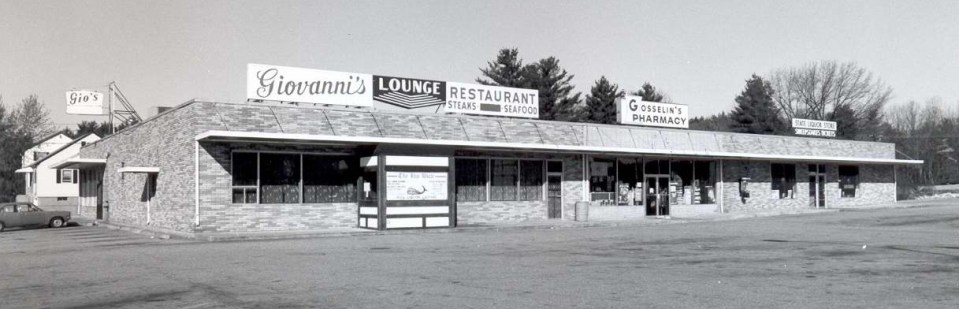
By the mid 1960’s business at the Hudson Shopping Center and their main store, The Hudson Super Market, was expanding and the Provencal Family would soon be expanding yet another time.  In early 1968 the State of New Hampshire was searching for a site in Hudson for a State Liquor Store and this shopping center was soon selected as the site.  By July of that year the ground breaking ceremony was held.  Construction of a multi-unit building was started immediately and completed in November.  By the first week in December what was slated as the most modern self service facility operated by the state was opened at the corner of Birch Street and Lowell Road and part of the  Hudson Shopping Center.  Our first photo shows the building  as it appeared In 1977.    At that time  the building was the site of  Gio’s Pizza on the Birch Street side with Giovanni’s Blue Whale Restaurant, Gosselin’s Pharmacy, and the NH State Liquor Store facing Lowell Road.
OLYMPUS DIGITAL CAMERA

TBones Plaza 2006

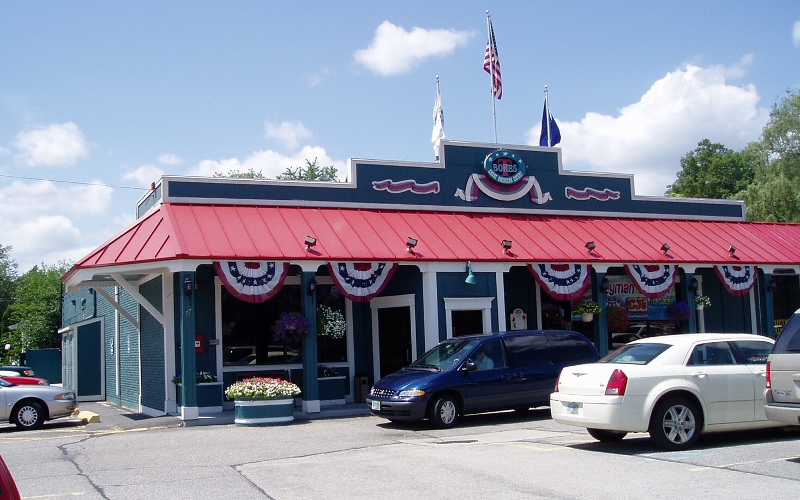
Today this is knows as T-Bones Plaza.  T-Bones moved into Hudson in 1991 and soon became a popular place for lunch and/or dinner.  In 2006, when our second photo was taken, this was the location of T-Bones as well as Postal Center, Supercuts, Subway, a dance academy, tanning spa, and a dry cleaners.  Both photos are from the Historical Society Collection.


Hudson Super Duper Market

super-duper

Hudson Super Duper C 1970

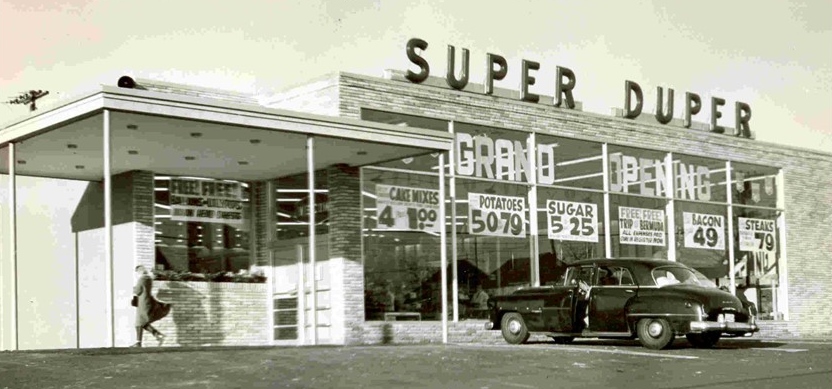
As early as the mid 1950’s the ‘go-to’ grocery store for many Hudson residents, especially those living on or near Lowell Road, was the Hudson Super Market owned and operated by Robert “Bob” and Doris Provencal.   Hudson was a fast growing town and business expanded so that by September 1970 the Provencal family held the grand opening of The Hudson Super Duper as shown in this week’s first photo.   This event included onsite broadcasting of a local radio station, door prize of 18 inch portable TV, and special sale prices from all departments within the store.
The story of The Hudson Super Market, The  Super Duper, and later The Piggly Wiggly, is also the story of Bob and Doris Provencal and their family.  It began  as early as 1936.  Bob, then 16, lived with his family a short distance from what would later become the Super Duper. Bob needed extra money to buy a car.  He had the idea of making bleach water and selling it for .20 a gallon to neighbors and friends.  His efforts were profitable enough so he could purchase his first car.  At 18 he took over his father’s filling station in Hudson as a mechanic.  Again he was successful and needed to hire extra people.
After our country became involved with World War II, Bob wanted to enlist in the Army.  His classification made him not eligible.  Wanting to do something to help, he closed the gas station and went to work at Fort Devens where he ran a dynamometer and tested White Engines.  By 1945 he met and married Doris Ledoux, also of Hudson.  Soon thereafter he resigned from Fort Devens and re-opened the gas station, hoping to settle in Hudson; but there was a lack of housing in town so they settled in Nashua while making plans for and building an apartment building in Hudson.  The rent they received would help pay the mortgage plus they would have a place to live in Hudson.  As things were looking bright for the young couple, they were saddened by the loss of their first born son at the age of 10 days.
For her own health Doris knew she should keep busy.  She suggested they put an extension onto their house so she could open a small store.  This they did, and Doris ran the store where she met people while Bob ran the business of his own across the street.They added a grill and soda fountain and the endeavor became an immediate success.  When not busy in the station he would help Doris in the store.  One could say ‘the rest is history’.
The Hudson Super Market was opened in October 1952.  Business grew and the store was expanded.  A  few years later the family realized the existing store could not accommodate the growing demands.  On September 2, 1970 the ribbon cutting ceremony for the Hudson Super Duper took place.   That same year Bob Provencal was named Grocer of the Year by The NH Grocers Association.  Doris and Bob had a family of 2 sons (Greg and Donald) and 1 daughter (Charlene).  The family grew up with the grocery business; and by 1970 Charlene was studying floral arrangement in Boston.  She would later open her own Charlene’s Flower Shoppe nearby on Lowell Road.  Donald was managing the frozen food department in the family store; and Greg was studying business in a local college.
By 1972 the Provencal family aligned their Super Duper Market with the Piggly Wiggly enterprise.  This Super Market, along with Shop and Wash, and Richard Coiffures were located on Lowell Road, a major part of The Super Duper Shopping Center in Hudson.
 By 1977 The Nashua Trust Company,  which held the mortgage,  foreclosed on the The Piggly Wiggly building.   Two business remained there as tenants:  Richard Coiffures and the Shop and Wash Laundromat and Dry Cleaners.  In 1979 Nashua Trust announced its  plans to build a new banking facility on this location and the two remaining tenants had to vacate.  By 1980 construction was completed and The Nashua Trust moved from its location at 1 Derry Street to open its Hudson Community Banking Center at 71 Lowell Road.  Since that time due to bank mergers and closures  the Nashua Trust became The First NH Bank and later Citizens Bank. Our second photo shows this site in 2006 – home to Brooks Pharmacy, Citizens Bank, and Hudson Chamber of Commerce.  
OLYMPUS DIGITAL CAMERA

Citizen’s Plaza 2006

 
Both photos are from the Historical Society Collection.  Much of the history of the Provencal family appeared in  February 24, 1971 edition of The Hudson News.

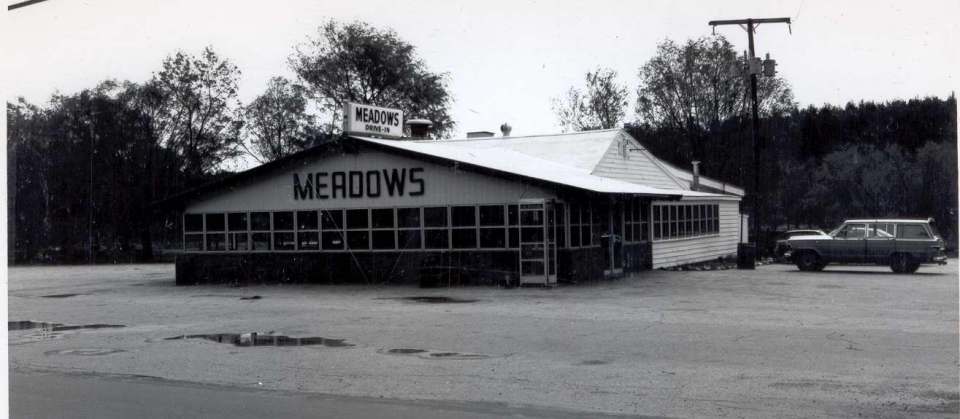
The Meadows Restaurant of Hudson Center C 1977
1977036030

The Meadows C 1977

In the late 1940’s traffic along the Route 111 corridor known as Central Street in Hudson Center was on the increase.  This was the result of the popularity of Benson’s Wild Animal Farm as well as the convenience of automobile travel for business and pleasure.  Businesses were beginning to open up or relocate  to  this section of the highway.    One of these that holds a permanent place in our memories is “The Meadows”, a seafood restaurant.
 
In September 1947 John Wollen, founder and long time owner of The Meadows,  purchased about 20 acres on the east side of Central Street from Perley B. and Clara E. Smith.  The Smith’s lived in the area and Perley operated a Cider Mill just a few lots south towards Belknap Road.  By the spring and summer of 1949 The Meadows opened for business and soon became a popular eating place for the locals as well as the tourists visiting Benson’s.  Their menu included fried clams, haddock, scallops, and sandwiches along with onion rings, french fries, and cold slaw.  A soda fountain was added for drinks and ice cream based deserts.  In 1962  a miniature golf course and a shuffle board court were added just north of the restaurant and near the meadow around Merrill Brook.  
 
John Wollen was born in Hudson and educated in Nashua Schools.  He was the founder and owner of Meadows until a short time prior to his passing in November 1985.  He also operated the McNulty and Foley catering and function hall when it was located on Amherst Street in Nashua.  
 
The Meadows was destroyed by fire on November 23,1992  after business was closed for the day.  A neighbor across Central Street noticed the flames and called the fire department.  The fire was fought by the Hudson department with assistance from Londonderry, Windham, Nashua, and Litchfield.  At the time the building was owned by Arthur  Bursey of Manchester and the restaurant operated by George Apostolopoulas of Wilmington, MA.  The Meadows did not re-open following the fire.  
Many Hudson residents remember Berk and Son Farm Stand and Scott’s  Wood craft which operated on the northern end of The Meadows parking lot adjacent to Merrill Brook.  Little remains of The Meadows except our own memories of the delicious seafood and the summer evenings playing miniature golf.  The 20 plus acres with 500 feet of frontage onto Central Street which Mr Wollen purchased in 1947 has been idle for many years and is on the commercial real estate market.  
 
Today’s photo of “The Meadows” was taken about 1975 at the time of the preparation of “The Town In Transition” an update to Hudson’s History.