October 2, 2015 1:05 pm / Leave a comment

Ice Break 1834 to C1965
How many of our readers remember the ice break in the Merrimack River? Not many years after the wooden bridge was built at Taylor Falls, an ice jam and high water pressed so hard against the Hudson pier that there were fears for the safety of the bridge. To avoid this danger in the future this ice break was erected in 1834. Placed in the river on the Hudson side just north of the bridge this ice break has protected three bridges against surging ice flows: the wooden bridge, the iron bridge, and the concrete bridge. It was removed during the construction of the Veterans Memorial Bridge, the northern span of our current twin bridges. Photo from the Historical Society Collection.
September 25, 2015 12:09 am / Leave a comment
Library Park, that beautifully maintained, triangular park bounded by Ferry, Derry, and Library streets was a gift to the Town of Hudson by Mary Field Creutzborg and the efforts of her son-in-law Dr. Alfred Hills. There is a granite boulder with a tablet at the park near the intersection of Ferry and Derry Streets The tablet reads: LIBRARY PARK – The gift of Mary Field Creutzborg 1911.

Library Park C 1920
Just prior to 1911, this parcel of land was owned by parties living in Nashua. They had sub-divided it into eleven house lots and offered then for sale. Two had been sold and a house was being erected on one of them. The residents of Hudson were beginning to realize that a potential of eleven houses in that area would be of no real value. There had been earlier discussion about acquiring the land for a public park; but, no action had been taken.
A special town meeting was called May 15, 1911 to see if the town would authorize the Selectmen to acquire this land by eminent domain for the purpose of a public park. Dr Hills offered a resolution: that the Selectmen be authorized to acquire the property for a public park, to be known as Library Park, at no expense to the town. The resolution passed unanimously. The owner of the house under construction was compensated with a much larger lot in a more desirable site.
The selection of the name Library Park was deliberately chosen by the Hills/Creutzborg family. Mrs. Ida Virginia Hills had passed away and the nearby library had been presented to the town in her memory.
Our first photo of Library Park was taken C 1920 from the corner of what is now Ferry and Library Street. This photo is courtesy of Gerald Winslow and a part of the Historical Society Collection. The second photo is Library Park from Ferry Street looking toward Library Street C 1976 and is also a part of our collection.

Library Park 1975
Library Park is greatly appreciated by the citizens of Hudson. We are grateful to the donors for their foresight and generosity.
August 28, 2015 2:34 pm / 2 Comments on Concrete Taylor Falls Bridge

Concrete Taylor Falls Bridge
In 1909, after the iron bridge was found to be unsafe, a committee involving knowledgeable people from Hudson, Nashua, and managers of the street railroad company began plans for a replacement bridge. At first the plan was to replace the bridge with either an iron or a steel bridge. After consideration, this plan was tabled in favor of far more substantial structure of reinforced concrete. By June 1910 there was a contract to erect a reinforced concrete bridge with sufficient strength for a 50 ton electric train. This bridge was to have five arches, four piers in the river, and an abutment on each end. The roadway was to be 30 feet with a 6 foot sidewalk on the north side. There were problems during construction, especially with one of the piers on the Nashua side. A final inspection was made and the bridge accepted in November 1912.
During it’s lifetime the traffic from the eletric cars dimished and ended. The old concete bridge survived the flood of 1936. Over the years, travel from autos increased in both weight and volume. That increased usage, plus the demands from the trucking industry took its toll on the bridge. Discussions regarding a new bridge began in the early 1960’s and reached a milestone in 1970 when the Veterans Memoial Bridge was opened to the public. Emergency repairs were made to the concrete bridge in order to ‘shore it up’ for use during the construction period. Once the north span of the new bridge was opened the old concrete bridge was permanently closed and within a few years was replaced with the new Taylor Falls Bridge (southern span). Photo from the collection of the Hudson Historical Society.
August 14, 2015 12:26 am / 4 Comments on Taylor Falls Wooden Bridge

Taylor Falls Wooden Bridge
Up until 1826 there was no bridge across the Merrimack River from as far south as Lowell and north as Manchester. Reacting to this need some of the more prominent men of Hudson and Nashua petitioned the State Legislation for a charter to build a bridge. The wooden bridge shown in this picture was built by the Proprietors of the Taylor Falls Bridge and opened as a bridge in 1827. The characteristics of this bridge are quite interesting. It was 509 feet long with a 16 foot roadway and no sidewalks. The abutments had one tier of faced stone on the outside, filled with loose stone, all laid dry with no cement. A few years after completion ice jams and water pressed so hard against the abutments that an ice break was erected in 1834 to buffer the bridge from this danger. This ice break remained in use until it was removed during construction of the Veterans Memorial Bridge. It continued as a toll bridge until about 1855 when the county laid out a public highway over the bridge and it became a toll free bridge.
At a town meeting in 1881 a committee was chosen to examine the bridge and consider what was best: repair or replace. The committee recommended replacement as soon as practical. After conferring with a similar committee from Nashua the decision was made to replace this wooden bridge. Photo from the Hudson Historical Society collection.
August 7, 2015 1:00 am / 2 Comments on Ferry Boats Across The Cross The Merrimack River

Ferry Boat across Merrimack
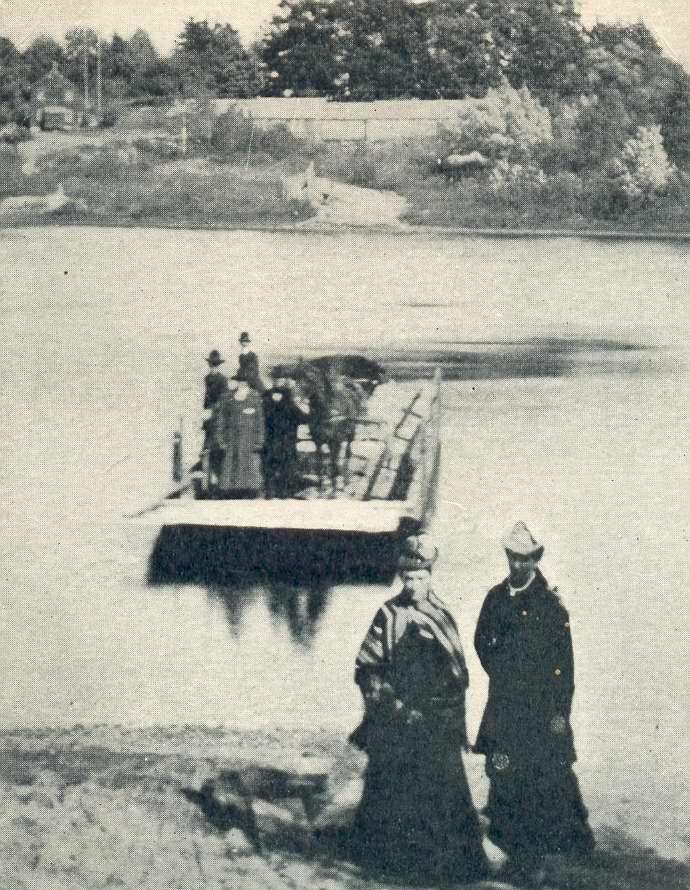
In the early history of our town, up until 1826, there were no bridges across the Merrimack River between Lowell and Manchester. River crossings between Hudson (then called Nottingham West) and Nashua were made by ferry boats similar to the one shown in this week’s photo. During these early years there were no less than three ferries operating between the two communities.
The earliest ferry was operated by Eleazor Cummings. His ferry left the east shore of the river a short distance north of the Veterans Memorial Bridge. It landed on the west side just south of the mouth of the Nashua River. Operation of this ferry continued until 1742, at which time Mr. Cummings relinquished his rights to another person who established Dutton’s Ferry just below the Taylor Falls Bridge.
A second ferry, called Hardy Ferry, operated from Lowell Road near the Hardy Farm. A Third ferry, Hills Ferry, was operated on Hills land just south of the town line into Litchfield. This was started by Nathaniel Hills and was continued by later generations of his family.
The first bridge between Nashua and Hudson was built in 1826. Even after it’s construction some of these ferries continued to operate. Photo from the Historical Society Collection.
July 31, 2015 1:50 am / 2 Comments on Twin Span Bridge Across the Merrimack C1975

Twin Span Bridge C 1975
The challenge of crossing the river between the communities of Hudson and Nashua has been a re-occurring one since the beginning of our town’s history. The twin span bridge shown in this C 1975 photo, is the result of such a challenge which began in the early 1960’s and extended for a decade or more. This photo was taken from the Hudson side at Ferry Street. These spans, constructed at separate times, now provide for traffic between the communities of Hudson and Nashua.
First to be completed was The Veteran’s Memorial Bridge (northern span). This span was constructed along side and parallel to the aging concrete Taylor Falls Bridge. Following 15 months of construction this span was opened in September 1970. Emergency repairs had been necessary to “shore-up” the deteriorating Taylor Falls Bridge; load limits and height restrictions were imposed to postpone its demise. State officials made the decision to permanently close the old bridge once the new span opened in September 1970. This set the stage for the construction of the southern span shown in this photo.The old bridge was demolished in the spring of 1973 and The Taylor Falls Replacement bridge opened in December 1974.
As necessary as these bridges were, their construction and the access roads required for their use completely eliminated the general business area which had developed at the bridge near Central and Ferry Streets. Photo from the Historical Society collection.
July 17, 2015 3:22 pm / Leave a comment
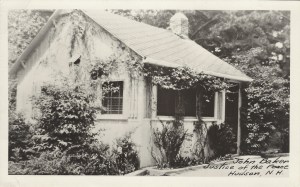
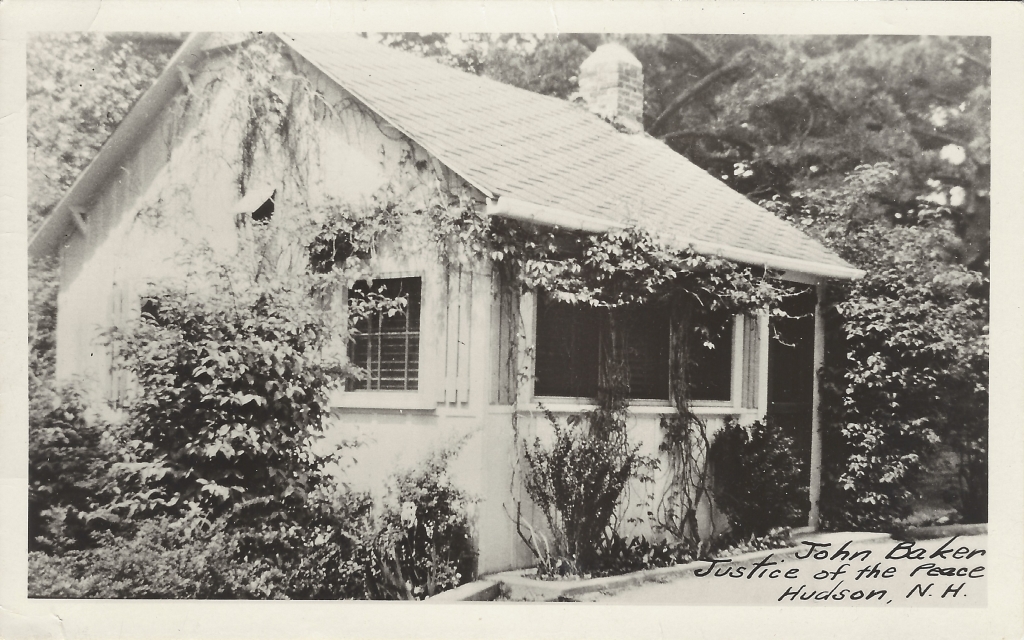
Baker Office Building
This popular photo of The Baker Office Building is on display in the Foyer at the Hills House on Derry Road. Visitors touring the Historical Society will often comment “This is where we got our marriage license”! John E. Baker served as Town Clerk and Treasurer from 1940-1965. At first he conducted his town business within the Baker Brothers’ Store on Central Street. By 1944 this privately owned office building was built on part of the old Kendrick property at the point of land between Derry Road and Baker Street. From this building Mr. Baker conducted his town responsibilities along with his private business as a John Hancock Insurance Agent and Justice of the Peace until the present Town Hall was completed in 1965. At that time the town office was moved to Town Hall on School Street.
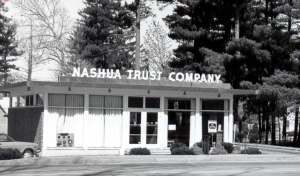
Nashua Trust Building Derry Road
When the access to the newly constructed Veterans’ Memorial Bridge were designed Baker Street became a dead end street at Ferry Street. This small office building was moved to a private residence on Ledge Road.
The Nashua Trust Company had established a temporary branch office in the Morey Building on Ferry Street and opened for business by the end of August 1964. By March 1967 the bank moved into this brick building on Derry Road opposite Library Park and near the site of the earlier Baker Office Building. By August 1980 the Nashua Trust expanded it’s operation and relocated to 77 Lowell Road, occupying a portion of the former Piggly Wiggly Building. After a series of bank mergers and buy-outs the Lowell Road site is now occupied by Citizens Bank. This photo shows the Nashua Trust Derry Road building C1976. The building still stands and has been used by a real estate firm and a loan company. It is currently vacant. Photos from the Historical Society Collection.
June 5, 2015 12:11 am / Leave a comment
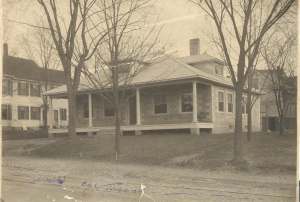
Bungalow Style Home of Mr and Mrs Harold Johnson on Ferry St
The bungalow style home, shown in the first picture, on Ferry Street was built of stone blocks with a metal roof after the previous family home was destroyed by fire in 1913. A careful look will show the electric car tracks on Ferry Street. The previous home, in the same location, was a two story clapboard house. It is shown here in 1913 fire as the firemen from
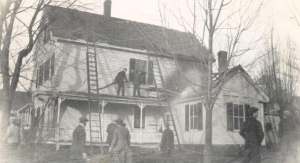
Hudson men battling an active fire at the Bassett Home on Ferry Street – 1913
Hudson were battling the blaze which destroyed the house. We see the men on the porch roof with hoses in an attempt to contain the fire. These houses were the home of the Bassett/Johnson family from about 1890 until the mid 1970’s. The first Indian Head bank building in Hudson which opened in November 1965 was to the right of this home. By the mid 1970’s the bank had expansion plans and this property was purchased, the building razed, and the enlarged bank building constructed by 1976. The original bank building was moved to the corner of Ferry and Library Streets and is now in use by the Hudson Fire Department.
Almeda (Bassett) Johnson was a Hudson native. She married Charles Harold Johnson of Portsmouth in 1925. They spent most, if not all of their married life in the bungalow on 15 Ferry Street. He worked as a foreman in Nashua. Almeda was active in the Community Church, women’s organizations, and in the mid to late 1950 was the proprietor of Wee Wisdom Kindergarten which she operated from her home. Almeda’s father, Joseph Bassett was a painter of high end carriages and automobiles.
This location is now the site of Sandander bank. The photos were a donation to the Hudson Historical Society from Mrs. Almeda (Bassett) Johnson. (Published HLN June 5, 2015)
May 15, 2015 11:02 am / Leave a comment

St John’s and Library Street School c1977
This familiar school on Library Street was built in 1957 by St. John’s Church as a private parochial school. During the year 1974-75 the church found it necessary to close the school. The Hudson School Board and officials of the church worked on a mutually agreeable contract so that all Hudson students could be accommodated. St. John’s school was re-opened in the fall of 1975 as part of the public school system of Hudson. The town leased the school from St. John’s for that first year with an option to renew for up to 2 years. As a part of this lease agreement St. John’s Church would use the facilities during non-school hours for it’s confraternity christian doctrine (CCD) classes. The town purchased the property in July 1976 at a cost to the district of $616,000; a significant savings when compared to the cost of new construction at the estimated 1.2M. After this purchase the school was renamed Library Street School. Today this school at 22 Library Street is part of the town’s Early Learning Center; as such all preschool and kindergarten classes are held here. Photo by John Allison and a part of the photo collection of The Hudson Historical Society.
January 13, 2015 12:12 pm / 1 Comment on Post Office Square at Central Street c1900

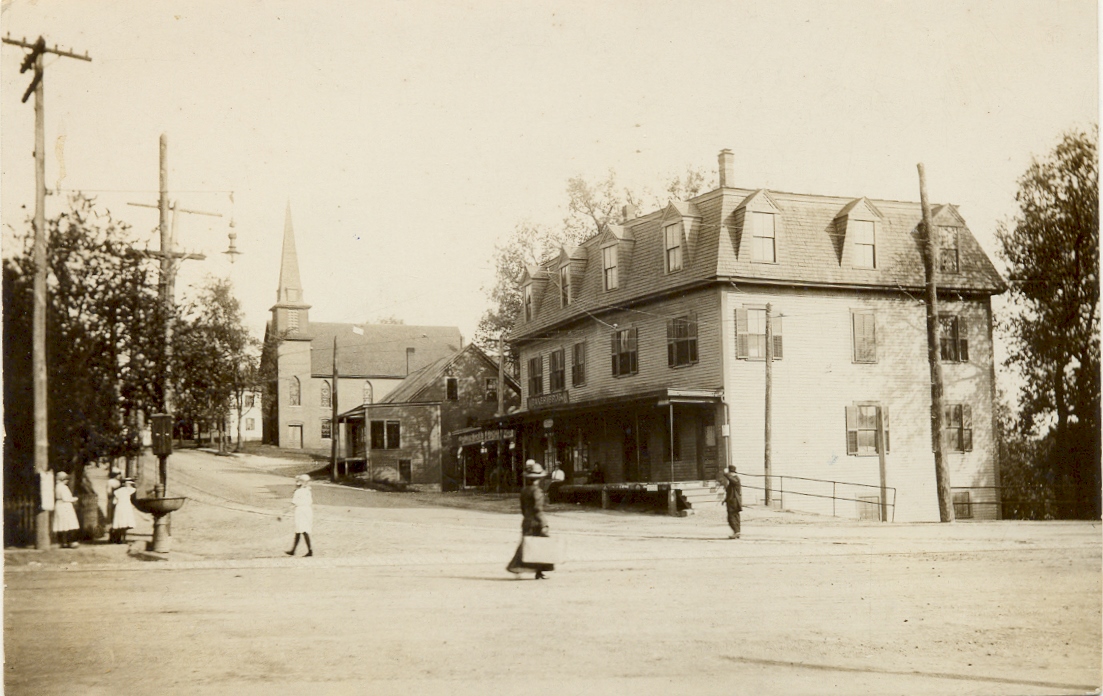
This is among my favorite pictures! A view of Central Street from Post Office Square at the bridge c1900. On the hill we see the Baker Brothers Store, Cumming Brother’s Shop, and the Methodist Church (now the Community Church). In the fore ground to the left we see the watering fountain. Walking across the square are pedestrians coming and going to the waiting station for the electric trolley. If you look carefully you can see the electric tracks coming from Nashua and up Central, out Webster, and Ferry Streets. From this square one could take public transportation to Nashua as well as down Webster Street to Manchester; up Ferry Street to Hudson Center and on to Salem; and up Central Street to Lowell Road and on to Dracut and Lowell. The waiting station and ticket office is off the picture to our right. In 1853 the location of the Hudson Post Office was moved from Hudson Center to the bridge area and was located at first in the Greeley Store Building. As time progressed, the location would shift from that site to the Baker Brothers Store depending upon who was appointed Post Master. Photo from the Historical Society collection.





 Remember Hudson NH When...