Home » 2017 (Page 4)
Yearly Archives: 2017

Hudson Center From Kimball Hill 1946

Hudson Center from School 1946

Hudson Center 2017
EssoHeat Truck Crash May 23, 1947

Essoheat Truck Crash May 23, 1947
On May 23, 1947 John J. Montgomery of Lowell, MA was operating this EssoHeat delivery truck in Hudson on route to a delivery in Derry. At about 3:00 pm he lost control of the vehicle near the Gile home on Derry Road and crashed headlong into a stone Wall. Mr. Montgomery was shaken up but escaped serious injury. The front end of the truck was badly damaged. Police Chief Polak reported the accident was due to faulty steering mechanism.
Police Chief Polak detailed police officers to guard the truck and also called for a fire truck which remained at the scene as a safety measure until 10:00pm. Assistant Fire Chief Harry D. Emerson was in charge.
I had no idea where the Giles home was on Derry Road. In 1947 Derry Road also included Old Derry Road out to the Londonderry Line. After a trip to the Registry of Deeds and access to the town records I learned that the Giles home had been located at what is now 145 Old Derry Road. As you travel on Old Derry Road, heading towards Londonderry, you pass the Hudson Speedway and the intersection with Robinson Road. On your left is the Senter Cemetery. About 1/10 mile further you come to 145 Old Derry Road on your right
Elizabeth Gile purchased this homestead in 1944. Prior to that the property was owned by Alphonse Lee and his wife Delima. Prior to that it was owned by members of the Heath family and earlier the Senter Family. In 1952 Roy Cross and his wife Lena (Avery) purchased the property from the estate of Elizabeth Gile. Roy Cross passed in 1959 and Lena continued to make this her home until she passed in 1970. In 1972 the property was purchased by Paul F. Gauvreau from Lena’s daughter Flora Kinsey. Paul had a keen interest in this section of Hudson particularly the Poor Farm and the Poor Farm Cemetery behind the farmhouse on Old Derry Road. Paul’s research was instrumental in kindling public awareness of the old Poor Farm Cemetery.
Officer Polak and the Cruiser 1942

Officer “Andy” Polak and the Cruiser 1942
Webster Street looking North C 1920

Webster St North from Ferry St C 1920
This brings us to this week’s photo of Webster Street, looking north, just after the intersection with Ferry Street C 1920. Along the left of Webster Street are the tracks of the trolley which went north to Manchester. Think of the sharp turn the trolley car(s) made after leaving the bridge, stopping at the transfer station to leave and/or pick up passengers, then making the turn onto Webster street and heading north.
The small building on the left is the grainery which history tells us was also used as the local jail. You may ask what became of the jail? According to the Town Report for the year ending 1918 the town paid Law and Ingham $13.00 to move a safe and cells. Did not state where they were moved from or to. Also, a brief article in the February 19, 1918 edition of the Nashua Telegraph tells us that a young man named Roland Abbott had plans to repair and remodel the building and use it as a club house for the young people of Hudson. It is doubtful that this club house ever became a reality. We do know the building was later moved to Ferry Street, placed on a foundation and used as part of the dwelling at what is now 88 Ferry Street. At the time of this move the property was owned by Nathen Cummings. Some residents of today may remember it as the home of Clayton and Victoria Smith. Photo from the Historical Society Collection.
Hudson Center School Bell

School Bell at Hills House
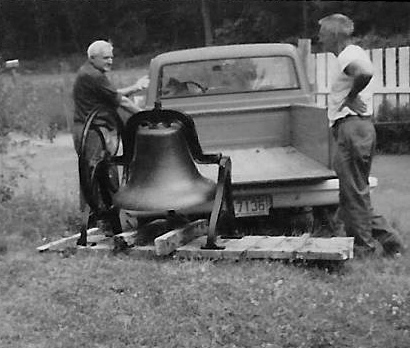
Charlie and Eric Parker Transporting Bell
Aerial View Fulton and Reed Streets C 1955

Aerial View Fulton, Reed, Central Streets C 1955
If you live in the vicinity of Maple Avenue, Reed, Fulton, and Central Street you may well be able to locate your home on this C 1955 aerial photograph. Based upon our accession records at the Historical Society this photo was taken C 1955 from an aircraft owned by Sanders Associates (now BAE Systems of Nashua). The lack of foliage on the trees during the winter months increased the visibility of the buildings from the air. The aircraft was flying in a south easterly direction over this area.
If we look to the left of center the easiest building to locate is the American Legion building at the corner of Central and Fulton Streets at 37 Central. Opposite Fulton at Central is the beginning of Chase Street. We can see the homes from 43 Central westerly toward Maple Avenue and the bridge; including homes to 16 Central Street. The Hudson Community Church (Brick Church) is not shown but you can see the shadow of the church building on Central Street and the home opposite the church. At the time of this photo this home was known as the Dudley/Emerson House; home of Deputy Harry Emerson; a 50 year member of the Hudson Fire Department. In the late 1960’s this home and other homes in the area of Central and Ferry Streets were razed in order to improve access to and egress from the Veteran’s Memorial and New Taylor Falls Bridges. This lot remained empty until 2016 at which time the property was sold and a duplex house is now being built on this site.
Between 27 and 25 Central we see Maple Avenue going southerly past the intersection with Reed Street on the left and on toward what is now Merrill Park on the right and near the edge of the Merrimack River. At the end of Maple Avenue is the remains of the right of way for the steam railroad used by residents to make a connection with the southern end of Fulton Street. Another easy to identify landmark is at the corner of Maple and Reed Street. This house is the former Merrill Family Home. Known to many as the home of Marjorie and Natalie Merrill and a previous site of Hudson’s Town Library.
Returning on Fulton Street towards Central we see most of Reed Street running parallel with Central and extending towards Gillis Street on the upper left of the photo. As we move away from the bridge area we can identify a number of undeveloped lots and open space beyond Gillis and Reed Streets.
One final street to locate is the beginning of School Street just at the intersection with Cummings Street as shown on the lower left in the photo. Easily identified are the homes of Paul and Hazel Buxton and their family on School Street; and the former home of Dr. William Quigley and his family facing the intersection with Cummings Street. The Buxton Family has (and is) serving the town in a number of areas; including Fire Department, Historical Society, and Hills Memorial Library. Dr. Quigley provided medical services to Hudson and Hudson Schools. This photo is from the collection at the Historical Society.
Odd Fellows Building

Odd Fellows Hall C 1912
Before 1895 a good number of men from Hudson were members of one of two Odd Fellows Lodges in Nashua. The participation from Hudson grew as did interest in organizing a lodge in Hudson. In October 1895 decisive action was taken and Hudson Lodge No 94 was instituted in the newly constructed Andrews hall located near the bridge. Membership grew and so did interest in having their own building in Hudson. In 1902 the Odd Fellows Building Association of Hudson was organized for that purpose. Many members of the lodge as well as many townspeople who were not members became stockholders in this endeavor. A parcel of land on Central Street was purchased from the William Hutchinson and Charles M. Woodward. This parcel, located at what is now 37 Central Street, had been a portion of the estate left to Helen E. and H. Georgina Gillis from their father. At the time of purchase Fulton Street was in the planning stage.
The building contained a large ‘lodge room’ with anti-rooms and other accommodations for the lodge membership. The basement contained a spacious banquet room and adjacent kitchen. The first floor had another large hall, called Association Hall. It was a large assembly room complete with a stage.
The building was completed and occupied by the lodge in early 1903. This building not only provided meeting space for the Odd Fellows and the Echo Rebekah Lodge it also provided meeting and banquet space for other organization and private occasions. The lodge continued as a thriving organization or several years, helping their fellow man, assisting widow and orphans and generally offering a good influence in Hudson. By the early 1940’s membership was dwindling and by 1947 the remaining members transferred to Granite Lodge in Nashua.

American Legion C 2016
In April 1944 after a vote by the residents at the previous Town Meeting the town purchased the building for $4,000. The intent of this purchase was to donate and dedicate the building to the American Legion in honor and memory of all veterans who have or will serve to defend our country. A condition of this purchase and transfer was that future maintenance and improvements were the responsibility of the American Legion Post 48. In 1954, in order to clean up any question of title, the property was again deeded to the American Legion Post #48 by the town. The earliest photo is of the Odd Fellow’s Building as shown in The History of Hudson C 1912. The later photo is the American Legion Building as shown in the town records.
World War II Honor Roll and War Memorial

WW II Honor Roll at Library Park
Soon after the attack on Pearl Harbor in December 1941 the registration of young men for the draft was begun by the Draft Board of Exeter, NH. Registration of Hudson men was held in February 1942 in the lower room of the Hills Memorial Library. Males between 18 and 45 were registered and classified. The total population of our town was then about 3,400.
Members of the American Legion Post No. 48 constructed an honor roll on the east side near Library Street) of Library Park in 1942. As individual men and women entered the service their name was added to the honor roll. As the number of service men increased the initial honor roll board became filled and was replaced by a larger one. The Post Commander, Webster W. White, and a committee of three members, Robert Pratt, Chairman, Paul Buxton, and Harold Farnum with cooperation of the Town Clerk were responsible for the posting of names.The earliest photo shown here is that of the World War II honor roll with some 368+/- names as listed in the Town Report for the year ending January 31, 1944. After the hostilities ended in 1945 this honor roll remained in place on Library Park. Just how long it remained, I am not sure. After it was removed there was no War Memorial for veterans of World War II or any subsequent wars or conflicts until August 1991 when the American Legion erected the present War Memorial.
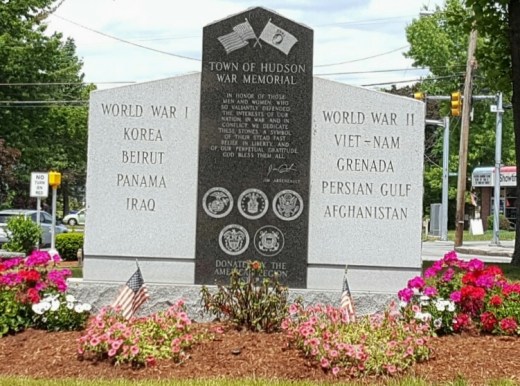
War Memorial 2016
The Hudson Veterans War Memorial is in honor all who have honorable served in our armed forced, both living and deceased, during all conflicts of our great nation. This project was started in 1989 and authorized by the veterans group in early 1990. Past Post Commander “Billy” Mitchel promoted the original concept, which was further refined by other post members. As with most projects of this magnitude, help from many sources were needed. Mr. James Arsenault designed the center of the monument, Hudson Monument Company was contracted for the stones and artwork. Employees of the Hudson Public Works Department volunteered services for the groundwork, concrete was provided by Brox Industrues, and Hudson Paving Company formed the foundation. The completed memorial was dedicated Sunday August 18, 1991 as part of Hudson’s Old Home Days. Both photos are from the collection of the Historical Society.
147 Derry Road
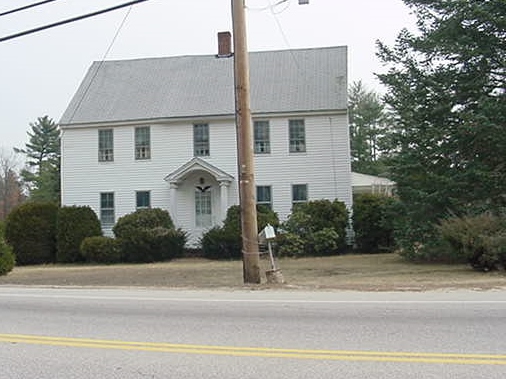
The Home at 147 Derry Road C 2015
This house at 147 Derry Road was vacant for many years, boarded up for security and recently marked as a training site for the Hudson Fire Department. These past few weeks any visible evidence of it’s existence has been removed by the skillful operation of a back hoe. I visited the site a few times while the demolition was taking place and noticed the basement (cellar) of the house was a poured concrete foundation. I would expect stones or stones with a leveling layer of bricks. I was also able to see the center support beam under the main floor. Clearly one end had been rotted and repaired in order that it may be returned to service. As this 3.95 acre parcel gets ready for the next chapter in it’s existence, let us look back at previous chapters and some of the families who lived there.
Town records show this was a single family colonial style home consisting of 7 rooms including 4 bedrooms, 2 baths, built C 1790 on approximately 4.49 acres (the actual deed says 3.95 acres). The current owner is 147 Derry Road, LLC who purchased the property in 2008 from the estate of Gladys (Alukonis) Kosman. This home was owned by the family of Walter and Annie Alukonis from 1945 to 2008, a period of 63 years. Prior to that the home was owned by the family of Mary and Albert Kopitsko who purchased the property (land and buildings) from Joseph Cerier in July 1927.
At this point let’s step back in time to 1892. The heirs of Enoch S. Marsh sold a 125 acre parcel (land and buildings) of the Marsh farm to Kimball Webster. A few years later, in 1898, a 3.95 acre parcel of land was separated and sold to Sophrinia Smith. Smith owned this parcel until May 1927 when the land was sold to Joseph Cerier. By July 1927 the same 3.95 acre parcel with buildings were sold to Albert Kopitsko. In summary, the deeds for this parcel indicate there was no building on the 3.95 acre piece until July 1927.
At this point let me leave you, the readers, with a mystery. When was this house constructed? Was it constructed on some other location and moved to this spot in 1927? Are the deeds in error and the house constructed on this site in the early 1800’s and then given the benefit of major repairs to repair the support beam and improve the basement? If anyone has comments or insights, please share them!!
So, we know something of the history of the site; let’s now look at the families who lived there. The family of Marie and Albert Kopitsko from 1927 to 1945 and the family of Walter and Annie Alukonis from 1945 until the death of their daughter, Glayds (Alukonis) Kosman.
Family of Albert and Mary Kopitsko
Our story of the Albert and Mary Kopitsko family begins in September 1909. 18 year old Wojciech Kopicko arrived at Ellis Island on the Kaiser Wilhelm II from Germany. He had been a resident of Russia. It is not known when he changed his name to Albert Kopitsko. A short time later in June 1910, 17 year old Stanislawa Muckrowska arrived at Ellis Island on the Nieuw Amsterdam from the Netherlands. She decided to use the name Margerne (Mary). By October 1913 both Albert and Mary had been residing in Nashua. They were married in Nashua October 12, 1913 at St. Stanislaus Roman Catholic Church.
The 1930 US Census places Albert and Mary with their family of four children owning their home on Derry Road, Hudson. Albert was employed as a laborer in the Shoe Shop in Nashua. Their children were John (b:1915), Stephen (b:1916),Priscilla (b:1919) and Annie (b:1920). Annie was born in Hudson; most likely her older siblings were born in Nashua.
John and Stephen both served in World War II. Prior to entering the service John married Agnes Walkawicz in 1937 and was employed by he Granite State Tanning Co. John ended his service with a rank of Sergeant and was stationed at Fort Devens with the Military Police. Stephen was drafted into the service in 1941 and served in the infantry. He was wounded during the Battle of the Bulge towards the end of the conflict in Europe and was awarded the Purple Heart. He was discharged in 1945 after serving nearly 4 years. Prior to entering the service he was employed at the International Shoe Co. Stephen and Lois Straub were married in Hudson in 1961.
During the war years Albert along with John and Agnes, Stephen, and Priscilla and Raymond resided at the Derry Road home which he had purchased in 1927. After the war
the younger generation returned to their jobs and sought their own homes. Albert sold the Derry Road home in 1945 to Walter and Annie Aulkonis. It is not entirely clear, but I believe that Mary passed as early as 1937. In the years after selling the home, Albert resided with his daughter Priscilla and son-in-law Raymond Bouley. Albert passed in December 1957. Each of the families of John, Stephen, and Priscillia continued to live in Hudson. Agnes (Mrs. John) was employed for a number of years at The Meadows in Hudson Center.
. The youngest, Ann, attended schools in Hudson and later Nashua; graduating from Nashua High in 1939. She graduated Peter Bent Brigham Hospital School of Nursing as a registered nurse. Ann and her husband, George Christopher were married in 1942
and made their home on Melendy Road in Hudson. She served her town and the school district for 22 plus years as a school nurse. She was beloved and respected by both the students and their parents. Her activities extended beyond the school system. She was active in the Hudson community Church, Hudson Historical Society, a trustee for Hills Farm Cemetery to name a few. She has been honored through the years for her humanitarian service to this town: Citizen of the Year in 1982, Appreciation awards by
Wattannick and Hudson Granges as well as the Kiwanis Club. The latter created a scholarship in her honor. Ann passed in 1989 leaving with us many fond memories.
Family of Walter and Annie Alukonis
Annie (Tartalis) and Walter Alukonis were each natives of Lithuania, coming to this country and this area in their early 20’s. They purchased the home at 147 Derry Road from
Albert Kopitsko in 1945. Walter was a farmer and they previously lived on Barretts Hill Road. After Walter passed in 1950, Annie continued to live here until she passed in 1977; the last years she made her home with her daughter, Gladys (Alukonis) Kasman. Gladys or members of her family remained here until she passed in 2008.
This has been an interesting article to research and like most family history stories, they never finish. I am grateful to the family of Stephen and Lois Kopiski for the information and memories they provided me. The spelling used for the family surname has many variants: Kopiski/Kopisky etc. This has made the research for this article an interesting adventure. The photo shown here is of the house at 147 Derry Road C 2015. If you wish to comment on the history of this house, please send email to HudsonHistorical@live.com.
 Remember Hudson NH When...