Home » 2016 (Page 5)

Yearly Archives: 2016

Organ Concert

 Organ Concert
on 19th Century Mason & Hamlin Organ
Presented by the Hudson Historical Society


When: Sunday, April 10

Time:  Doors open at 3 p.m.                                          1850 organ comp

 Where: Alvirne Hills House 

                   211 Derry Road


The Hudson Historical Society is proud to present an afternoon of music on the recently restored Mason and Hamlin Organ. Bruce Stevens, of Ryegate, Vermont, who completed the restoration, will perform selections from a variety of composers – Bach, Joplin, Gershwin and more- as well as some musical surprises to demonstrate the versatility of the organ. The historic organ was the organ at the Hudson Baptist Church for many years.

Doors will open at 3:00 p.m. and concert will begin at 3:30 p.m. Refreshments will be served. Admission is free, but donations will be gratefully accepted.

www.hudsonhistorical.com

Town Office Building C 1965

1965002001

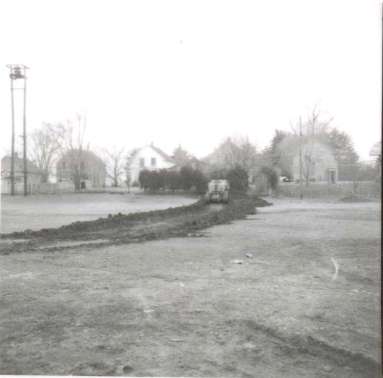
Breaking Ground for Town Office March 1965

At the Annual Town Meeting in March 1964 we appropriated $50,000 for a Town Office Building.  Soon thereafter Leonard Smith was selected as the designer.  Plans and specifications moved forward and the required public hearing was scheduled for December 8, 1964 at the  H.O. Smith School.   The plans provided about 4,800 square feet of floor space which  would accommodate the Selectmen’s office, Police Department, Town Clerk and Tax collector, Planning Board, Board of Adjustment. the Building Inspector, as well as a meeting hall for officials and civic groups.   The School Street site was selected because the town owned the property and the playground facilities located there could be transferred to the H O Smith playground.   Bids were asked for and all  bids received were above the appropriation.  This resulted in negotiations between the Board of Selectmen and the lowest bidder.   The contract was signed and ground was broken in early spring 1965.  Our first photo shows the first ‘swipe’ of ground taken by the bulldozer to prepare the former playground on School Street for the foundation for this office building. In the background we see the old fire alarm and the rear of the  row houses along Ferry Street.
Adrien Labrie of Nashua was the General Contractor for the project.  This company was also the contractor for the Alvirne High School addition, in process at the same time.    Because of  pressures to have the school addition ready for September, construction of the Office Building received several setbacks. Originally the  schedule hoped for occupancy during summer of 1965; actual occupancy was delayed until late December of that year.At that time the Police Department and town officers mentioned above moved into this new facility.
1977032013

Town Office Building C 1970

In 1974 a 30 x 60 foot addition was made; and in 1985 a second addition was approved by the town.  This latter addition included the addition of a porch-style life and ramps for handicap accessibility.  Photos from Historical Society Collection.

Ferry Street Fire Station C 1926

Ferry st fire station  c 1926 comp

Ferry Street Station and Crew C 1926

The Hudson Fire Department takes its origin back to 1892 when the Hudson Hose Company was founded by a group of volunteers.  This independent company raised their own funds for equipment and expenses.  Individuals paid dues, were fined for missed meetings, and engaged in fund raisers.  Their first project was the building of the Old Hose House on Central Street just above the Methodist (now Community) Church.  Individuals pledged time in order to supply the necessary labor.  This building was sufficient to house early equipment and provide a place for volunteers to meet.
In 1913 this group purchased the Kelly Springfield truck by public subscription at a cost of $1,030.  Individuals signed a note at The Nashua Trust Company.  This vehicle is said to be the first piece of motorized fire equipment used in New Hampshire.  The next year this truck and the balance of payments was turned over to the town with the understanding that the truck would be housed near the bridge.  Prior to this time the town had not formerly helped the department.  Through this action and payment of a small salary our early firefighters were able to join the State’s Firemen’s Relief Association.  The Kelly was housed in a  garage on Campbell Avenue donated by Charles Norton.  As the department expanded and more equipment purchased, the move was made to to the House Brothers’ Garage on Ferry Street.
In April 20, 1926 The Osgood Construction company of Nashua was awarded the contract for a new fire house for the Hudson Department; built for Raymond House.  Details were finalized and work started .immediately.  The press release in the local paper April 20, 1926 stated that part of the old garage was moved to make room for the new engine house.  The Town of Hudson had signed a five year lease with Mr House for this new station which had two vehicle stalls, an office and lounging room for members of the department as well as a sleeping room.  It was a bungalow style building made of brick and  concrete blocks.  Brick on the front and concrete blocks on the sides.  The new building was expected to be ready for occupancy in a few months. This station was located on Ferry Street, opposite and slightly north of the intersection with Campbell Avenue; about where the Gulf Station is now located.
A vote was recorded to have a photograph of department members in front of the newly completed station in the mid 1920’s.  The photo of the Ferry Street Station C 1926 seen here could be the result of that motion.  The photo shows the two stall station, the Reo firetrucks used at the time, along with drivers and members of the department.  Charles Reynonds and Ray House are in the driver;s seat of the left engine.  Harry Emerson and Fred House are in the right engine.  Standing between the engines from left to right are:  Ornam Campbell, Bill Edgley, Charles Farmer, Edward Robinson, Sidney Baker, Earl Alexander, Chief Harry Connell, John Pearson, Allen Andrews, Joseph Fuller, Walace Baker, Paul Buxton (arrow), and Roland Abbott.
This Ferry Street station served the department and the community until some time after World War II when it was expanded to a four stall station.  Then, as town growth occurred  in the early 1950’s the Central Fire station (now Leonard Smith station) was built on corner of Library and School Streets.  In time the Ferry Street building was razed to make way for the access roads leading to and from the bridges. Photo from the Historical Society collection.

Central Fire Station C 1955

1989002007

Central Fire Station C 1955

The year was 1951 and Hudson’s population was rapidly growing.  The Town’s four-stalled rented fire station on Ferry Street was already overcrowded.  The problem was simple:  how could the town build a larger fire station without raising the already high tax rate?  The Selectmen, the then volunteer fire department, and Frank Nutting had a plan.  They would borrow $40,000.  The  yearly cost to repay  this loan would be about the same as what the town was already paying for the rented station.  This money would be used for materials; the labor to build the station would come from volunteers.  At the town meeting in March 1952, the town voted to build a firehouse at a cost not exceeding $40,000.
The planning and architectural work was done by Leonard Smith, a local builder and member of the volunteer fire department.  Ground was broken May 1, 1952 on town owned land at the corner of Library and School Streets, opposite Webster School;  utilizing about one-half of the approximately 1.3 acres of the old ball field. Community spirit was high; volunteers came from within the department, the town, town organizations, and even from surrounding towns.  Engineers, builders, merchants, and laborers came forward to help.  The result was this fire station of typical New England architecture with housing for nine trucks, offices, rest rooms, kitchen, future sleeping area, and an assembly hall.  There was also room for expansion.  By fall of 1952 the building was enclosed for winter work and by summer of 1953 the new station was put into service.  One work session occurred on April 3, 1953 with 24 men and 16 members of the fire department.  Following work they were rewarded by a ham and bean supper prepared by Leon Hammond, Norman Crosby, and Lewis Reynolds.
This facility housed the fire and police departments.  Later the upstairs was used for temporary classrooms, then for meetings and classes for both departments with space for supplies.  The Board of Selectmen moved their office from the basement of the Hills Library into the fire station, remaining here until the town office building was built next door  on the corner of School and what is now Chase Street.  At that time Chase Street ended at School Street and did not extend to Ferry Street.
As town growth  and needs of the fire department continued an addition to this station has occurred as well as the addition of satellite stations on Burns Hill and Robinson Roads.  Shortly after the passing of Leonard Smith in  2002, the Central Fire station was renamed The Leonard  E. Smith Fire Station” in his memory.  Photo from the Historical Society collection.

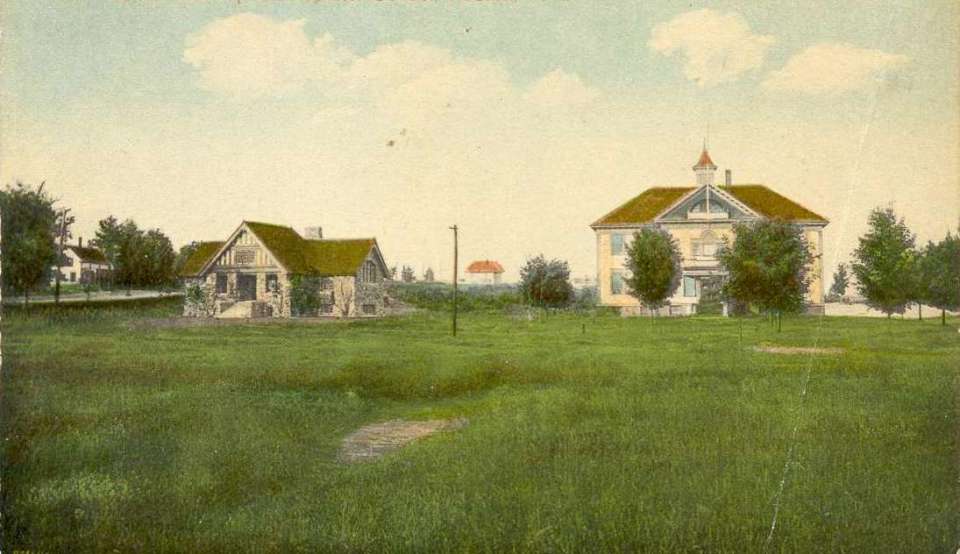
Area Surrounding Library and Webster School C 1910
2013006004

Area Surrounding Library and Webster School C 1910

From this early post card of Webster School, Hills Memorial Library, and the surrounding area we get an idea of what this section of town looked like about 1910.   Kimball Webster School (right) had been in use since it’s completion in 1896.  The new Hills Memorial Library (left) was  completed in 1908.  The photo  for this post card was taken from an open field across the street from Webster School at the corner of School and Library Streets.  In fact, what is now Library Street was barely a dirt road in this picture.  One can locate the road by following the utility pole.  An 1892 map of Hudson shows an ice house where the Hills Library is located and what is now Library Street was called Sanders Street.
Looking beyond these buildings and along Ferry Street we see very little construction.  On Ferry Street and opposite the library is the home at what is now 42 Ferry Street; known by many as the Cunningham home and now owned by Kurt Smith.  On the knoll behind the library and the school we see another early home;  most likely the home at what is now 55 Ferry Street.
Today this open field is the site of the Leonard Smith Fire Station and the Town Office Building; built in the  the 1950’s and 1960s respectively.  Before these buildings this field was a popular playground; used during pre-school,recess, and after school activities for Webster School.  During the spring and summer months this field was used by the Recreation Department for a ball field, basketball court, and playground for the younger kids.  As a point of memory, Hudson resident Dan O’Brien has fond memories of little league games played here, as early as 1950 or 51,under the direction of Manager Brown.  These may have been some of the earliest little league games in Hudson.  The year construction was underway for the new fire station Dan recalls breaking a window in the station while throwing rocks.  Yes! He was busted by Chief Andy Polak.  In Andy’s  way all he did was report Dan to his parents.  But, that was enough!  Photo from the Historical Society collection.

Alvirne Summer Home (The Hills House)

Hills House Derry Road 1890

Hills House Derry Road 1890

This week we look at  Alvirne, the summer home built in 1890 by Dr. Alfred and Virginia Hills on a knoll in the field across from the Alvirne farm house.  Their primary residence was in New York City but rail travel to Nashua’s Union Station and a coach drive from Nashua to Hudson facilitated travel to Hudson.  We can only imagine the entertainment and festivities enjoyed on these grounds by the Hills as they mingled with guests from New York as well as locals from Hudson and Nashua.  Our first photo shows the home in 1890.  You will notice that the meeting room and the field stone chimney were not part of the original building.  These were added in 1891.  You will also note that the driveway did not encircle the house.

This summer home, now called the Hills House, was enjoyed by Alfred, Virginia, and also by Virginia’s mother, Mary Creutzborg.  Although they had two daughters neither of them lived beyond infancy.  Virginia passed in 1908, a true loss to Dr Hills and  their friends here in Hudson.  Dr Hills completed his plans for the Alvirne Chapel; Virginia and their infant daughters were laid to rest within this chapel.

A short time later, in 1910, Alfred married Jessie Norwell, a Nashua native.  Alvirne continued to be the summer home of Dr Hills, Mary Creutzborg, and  Jessie.  After Dr. Hills passed in 1920, Jessie, her sister Helen Norwell, and Mary Creutzborg continued the use of this summer home.  Dr Hills left a  provision in his will so that Jessie, his third wife, and Mary, his second mother-in-law, could  co-habitate in the summer home as long as the arrangement satisfied both parties.  Mary passed in, 1928, at the age of 102, spending many years living with Jessie, either in Nashua or Hudson.  Jessie passed in 1963; but not until she saw  her husband’s vision of a school named Alvirne  established in Hudson.

After her passing, furnishings within the house were sold or distributed to friends and family.  In the end, the building was  vacant, windows and doors boarded up, closed to the outside world except for vandals. By his will,  following the death of Jessie, the summer home became the property of the School District and Alvirne Trustees.  Attempts were made to find a useful purpose for this building; but to no avail.  The destiny of this fine Victorian home came down to an article placed in the School District warrant for voting on March 9, 1965:

To see if the district will vote to authorize the School Board to raze the vacant dwelling on the Derry Road known as the Hills House.

A school board member rose to move adoption of the article.  This opened discussion and  Zoula Rowell, a member of the Hudson Fortnightly Club, rose to speak in opposition.  The article was tabled…ultimately forever.   This action provided the incentive for the incorporation of the Hudson Historical Society with a goal of preserving the Hills House and using it as a museum of Hudson History.


For about 10 years prior to this time,  the Historical Committee of the Fortnightly Club was actively collecting and cataloging items pertaining to Hudson History.

The Hills house was found to be structurally sound; but in need of repairs, cleaning, and the decorating of individual rooms.  Over the next few years a community effort occurred; individuals, organizations, and families helped with this project; some taking responsibility of an entire room.  A caretaker apartment was established and a caretaker secured.  As rooms became available the historical items collected by the historical committee were moved to the Hills House.  Some of the Hills family furnishings were returned; many other items were donated by Hudson families.  The catalogue system used by the historical committee was continued by the society.  The success of this restoration was climaxed in 1983 when the Hills House was named to the National Register of Historic Places.
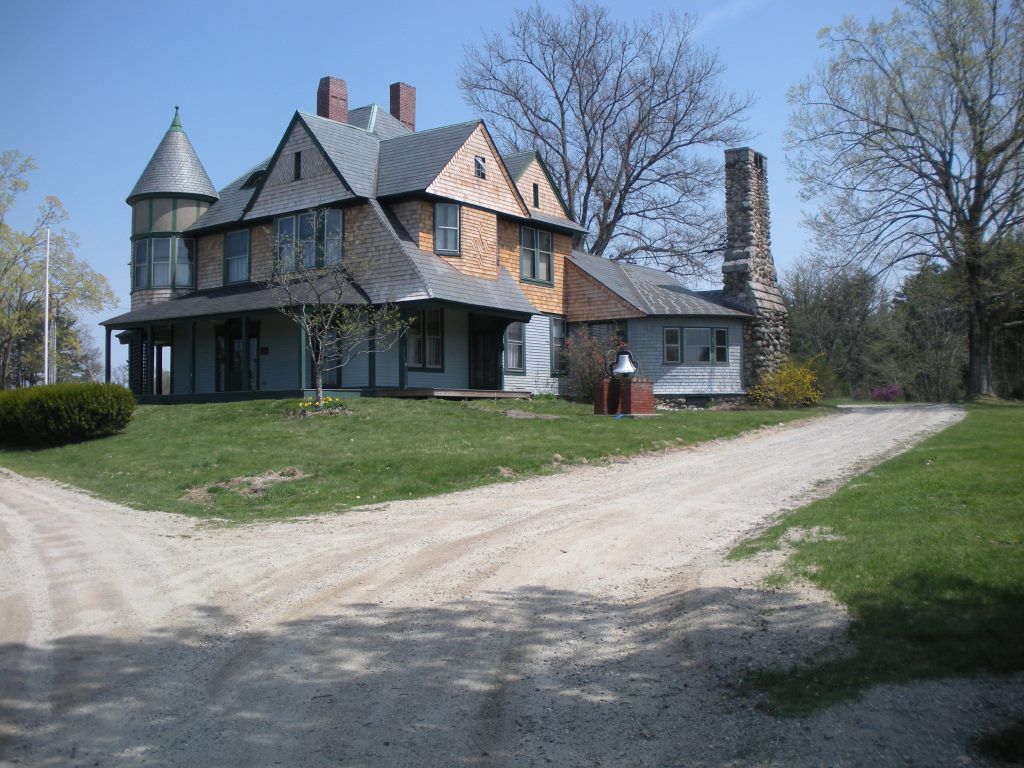
Hills House 2010

Hills House 2010

Ironically, the generosity of Dr Hills provided for the building and maintenance the Hills Memorial Library,  Library Park, Alvirne High,  and Alvirne Chapel.   He took no similar precautions for his lovely summer home.  That responsibility is now being met by the Historical Society with support of the School District and various organizations in town.  Our second photo shown the house just a few years ago,  Both photos are from the Historical Society collection.  The year 2016 marks the 50th anniversary of the incorporation of the Hudson Historical Society.

Alvirne Barn
1977031003

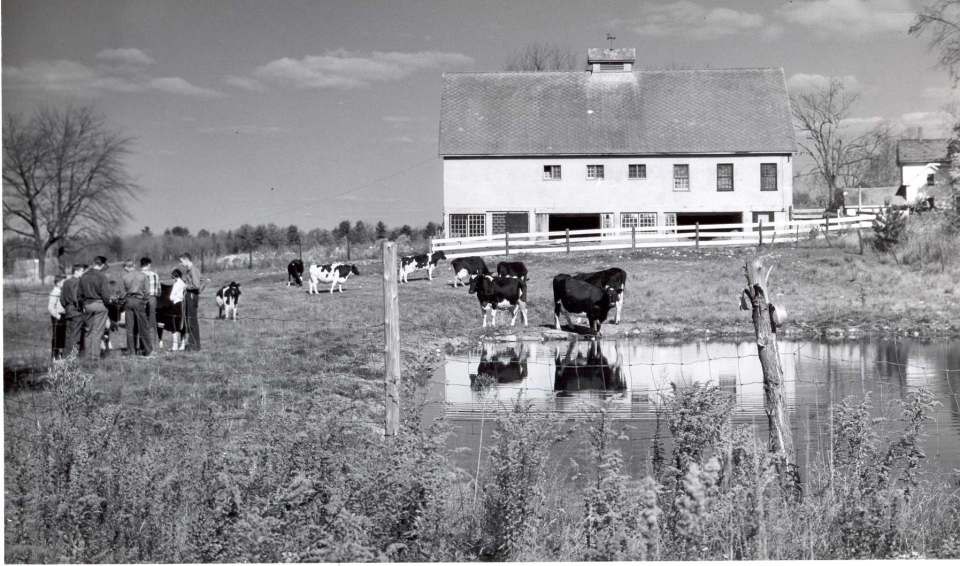
Alvirne Barn C 1970

The subject of today’s photo is well known to most of our readers; the Alvirne High School barn.  Hudson is fortunate to have a working farm as part of it’s educational program and also to have an  historic farm which dates back for several generations in the Hills Family.

Alfred Kimball Hills, Hudson benefactor, was born on this farm in 1840.  This was his father Alden’s, farm, and his grandfather Elijah before that; going back to James.  James was the youngest of three brothers who established the Hills Garrison about 1710. Their grandfather, Joseph Hills of Malden, MA received a grant of some 500 acres of land within the boundaries of the present town of Hudson from the Commonwealth in 1661.  
 
Alfred married Martha Simmons of Rhode Island, studied medicine at Harvard, and established his medical career in New York City.  Martha passed while he was still a young man.  He married a second time to Ida Virginia Creutzborg of Pennsylvania.  Alfred and Virginia purchased The Hills Family farm and built a summer home on the premises.  He called the farm and his summer home Alvirne.  Today we refer to the High School and farm as Alvirne; the summer home is called The Hills House.  Dr. Hills continued the operation of the farm by a farm manager.  Ida Virginia passed in 1908.  A short time later he married Jessie Norwell, a Nashua native.  Dr. Hill passed in 1920 and by his will he established the funding for an ‘industrial school’  to be called Alvirne.  His will was met with many challenges; but, on June 7, 1948 Alvirne High School opened it’s doors for the first time.  A six week summer session was held for 22 girls and 15 boys.  Classes were held within the Hills House and on the surrounding farm land.  This brief session, taught by Maude French and  KennethGibbs, was sufficient to secure the funds for the town of Hudson.  Through the encouragement Jessie Norwell Hills Alvirne High was built on the site of the Hills family estate and the Alvirne farm became part of the educational program of Hudson.  The first graduation was held in June 1950.  
 
This photo was taken C 1970, before the expansion of Alvirne to include the Palmer Vocational Technical Center.  It was taken from a roadway which led from the north end of the high school to the farm.  We can see the herd, barn, and some of the students.  
 
As most readers recall,  Alvirne suffered a severe fire in 1974 and was rebuilt one year later.  What may have been forgotton or not realized is that the Alvirne barn was also destroyed by fire on the last day of March 1993.
Alvirne Barn 2016 comp

Alvirne Barn 2016

 The new barn, very similar to the original, is shown in the second photo.  One sure way of distinguishing photos of the barn is the weather vane (called by many a ‘Web vane”) on the new barn.  This vane was placed upon the cupola of the barn in honor of Web “Wilbur” Palmer, long time Vot-tec director and agricultural teacher of Alvirne.  Both photos are from the Historical Society collection.

Sidney Gowing Farmhouse C 1917

2004023006

Sidney Gowing Farmhouse C 1917 Lowell Rd at Gowing Corners

This 1917 photo of the Sidney Gowing Farmhouse, located at Gowing Corners, was taken by a traveling photographer from Derry, NH just about one year before Sidney passed.  Sidney and Clementine (Fuller) Gowing raised a family of 2 sons (Edwin E, and Percy S.) and 3 daughters (Mabel, Eva, and Josie).  Sidney, with his family and hired laborers, operated a market garden beginning as early as his marriage to Clementine in 1881.  After Sidney passed in 1918, Clementine, his wife, and later Mabel, their oldest daughter continued to operate the farm until about 1950.  In 1939, after Clementine passed, ownership of the property was transferred to Mabel.
In July 1958 Mabel moved to Central Street and sold the property to Gerard and Medora Viens.  Mabel continued to live at Central Street until she passed in 1969.  From 1958 until about 1973 the Gowing farmhouse was used as a residence or for rental units.  In 1973 the building was demolished to make way for an industrial park.
At least a portion of this Gowing Farm was part of the original Thomas Pollard, Jr. farm which was settled about 1731-32.  Between the Gowing and Pollard families the property was owned by James Palmer and Mr. Richardson and by Rodney Fuller.
Over the years this section of Lowell Road had become known as “Gowing Corner”; located at the intersection of Lowell  and Wason Roads.  Flagstone Drive and the industrial park opposite Wason Road did not exist; in fact that was the industrial park which emerged from the Gowing farm.  Based upon discussions with Eleanor (Gowing) Freeman and my own memory, the Gowing farmhouse was located on the right of way for Flagstone Drive and what is now Dunkin Donuts.  To chalenge your memory even further do you remember Bank East;  a commercial bank located where Dunkin Donuts is now!!  Photo from the Historical Society Collection.


Raymond and Ebenezer Pollard House C 1942

EPollard1942_1

Ebenezer Pollard House Lowell Rd  C 1942

This home of Raymond Pollard was located on the east side of  Lowell Road opposite the Luther Pollard/Hardy Farm.  Using today’s Lowell Road landmarks it was located on what is now the northern end of the parking lot for Market Basket.  The Raymond Pollard farm, was part of the original Thomas Pollard, Jr farm which was settled C 1731.  The exact boundaries of the original  farm in this area are unclear; but did include this farm, as well as parts or all of the Luther Pollard Farm, and the Samuel Gowing Farm.  This house was built about 1838 by Ebenezer Pollard, the grandfather of Raymond, on the exact site of an earlier house built by an earlier ancestor!!

Raymond was born in Hudson in 1878 and lived all but the last few months of his 93 years living  in this home.  In fact, up until age 90 he was actively operating this family farm which had been in his family for over 250 years.

From documentation of this house written in 1942 we learn that the timbers in the timbers and many of the rafters,  were hand hewn and many of the joints were held together by wooden pegs and any nails used were hand made.  The main timbers were very large, mostly 10″ by 10″ and a few 8″ by 8″. The stairways was narrow and winding. The chimneys were made of  mud brick and, in 1942, one chimney was still in good condition and in constant use.

Raymond and his wife Cora (Cooper) had a daughter Vernetia who married Sullivan W. Brown of Nashua in 1924.  Cora passed about 1965; Raymond continued to live here until 1970.  Some time, just before or after his passing this property was sold.  By 1986 a shopping center consisting of Hudson Snack Bar, State of NH Liqueur Store, and Osco Drug.  The center has been expanded and now includes Market Basket of Hudson.  Photo and documentation of the house are from a booklet entitled “Hudson NH Homes Built Before 1842”; a project of The Hudson Fortnightly Club and on file at the Historical Society.

Robert and Bertha Hardy House on Lowell Road C 1980

2004023004

Robert and Bertha Hardy House on Lowell Road C 1980

This home was located on the east side of Lowell Road, opposite Fairview Nursing Home and adjacent to the entrance road to what is now Mission Pointe.  In the 1920’s the family of Marion (Parker) Brown lived here.  Marion was one of the daughters of Caroline and George Parker.  When John Hardy purchased the Pollard Farm this became the home of his parents, Bertha and Robert Hardy.  Robert passed in 1969 and Bertha passed in 1984.  The property was sold to settle Bertha’s estate.  The home was vacant for a number of years and in 1996 it was demolished to allow for the expansion of Lowell Road in that area.  In 2001 it was purchased by the Town of Hudson.   This home was on the site recently selected by our town for the proposed Lowell Road Fire Station.  Photo from the Historical Society Collection.