Home » Uncategorized (Page 17)
Category Archives: Uncategorized
Alvirne Summer Home (The Hills House)

Hills House Derry Road 1890
This week we look at Alvirne, the summer home built in 1890 by Dr. Alfred and Virginia Hills on a knoll in the field across from the Alvirne farm house. Their primary residence was in New York City but rail travel to Nashua’s Union Station and a coach drive from Nashua to Hudson facilitated travel to Hudson. We can only imagine the entertainment and festivities enjoyed on these grounds by the Hills as they mingled with guests from New York as well as locals from Hudson and Nashua. Our first photo shows the home in 1890. You will notice that the meeting room and the field stone chimney were not part of the original building. These were added in 1891. You will also note that the driveway did not encircle the house.
This summer home, now called the Hills House, was enjoyed by Alfred, Virginia, and also by Virginia’s mother, Mary Creutzborg. Although they had two daughters neither of them lived beyond infancy. Virginia passed in 1908, a true loss to Dr Hills and their friends here in Hudson. Dr Hills completed his plans for the Alvirne Chapel; Virginia and their infant daughters were laid to rest within this chapel.
A short time later, in 1910, Alfred married Jessie Norwell, a Nashua native. Alvirne continued to be the summer home of Dr Hills, Mary Creutzborg, and Jessie. After Dr. Hills passed in 1920, Jessie, her sister Helen Norwell, and Mary Creutzborg continued the use of this summer home. Dr Hills left a provision in his will so that Jessie, his third wife, and Mary, his second mother-in-law, could co-habitate in the summer home as long as the arrangement satisfied both parties. Mary passed in, 1928, at the age of 102, spending many years living with Jessie, either in Nashua or Hudson. Jessie passed in 1963; but not until she saw her husband’s vision of a school named Alvirne established in Hudson.
After her passing, furnishings within the house were sold or distributed to friends and family. In the end, the building was vacant, windows and doors boarded up, closed to the outside world except for vandals. By his will, following the death of Jessie, the summer home became the property of the School District and Alvirne Trustees. Attempts were made to find a useful purpose for this building; but to no avail. The destiny of this fine Victorian home came down to an article placed in the School District warrant for voting on March 9, 1965:
To see if the district will vote to authorize the School Board to raze the vacant dwelling on the Derry Road known as the Hills House.
A school board member rose to move adoption of the article. This opened discussion and Zoula Rowell, a member of the Hudson Fortnightly Club, rose to speak in opposition. The article was tabled…ultimately forever. This action provided the incentive for the incorporation of the Hudson Historical Society with a goal of preserving the Hills House and using it as a museum of Hudson History.
For about 10 years prior to this time, the Historical Committee of the Fortnightly Club was actively collecting and cataloging items pertaining to Hudson History.
The Hills house was found to be structurally sound; but in need of repairs, cleaning, and the decorating of individual rooms. Over the next few years a community effort occurred; individuals, organizations, and families helped with this project; some taking responsibility of an entire room. A caretaker apartment was established and a caretaker secured. As rooms became available the historical items collected by the historical committee were moved to the Hills House. Some of the Hills family furnishings were returned; many other items were donated by Hudson families. The catalogue system used by the historical committee was continued by the society. The success of this restoration was climaxed in 1983 when the Hills House was named to the National Register of Historic Places.
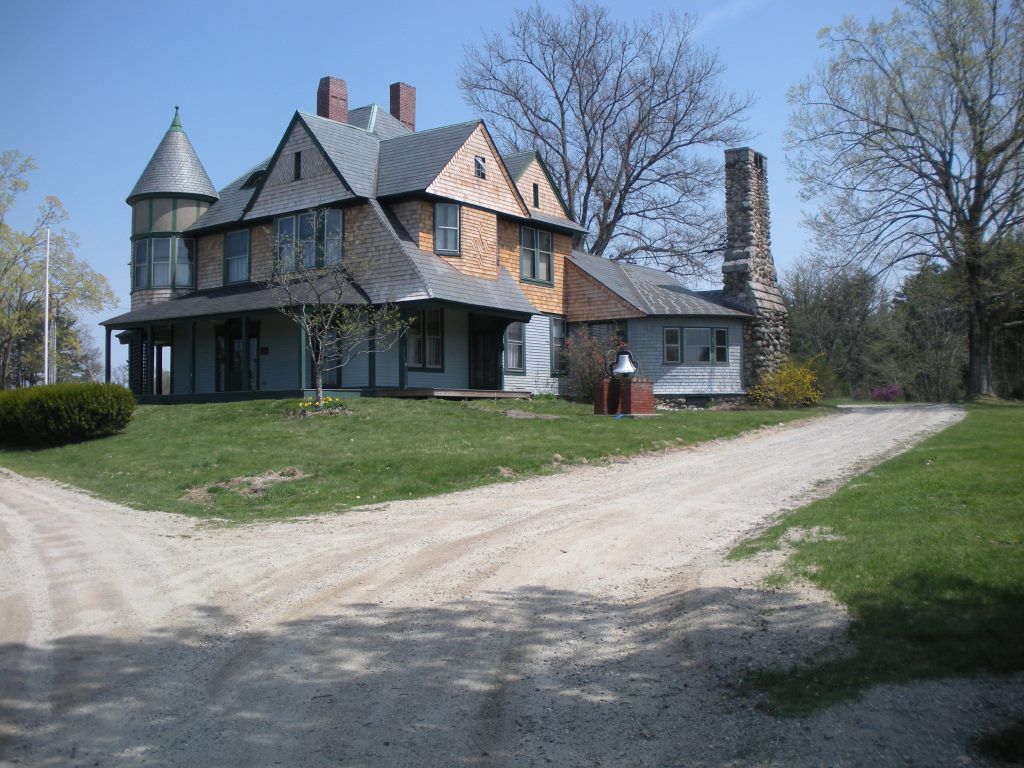
Hills House 2010
Ironically, the generosity of Dr Hills provided for the building and maintenance the Hills Memorial Library, Library Park, Alvirne High, and Alvirne Chapel. He took no similar precautions for his lovely summer home. That responsibility is now being met by the Historical Society with support of the School District and various organizations in town. Our second photo shown the house just a few years ago, Both photos are from the Historical Society collection. The year 2016 marks the 50th anniversary of the incorporation of the Hudson Historical Society.
Alvirne Barn
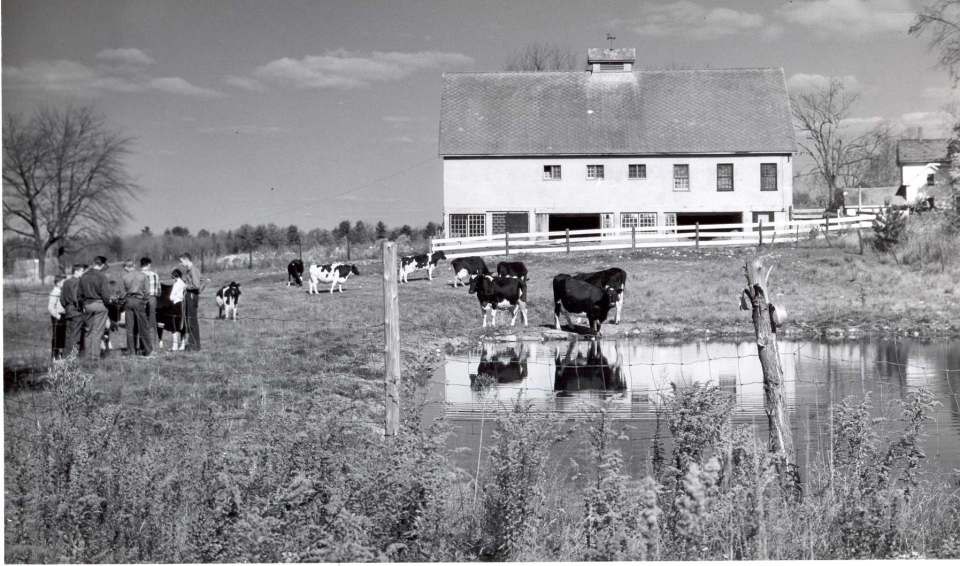
Alvirne Barn C 1970
The subject of today’s photo is well known to most of our readers; the Alvirne High School barn. Hudson is fortunate to have a working farm as part of it’s educational program and also to have an historic farm which dates back for several generations in the Hills Family.

Alvirne Barn 2016
Sidney Gowing Farmhouse C 1917

Sidney Gowing Farmhouse C 1917 Lowell Rd at Gowing Corners
Raymond and Ebenezer Pollard House C 1942

Ebenezer Pollard House Lowell Rd C 1942
This home of Raymond Pollard was located on the east side of Lowell Road opposite the Luther Pollard/Hardy Farm. Using today’s Lowell Road landmarks it was located on what is now the northern end of the parking lot for Market Basket. The Raymond Pollard farm, was part of the original Thomas Pollard, Jr farm which was settled C 1731. The exact boundaries of the original farm in this area are unclear; but did include this farm, as well as parts or all of the Luther Pollard Farm, and the Samuel Gowing Farm. This house was built about 1838 by Ebenezer Pollard, the grandfather of Raymond, on the exact site of an earlier house built by an earlier ancestor!!
Raymond was born in Hudson in 1878 and lived all but the last few months of his 93 years living in this home. In fact, up until age 90 he was actively operating this family farm which had been in his family for over 250 years.
From documentation of this house written in 1942 we learn that the timbers in the timbers and many of the rafters, were hand hewn and many of the joints were held together by wooden pegs and any nails used were hand made. The main timbers were very large, mostly 10″ by 10″ and a few 8″ by 8″. The stairways was narrow and winding. The chimneys were made of mud brick and, in 1942, one chimney was still in good condition and in constant use.
Raymond and his wife Cora (Cooper) had a daughter Vernetia who married Sullivan W. Brown of Nashua in 1924. Cora passed about 1965; Raymond continued to live here until 1970. Some time, just before or after his passing this property was sold. By 1986 a shopping center consisting of Hudson Snack Bar, State of NH Liqueur Store, and Osco Drug. The center has been expanded and now includes Market Basket of Hudson. Photo and documentation of the house are from a booklet entitled “Hudson NH Homes Built Before 1842”; a project of The Hudson Fortnightly Club and on file at the Historical Society.
Robert and Bertha Hardy House on Lowell Road C 1980

Robert and Bertha Hardy House on Lowell Road C 1980
This home was located on the east side of Lowell Road, opposite Fairview Nursing Home and adjacent to the entrance road to what is now Mission Pointe. In the 1920’s the family of Marion (Parker) Brown lived here. Marion was one of the daughters of Caroline and George Parker. When John Hardy purchased the Pollard Farm this became the home of his parents, Bertha and Robert Hardy. Robert passed in 1969 and Bertha passed in 1984. The property was sold to settle Bertha’s estate. The home was vacant for a number of years and in 1996 it was demolished to allow for the expansion of Lowell Road in that area. In 2001 it was purchased by the Town of Hudson. This home was on the site recently selected by our town for the proposed Lowell Road Fire Station. Photo from the Historical Society Collection.
“Fair View” Summer Home of the Pollard/Parker Families
The elegant summer home shown in this photo, became the summer residence of sisters Mary and Caroline and the family of Caroline (Pollard) and George Parker. It was located directly north of the Pollard/Hardy farmhouse and on the same side of the road at what is now 203 Lowell Road. Caroline’s family consisted of four girls: Edith, Helen, Marion, and Caroline. In years to come Caroline’s grandchildren would also enjoy their summers on the family farm here in Hudson. This photo from the Historical Society collection shows the rear view of the summer home as it overlooks the fields and river.

“Fair View” Summer Home
We are uncertain when this home was built; but would estimate about 1900. We do know that by 1915 Mary, Caroline and her family enjoyed their summers at this Parker Summer Home called “Fair View”. It was so named by the family because of the countryside viewed from the home.
By 1946, after the passing of Edith Parker and after World War II the remaining members of Caroline’s family decided to sell the farm; the entire farm, including three houses, was to be sold as a single transaction. By May 1946 John Hardy purchased the Luther Pollard farm from Luther’s descendants. By December of that same year the summer home “Fair View” was subdivided and sold to Putnam Stearns as a family home. It was later sold to become a nursing home, called Fairview, operated by Mr and Mrs Coulter and Mrs Blacktin. Ove the years and as a result of modernization the original building has been completely replaced. It now includes the complex of Fairview Nursing Facility, Rehabilation, Laurel Place, and The Inn at Fairview.
Hudson resident Ellie (Gowing) Freeman remembers the original building as she, at the age of 16, worked for the nursing home. Resident Leo Demers was a child-hood friend of Francis “Fran” Coulter. These boys often sat on the stone-wall entryway uprights to Fairview and wave to passing vehicles on the two lane Lowell Road. These vehicles were mostly farm tractors and hay bailers. Today, the road is four lanes and even trying to walk across the road is almost impossible.
Luther Pollard/Hardy Farmhouse C 1950
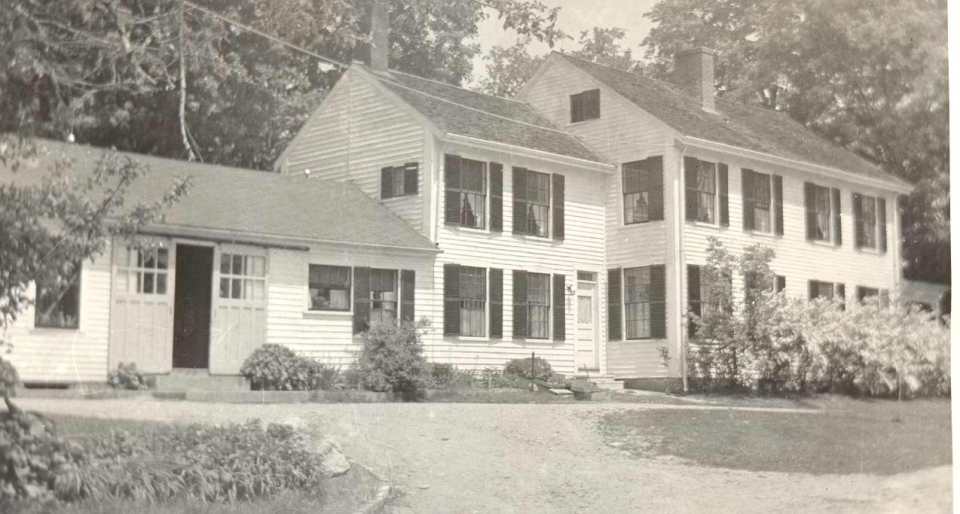
Luther Pollard/Hardy Farmhouse C 1950
The family of Thomas Pollard, Jr was one of the earliest to settle in Dunstable on the east side of the Merrimack River. His farm was south and adjoining that of Joseph Blodgett and extended to the river. The exact date of his settlement is unclear but probably was about 1731-2. This part of Dunstable later became Nottingham, MA, then Nottingham West, NH and now Hudson. By 1900 there were two family farms in this area bearing the name of Pollard. This week’s photo is of the farmhouse of the Luther Pollard Farm located at 205 Lowell Road. The second Pollard Farm that of Raymond Pollard will be remembered at a later time!!
Luther acquired his farm in 1853 from Calvin Pollard. Luther and his wife Eliza raised a family of one son, George, and two daughters, Mary and Caroline. After Luther passed in 1898 ownership of the farm went to his children. George passed early, leaving sisters Mary (also called May) and Caroline as owners. Caroline married George Parker a business man from Lowell/Boston, MA whereas Mary remained single. Over time the sisters became residents of Lowell and the Hudson farm became their summer home. The farmhouse was used for the farm manager and a summer home built for the sisters and the growing family of Caroline and George Parker. In the late 1920’s Robert Hardy and his wife Bertha and family of 9 children moved from Durham, NH to work as farm manager for the Pollard/Parker family. Two additional children were born to them later for a total of 11.
For the next fifteen plus years the Hardy family managed the Pollard Farm. During the summer months the Parker/Pollard family spent their vacation time in the summer home. These two families were such a part of each other’s lives that they felt like one big expanded family. They played together, worked together, and took day trips together. The two older Hardy children, John and Helen, graduated Nashua High School in 1941. As the war started John remained in Hudson and expanded the farm to include a small greenhouse so as to start field tomatoes early during the cold weather before transplanting outside. In 1943 he was able to start about 1500 plants to transplant in to the fields.
After World War II members of the Pollard/Parker family decided to sell the property; the entire acreage and buildings to be sold as one parcel. The property was offered to Robert Hardy; he turned it down and suggested the property be offered to his son John as he was the one still farming. John purchased the farm in May 1946. By December 1946 a survey had been done and the summer house was sold. John continued with and expanded the farm operation; specializing on market gardening. In 1948 he erected a steel framed greenhouse over 39 feet wide by 200 feet long!! He became a pioneer in the pick-our-own vegetable harvesting; particularly tomatoes.
John Hardy and Hudson native Elaine Esty were married in 1952. Their family of 2 girls and 2 boys arrived between 1953 and 1959. The Hardy farm continued to operate as a major market garden for several years as the family grew. By 1971 they specialized in tomatoes. Their children grew up, went to school, married and moved on. By the late 1970’s farm operations were winding down; hastened by a collapse of the huge greenhouse. John began to sell parcels of land. He had lived on that farm for about 85 years; passing in February 2007. The final parcel to be sold was the farmhouse and outbuildings to their neighbors, the Fairview Nursing Home in 2008.
The era of the John Hardy farm came to an end August 2008 when the farmhouse was razed to make way for the expansion of the Fairview Nursing Home. It is now the location of the modern Memory care Unit. One final piece of farm history was yet to be completed. In 2010, Elaine Hardy printed for her family and the Historical Society a history of the Pollard, Parker, Hardy Farm of Lowell Road. This photo from of the Historical Society Collection.
Aerial View – Luther Pollard Farm Lowell Rd C 1939

Aerial View Luther Pollard Farm Lowell Rd C 1939
The Sanders/Smith House Derry Street
This fine Victorian home was built by Hudson native George O. Sanders between 1873 and 1875. He was born in 1850 and at the age of 17 began an apprenticeship with his father, Abi Sanders, a respected carpenter and contractor in this area. This young man designed and built his own house; as such the dwelling represents the exuberance of youth and is an example of New Hampshire’s finest French Empire style of the Victorian Period.

Sanders/Smith House 1897
The main house is a two-and-a-half story dwelling on a granite foundation and covered by a Mansard roof with strongly flaring eaves. Today the exterior walls are sheathed with grey aluminum siding; applied over the original rusticated wood exterior. This work was done in the 1970’s by Leonard Smith. Mr. Smith worked diligently to retain as much of the original detail as possible. The front corner, facing Derry Street, has an elaborate three story tower capped with wrought iron railings and canopy terminated with scroll work and a weather vane bearing the letter “S”.
The L-shaped one-story wing extending from the main house originally had a hayloft door for access to the stable. This has been modified over the years. Above this hayloft door was a dormer, and on the roof stood a tall shingled spire rising from a cupola. The cupola remains today, but the spire has been replaced by a hipped roof.
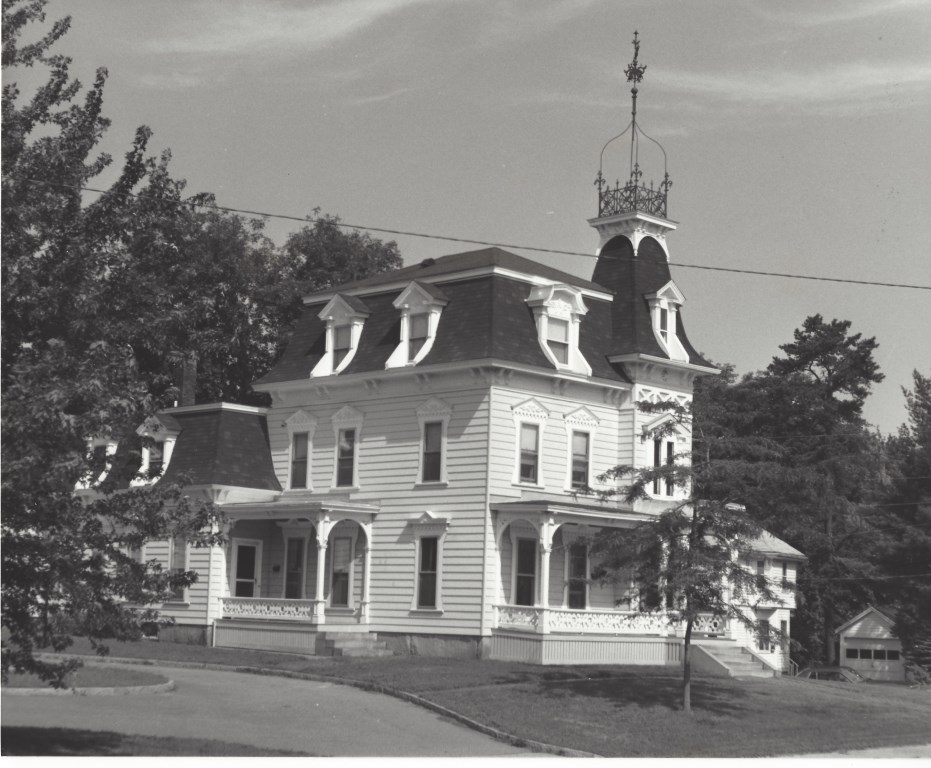
Sanders/Smith House 1985
The lot on which the house stands has been enclosed by several varieties of fencing over the years. When the house was first built, it was supplied by water from a deep well which was pumped up by a tall windmill in the front yard. Later, probably by 1893, when Mr. Sanders became principal stockholder of Hudson Water Works, the well and windmill were replaced by town water mains. The tower and weather vane over the main entry, the hayloft door and shingled spire on the wing, the windmill, and fencing can be seen in the 1887 photo of the George O. Sanders house.
The life of George O. Sanders is also of interest. He was an accomplished builder by his early 20’s. He left Hudson in 1878 to work as an engineer in Kansas, returning four years later to begin a business which would grow to become NH’s largest wooden box factory, employing nearly 190 men in three separate mills. In later years he also engaged in a number of civic interests. This included establishing, surveying, and construction of the Hudson Water Works Company: the construction of the multi-unit housing block and a row of single family houses around what is now Library Park; and the initiation of the Nashua Street railway Company.
In its 142 years, this fine Victorian has had just three owners. In 1904 Harry Kendrick. an employee for Sanders, acquired this home. It was owned by the Kendrick’s until purchased from Mrs. Kendrick in 1943 by Leonard Smith. From 1943 to the present, the home remains in the Smith Family. While the G. O. Sanders house retains its original configuration, certain details have been altered or lost over the years. This is particularly true in the 1940’s when the house was changed from a single-family to a seven-apartment complex by Leonard Smith. In 1986 the George O. Sanders house was proudly entered onto The National Register of Historic Places by Leonard Smith. Our thanks to the imagination of George O. Sanders and to Leonard Smith’s avid interest in maintaining the character and beauty of this house. Photos from the Smith family and the Hudson Historical Society Collection.
57 Lowell Road C 1947

57 Lowell Road C 1947
 Remember Hudson NH When...