Home » Schools (Page 2)
Category Archives: Schools
Hudson Junior High School

Hudson Junior High School/H.O. Smith Elementary c 1976
In the early 1930’s Hudson students were educated in Webster (grades 1-8) and Hudson Center (grades 1-6) schools. For grades 9-12 they attended Nashua High school and out town paid the tuition. The per pupil cost for grades 1-8 in 1935 was about $52.00; tuition to Nashua High was about $101.00 per student with about 130 students attending. Hudson’s annual school budget for grades 1-8 was $28,110 of which $15,975 was for salaries; the remainder was text books, supplies, transportation, janitor, and utilities. The cost for tuition to Nashua was $15,150. Nashua was entertaining the concept of a 6-3-3 plan which would require Hudson students to make two adjustments. The first to a Junior High for grade 9 the second to the High School for grades 9-12.
The depression hit Hudson and our schools in full force. Budgets were submitted in light of these economics. The school administration did not feel they could push for a land purchase or a building program for a new school. Then Nashua postponed the implementation of the 9-3-3 plan because of the depression. So our own building program became less of a problem.
Enrollment at Webster School was at a maximum. A portable classroom called ‘The Portable’ was used at Webster for extra students in grades 3 and 4; also a classroom was established at the IOOF building (now the American Legion) for grades and 5 and 6. With these issues in mind and the increasing cost of tuition to Nashua schools, Hudson voters were asked to consider the construction of a high school or a junior high school.
Warrant articles for an additional school began as early as March 1935; including one in 1937 to build using money from the A.K. Hills Estate. None of these early attempts were approved. In 1938 it did became possible to build a long needed junior high school. Federal funds were available under the Public Works Administration (PWA) which could be used for materials and labor. Plans and justifications for a proposed building were put in place and submitted for a grant. Upon approval of the grant a special school district meeting was held on the Odd Fellows building August 1938 to accept a grant of $38,250 from PWA. Newspaper accounts reported it as a lively meeting. The grant was accepted. The junior high would consist of 6 classrooms, an auditorium-gym, manual and domestic arts, an office, and a large study room. Total cost $85,000 including price of a land located on School and First Street for which the school district had an option. The district meeting also approved a bond issue of $46,670 to complete the payment of the school.
The school opened September 1939 and was formerly dedicated November 7, 1939, Members of the building committee were Herbert Canfield, Mrs. Ida Gatz, Robert Hardy, Reuben Groves, Amedee Paul, Louis Spalding, and Mildred Fuller. Dr. H.O. Smith, well known physician and 24 year member of the School Board, spoke at the dedication. His topic was the educational history of Hudson dating into the 1700’s. In June 1940 a group of citizens donated a portrait of Dr. Smith. This portrait hangs in the upper hallway to this day.
With the completion of the junior High overflow classes in the IOOF Building and ‘The Portables’ were no longer needed. These classes returned to Webster. The Portables, along with a piece of land on Oakwood between First and Second Streets were made available to the town recreation department.
The Hudson Junior High remained in use with grades 10-12 attending Nashua High until the completion of Alvirne as a Junior/Senior High School in 1950. At which time Hudson students completed high school in their home town. After the completion of Alvirne High School the junior high building was renamed and re-dedicated as the Dr. H.O. Smith Elementary School in 1950. Grades 1-3 occupied that school with grades 4-6 at Webster.
Expansion was again necessary and in 1956 the H.O.Smith annex on the west side of the building was approved by the voters. Today, with 80 years of service, this building is an integral part of the campus for Hudson’s Early Learning Center. Our photo shows the Dr. H.O. Smith Elementary School c1976 as photographed for the Town In Transition.
Revisit … Area Surrounding Library and Webster School C 1910

Area Surrounding Library and Webster School C 1910
This is one of the most popular post cards of Hudson.
From this early post card of Webster School, Hills Memorial Library, and the surrounding area we get an idea of what this section of town looked like about 1910. Kimball Webster School (right) had been in use since it’s completion in 1896. The new Hills Memorial Library (left) was completed in 1908. The photo for this post card was taken from an open field across the street from Webster School at the corner of School and Library Streets. In fact, what is now Library Street was barely a dirt road in this picture. One can locate the road by following the utility pole. An 1892 map of Hudson shows an ice house where the Hills Library is located and what is now Library Street was called Sanders Street.
Looking beyond these buildings and along Ferry Street we see very little construction. On Ferry Street and opposite the library is the home at what is now 42 Ferry Street; known by many as the Cunningham home and now owned by Kurt Smith. On the knoll behind the library and the school we see another early home; most likely the home at what is now 55 Ferry Street.
Today this open field is the site of the Leonard Smith Fire Station and the Town Office Building; built in the the 1950’s and 1960s respectively. Before these buildings this field was a popular playground; used during pre-school,recess, and after school activities for Webster School. During the spring and summer months this field was used by the Recreation Department for a ball field, basketball court, and playground for the younger kids. As a point of memory, Hudson resident Dan O’Brien has fond memories of little league games played here, as early as 1950 or 51,under the direction of Manager Brown. These may have been some of the earliest little league games in Hudson. The year construction was underway for the new fire station Dan recalls breaking a window in the station while throwing rocks. Yes! He was busted by Chief Andy Polak. In Andy’s way all he did was report Dan to his parents. But, that was enough! Photo from the Historical Society collection.
Revisit Hudson Schools…Hudson Center School Circa 1909
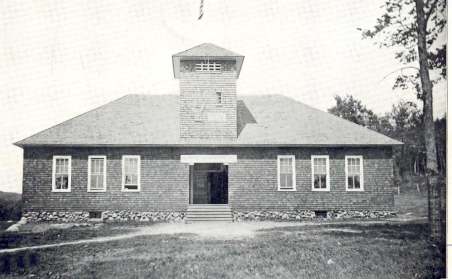
Hudson Center School circa 1909
Also known as the school on Kimball Hill Road. I attended this two-room school house for five years. Grades 1-3 with Mrs. Marguarite Gilman and grades 4 and 5 with Miss Florence Parker. After that the 6th grade at Webster then off to Alvirne!!
After the D.O. Smith School on Windham Road was destroyed by fire, the school district voted to build a new school of similar size. The sum of $900 plus the amount received from insurance was allocated for this purpose. A conscious decision was made to not re-build on the Windham Road location. The Hudson Center School, a two room house, was built on the east side of Pelham Road (now Kimball Hill Road) just a short distance from Hudson Center. This school remained in use until 1956 when it was closed. The students were combined with the classes at Webster School. Of the two teachers: Florence Parker became a reading supervisor and Mrs. Marguerite Gilman taught a second grade. This building remains today and is privately owned. Photo from Historical Society Collection.
Revisit Schools . D.O. Smith School on Windham Road

D.O. Smith School built 1896
In 1896 Hudson residents voted to erect two new school houses. This vote began the movement to a centralized school system; departing from the the district school system. The Smith School shown here was erected for the convenience of families in/near Hudson Center.
The Smith School house was erected in Hudson Center on what is now Windham Road. The building committee was authorized to spend up to $3,000 to build and equip this school; which was named in honor of Dr. David O. Smith. In his younger years David O. was a successful teacher, he then studied medicine and became a very skillful physician. After becoming a doctor he retained his interest in the schools of this town, doing more for our schools than any other person during his long lifetime. This school house was completely destroyed by fire and was replaced by the Hudson Center School on Kimball Hill Road in 1909. The Smith School was located on the north side of the road at or near the present address of 42 to 44 Windham Road. This picture is from an old sepia photograph from the Historical Society collection.
Revisit Number 9 School House

Number 9 School C 1921
Of the ten district schools number 9 is the only house remaining. Each of the others have been demolished and replaced with a dwelling or converted into a dwelling. Number 9 is privately owned by the Jasper Family and was restored by Shawn Jasper in the late 1970’s.
Before 1886 the No 9 house (Kidder District) house was located on what is now Robinson Road. The approximate location was on the left side of Robinson (as you turn up the hill from Old Derry Road) towards the top of the hill. The No 10 house (Hills Row District) was located on what is now Old Derry Road (earlier Derry Road) just north of the intersection with Greeley Street. These two districts were merged into a single district and this No 9 School House was built by the town of Hudson in 1886. It operated as a one-room school house until 1932. In the mid-1930’s Grant Jasper purchased the property from the town. The No 9 Schoolhouse is the only one which survives intact as a school house. In the late 1970’s it was renovated by Mr. Jasper’s grandson, Shawn. The school house is owned by Jasper Corporation.
Revisit Hudson Schools …District School #1 at Musquash

District School #1 at Musquash
Presentation of Mary Gates Lowell Road
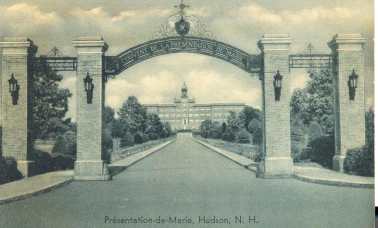
Early Image of Presentation Gates
In 2004 a large portion of Lowell Road, including that section near the Presentation of Mary (PMA), was widened to accommodate the increase in traffic. Prior to this project the historic gates embraced the driveway which lead from Lowell Road to the oval in front of the PMA building. Once the right of way for the reconstructed Lowell Road was laid out these gates were found to be in the way and had to be moved. When the project first started it was estimated the gates could be moved for about $50,000. The early image of the PMA gates is from a post card compliments of Gerald Winslow.
When plans were finalized the historic gates would be moved approximately 75 feet back from Lowell Road. Once moved the gates would grace the front of the property but they would no longer embace the driveway to the Presentation. A new and safer driveway entrance to was planned opposite the Executive Drive intersection with Lowell Road. This change in the driveway would also permit safer access of fire equipment to PMA as the modern vehicles were too large to pass under the gate. According to a July 2004 article in the Hudson Litchfield News, once the bid specs for moving the gates were prepared nine bid packages were sent out, but only two actual bids were returned. Both of these had prices far in excess of the planned $50,000.
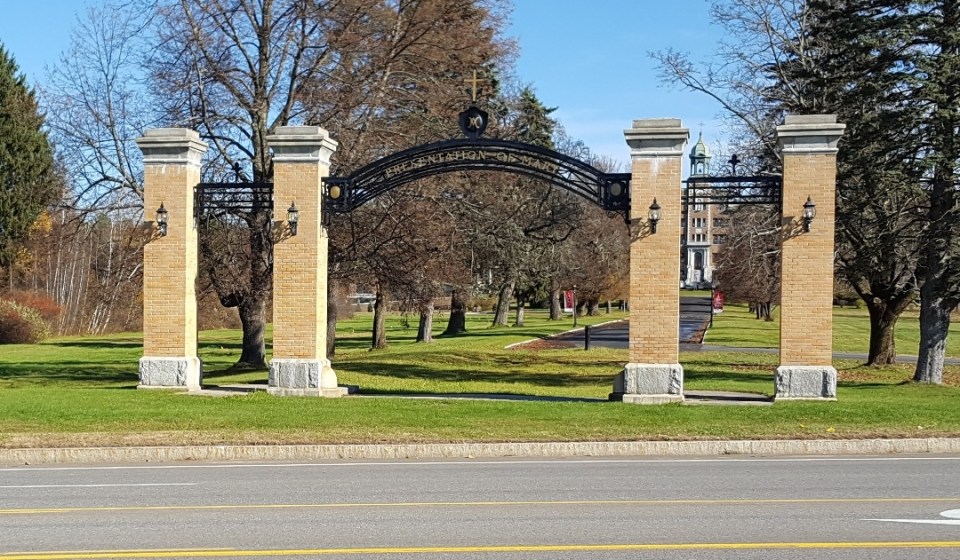
Presentation Gates 2018
The gates were not on the National Historic Register but they could be eligible to be on the register and the project to move the gates could not endanger this eligibility. The exterior bricks on the gates had been replaced in 1980. The granite blocks used in the foundation and the wrought iron work on the top of the gate were deemed as the important pieces. In actuality parts of the gate, such as the wrought iron fixtures and the sections on the top and bottom were salvaged and new gates were built back from the widened roadway by about 75 feet. This work was completed in September and October of 2004. The modified driveway was completed in 2003. The recent photo of the gates was taken by the author this past week. I wish to acknowledge an article “Presentation of Mary Gates to be Moved” authored by Lynne Ober which appeared in a July 2004 edition of the HLN.
Hudson Center School Bell

School Bell at Hills House
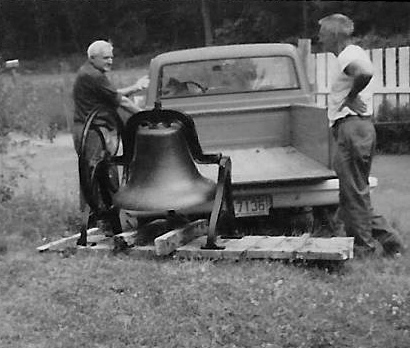
Charlie and Eric Parker Transporting Bell
St John Parish House and Elementary School

St John’s and Library Street School c1977
St John Elementary School
St John Parish Center

Parish House 2016
Bronze Tablet Donated by Webster School Students in 1933
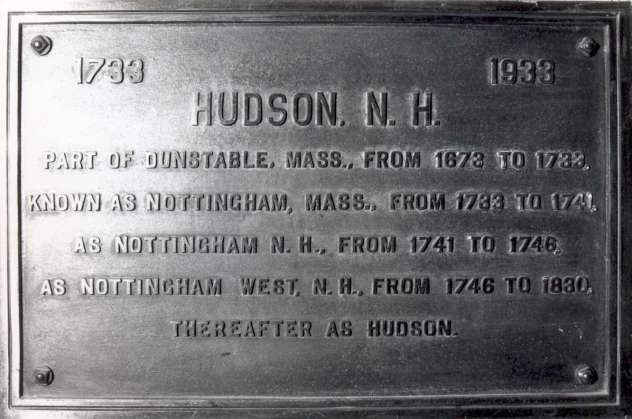
Bronze Tablet Donated by Webster School Students in 1933
 Remember Hudson NH When...