Home » Derry Rd (Page 3)
Category Archives: Derry Rd

EssoHeat Truck Crash May 23, 1947

Essoheat Truck Crash May 23, 1947
On May 23, 1947 John J. Montgomery of Lowell, MA was operating this EssoHeat delivery truck in Hudson on route to a delivery in Derry. At about 3:00 pm he lost control of the vehicle near the Gile home on Derry Road and crashed headlong into a stone Wall. Mr. Montgomery was shaken up but escaped serious injury. The front end of the truck was badly damaged. Police Chief Polak reported the accident was due to faulty steering mechanism.
Police Chief Polak detailed police officers to guard the truck and also called for a fire truck which remained at the scene as a safety measure until 10:00pm. Assistant Fire Chief Harry D. Emerson was in charge.
I had no idea where the Giles home was on Derry Road. In 1947 Derry Road also included Old Derry Road out to the Londonderry Line. After a trip to the Registry of Deeds and access to the town records I learned that the Giles home had been located at what is now 145 Old Derry Road. As you travel on Old Derry Road, heading towards Londonderry, you pass the Hudson Speedway and the intersection with Robinson Road. On your left is the Senter Cemetery. About 1/10 mile further you come to 145 Old Derry Road on your right
Elizabeth Gile purchased this homestead in 1944. Prior to that the property was owned by Alphonse Lee and his wife Delima. Prior to that it was owned by members of the Heath family and earlier the Senter Family. In 1952 Roy Cross and his wife Lena (Avery) purchased the property from the estate of Elizabeth Gile. Roy Cross passed in 1959 and Lena continued to make this her home until she passed in 1970. In 1972 the property was purchased by Paul F. Gauvreau from Lena’s daughter Flora Kinsey. Paul had a keen interest in this section of Hudson particularly the Poor Farm and the Poor Farm Cemetery behind the farmhouse on Old Derry Road. Paul’s research was instrumental in kindling public awareness of the old Poor Farm Cemetery.
Hudson Center School Bell

School Bell at Hills House
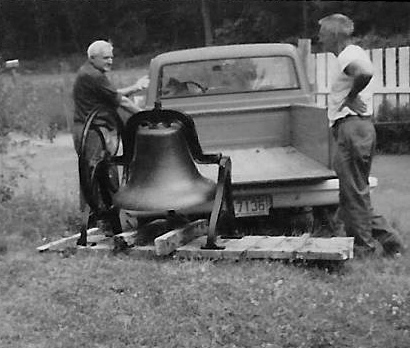
Charlie and Eric Parker Transporting Bell
147 Derry Road
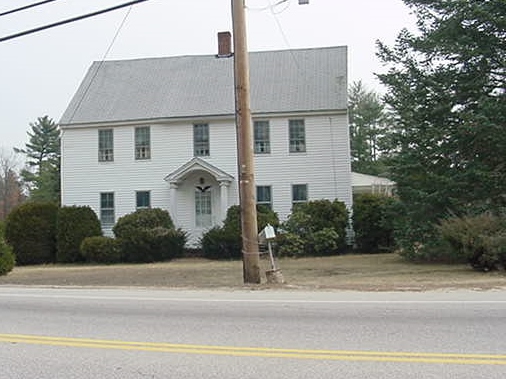
The Home at 147 Derry Road C 2015
This house at 147 Derry Road was vacant for many years, boarded up for security and recently marked as a training site for the Hudson Fire Department. These past few weeks any visible evidence of it’s existence has been removed by the skillful operation of a back hoe. I visited the site a few times while the demolition was taking place and noticed the basement (cellar) of the house was a poured concrete foundation. I would expect stones or stones with a leveling layer of bricks. I was also able to see the center support beam under the main floor. Clearly one end had been rotted and repaired in order that it may be returned to service. As this 3.95 acre parcel gets ready for the next chapter in it’s existence, let us look back at previous chapters and some of the families who lived there.
Town records show this was a single family colonial style home consisting of 7 rooms including 4 bedrooms, 2 baths, built C 1790 on approximately 4.49 acres (the actual deed says 3.95 acres). The current owner is 147 Derry Road, LLC who purchased the property in 2008 from the estate of Gladys (Alukonis) Kosman. This home was owned by the family of Walter and Annie Alukonis from 1945 to 2008, a period of 63 years. Prior to that the home was owned by the family of Mary and Albert Kopitsko who purchased the property (land and buildings) from Joseph Cerier in July 1927.
At this point let’s step back in time to 1892. The heirs of Enoch S. Marsh sold a 125 acre parcel (land and buildings) of the Marsh farm to Kimball Webster. A few years later, in 1898, a 3.95 acre parcel of land was separated and sold to Sophrinia Smith. Smith owned this parcel until May 1927 when the land was sold to Joseph Cerier. By July 1927 the same 3.95 acre parcel with buildings were sold to Albert Kopitsko. In summary, the deeds for this parcel indicate there was no building on the 3.95 acre piece until July 1927.
At this point let me leave you, the readers, with a mystery. When was this house constructed? Was it constructed on some other location and moved to this spot in 1927? Are the deeds in error and the house constructed on this site in the early 1800’s and then given the benefit of major repairs to repair the support beam and improve the basement? If anyone has comments or insights, please share them!!
So, we know something of the history of the site; let’s now look at the families who lived there. The family of Marie and Albert Kopitsko from 1927 to 1945 and the family of Walter and Annie Alukonis from 1945 until the death of their daughter, Glayds (Alukonis) Kosman.
Family of Albert and Mary Kopitsko
Our story of the Albert and Mary Kopitsko family begins in September 1909. 18 year old Wojciech Kopicko arrived at Ellis Island on the Kaiser Wilhelm II from Germany. He had been a resident of Russia. It is not known when he changed his name to Albert Kopitsko. A short time later in June 1910, 17 year old Stanislawa Muckrowska arrived at Ellis Island on the Nieuw Amsterdam from the Netherlands. She decided to use the name Margerne (Mary). By October 1913 both Albert and Mary had been residing in Nashua. They were married in Nashua October 12, 1913 at St. Stanislaus Roman Catholic Church.
The 1930 US Census places Albert and Mary with their family of four children owning their home on Derry Road, Hudson. Albert was employed as a laborer in the Shoe Shop in Nashua. Their children were John (b:1915), Stephen (b:1916),Priscilla (b:1919) and Annie (b:1920). Annie was born in Hudson; most likely her older siblings were born in Nashua.
John and Stephen both served in World War II. Prior to entering the service John married Agnes Walkawicz in 1937 and was employed by he Granite State Tanning Co. John ended his service with a rank of Sergeant and was stationed at Fort Devens with the Military Police. Stephen was drafted into the service in 1941 and served in the infantry. He was wounded during the Battle of the Bulge towards the end of the conflict in Europe and was awarded the Purple Heart. He was discharged in 1945 after serving nearly 4 years. Prior to entering the service he was employed at the International Shoe Co. Stephen and Lois Straub were married in Hudson in 1961.
During the war years Albert along with John and Agnes, Stephen, and Priscilla and Raymond resided at the Derry Road home which he had purchased in 1927. After the war
the younger generation returned to their jobs and sought their own homes. Albert sold the Derry Road home in 1945 to Walter and Annie Aulkonis. It is not entirely clear, but I believe that Mary passed as early as 1937. In the years after selling the home, Albert resided with his daughter Priscilla and son-in-law Raymond Bouley. Albert passed in December 1957. Each of the families of John, Stephen, and Priscillia continued to live in Hudson. Agnes (Mrs. John) was employed for a number of years at The Meadows in Hudson Center.
. The youngest, Ann, attended schools in Hudson and later Nashua; graduating from Nashua High in 1939. She graduated Peter Bent Brigham Hospital School of Nursing as a registered nurse. Ann and her husband, George Christopher were married in 1942
and made their home on Melendy Road in Hudson. She served her town and the school district for 22 plus years as a school nurse. She was beloved and respected by both the students and their parents. Her activities extended beyond the school system. She was active in the Hudson community Church, Hudson Historical Society, a trustee for Hills Farm Cemetery to name a few. She has been honored through the years for her humanitarian service to this town: Citizen of the Year in 1982, Appreciation awards by
Wattannick and Hudson Granges as well as the Kiwanis Club. The latter created a scholarship in her honor. Ann passed in 1989 leaving with us many fond memories.
Family of Walter and Annie Alukonis
Annie (Tartalis) and Walter Alukonis were each natives of Lithuania, coming to this country and this area in their early 20’s. They purchased the home at 147 Derry Road from
Albert Kopitsko in 1945. Walter was a farmer and they previously lived on Barretts Hill Road. After Walter passed in 1950, Annie continued to live here until she passed in 1977; the last years she made her home with her daughter, Gladys (Alukonis) Kasman. Gladys or members of her family remained here until she passed in 2008.
This has been an interesting article to research and like most family history stories, they never finish. I am grateful to the family of Stephen and Lois Kopiski for the information and memories they provided me. The spelling used for the family surname has many variants: Kopiski/Kopisky etc. This has made the research for this article an interesting adventure. The photo shown here is of the house at 147 Derry Road C 2015. If you wish to comment on the history of this house, please send email to HudsonHistorical@live.com.
United Pentecostal Church (The Sanctuary)
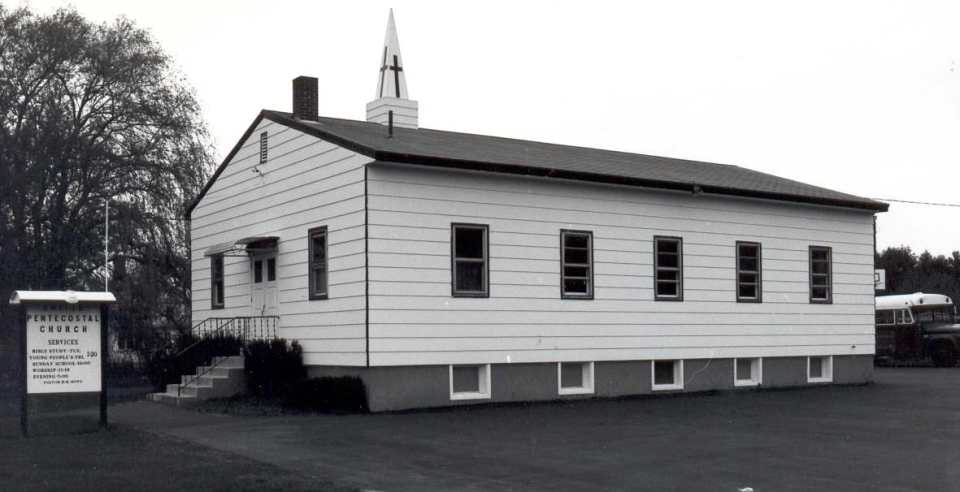
United Pentecostal Church C 1975
Hudson Speedway C 1947
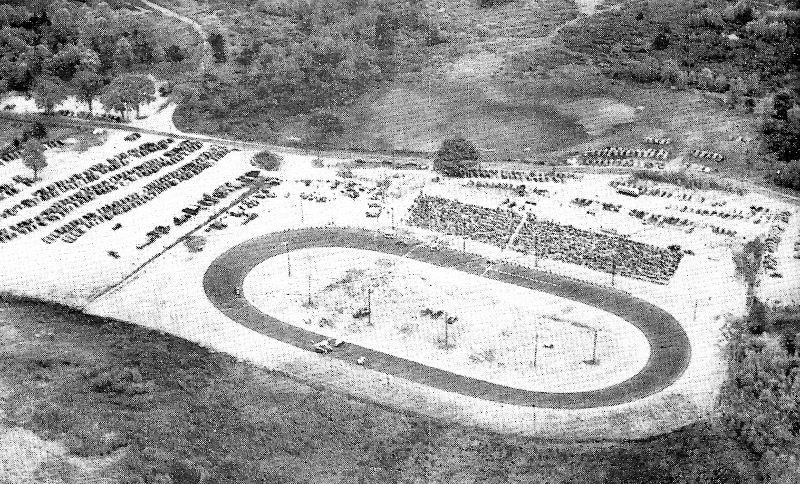
Hudson Speedway C 1947
Alvirne Summer Home (The Hills House)

Hills House Derry Road 1890
This week we look at Alvirne, the summer home built in 1890 by Dr. Alfred and Virginia Hills on a knoll in the field across from the Alvirne farm house. Their primary residence was in New York City but rail travel to Nashua’s Union Station and a coach drive from Nashua to Hudson facilitated travel to Hudson. We can only imagine the entertainment and festivities enjoyed on these grounds by the Hills as they mingled with guests from New York as well as locals from Hudson and Nashua. Our first photo shows the home in 1890. You will notice that the meeting room and the field stone chimney were not part of the original building. These were added in 1891. You will also note that the driveway did not encircle the house.
This summer home, now called the Hills House, was enjoyed by Alfred, Virginia, and also by Virginia’s mother, Mary Creutzborg. Although they had two daughters neither of them lived beyond infancy. Virginia passed in 1908, a true loss to Dr Hills and their friends here in Hudson. Dr Hills completed his plans for the Alvirne Chapel; Virginia and their infant daughters were laid to rest within this chapel.
A short time later, in 1910, Alfred married Jessie Norwell, a Nashua native. Alvirne continued to be the summer home of Dr Hills, Mary Creutzborg, and Jessie. After Dr. Hills passed in 1920, Jessie, her sister Helen Norwell, and Mary Creutzborg continued the use of this summer home. Dr Hills left a provision in his will so that Jessie, his third wife, and Mary, his second mother-in-law, could co-habitate in the summer home as long as the arrangement satisfied both parties. Mary passed in, 1928, at the age of 102, spending many years living with Jessie, either in Nashua or Hudson. Jessie passed in 1963; but not until she saw her husband’s vision of a school named Alvirne established in Hudson.
After her passing, furnishings within the house were sold or distributed to friends and family. In the end, the building was vacant, windows and doors boarded up, closed to the outside world except for vandals. By his will, following the death of Jessie, the summer home became the property of the School District and Alvirne Trustees. Attempts were made to find a useful purpose for this building; but to no avail. The destiny of this fine Victorian home came down to an article placed in the School District warrant for voting on March 9, 1965:
To see if the district will vote to authorize the School Board to raze the vacant dwelling on the Derry Road known as the Hills House.
A school board member rose to move adoption of the article. This opened discussion and Zoula Rowell, a member of the Hudson Fortnightly Club, rose to speak in opposition. The article was tabled…ultimately forever. This action provided the incentive for the incorporation of the Hudson Historical Society with a goal of preserving the Hills House and using it as a museum of Hudson History.
For about 10 years prior to this time, the Historical Committee of the Fortnightly Club was actively collecting and cataloging items pertaining to Hudson History.
The Hills house was found to be structurally sound; but in need of repairs, cleaning, and the decorating of individual rooms. Over the next few years a community effort occurred; individuals, organizations, and families helped with this project; some taking responsibility of an entire room. A caretaker apartment was established and a caretaker secured. As rooms became available the historical items collected by the historical committee were moved to the Hills House. Some of the Hills family furnishings were returned; many other items were donated by Hudson families. The catalogue system used by the historical committee was continued by the society. The success of this restoration was climaxed in 1983 when the Hills House was named to the National Register of Historic Places.
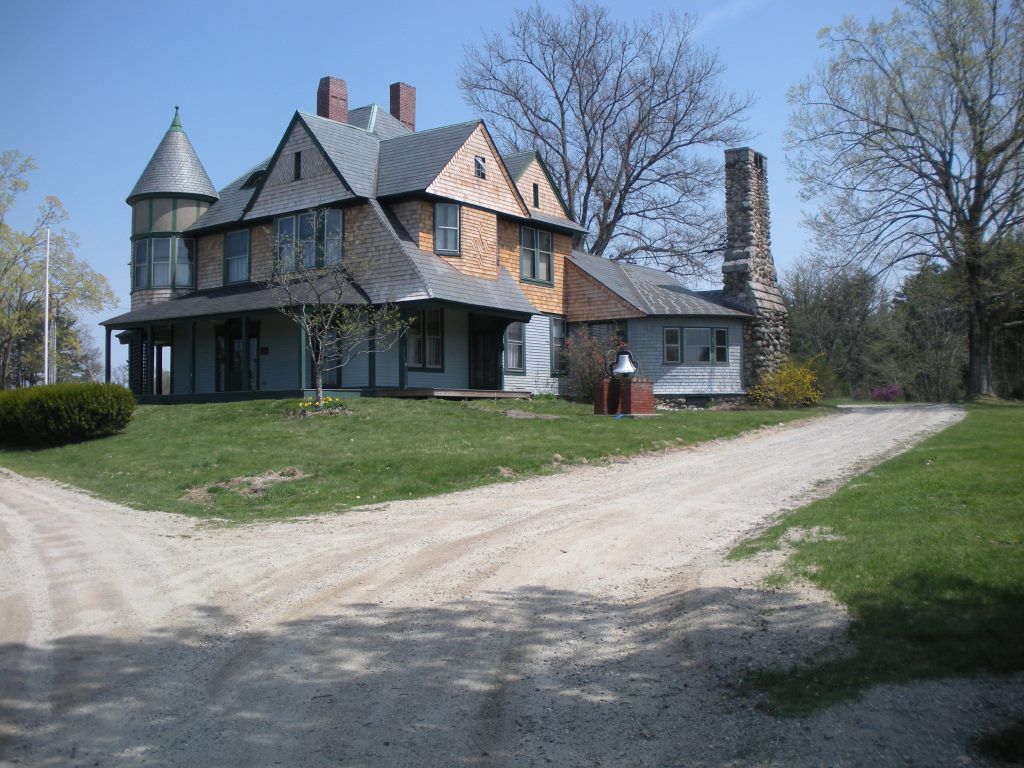
Hills House 2010
Ironically, the generosity of Dr Hills provided for the building and maintenance the Hills Memorial Library, Library Park, Alvirne High, and Alvirne Chapel. He took no similar precautions for his lovely summer home. That responsibility is now being met by the Historical Society with support of the School District and various organizations in town. Our second photo shown the house just a few years ago, Both photos are from the Historical Society collection. The year 2016 marks the 50th anniversary of the incorporation of the Hudson Historical Society.
Alvirne Barn
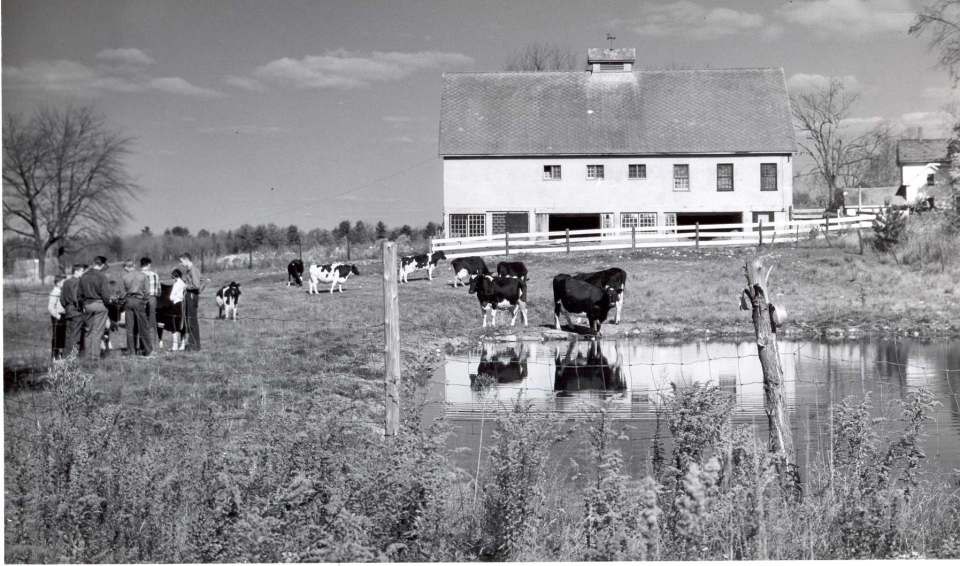
Alvirne Barn C 1970
The subject of today’s photo is well known to most of our readers; the Alvirne High School barn. Hudson is fortunate to have a working farm as part of it’s educational program and also to have an historic farm which dates back for several generations in the Hills Family.

Alvirne Barn 2016
The Sanders/Smith House Derry Street
This fine Victorian home was built by Hudson native George O. Sanders between 1873 and 1875. He was born in 1850 and at the age of 17 began an apprenticeship with his father, Abi Sanders, a respected carpenter and contractor in this area. This young man designed and built his own house; as such the dwelling represents the exuberance of youth and is an example of New Hampshire’s finest French Empire style of the Victorian Period.

Sanders/Smith House 1897
The main house is a two-and-a-half story dwelling on a granite foundation and covered by a Mansard roof with strongly flaring eaves. Today the exterior walls are sheathed with grey aluminum siding; applied over the original rusticated wood exterior. This work was done in the 1970’s by Leonard Smith. Mr. Smith worked diligently to retain as much of the original detail as possible. The front corner, facing Derry Street, has an elaborate three story tower capped with wrought iron railings and canopy terminated with scroll work and a weather vane bearing the letter “S”.
The L-shaped one-story wing extending from the main house originally had a hayloft door for access to the stable. This has been modified over the years. Above this hayloft door was a dormer, and on the roof stood a tall shingled spire rising from a cupola. The cupola remains today, but the spire has been replaced by a hipped roof.
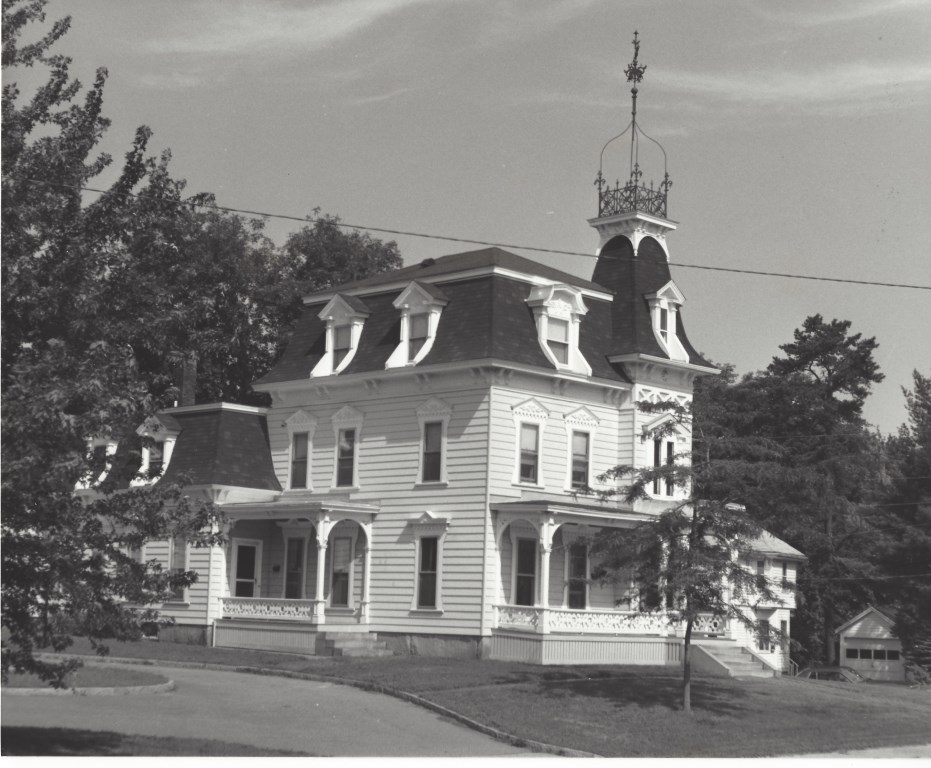
Sanders/Smith House 1985
The lot on which the house stands has been enclosed by several varieties of fencing over the years. When the house was first built, it was supplied by water from a deep well which was pumped up by a tall windmill in the front yard. Later, probably by 1893, when Mr. Sanders became principal stockholder of Hudson Water Works, the well and windmill were replaced by town water mains. The tower and weather vane over the main entry, the hayloft door and shingled spire on the wing, the windmill, and fencing can be seen in the 1887 photo of the George O. Sanders house.
The life of George O. Sanders is also of interest. He was an accomplished builder by his early 20’s. He left Hudson in 1878 to work as an engineer in Kansas, returning four years later to begin a business which would grow to become NH’s largest wooden box factory, employing nearly 190 men in three separate mills. In later years he also engaged in a number of civic interests. This included establishing, surveying, and construction of the Hudson Water Works Company: the construction of the multi-unit housing block and a row of single family houses around what is now Library Park; and the initiation of the Nashua Street railway Company.
In its 142 years, this fine Victorian has had just three owners. In 1904 Harry Kendrick. an employee for Sanders, acquired this home. It was owned by the Kendrick’s until purchased from Mrs. Kendrick in 1943 by Leonard Smith. From 1943 to the present, the home remains in the Smith Family. While the G. O. Sanders house retains its original configuration, certain details have been altered or lost over the years. This is particularly true in the 1940’s when the house was changed from a single-family to a seven-apartment complex by Leonard Smith. In 1986 the George O. Sanders house was proudly entered onto The National Register of Historic Places by Leonard Smith. Our thanks to the imagination of George O. Sanders and to Leonard Smith’s avid interest in maintaining the character and beauty of this house. Photos from the Smith family and the Hudson Historical Society Collection.
Bank of NH C1976

Bank of New Hampshire Derry Road C 1976
In August 1970 the Bank of New Hampshire president, Davis P. Thurber, announced the purchase of land at the northern part of the 20th Century Shopping Center on the Derry Road and their plans to build a branch office as a free-standing unit. This bank celebrated its opening in January 1971 under the management of Edward Kerouac. The Hudson Board of Selectmen; Frank Nutting, Stanley Alukonis, and James Hetzer; Chamber of Commerce President, Don MacIntyre; and officials of the Bank were present at the ribbon cutting ceremony. The bank offered longer hours, more services, and drive-up banking. The Bank of New Hampshire was the former Second National Bank of Nashua.
In 2005, by vote of the shareholders, the bank became a division of the Toronto-Dominion Bank.Still doing business at the Derry Street location the name is now TD Bank. Photo from the Historical Society collection.
 Remember Hudson NH When...