Home » Central St (Page 2)
Category Archives: Central St
192 Central Street – The McCoy Home

The McCoy Home on Central Street
This house which stood at 192 Central Street was home to as many as 5 generations of McCoys. The earliest McCoy we find that lived here was James Otis McCoy, born 1788 in Windham, NH. He purchased this location and a corresponding site on the opposite side of the road from Abigail Chase in 1859 when he was 71. Ownership of this homestead passed from James Otis to his grandson James (B:1846), then to Herman Richards (B: 1878) and then to Herman’s daughter and son-in-law,Thelma McCoy Ives and Merrill ‘Joe’ Ives, Herman’s widow, Ethel Augusta Woodward, continued to reside there until she passed in 1968.
The younger James McCoy was born in Boston, MA in 1846 and came to Hudson with his parents, Daniel Gregg and Harriet (Barrett) McCoy, at the age of 6 weeks. By 1856 his father Daniel Gregg passed at the age of 41. James was 10 years old. By 1863, when James was 17, his mother Harriet passed at the age of 51. When he was 19 James enlisted in Company I First NH Heavy Artillery volunteers. Returning to Hudson after his service in the Civil War he purchased the McCoy homestead on Central Street from his grandfather, James Otis, in 1867.
On December 2, 1868 at the age of 21 James and Emma Cinderella Richards were married in Hudson. They lived their 26 years of marriage in this McCoy home. During this time they raised a large family. James passed in January 1915 after a period of poor health. He was survived by six children: James Otis of Manchester; Mary Haselton of Hudson, Herbert W. of Shirley, MA, Herman Richards, Daniel Gregg, and Elgin Leon all of Hudson. He had been predeceased by his wife Emma Cinderella Richards. James was known as a quiet man who was well liked by his fellow townspeople. Of his surviving children Herman, Daniel, and Elgin are significant to the history of 192 Central.
Herman received title to this Central Street home in 1915; 1/3 by will from his father James; 1/3 from his brother Elgin; and 1/3 from his brother Daniel. In October 1916 at the age of 37 Herman and Ethel Augusta Woodward were married in Nashua. Herman and Ethel made their home in the house where he was born. They raised a family of 2 daughters, Mildred (b:1918) and Thelma (b: 1925) and 1 son, Robert (b:1922). Mildred married and moved to Nashua. Robert moved to Illinois. Thelma married Merrill “Joe” Ives and they remained local.
Herman was employed with B&M Railroad, Maine Manufacturing, and later with Beede Ruber Co. For many years he served as superintendent and secretary of Westview Cemetery which was located adjacent to the rear of his house. His widow, Ethel, continued to reside here until she passed in February 1968. Thelma and “Joe” Ives purchased the McCoy home and resided there until the time of their divorce when it was sold to John C. Graichen who resided there for several years. Following the passing of Mr. Graichen it was sold to the family of Michael Dumont and later to his son Donald. Our photo of the house was taken by the author in 2010, following several years where the house was unoccupied. Soon after this photo was taken the building was razed. The lot at 192 remains vacant to this day. Thelma (McCoy) Ives remarried to Al Carroll. Thelma Carroll passed in 2017.
It is difficult to determine when this house was built. We do know there was a dwelling on the property when it was purchased by the McCoy family in 1859 from Abigail Chase. Prior ownership has been traced through various owners to Paul Tenney in 1834 at which time there was also a dwelling on the property.
200 Central Street – The Parker House
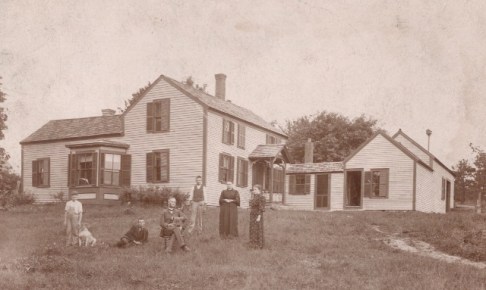
200 Central St C 1895
The house at 200 Central Street in Hudson Center is known to many as the home of Florence Parker, her sister Ernestine, and Ernestine’s son Raymond Parker. They were the oldest daughters of Rev. Clarence Charles and Hattie (Robinson) Parker. As a pastor Rev Parker served in Nottingham, NH, East Hampton, MA, Bolton, CN, and Post Mills, VT. Their mother, Hattie, passed in April 1912 at the age of 42 while they were serving a church in VT. In addition to her husband she was survived by eight children ranging in age from 3 to 15 years. There were 6 daughters (Florence, Ernestine, Ruby, Mildred, Helen, and Alice) and 2 sons (Charles and Lehsten who was also known as Erich. After Hattie passed her eight children returned to Hudson to reside with either their Parker or their Robinson family. Florence, Ernestine, Ruby, and Erich lived with their Parker grandparents, Lydia (Batchelder) and Charles Clarence Parker in this very house. Mildred lived with a neighbor and aunt, Lillian (Parker) Smith. Charles, Helen, and Alice went to live with their Robinson grandparents on Robinson Road.
So, this house was home to Florence and Ernestine from 1912 until they passed. Florence passed in 1977 just short of her 80th birthday; Ernestine in 1990 at the age of 91. Of the other siblings who also lived here Ruby died at the age of 20 and Erich married Almina Bassett and they moved elsewhere in the area.
Professionally Florence was a school teacher in Hudson for more than 40 years, mostly at the Center School on Kimball Hill Road. She received her training from Nashua High School and Keene Normal School. Florence had a natural aptitude for teaching and received many awards and recognitions. The photo shows Florence as she received the Teacher of the Year Award just prior to her retirement.
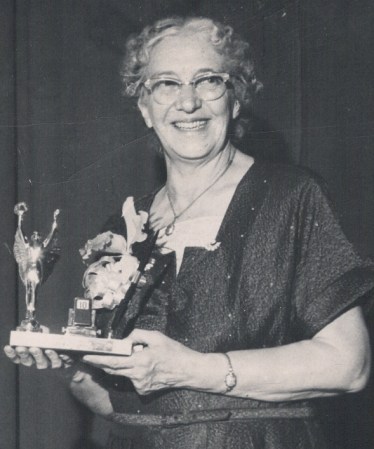
Florence With Award
Ernestine commuted to Nashua and was employed for many years in the mills in Nashua. As a young adult Ernestine enjoyed visiting with her brother Charlie on the Robinson Farm. This photo shows Ernestine and Charlie C 1920.

Ernestine and Charlie C1920
By the middle 1950’s the Parkers had reconfigured their home to include a gift shop on the front of their house facing Central Street. From this shop they sold some very fine pieces of glassware as well as souvenirs of Benson’s and Hudson. This shop continued to operate into the early 1970’s.
Both sisters had a talent for the arts and crafts. An untold number of scarfs, sweaters, and mittens were distributed to Hudson children that originated from the needles and hands of Florence or Ernestine. Florence caned chair seats, even into her later years with failing eyesight. Ernestine’s specialty, especially in her younger years, was quilting. I have seen some phenomenal original quilt patterns which she has designed and made.
They were both active with the Baptist Church at the Center. Ernestine served for many years as a financial officer and teacher in the Sunday school. Florence served as the church organist for years.
Before opening their home in 1912 to their grandchildren, Charles Clarence Parker and his wife Lydia Lowe Batchelder had already raised their own family. He was born in Warren, NH in May 1852 a son of Rev. Lafayette and Hannah Wyman Parker. He came to Nashua as a student in the Crosby school. For 30 years he worked diligently compiling and publishing a dictionary of the English language. While engaged in this work he had a book store on Main Street in Nashua.
He married Lydia Lowe Batchelder August 1873. She was born in Hudson May 1852 a daughter to Mark Batchelder and Lydia Steele. Charles and Lydia settled and raised their family in Hudson; spending most if not all of their married life in this house on Central Street. Their oldest Clarence Charles was born April 1874. He was 38 years old when his wife Hattie passed leaving him with 8 children between the ages of 3 and 15. Their second child and only daughter, Lillie Jane,was born July 1877. She married a neighbor, Herbert Newton Smith and resided next door to her parents. Their second son George Henry was born October 1879. He married Edith Snow of Hudson. Their third son Ernest Josiah was born August 1883 and died young at the age of 15. The 1895 photo of the house includes the family of Charles C. and Lydia. From left to right we have Ernest with his dog, Clarence in the grass, Charles seated, Lydia, and Lillie Jane.
Members of the Parker family owned this house at 200 Central Street as early as March 1870 when Daniel Marshall, administrator for the estate of Moses Griffin, sold it at public auction to Josephine Parker in order to settle claims against the estate. A few years later it was transferred to Lafayette Washington Parker, the father of Charles Clarence. It is probable that Charles Clarence and Lydia moved into this house soon after their marriage even though some other member of the Parker family owned it. He did take title to the house in January 1887 after the death of his father Lafayette. Charles retained title until his death in November 1936.
By the will of Charles Clarence the title of this house was transferred to Florence and Ernestine. By 1989 Ernestine entered a local nursing home. Her son Raymond acting as her power of attorney sold the property to Randy Turmel and Kevin Slattery. Soon after thereafter fire destroyed the building. The property remains idle and is available for sale.
It is difficult to determine the age of the house. We do know that in 1858 it was the home of Moses and Dolly Griffin. In 1856, Moses Griffin of Somerville, MA purchased an acre parcel with building from Olivia Tenney. No clues who may have lived here. Moses passed at the age of 69 in July 1858 and was survived by his widow, Dolly, a son, George, and three daughters; Francis, Rachel, and Louisa Ann. He was predeceased by a daughter also named Louisa Ann who passed at the age of 2 prior to their move to Hudson. Dolly continued to reside in the home. After her death it was sold at public auction to settle the estate. Moses and Dolly are interned in their family plot in Westview Cemetery near their Hudson home.
Hudson Furniture and Home Fashions

214 Central (Formerly Hudson Furniture)
Do your memories of Central Street along Route 111 in Hudson Center include Hudson Furniture and Home Fashions operated by Joseph and Ann Gagnon? Shopping for a dining room set, a sofa for your living room, or a comfortable chair for the den? Hudson Furniture offered a display of options with the convenience of local shopping.
Joseph (Joe) Gagnon purchased the Lester Gove residence in May 1969 and was soon operating Hudson Furniture. A few years later, as the adjacent residential property of Berkley Swinertin at 216 Central became available, Ann and Joe Gagnon made that purchase along with a smaller parcel from a local real estate agent. Gagnon then consolidated the three parcels and subdivided into two parcels. The first contained two plus acres and the preexisting buildings; Hudson Furniture and the dwelling from the Swinertin home. This dwelling would soon become Home Fashions. The second parcel was a small lot adjacent to Merrill Brook; over time this retail lot was used for Parent Farm Stand and other sellers.
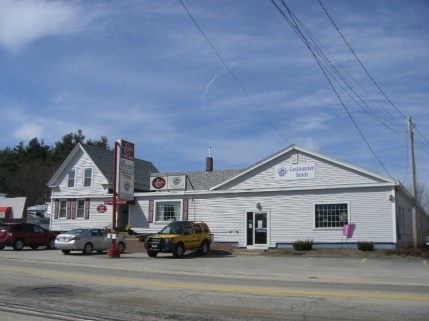
216 Central (Formerly Home Fashions)

216 Central C1955
The Hadley /Willoughby Mill

“Old Mill” Facing Melendy Road
In his “History of Hudson, NH” Webster states it is impossible to determine when, where, or by whom the first mill was built in our town. Having said that, he does provide us some insights into where early mills did exist and who may have operated them. Settlers into this area needed sawed lumber. Just imagine how impractical it would have been to transport these products from Dunstable, across the Merrimack River with no bridge or ferry. Standing timber was plentiful and a number of brooks existed to provide the necessary power. Once their homes were established these settlers would also need a grist mill to grind their corn and grains into flour. Without a doubt these first mills were established by the early settlers along these streams.

The Old Mill from Across Melendy Pond
Railroad Handcar and Crew at West Windham

Hand Car and Crew at the West Windham Station
Hand cars like the one shown here were used by railroad crews to travel from station to station in order to perform maintenance such as the removal of fallen trees, debris, or minor repairs to the tracks and the right of way. These vehicles were called hand cars because they were propelled by the hands, and muscles, of the people riding on them.
This crew and hand car were likely used to maintain the tracks between the West Windham station and the station in Hudson Center. The Hudson Center station was located just off of Greeley Street and behind the Town Hall (now Wattannick Hall). The station at West Windham was located on your left just beyond the intersection of Route 111 (Windham Road) with Route 128 (Mammoth road) in West Windham. The West Windham station has been destroyed by fire several years ago but it was located on the site of the present Kiddie Academy, an educational day care.
The single track line through Hudson crossed the river from Nashua just south of the Taylor Falls Bridge and then proceeded toward Hudson Center in a north easterly direction. After crossing over Lowell Road near Hammond Park the tracks crossed Central Street at “Long Crossing” and then continued to the Hudson Center station. From Hudson Center the tracks continued along or near the route of the present 111 into West Windham. “Long Crossing” was a street level intersection of the railroad line with Central Street. The name “Long Crossing” refers to the angle at which the two right of ways intersected;that is an angle greater than 90 degrees.
This undated photo of the handcar at the West Windham station is a part of the collection of the Hudson Historical Society.The identity of the crew members in this picture are not known.
The “Bee Hive” on Central Street
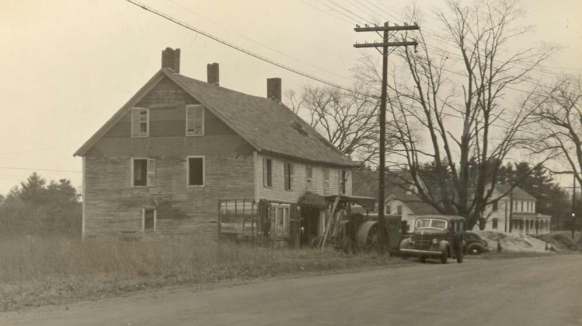
The “Bee Hive” on Central Street
We’ve heard the expression “A picture is worth a thousand words”. That is the case with this early 1940’s photo of the house, known as “the bee hive” located on what is now 73 Central Street; opposite what many remember as the home of Leon and Gerri Hammond. To the right and slightly behind this house we see two homes; the right most of these is located at 65 Central Street, home to Henry Frenette. The second, smaller home, is at 1 Lowell Road and home to Alfred Bastien.
A few first hand memories have been documented about the “bee hive”. The first is from Maurice “Nick” Connell who grew up in Hudson and later recorded some of his memories via a series of occasional articles in The Hudson News. In one such article (August 24, 1984) “Nick” recalls the “going’ swimmin'” routine of his gang of friends in the 1930’s. They would swim and dive in the Merrimack River near the railroad bridge abutments; then walk the tracks to the Lowell Road underpass and explore the “old haunted house” on Central Street near the overpass. He remembered this two storied, weather beaten structure also known as the “bee hive”. This nickname was applied to the house because of the strange and shady goings on there. This reputation added to the excitement of the barefoot summertime explorations of a group of young boys. They would walk the tracks to Melendy Pond, another popular “swimmin hole”. According to Nick, this house was torched by some unnown arsonist on November 1, 1945 and torn down on November 27, 1945.
Another memory of this house was left by Leo J. Gagnon. He recalled Anton’s restaurant and their parking area on the opposite side of Central Street – where a house called the ‘bee hive” once existed. By his memory this house was a half-way house. Other memories I have heard suggest it was a frequent and convenient “overnight” stop for individuals catching a free ride on the train as it passed through Hudson then on to West Windham, and Rochester, NH.
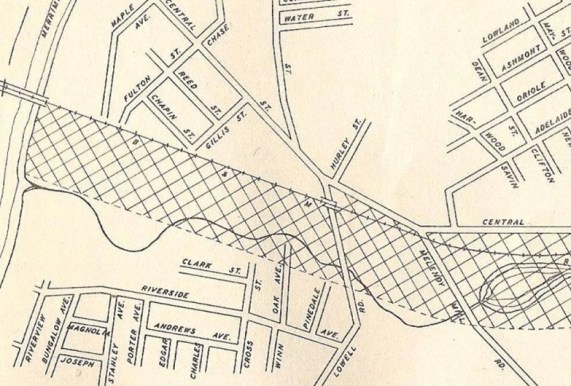
1942 Hudson Zoning Map
Speaking of the railroad, the second photo shows a portion of the Hudson zoning map for 1942 from the Hudson Town Report. This map traces the route of the steam railroad from the river to the overpass at Lowell Road where the tracks crossed over Lowell Road and ran behind the ‘bee hive” house and continued on to Melendy Road, “Long crossing” and Hudson Center.
A few additional details are known about this house. According to the town report for 1947, the Walton land on which was situated the so called “bee hive” was purchased (at least in part) by the Town of Hudson from the State of NH.
By 1870, and possibly before, this house was home to Samuel Walton, (age 49), his wife Fanny (age 48), and their daughter Sarah (age 21) and son James (age 19). Samuel was born about 1817 in England and was employed in a shingle mill. Based upon census records Samuel lived here until his death in February 1892, at which time the home was passed to his daughter, Susan (Walton) Brown, and his son, James Walton. His wife, Fanny had predeceased him by a year. At the time of his death he had an ownership interest in the Melendy Mills. With Central Street in your front yard and the railroad tracks in your back yard, the lot upon which this house existed was likely reduced in size and attraction through the years. By 1897, Susan and James sold the house to William Fitzgerald of Nashua. Samuel Walton purchased the property from Joseph Fuller and Fred Steele in 1868. After being sold by members of the Walton Family this house had a variety of owners, tax issues, and foreclosures.
In February 1999 in an effort to remember those fire fighters who had fought and those who have fallen the Hudson Fire Department announced they were seeking to build a new and larger memorial. A modest memorial for fallen firefighter James Taylor did exist in front of the Library Street Station. Their plan was for a larger memorial which would be dedicated to all men and women of the Hudson Fire Department. A Memorial Committee, chaired by David Moran was organized and they proceeded to design and raise funds for such a memorial. The committee reached out to town and school officials for a suitable location. A number of sites were considered and by April 2000, their plans had cleared the final hurdle. Ground breaking began and by May 21, 2000 the Hudson Fireman’s Memorial was dedicated upon a grassy knoll at the intersection of Central Street and Lowell Road. The location of this memorial has been named Hammond Park in memory of firefighter and neighbor Leon Hammond. Hammond Park and the fireman’s memorial is located upon or near the site of the Samuel Walton home, more recently known as the “bee hive”.
Sunnyside Cemetery on Central Street

Entrance to Sunnyside Cemetery on Central Street

Joseph Fuller Monument
Aerial View Fulton and Reed Streets C 1955

Aerial View Fulton, Reed, Central Streets C 1955
If you live in the vicinity of Maple Avenue, Reed, Fulton, and Central Street you may well be able to locate your home on this C 1955 aerial photograph. Based upon our accession records at the Historical Society this photo was taken C 1955 from an aircraft owned by Sanders Associates (now BAE Systems of Nashua). The lack of foliage on the trees during the winter months increased the visibility of the buildings from the air. The aircraft was flying in a south easterly direction over this area.
If we look to the left of center the easiest building to locate is the American Legion building at the corner of Central and Fulton Streets at 37 Central. Opposite Fulton at Central is the beginning of Chase Street. We can see the homes from 43 Central westerly toward Maple Avenue and the bridge; including homes to 16 Central Street. The Hudson Community Church (Brick Church) is not shown but you can see the shadow of the church building on Central Street and the home opposite the church. At the time of this photo this home was known as the Dudley/Emerson House; home of Deputy Harry Emerson; a 50 year member of the Hudson Fire Department. In the late 1960’s this home and other homes in the area of Central and Ferry Streets were razed in order to improve access to and egress from the Veteran’s Memorial and New Taylor Falls Bridges. This lot remained empty until 2016 at which time the property was sold and a duplex house is now being built on this site.
Between 27 and 25 Central we see Maple Avenue going southerly past the intersection with Reed Street on the left and on toward what is now Merrill Park on the right and near the edge of the Merrimack River. At the end of Maple Avenue is the remains of the right of way for the steam railroad used by residents to make a connection with the southern end of Fulton Street. Another easy to identify landmark is at the corner of Maple and Reed Street. This house is the former Merrill Family Home. Known to many as the home of Marjorie and Natalie Merrill and a previous site of Hudson’s Town Library.
Returning on Fulton Street towards Central we see most of Reed Street running parallel with Central and extending towards Gillis Street on the upper left of the photo. As we move away from the bridge area we can identify a number of undeveloped lots and open space beyond Gillis and Reed Streets.
One final street to locate is the beginning of School Street just at the intersection with Cummings Street as shown on the lower left in the photo. Easily identified are the homes of Paul and Hazel Buxton and their family on School Street; and the former home of Dr. William Quigley and his family facing the intersection with Cummings Street. The Buxton Family has (and is) serving the town in a number of areas; including Fire Department, Historical Society, and Hills Memorial Library. Dr. Quigley provided medical services to Hudson and Hudson Schools. This photo is from the collection at the Historical Society.
Odd Fellows Building

Odd Fellows Hall C 1912
Before 1895 a good number of men from Hudson were members of one of two Odd Fellows Lodges in Nashua. The participation from Hudson grew as did interest in organizing a lodge in Hudson. In October 1895 decisive action was taken and Hudson Lodge No 94 was instituted in the newly constructed Andrews hall located near the bridge. Membership grew and so did interest in having their own building in Hudson. In 1902 the Odd Fellows Building Association of Hudson was organized for that purpose. Many members of the lodge as well as many townspeople who were not members became stockholders in this endeavor. A parcel of land on Central Street was purchased from the William Hutchinson and Charles M. Woodward. This parcel, located at what is now 37 Central Street, had been a portion of the estate left to Helen E. and H. Georgina Gillis from their father. At the time of purchase Fulton Street was in the planning stage.
The building contained a large ‘lodge room’ with anti-rooms and other accommodations for the lodge membership. The basement contained a spacious banquet room and adjacent kitchen. The first floor had another large hall, called Association Hall. It was a large assembly room complete with a stage.
The building was completed and occupied by the lodge in early 1903. This building not only provided meeting space for the Odd Fellows and the Echo Rebekah Lodge it also provided meeting and banquet space for other organization and private occasions. The lodge continued as a thriving organization or several years, helping their fellow man, assisting widow and orphans and generally offering a good influence in Hudson. By the early 1940’s membership was dwindling and by 1947 the remaining members transferred to Granite Lodge in Nashua.

American Legion C 2016
In April 1944 after a vote by the residents at the previous Town Meeting the town purchased the building for $4,000. The intent of this purchase was to donate and dedicate the building to the American Legion in honor and memory of all veterans who have or will serve to defend our country. A condition of this purchase and transfer was that future maintenance and improvements were the responsibility of the American Legion Post 48. In 1954, in order to clean up any question of title, the property was again deeded to the American Legion Post #48 by the town. The earliest photo is of the Odd Fellow’s Building as shown in The History of Hudson C 1912. The later photo is the American Legion Building as shown in the town records.
Hudson Community Church C 1975

Community Church C 1975
Parish House Completed
Celebration Service February 12

Parish House Window 2017
 Remember Hudson NH When...