Home » 2016 (Page 4)
Yearly Archives: 2016
Railroad Overpass at Hudson Center

Railroad Overpass at Hudson Center
After crossing from Nashua into Hudson on the Taylor Falls Bridge, the street railway (trolley) branched in 3 directions. The first made a sharp turn down Webster Street and north to Litchfield and Manchester. The second proceeded up Central Street and on to and then down Lowell Road. The third, and the route of interest to us today, came up Ferry Street past Library Park. The trolley tracks remained on or alongside Ferry Street until the street ended at Burnham Road (near what is now Merrifield Park). At this point the trolley continued in a more or less straight line through the wooded and marsh area around Tarnic Pond. A relic of these tracks can be seen to the right of C.J. Chasers. The trolley line ultimately made a sharp right turn toward Central Street (route 111) emerging onto Central Street between Burger King and 7-11. It then crossed Central, onto the Benson’s property, and towards Bush Hill Road and the Haselton Barn.
The steam railroad crossed from Nashua into Hudson just a few rods south of the Taylor Falls Bridge, proceeded on a NorthEast path converging with Central Street near it’s intersection with Lowell Road ( site of Hammond Park). The railroad proceeded eastward towards Hudson Center crossing Burnham Road (called Betsey Cutter Crossing) on to part of Westview Cemetery and to the Station at Hudson Center at Greeley Street.
These 2 lines met behind what is now Burger King and to the right of The White Birch. At this junction the railroad went on the overpass and the trolley on the lower level. The overpass itself and the tracks for both the railroad and the trolley have been removed; leaving the huge granite blocks or abutments. This photo was taken C 1980 and is part of the Historical Society collection.
Town Seal and Flag

Town Seal 1965
We see the town seal prominently displayed on various town vehicles, in town literature, on the web site, and even used (with permission) by some town organizations. The seal, as show here, was first displayed on the back cover of The Hudson Annual Report for 1960. At the town meeting in March 1961 the voters adopted this seal as the official seal.Just prior to this Henry A. Fraser, a Hudson resident designed this seal at the request of Ned Spaulding, long time moderator of Hudson. He used a sketch of a typical garrison house from Webster’s History of Hudson as a basis for the center. The letters encircling identifies the incorporation date of 1746; when the town of Nottingham West (now Hudson) was chartered by New Hampshire. The original charter signed by then governor Benning Wentworth is preserved in the archives of Rodgers Memorial Library.
Mr. Fraser and his wife Gloria built their home and raised a family after he purchased land from the Merrill family on Maple Avenue. Professionally he was a wood worker and artist; employed by various companies in NH and Mass.
After adoption as the official seal a full color rendition was converted to a decal/print for use by and by permission of the Town of Hudson.

Town Flag 1975
The official town flag shown here was created as part of Hudson’s celebration of the US Bicentennial which began in 1975. A contest was held by the art department of Alvirne High School and a number of entries resulted. This particular design was selected as the winner and later adopted for the official town flag at the Town meeting of March 1975. The winning entry was by Terry Battey, then a senior at Alvirne. The design is simple but nice: the center being the same garrison house used in the town seal, surrounded by 9 stars signifying that New Hampshire was the 9th state to ratify the US Constitution. These were then placed in the center of a light blue flag. After the winner was chosen, some number of flags were made and displayed at commemorative events during the US bicentennial celebration, one is now on display in the corridor of the main floor in the Hudson Town Building. After graduating from Alvirne Terry attended Keene State College. She now lives in Auburn,NH and is busy with a full time job,and as a mother, and grandmother.
The rendition of the town seal shown here is from the 1960 Town Report; the photo of the flag is from 1975 Town Report
Minuteman Marker at Hudson Center Common 1975

Minute Man Marker Hudson Center Common
Shortly before midnight on April 18, 1775 a detachment of 800 British troops began their march from Boston to Lexington and Concord. The word of the impending battle was immediately sent by mounted messengers throughout the country; including the Merrimack Valley and Nottingham West, a distance of about 40 miles. Tradition says the news reached Nottingham West before noon of April 19 and mounted messengers again sent the word out to the various sections of our town. The message and the response was so quick that by that very same afternoon, 65 men equipped for war with muskets and ammunition had gathered at the Hudson Center Common ready to march to Lexington. These men were organized under the command of Captain Samuel Greeley and awaited his orders. The old military records are lost or destroyed but we do have the muster roll of this company of 65 men – all from Nottingham West. These men left for Lexington on the evening of April 19.
Before reaching their destination they were met by a courier who informed them of the retreat of the enemy. The command returned to Nottingham West. After this, many of these men enlisted in the army at Cambridge and at least 16 of them later fought at Bunker Hill in June of the same year.
Samuel Greeley was the oldest son of Samuel and Rachel Greeley. In 1740, at the age of 19, he came to Nottingham West from Haverhill and settled with his father on the Greeley Farm. This was a 200 acre farm just north of the Joseph Blodgett Garrison place on Lowell Road. Samuel married Abigail Blodgett, daughter of Joseph and Dorothy (Perham) Blodgett of the Blodgett Garrison in May 1744. He lived here until 1777, when at the age of 56, he and Abigail moved to Wilton; leaving the farm to his sons Joseph and Samuel. He died in Wilton. After his passing, his wife Abigail returned to town where she lived until the age of 95. While in Nottingham West Samuel was Town Clerk for about 28 years and on the Board of Selectmen for 14 years. He is remembered in our history as the Captain of the company of militia from Nottingham West who turned out 65 men as volunteers at the time of the Battle of Lexington April 19, 1775.
The Town Common at Hudson Center, originally about 2 acres of land, was used for many events including training for the town militia, Old Home Day activities, Chautauqua Programs, and recreation. In the early 1960’s the State of New Hampshire built the present route 111 through the center of the Common and eastward to West Windham. In 1962, the Board of Selectmen received a letter from the Hudson Fortnightly Club recommending that an historic marker commemorating the town’s minutemen be placed on that part of the Common which was not taken by the state for the highway. This was done by the town in 1963.
On April 19, 1975, some 200 years after the Battle of Lexington and as part of the United States bi-centennial activities a wreath was placed at this monument. For this event the carillon bells of the Baptist Church were played, and a floral wreath was placed by Phyllis Keeney, Selectman and a Past President of Fortnightly. The floral wreath was made by club member Mrs. Florence Bogan. Following the raising of the American Flag with color guards from Veteran’s Auxiliary and Girl Scouts and the singing of the National Anthem by Mrs. Bruce Cole, the Muster Roll of the 65 men was read by John Beaumont. A benediction and playing of God Bless America on the carillon bells closed the activities. This marker is located at the point of land on the common near Kimball Hill Road at the intersection with Central Street. Photo from the Historical Society collection.
Blodgett Garrison Marker
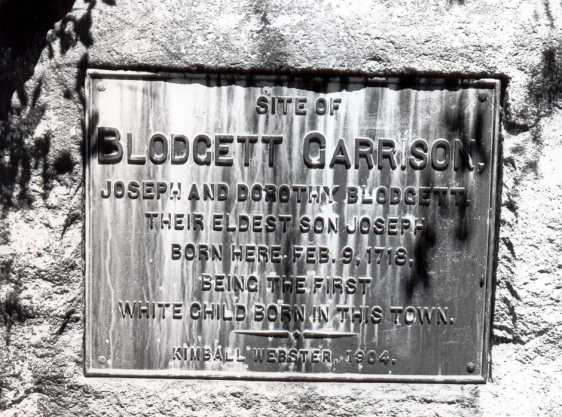
Blodgett Garrison Marker
Of the four garrisons constructed for the protection of early settlers in Nottingham, Mass, we have discussed the Hills Garrison. Moving south from the Hills garrison was the Taylor Garrison built on land which was originally part of the Joseph Hills grant, passed to a family member and then sold to John Taylor. Very little is known about John Taylor except that the Taylor Falls and thus the Taylor Falls Bridge bear his name. The location of his garrison was not marked by Kimball Webster but was identified by him as behind the Spaulding Farm on Derry Road (now Continental Beauty School) and along side Grand Avenue in the direction of the river.
Moving south the next garrison is the Blodgett Garrison. Kimball Webster placed the site 2.5 miles south of the mouth of the Nashua River and 1/2 the distance between Lowell Road and the river. The marker was placed on the Philip J. Connell Farm in 1905. The Connell Farm was a part of the original 200 acre farm of Joseph Blodgett. Today this is the general area around Fairview Health Care on Hampshire Drive. The granite boulder with a bronze tablet now resides on the lawn of 14-16 Hampshire Drive just east of Fairview.
After Joseph and Dorothy Blodgett settled here their oldest son Joseph was born in Feb 1718; he was the first white child (as opposed to Native American) child born in our town. Both Joseph and Dorothy were born in Chelmsford. Most likely the family traveled up the Merrimack River by canoe to settle their farm. Their descendants became very numerous and includes many distinguished men and women in NH, Mass, and other states.
The last garrison, was located on Fletcher land and was in that part of Nottingham which remained in Massachusetts when the provincial boundary was established. The location is a short distance south of the state in Tyngsborough. The photo of the Blodgett marker is from the Historical Society Collection.
Garrison Farm at 187 Webster Street

Garrison Farm at 187 Webster
While researching the initial location of the Hills Garrison Marker for last week’s photo, I was reminded of this aerial photo of The Garrison Farm at 187 Webster Street. The garrison marker was placed by Kimball Webster in the open field a short distance east (to the right) and down the farm road between the barns. At that time, in 1902, this farm of about 60 acres was owned by Justin M. Sleeper and operated by himself and his son-in-law Joseph Howard Legallee.
Earlier and following some medical issues Joseph Howard Legallee could no longer continue his work as a paper hanger. It was decided that he and his father-in-law Justin M. Sleeper would go into farming together. In 1891 Sleeper purchased a farm from John M. Thompson on what is now the Marsh Road. This farm later became the Marsh Place and the site of the present golf course. Joseph Howard Legallee, his wife Eva, their 2 year old son Howard Sleeper Legallee and his father-in-law Justin Sleeper moved to Hudson. By 1900 they sold the Marsh Road farm and purchased the Hill(s) Farm of about 60 acres on Webster Street at the intersection with Derry Lane. This farm included 20 tillable acres and a house in need of repair. The farm fields were in the river valley and extended on both sides of Webster Street. On the west they stretched to the river bank. On the east was the house, pasture for the family cows, and a year-round brook which provided a gravity fed water source for the family home, the farm, as well as water source to the Ferryall Farm (later the Rowell Farm and now Sparkling River) as well as The Hardy Place at the end of Elm Avenue (now the home of Dr. and Mrs. Brody). The Sleeper/Legallee family remained on and expanded the farm operation for 3 generations until about 1950 when the farm was sold to Colby Brothers.
As a farm it changed hands one more time about 1959 when it was operated by George Colby, Jr and Taze “Mac” McPherson. This weeks photo was taken some time after 1959 but before George and “Mac” built the Garrison Farm Stand just south of the farmhouse. The farm stand became a ready source for locally grown produce. By the late 1980’s and into 1990 subdivision of the farm occurred. The west field became a residential development (Scenic Lane and Shoreline Drive) and the east side became both residential and commercial. Currently a small convenience store and landscaping business has developed from the farm stand.
Prior to the 1900 purchase by Sleeper/Legallee this farm takes its roots back to 1661 as it was the northern most part of the land granted to Joseph Hills by the Province of Mass. Joseph willed this northern parcel of about 89 acres to his son Samuel. In turn 3 of Samuel’s’ sons – Nathaniel Henry, and James built a garrison and settled here about 1710. It remained a Hill(s) farm until 1900.
A number of Hudson locals remember the farm stand under ownership of George and “Mac”. As owners they continued to truck produce to markets but also marketed their produce locally. A few residents may even remember the ownership of Howard Legallee, his wife Phoebe, and their daughters Shirley, Beth, and Frances. It was Howard Legallee who transitioned the farm from a family dairy farm into a productive market garden. This began as early as 1913 when Howard completed a special course in agriculture at UNH Durham. He specialized in potatoes and later potatoes and sweet corn. One year his production reached 4500 bushels of potatoes. With the addition of irrigation and the proper storage barn he was able to sell potatoes year round.

Legallees Float 1939 Parade
Foremost in what I have read was their participation in the 1939 Old Home Day parade with a huge potato pulled on a flat bed trailer by Howard on his John Deere tractor. The family worked together on this float; constructing a potato from canvas, colored brown with eyes, sewn into the shape of a potato and stuffed with hay. Both photos from the Historical Society Collection.
Hills Garrison Marker

Hills Garrison Marker
Four garrisons were built within the town of Nottingham, MA as a protection against the Indians at the start of or during the time of Lovewell’s War. A garrison consisted of a two-story dwelling surrounded by a stockade style fence with one opening. The second story of the dwelling extended out over the first story so the settlers could look down and fire upon any intruders below.
The earliest and most northerly of these garrisons was settled about 1710 on land then owned by Samuel Hills of Newbury, MA and settled by three of his sons, Nathaniel, Henry, and James. Kimball Webster, town historian, determined the location of the Hills garrison and placed a granite boulder to mark the location in 1901. This marker was originally placed 25 rods east (412 feet) of the Litchfield Road on a farm then owned by Joseph H. LeGalee. Often called Garrison Farm, this farm remained in the LeGalee family for three generations and became a large market garden; it was later operated by Colby Brothers. The stone marker was easily accessible and visible to those working in the fields. As progress occurred and the use of the fields changed to industrial there was concern over the safety of the marker and it’s interference with the development of the area.
In 2008 when Hills Garrison School was completed and so named, the marker was removed from the Garrison Farm location. The photo of the Hills Garrison Marker shown here was taken at its present location along the entry road to Hills Garrison School. There is a mystery about this marker for which I do not have an answer. Three brothers, Nathaniel, Henry, and James built and settled in the garrison about 1710; however, Kimball Webster when he erected the marker only mentions the older 2 brothers, Nathaniel and Henry. Why was James omitted? Could it be because at the time he was just a lad of about 13 years of age?
The Hills Garrison was built upon a 45 acre parcel which Samuel Hills had inherited from his father Joseph in 1688; a part of Joseph’s original 500 acre grant from the province of Massachusetts. Neither Joseph or Samuel settled on their land. But, the ensuing families of Nathaniel, Henry, and James became the foundation of all the Hills development and family in Hudson and many of the surrounding towns. Photo from the Historical Society collection.
Location of First Meeting House

First Meeting House Historic Marker
Continuing with the markers of our historic past, this week we visit the Musquash area and the site of the First Meeting House. Shown here is the second of two markers placed by the town Bi-Centennial Committee following the 1933 celebration. It was placed near the No 1 schoolhouse, still standing in 1933, which was also the general location of the first meetinghouse for the town of Nottingham, Mass. Today the marker faces Musquash Road and is easily visible as you enter the Musquash Conservation Area. When you are in the area and look closely behind the marker you will find remnants of the foundation stones of the No 1 school. The 1933 committee searched the area for a suitable boulder and located one in an old wall on the north side of the schoolhouse. The marker on granite boulder with a bronze tablet was placed in June 1934. The bronze has since been removed by vandals and the inscription placed directly into the granite.
Nottingham, Mass was granted a charter, separating it from Dunstable, in 1733. The town was required to establish a meetinghouse and establish a minister within 3 years. Settlements within the town of Nottingham were primarily along the river; but they extended for the full length of the town to Lithcfield on the north and including much of Tyngsboro at the south. Imagine the difficulty the early town had in agreeing upon a center of town and location of the meeting house! Finally, on May 27, 1734 it was voted to build the house on this site and to raise it by June 5! With a schedule like this, I believe the men folk of the town were working on the side frames of the house before this site was selected. About 1 year later they voted to add a pulpit and seats the meeting house. Four different sites were considered before this final selection was made.
Nathaniel Merrill, the first settled minister, was ordained here as a congregational minister in November 1737. His farm was located on the Back Road (now Musquash) 1/4 mile north of this site. He remained here until his passing in 1796. Strictly speaking Rev. Merrill was not settled within 3 years; but, the early residents did not neglect their responsibility. Money was allocated to hire preachers from time to time for short periods until Rev. Merrill was settled in 1737.
Once established little appears in the town records about the meeting house until the settling of the province line in May 1741 and the subsequent incorporation of New Hampshire towns; especially Nottingham West. These boundary changes completely upset any agreements and calculations for a meeting house in the center of town. The town center had just shifted north to about the location of Blodgett Cemetery. Photo from the Historical Society collection.
Town Pound on Pelham Road C 1975

Town Pound on Pelham Road C 1975
Early towns were required to build and maintain a pound. Any person within the town could impound domestic animals (swine, cattle, horses, sheep…) which were creating damage or running loose on the roadway, the common, or was in violation of local laws. A pound keeper was chosen each year as one of the town officers. Owners of the impounded animals would claim them and pay for any damages, board, or fines.
Our early town records mention pounds as early as 1737 in Nottingham, Mass; then again in 1744 in the District of Nottingham, NH; in 1747 in Nottingham west. The earliest of these was likely built in that part of Nottingham which ended up in Pelham. The others were either not built or constructed of wood and did not last.
In 1759 the town of Nottingham West voted to have a pound built on common land near the house. This was likely on the common near the Blodgett Cemetery. Yes, there was a meeting house and town common in that area; it is now the location of Blodgett Cemetery and the intersection of Lowell and Pelham Roads, at Meineke Car Care.
The pound shown in this weeks photo was erected in 1772 after a vote at the annual town meeting. It was voted to erect a pound on high land between land owned by Nehemiah Hadley and Timothy Smith. Today this location is at the intersection of Pelham and Melendy Roads, on your left after the stop sign as you proceed down Pelham Road toward Bush Hill Road.
A committee of 3 was elected to build it with stone, 33 feet within the walls to a height of 6 feet plus one foot of wood. The pound was completed by September 1772, its date was carved on the gate post. At the next town meeting Timothy Smith was elected keeper of this new pound. This pound was continually used for over 100 years. In 1887, since the pound had not been used for some years the town considered selling it. At the town meeting this was rejected and the voters instead decided to keep it as one of our town’s ancient relics.
This pound stands today, a relic of early times; maintained by our faithful Highway Department. Photo from the Historical Society Collection.
Site of First Town Meeting
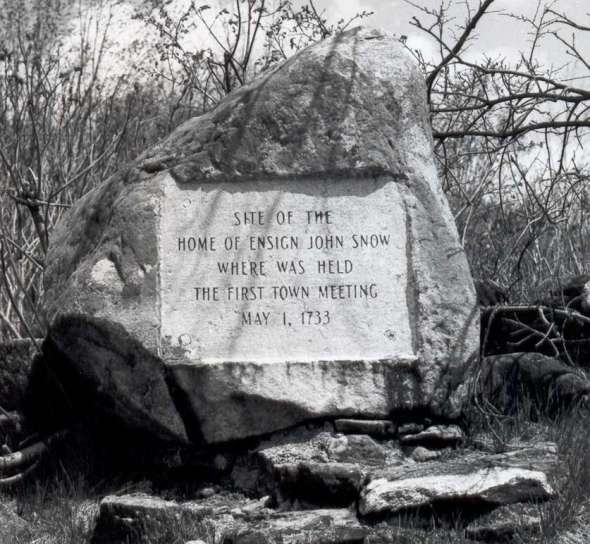
Site of First Town Meeting of Nottingham in 1733
In this week’s photo we travel to the south end of Hudson and visit the historic marker for the home of Ensign John Snow and the first town meeting for the town of Nottingham, Mass held May 1, 1733. This marker was placed in 1934 by the town Bi-centennial Committee using funds remaining in their accounts after the celebration was completed. The committee searched the area for a suitable boulder and one was found close to the highway on land then owned by Charles Shunaman near 103 Musquash Road, not far from the site of the Snow homestead. The original marker consisted of a bronze tablet attached to the boulder. Later, after vandals removed the tablet, the inscription was made directly into the stone.
On April 4, 1733 some 3 months after the charter of Nottingham, Mass was issued, an order was directed to Mr Robert Fletcher, a principal inhabitant, giving him the authority to assemble and convene the town for the purpose of choosing town officers to hold until the following March. Mr. Fletcher issues the call for the meeting to be held May 1, 1733 at 10:00 am at the home of Ensign John Snow. At this meeting the inhabitants chose a moderator, clerk, treasurer, 5 selectmen, surveyors, fence viewers (in charge of boundaries and disputes), and hog reeves (warden in charge of wandering swine and appraisal of damages they cause). The 1733 tax list contained 55 men. This may seem like a large population but we must remember, many residents of Nottingham lived outside the area which later became Nottingham West and Hudson. Of these 55, only 18 resided within the boundaries of the present day Hudson.
Ensign John Snow, born about 1667 in Woburn, married Sarah Stevens in 1693. They had 3 children; Elizabeth who died young, Joseph who also resided in Nottingham, and Mary. Little else is known about Ensign John except he was elected the first town treasurer, and a few years after this first town meeting he passed at he age of 68. He is buried in Ford Cemetery not far from his home.
The cellar where his house stood was pointed our to Kimball Webster by Timothy S. Ford many years prior to 1912 and the publication by Webster of the town history. Today this marker can be found on Musquash Road just south of its intersection with Gowing Road and on your left. Look for it along the side of the road near a stone wall. Photo from the Historical Society Collection.
Bronze Tablet Donated by Webster School Students in 1933
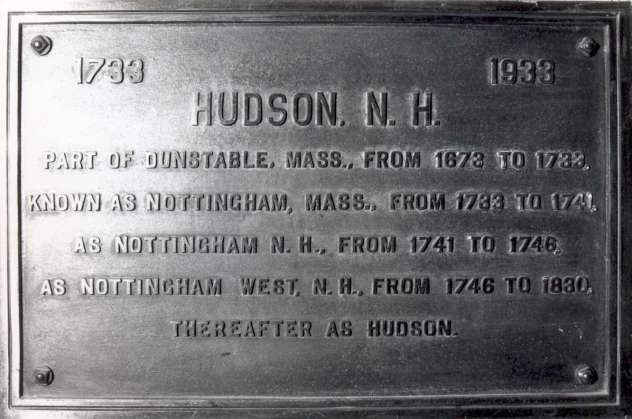
Bronze Tablet Donated by Webster School Students in 1933
While giving tours and talking town history we at the Historical Society frequently hear the question “When was our town established? The bronze tablet pictured here identifies the five birthdays, or founding dates, for our town.
Dunstable, Mass was founded in 1673. Most of the land contained within the present boundaries of Hudson was included within that town, with the exception of about 4,600 acres in the northeast part of Hudson which was then a part of Londonderry. The geography of Dunstable included land on both sides of the river including all or parts of some 14 towns in present day Mass and NH. In the early days of Dunstable land had been granted on the east side of the river but no real settlements occurred until about 1710. We remained a part of Dunstable, Mass until 1733.
As the number of settlers on this side of the river increased they petitioned Mass to be set off as a separate town. This petition was answered on January 4, 1733 when the charter for Nottingham, Mass was granted This town included all Dunstable lands on the east side of the river. The General Court ordered that a Town Meeting be held within 3 months and a minister be settled within 3 years. After survey and much debate the center of the town of Nottingham, Mass was agreed upon and a meeting house built on what is now Musquash Road. The town of Nottingham, Mass remained as such for only 9 years, until 1741.
The ancient boundary between the provinces of NH and Mass was based upon the Merrimack River and the misconception that the river flowed from west to east; with no idea of the abrupt bend northward the river made near Chelmsford. This resulted in some dual grants by the rival provinces of NH and Mass and a boundary dispute which was not settled until 1741. At that time the line was established to run 3 miles north of the Merrimack River from the ocean until reaching a specific point north of Pawtuckett Falls; after that the line ran due west to the Connecticut River. All land south of this line was in Mass. Land to the north was in Nottingham,NH; called by many historians as the District of Nottingham as towns had not yet been incorporated under the laws of The State of NH.
During the time after 1741 a number of smaller New Hampshire towns were spun off from Nottingham and were incorporated within NH. One of these, Nottingham West was incorporated in 1746 and a charter issued July 5, 1746. Nottingham West contained most of the lands of the present town of Hudson, except for those acres in Londonderry and minor adjustments to the boundaries with Windham and Pelham.
We remained as Nottingham West until 1830. At the annual town meeting of 1830 the voters of Nottingham West adopted an article to petition the General Court of NH to alter the name to Auburn or to designate some other name. The name was changed to Hudson July 1, 1830.
Our town has 5 founding dates or birthdays. In 1672 we were established as Dunstable, MA; 1733 as Nottingham, MASS; 1741 as Nottingham, NH; 1740 as Nottingham West, NH; and in 1830 as Hudson, NH. This confuses our celebrations! In 1933 we celebrated the 200th birthday of incorporation of Nottingham, Mass; in 1972, some 39 years later, we celebrated the 300 birthday of the founding of Dunstable! To my knowledge there was never a centennial or bi-centennial celebration for Nottingham West and no centennial celebration for changing name to Hudson in 1830. So, when will our next celebration be? perhaps in the year 2022, some six years from now, when we celebrate the 250th anniversary of Nottingham West?
This tablet is located within the School Administration Building, aka Kimball Webster School, and was donated to the Town by the students of Webster School as part of our 1933 bi-centennial celebration. Photo taken for publication of Town in Transition and is part of the Historical Society collection.
 Remember Hudson NH When...