Home » Uncategorized (Page 10)

Category Archives: Uncategorized

Cemetery of the Unknown

Peremiter fence cemetery of unknown

Perimeter Fence

The Cemetery of the Unknown was a part of the town poor farm  located in the north west section of Hudson on what is now Old Derry Road.  For this cemetery there are no monuments, no headstones, and no records to identify the individuals buried there.  The farm was purchased by the town in 1828 in the days when the resident poor were kept at the town farm.  Those who could worked the farm in an effort to produce food for all residents on the farm.  The town maintained this farm for some  40 years until 1868 .  At that time the farm was sold and the few paupers which did exist at the time were boarded out to private homes at the expense of the town. The  only known records of activity at the town farm was recorded by the Overseer of the Poor in the annual town reports.  It is estimated from these records that over the course of 40 years the  number of residents at this farm varied from 6 to 12 per year.   Any of them who spent their final months at the farm likely found their final resting place within the Cemetery of Unknown.  Some of these folks had been prosperous citizens of Hudson  but due to reversal of fortune  or conditions, spent their final times here and were laid to rest in the yard at the end of the farm.
The number of deaths which occurred here during these 40 plus years in not known; but it is estimated there was an average of at least 1 per year.  There are no records to indicate who they are, when they passed, and where within the cemetery each was laid to rest.
As time progressed  the land upon which the burial yard existed continued in private use.  Fewer and fewer residents of town retained any memory of this cemetery.  Perhaps the stage was set for the Cemetery of the Unknown to be lost to history forever.
100 years after the town poor farm and the site of the Cemetery of the Unknown was sold by the town of Hudson, Paul Gauvreau and his family purchased their homestead on Old Derry Road.  In talking with family of the previous owner, Paul was told about the Cemetery of the Unknown and that only a few people were still alive to remember that it existed; soon it would be grown over and all traces of the cemetery gone forever.
In 1982 plans were made to construct a new road, Twin Meadow Drive, and to build a number of duplex residences.   Aware of the existence of the cemetery but not sure of it’s exact location, Paul informed the Hudson Planning Board of the cemetery.  The developer agreed to stop excavation if burial sites were unearthed.  None were found and several duplexes were constructed along Twin Meadow Drive bordering the  field off Old Derry Road.
In 1990, Paul along with some of the  neighbors on Twin Meadow Drive did some local detective work  in the fields behind Twin Meadow Drive.  After removing brush and mowing the tall grass on a flatter section of the field, they discovered what appeared to be several sunken grave sites.  These depressions measured about 2 1/2 feet wide and about 6 feet in length and faced east and west; consistent with grave sites.  The depressions were likely caused by the collapse of the wooden enclosures over the years.  Paul contacted the town Executive Administrator, town Planner, and the Town Librarian .  Upon visiting the site, all agreed the site was worthy of further study; but, since the form of town government was about to change, all agreed to postpone the matter until the new government was in place.
Paul researched the Hudson town reports for the years 1845 through 1870; specifically the Reports of the Overseers of The Poor which lists the activities and financial transactions of the Poor Farm.  It should be noted that reports from 1828 through 1844 were not available.  He was able to compile a list of some 32 names of  individuals that died as paupers associated with the poor farm during these years, either living at the farm or being boarded in private homes at town expense.  Of these 32, 3 were buried in Nashua or Litchfield.  Most, if not all if the remaining 29 were buried on the farm. It is not possible to discover the exact number or identity of the individuals laid to rest in this cemetery during it’s 42 years of operation. The names we do have include individuals from well known Hudson families:  Barrett, Hamblet, Johnson, Marsh, Parker, Robinson to name a few.
In August 1994, as agreed with the town officials, Paul contacted Mr. Gary Hume, State Archaeologist, and asked him to conduct archaeological probings.  These probings and investigations took place during the fall months of 1994.  Present at each of these sessions were representatives from the state, officials from Town of Hudson, the Historical Society, various neighbors in the area, and Paul Gauvreau.  Paul had previously shared the results of his findings with both town and state representatives.  In March 1996, the New Hampshire Division of Historical Resources issued a report of their findings to Hudson Cemetery Trustees.  In essence this report confirmed the location and existence of the Cemetery of the Unknown.  The report did not make specific recommendations as to how this cemetery should be preserved; but did direct the town of Hudson to proceed with the recognition and protection of the property. In the months to follow, the town of Hudson led by the Cemetery Trustees, purchased from the landowners the Cemetery of the Unknown (also known as Poor Farm Cemetery) along with an access easement from Twin Meadow Drive to the cemetery.  On September 1, 2007 the cemetery was dedicated and a single monument placed there in memory of the estimated 62 individuals buried there over the years.
Monument at cemetery of unknown s

Single Monument for All 62 Nameless

The author and Paul Gauvreau visited the cemetery this past weekend and met with Susan Bauman whose home abuts the cemetery.  Both Paul and Susan have maintained chronology of events leading up to the confirmation and dedication of this cemetery.  Our thanks to them for sharing information with us.

Holy Cross Cemetery on Ledge Road

Holy Cross Cemetery S

Entry Sign and Flagpoles at Holy Cross Cemetery in Hudson


The Church of the Immaculate Conception at what is now 119 Temple Street, Nashua was consecrated in 1857 as an Irish Catholic Community. By the early 1900’s the Lithuanian Community was on the increase and a pastor was added to this church to minister to them. As both communities continued to grow it became evident that a new church was needed. By 1909 the Irish Community moved into the newly constructed Saint Patrick’s Church on Spring Street. Soon thereafter The Church of the Immaculate Conception was transferred to the Lithuanian Community and the name of the church changed to Saint Casimir’s in honor of the Lithuanian saint.

One of the first additions made by Saint Casimir’s church was the purchase of property on Ledge Road in Hudson for a cemetery; Holy Cross Cemetery. At the entrance to this cemetery from Ledge Road there are two flagpoles: one flies the US Flag the other the Lithuanian Flag.

Saint Casimer’s church was closed in 2003 and the congregation merged into Saint Patrick’s on Spring Street. The property at 119 is now Casimir’s Place, an affordable housing complex. Holy Cross cemetery retains it’s original name but the management and operations have been combined with Saint Patrick’s Cemetery. In a sense the congregations of Saint Patrick’s and Saint Casimir’s have gone full circle. Originally the Irish and Lithuanian congregations shared The Church of the Imaculate Conception on Temple Street. As congregations grew, the Saint Patrick’s Church was built on Spring Street and the Lithuanian community remained on Temple Street as Saint Casimir’s. Some 90 plus years later in 2003, Saint Casimir’s has merged with Saint Patrick’s.

Initially this cemetery offered burial space to members of the Lithuanian community. Until recently the policy of this cemetery was to offer burial space to members of the Catholic community. This has changed and space within Holy Cross, like Saint Patrick’s, is available to any member of the Christian community. The contact person is Elaine Poulin at 881-8131.

The photo of the entrance to Holy Cross was taken by the author and is part of the Historical Society collection.

The Catholic Cemetery (Saint Patrick’s) on Derry Road
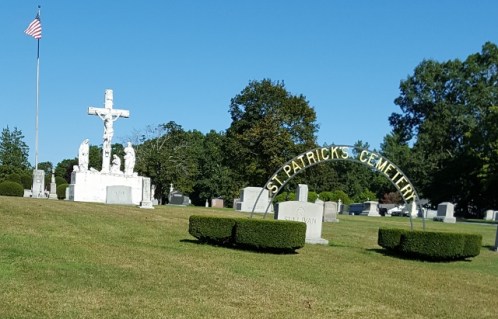
St Patricks Cemetery Entry S

St Patricks Cemetery Derry Road

The availability of jobs resulting from industry and factories coming to Nashua resulted in an increase in the immigrant population of Nashua.  The Catholic Church quickly recognized the need to have pastors and congregations available for these communities.  In the 1850’s Nashua experienced a great influx of Irish families, pushing the construction of The Church of the Immaculate Conception on Temple Street.  At the time of it’s consecration in  1857,  2,000 communicants were added to the church rolls. 

By the early 1900’s the Lithuanian Community was likewise on the increase and a pastor was added to The Church of the Immaculate Conception  to minister to them.  As both communities continued to grow it became evident that a new church was needed.  In March 1891 the church purchased the Hosmer Estate on Spring Street and by 1909  services were being held for the Irish Catholic Community at Saint Patrick’s Church on Spring Street.    
 
Soon after 1909 The  Church of the Immaculate Conception  was turned over to the Lithuanian Community and the name of the church changed to Saint Casimir’s.
 
 On or about 1857 ten acres of land on Derry Road in Hudson was purchased  by The Church of the Immaculate Conception and consecrated for the purpose of a cemetery for the Irish community.   The original land was conveyed by the Pierce Family of, James L, John P, and Edgar B, residents of Nashua.  With the exception of about one acre on the east side which was swampy and unfit for use as a cemetery, lots were laid out. In 1907, a strip of land was purchased on the north side and an enlargement made to the cemetery. By 1912, at the time of the writing of Webster’s History of Hudson, nearly all the lots had been taken up.  The vast majority of the interments within this cemetery were for families residing outside of Hudson. Our first photo shows the hillside as you enter the cemetery.  After the archway with the name of the cemetery is the sacred cross followed by the War Memorial and the American Flag.
Celtic Cross St Patricks

Celtic Cross at St Patricks

 
Acting as a sentinel and gateway to the newer section of the cemetery behind Hannaford’s Super Market is this Celtic Cross, in memory of  R. T.  Rev. Monsignor Matthew J.B.Creamer, the Pastor of St. Patrick’s Church from 1906 – 1939.  
 
Initially this cemetery was to offer cemetery space to members of the Irish community.  By 1895, the Catholic cemetery contained about 4,000 graves sites; the vast majority were for the Irish Catholic community, but a few hundred French Catholics were also interred here.  After St. Patrick’s  Church on Spring Street was built the name of this cemetery was changed to Saint Patrick’s.  Until recently the policy of this cemetery was to offer burial space to members of the Catholic community.  This has changed and space within Saint Patrick’s is available to any member of the Christian community.  With the recent expansion there are lots available.  The contact person is Elaine Poulin at 881-8131.  


Sunnyside Cemetery on Central Street

Sunnyside Entrance S

Entrance to Sunnyside Cemetery on Central Street

As the town grew and burial space in the older cemeteries became limited, the need for Sunnyside Cemetery arose.  According to the incorporation papers the legal name of this yard is ‘The Hudson Cemetery”.  The Sunnyside cemetery as it is commonly refereed to is located on the north side of the highway at 98 Central Street.   According to records, the original yard purchased from William Hadley in June 1846 was slightly over 1/2 acre.  The land was purchased for $13.00 and an additional $257.00 to Ethan Willoughby for the construction of the stone wall which enclosed the yard with an entrance off Central Street.  There were two  additional land purchases, one in 1885 and the second in 1910.  After the first purchase the stone wall was moved to include the parcel within the bounds of the yard.  At the present time this small cemetery contains 2.817 acres shaded from the canopy of maple trees.
According to Kimball Webster in his History of Hudson,  the first meeting of the Hudson Cemetery Association was held at the home of Ethan Willoughby on Central Street  December 6, 1845.  At this meeting the cemetery was organized, and the articles of association were signed by Ethan willoughby, Paul Colburn, Cyrus Warren, Nathan Marshall, William Hadley, David Clement, David Burns, Abiather Winn, Mark Willoughby, Benjamin A. Merril, and William Blodgett,  It was also agreed to purchase the original 200 by 113 feet original parcel for the cemetery.  No record of any subsequent meeting for several years; however business was conducted and the land was purchased, lots laid out,  and stone wall built  by 1851.  
 
The very first lot, number 17, was sold to Alfred Cummings on April 8, 1851.  By 1885 all the lots in the cemetery had been sold and during that same year a second land purchase of 1 acre was added to the cemetery on the east side and the wall was moved so as to enclose it.  The new ground was laid out into lots and the size of the cemetery more than doubled.  By 1908 all the lots in this section had been sold.  Again in 1910, a 1/2 acre was purchased from George Marshall, allowing expansion to the rear of the cemetery.  this land was subsequently improved and laid out into lots, all of which have been sold.
Joseph Fuller Monument

Joseph Fuller Monument

Sunnyside  is an attractive cemetery with a convenient location.  It contains a number of expensive and interesting monuments.   To me, the most elaborate monument is that for the families of Kimball Webster and his Brother Nathan.  This monument greets you on the right as you enter the yard.  The most interesting monument is that for Joseph Fuller (1818-1896) and his wife Belinda Steele (1823- 1891).  This metal monument is shown in our second photograph and  resembles a fireplace.  It is on the right side of the yard about halfway to the rear.
Unfortunately, the surrounding area does not include any possibility for expansion.  It has become the final resting place for many of Hudson’s families such as Baker, Batchelder, Chase, Colburn, Cummings, Davis, Gould, Hadley, Holmes, Martin, Marshall, Pollard, Sanders, Sargent, Stearns, Steele, Willoughby, Winn, and Webster.  At the present time the management of Sunnyside Cemetery in handled by Fred Fuller.
The photo of the entrance to Sunnyside was taken by Lorna Granger, a neighbor to the cemetery.  The photo of the Joseph Fuller monument was by the author.  Both will be part of the Society’s collection.

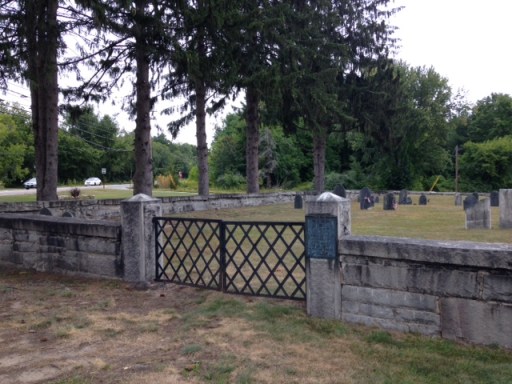
.. Hudson Center Cemetery

Hudson Center Gate1

Hudson Center Cemetery Gate

Actually, the next Hudson cemetery in terms of age is the Senter cemetery which we visited a few weeks ago when we were exploring Old Derry Road,  Remember, interments at the Senter site occurred as early as 1759 while this part of Hudson was within the town of Londonderry.  It became a Hudson cemetery when annexed to Hudson in 1788.
The old burial ground at Hudson Center is a small site containing about 1/2 acre.   It was first used a s burial site about 1775.  This was a public burying ground, given for that purpose by Deacon Henry Hale from a small piece of his farm.  Following tradition, the burial ground was located near the North Meeting House.  Today, this ground is  on the lower, east corner of the Hudson Center Common, just above Kahil’s Sub Shop.  The North Meeting House was located opposite the common on Central Street, and very near the site of the current Wattannick Hall.
Kimball Webster in his Hudson History, printed in 1913, stated there was a verbal tradition among the old timers that the first internment made in this yard was a Mrs. Gibson.  There is not such stone in the yard, probably none was erected.  Other than this possibility, the oldest date found here is that of John Haselton Smith, son of Page and Lydia Smith,, who died September 5, 1778 at the age of two,  This yard became filled with graves as early as 1850; and few, if any, burials have been made there since that date. It is estimated the unmarked graves within this yard out number those with headstones by as much as 200-300%.
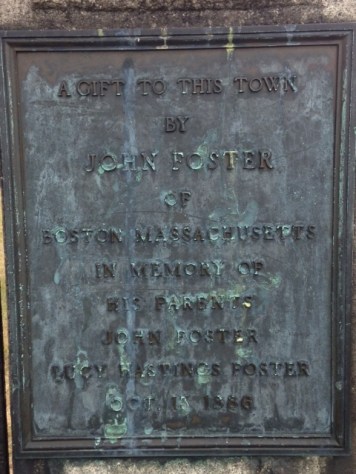
 Once burials ceased to be made, it became neglected and suffered from brush and trees so that it became a disgrace to the residents of Hudson,  A petition  suggesting the removal of the remains probably moving then to another cemetery.  In 1871 a special town meeting was called at which this petition was dismissed.  In 1886, Mr. John Foster of Boston, a native of Hudson, made a proposition to the town.  He would  pay the expenses of building a substantial and permanent granite wall enclosing the yard on the condition that the town would clean up the ground and to keep the site in a good condition.  His proposition was accepted  and in 1887 the current wall was erected.  It has ever since that time been maintained by the town of Hudson.
Center Sign

Foster Family Memorial Sign

A memorial plaque exists to the right of the game as a memorial for the wall to his parents. Today this is done by the Highway Dept. and the town cemetery trustees.  A few years after 1887 the fir trees were added to the Common beside the cemetery wall.
Today’s photos were taken in 2017 by Jonathan Rollins and are a part of the Society collection.

Blodgett Cemetery


Blodgett Cemetery

Blodgett Gate at Pelham and Lowell Roads

Our next cemetery to visit is the Blodgett Cemetery, located on Pelham Road at the intersection with Lowell Road and about 1 1/2 miles south of the Taylor Falls and Memorial Bridges. It is the third burial yard, in order of age, in Hudson. It contains about 1 acre of land and was acquired by the town on or before 1748 from Benjamin Whittemore for a meeting house and public uses. The state boundary with Massachusetts was established in 1746, leaving the residents of town in need of a meeting house site more central to it’s people. This site was selected and by 1748 the second meeting house was erected by the town. Kimball Webster in his History of Hudson describes the site of the meeting house as on the south side of the yard and near the present gate of the cemetery. The burial plots were the church yard, surrounding the house on the rear and on both ends.

In time the meeting house was moved away, and the No 4 school house built on the site. By the winter of 1855 the school house burned. Prior to this time a question was raised about the town’s title to this lot on the north side. At the town meeting of 1839 the town appointed a special committee of Thomas Wason, Jeremiah Smith, and Daniel Davis to investigate. This committee met with Reuban Greeley, Esq. the abutter on the north end. After this meeting, all parties agreed to establish an east west boundary on the north side of the town owned land.

After the schoolhouse fire in 1855 that site was abandoned in favor of a location nearby. As the land upon which the schoolhouse had stood belonged to the town it was added to the cemetery and a short time later a cemetery association was organized. The yard was then enclosed by a stone wall with an iron gate. The grounds were cleared of bushes and rubbish and other improvements were made. Family lots were located and laid out using the vacant grounds. Unfortunately, either from carelessness or willfulness, new lots were plotted upon grounds of some ancient graves and they were obliterated. In Webster’s History he reported this as inexcusable and lacking the respect which should have been due to these early settlers.

The most ancient date found among the inscriptions of this place is that of Priscilla Chase who passed October 5, 1749. The most frequent surnames found on the headstones are Blodgett, Greeley, Burns, Chase, Pollard, Winn, Wason, Hale, Caldwell, Page, Wilson, Cross, Merrill, and Burbank.

Within this cemetery are four generations of Blodgetts with the name Joseph. Joseph, born 1760, served in the Battle of Bennington in 1777. Being a lad of 17 he did not receive credit for his service at either the local or the national level until 2007, some 229 years later. His service has since been registered at the national level by Ruth (Baldwin) Williams, a descendant of his from Oak Forest, IL. when she applied for membership is the Daughters of the American Revolution (DAR). Young Joseph served with his father and the records for his service were credited to his father. His grave site in Blodgett Cemetery received a Revolutionary Soldier marker at a Memorial Day ceremony in 2007. Mrs. Williams coordinated this event with the Cemetery trustees, the American Legion of Hudson, and the Hudson Historical Society.

The photo shows the gate into this cemetery in 2007 and is part of the Historical Society collection.

Ford Cemetery at Musquash Road
Ford Cemetery S

Entrance Gate Ford Cemetery

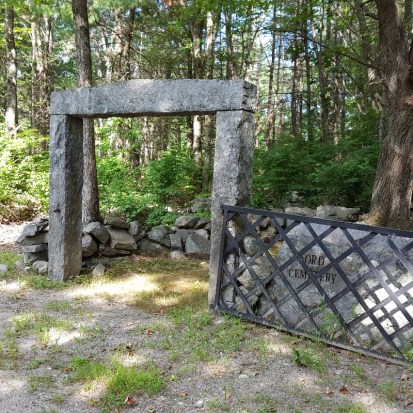
The Ford cemetery is located on Musquash Road less than 1/4 mile south of  the site of the first meetinghouse of Nottingham. and on the same side of the road.   The location of the meetinghouse is at the entrance to the  Musquash Conservation Area and is identified by a granite marker.  This  cemetery, also known as the South End cemetery and the Musquash cemetery,  was laid out and dedicated as a burial place in 1734, just a short time after the building of the meetinghouse.
The custom of the early settlers in this part of New England was to have a public burying ground, or church yard as often called, connected to and often times surrounding it on three sides of the meeting house..  This was not practical at this location because the land in that vicinity was rocky and ledgy, not suitable as a place for the internment of the dead.  The selected site is as near the church as as a suitable plot of ground could be found.
To locate this cemetery one needs only to travel south on Musquash from the conservation area less that 1/4 mile.  On your left you will find a gravel driveway; the cemetery will be found a short distance in on this driveway.  Be careful as the cemetery cannot be easily seen from Musquash Road.  This burying ground contains about 1/4 acre, enclosed by a stone wall with an iron gate.  Above the iron gate is perched a long granite post laying horizontal  with the ground and supported on each side buy a similar granite post.  You walk under this post as you open the gate to enter the cemetery.
The most frequent names found within this yard are Snow, Merrill, Ford, Fuller, Gowing, Barron, Wilson, and Connell.
There is no debate as to the antiquity of this place; in fact some historians have claimed that it is the most ancient of all Hudson;s cemeteries.  The earliest date found in this yard is that on the headstone of Ensigh John Snow, “who departed this life March the 28th, A.D., 1735.  Aged 68 years, 4 month, and 3 days.  This headstone is a very thick, wide and heavy one and not very high.  This is the most ancient inscription of any, not only in this yard, it also predates the earliest date of 1738 found in Hills Farm cemetery or any other cemetery in town.  Ensign John Snow resided nearly on Musquash Road.  The first town meeting of Nottingham, MA  was held at his house on May 1, 1733.
This yard is the final resting place of Rev. Nathaniel Merrill, the first minister settled in this town. and his wife Betsey. He preached here for more than 50 years.
Without a doubt the most intriguing headstone within this yard is the double stone indicating the death of Capt. Thomas Colburn, age 63, and his 3 year old son, Thomas.  Both were killed on August 30, 1765 while asleep in their bed by a single flash of lightening.
The most recent, and I believe the last, internment to be made in this place, were those of Leslie Shunaman (died 2005)  and his wife Leslie (dield 2004).  Louise and Leslie were well known residents of Hudson and life members of the Historical Society.
I have a mystery concerning this cemetery and perhaps some of our readers can help!  Allen Morgan grew up in South Hudson and recalls visiting this cemetery with some of his ‘buddies’.  He recalls an inscription within this cemetery which reads “here lies the body of x who was lost at sea and never found”.  I have searched the cemetery and the inscriptions printed in 1908 by Kimball Webster and can find no reference to this!!  If anyone has an idea they can sent email to Ruth at HudsonHistorical@live.com or leave a message at 880-2020.

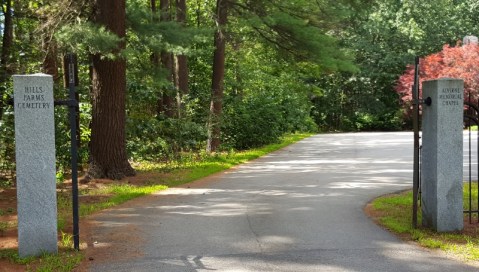
Hills Farm Cemetery

Cemetery Roadway S

Cemetery and Chapel Gate

There are  eleven cemeteries or burial places in Hudson.  They are Hills Farm, Ford, Blodgett, Hudson Center, Senter, Sunnyside, Westview, St. Pattrick, Holy Cross, Cemetery of the Unknown, and the Presentation of Mary’s cemetery.  Last week we looked at the Senter Burying Ground at Potash Corner.  This week we will visit the  Hills Farm Cemetery.
Early settlements of Dunstable, MA (now Hudson) clustered around the Hills Garrison in the north and the Blodgett Garrison in the south end of town.  The earliest of these  occurred about 1710 when three sons of Samuel  Hills (Nathaniel, Henry, and James) erected and settled in the Hills Garrison. The original part of the Hills Farm cemetery was located on level, sandy land about half way between what is now the Derry and Litchfield Roads and adjacent to Derry Lane.  This was the south-east corner of the Hills farm where Nathaniel and his brothers settled.  The exact date when this cemetery was first used as a burial place is not known but must have been some years after the Hills brothers settled at the garrison, and probably not earlier than about 1730.  It is known that Nathaniel Hills buried two or three of his children in the in the ancient burial ground in South Nashua near the entrance to Royal Ridge Mall.   The early settlers seldom erected head stones to identify the graves of their deceased loved ones; so, the markings we do find do not indicate the earliest interments.
The earliest  date found in this cemetery is 1738, crudely cut into a common stone with no inscription to indicate the individual interred there.  The next date found is that found in the inscription found on a headstone for  Joseph Greele , who departed this life March 7, 1745, in his 95th year.
Even though this cemetery was on the Hills property  and likely laid out by Nathaniel Hills it was it was used as a public burial place.  The early families of Hudson found among the headstones include Hills, Greeley, Spalding, Marsh, Marshall, Pierce, Cross, and Sprake.
About 1872 small additions of adjacent land were added to the cemetery.  These additions with some other vacant land in the yard were laid out into lots, streets were graded, the brush removed, and other improvements were made thus improving the overall appearance of the cemetery.  The cemetery contained a little less than one and one half acres.  In 1885, as permitted by state laws, the yard was incorperated as “The Farms Cemetery’  The charter was amended in 1905, changing the name to “Hills Farms Cemetery”.  About this time Dr. Alfred K. Hills, realizing the need for expansion of the cemetery, purchased a large tract of land adjacent to the cemetery and extending to the Derry Road.  He then had six acres of this parcel surveyed for an addition to the cemetery.  Upon part of the remaining land Dr. Hills built Alvirne Memorial Chapel in 1908 as a memorial for his wife Virginia.
Cemetery and Chapel Gate S

Roadway to Hills Farm

At the present time the Alvirne Chapel and the main entrance to Hills Farm Cemetery share access  from 160 Derry Road.  There is a secondary entry to the cemetery from Derry Lane.  The entrance from Derry Road is through an iron gate between two granite posts  inscribed  with Hills Farm Cemetery on one and Alvirne Memorial Chapel on the other.  Access to the cemetery is then through a right of way through  the parking lot to a shaded, wooden drive which takes you to the cemetery.  Hills Farm Cemetery is incorporated and under the management and direction of a Board of Trustees. This cemetery is open for new burials and there are lots available for purchase.  The contact person for the cemetery is George LaRocque.   The photos were taken by the author.

The Senter Homestead on Old Derry Road
Thomas Senter Home S

Senter Farmhouse Old Derry Road

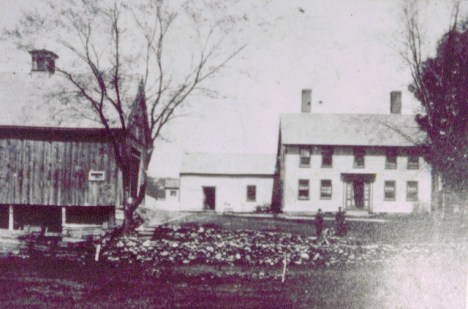
Best known as the home of Deacon Thomas Senter this  farm was home to five generations of the Senter Family, beginning with Samuel the father of Thomas.  The farm were settled in the South West part of Londonderry near “Potash” Corner.  This was the part of Londonderry annexed to Nottingham West in 1778.  We know the location today as the intersection of Old Derry Road with Robinson Road and a bit north of the Senter Cemetery.
Deacon Thomas was born May 1753 in Londonderry, NH the son of Susan Taylor and Samuel Senter.  Thomas married Esther Greeley, daughter of Ezekiel Greeley, circa 1775.  Their family consisted of 7 daughters (Kate, Bridget, Susan, Charlotte, Esther, Rebecca, and Nancy) and 2 sons (Thomas, Jr and Charles).  His wife, Esther passed at the age of 51 in 1800.  Thomas married a second time to Mercy Jackson and a third time to Eunice White.  There is no record of children born to these later marriages.  Thomas was a farmer and he enlisted in the spring of 1775 for 8 months and served at the Battle of Bunker Hill.
On May 1, 1805 the  Baptist Church of Christ of Nottingham West (now the First Baptist Church of Hudson) was organized in this home by a  council called for that purpose.  The new  church consisted of 65 members who had been “sett Off” from the Baptist Church in Londonderry.   That very same  council held an ordination for  The Reverend Thomas Paul.  For several years following the new church did not have a settled pastor.  The pulpit was supplied by various pastors, one of whom was the Reverend Thomas Paul.  The early church had two deacons.  Thomas Senter was chosen as one of the deacons, the other was Moses Greeley.  The anniversary of the organization of the Baptist Church (now at 236 Central Street) is recognized annually on or near May 1 as a Roll Call.  Members meet, enjoy a meal, fellowship, and call the roll.  When a member’s name is called they respond with a verse of scripture.
 This homestead remained with the Senter family until May 1889 when it was sold to Jeremiah Heath and  his son George M. Heath.  The Heath family owned the place until about 1921 when it was sold by Cora Heath, wife of George.  Either just before or soon after being sold by the Heath family the ancient home was destroyed by fire.  It is not clear if this was an intentional burn or not.  From the June 30, 1921 article in the Nashua Telegraph we get a description of the house.  The centerpiece of the house were two large brick chimneys probably made from Litchfield bricks.  These massive structures remained standing after the fire; showing the huge arches in the  cellar which supported 8 fireplaces.  One for each of the rooms in the house.  Cooking was done in an open fireplace.  The house had a front and a back door which led into a hallway from which one you access any of the four rooms downstairs.  The roof timbers were unusually strong and could have supported the extra weight of a slate roof.  To my knowledge, all evidence of this house has been replaced by more recent developments.
While researching Moses Greeley for last week’s article and Thomas Senter for this week, I began to understand the significant role each of these gentlemen had  to our town’s history; and the similarities of their lives.  Let me share:  They were farmers and neighbors, settling on the Derry Road.  They had adjacent farms and their houses were within 1/2 mile of each other.   They were both charter members of the First Baptist Church and both were elected as one of the two deacons for the church; a position held for life or until one resigned.  They were not related but their lives and the lives of their families were interwoven.  You see, Moses and Thomas married sisters.  Moses’ first wife was Hannah Greeley.  Thomas’ first wife was Esther Greeley.  These ladies were the daughters of Ezekiel Greeley.  The relationship between these two families continued beyond Moses and Thomas.
This photo of the Senter Homestead is courtesy of John Senter of Nashua; a direct descendant of Deacon Thomas Senter.

Greeley/Lambert/Nadeau Farm

98 Old Derry Early S

98 Old Derry Road Early View


Do you have memories of the Nadeau Dairy Farm at 98 Old Derry Road? Perhaps you stopped by and visited the cows; taking pictures while they grazed in the field or lay resting while they chewed their cud to take digestion to the next level!! Perhaps you drove past and saw the tractor and hay baler getting the crop ready for winter storage. One of my memories is intentionally driving past the farm near Halloween to see the numerous Jack-O-Lanterns positioned along the side of the road, gazing out of a barn window, or perched and lighted from the top of the blue silo. This was a local tradition prepared for us by the Nadeau family with help from friends and neighbors.

This four generation dairy farm had it’s beginning in 1902 when Joseph Lambert and his wife Mary were living in Nashua but looking to move to a dairy farm. In July of that year they purchased this home and farm from the heirs of Jackson Greeley. Joseph ran a milk route into Nashua. He later added chickens and pigs with the remainder of the farm was used for grazing and growing feed for the cows.

Joseph and Mary raised a family of six. Their daughter, Marion, married Emery Henry Nadeau in 1935. They lived on and worked the farm with her parents; purchasing from them in 1941. For another two generations and most of 70 years the farm continued; first with Marion’s son Emery E. and later with her grandson, Emery E.,Jr. The senior Emery E. was responsible for the day to day operations of the farm since the age of 14 when his dad, Emery Henry, took a job in Nashua. By 1961 Emery E. and Shirley (Craig) were married. They raised a family of 3 children; Lori, Emery E. Jr, and Elizabeth. The younger Emery joined the family business upon graduation from Alvirne High School in 1982.

By 1995 Emery E. then age 50 was working a herd of 75 milkers which produced about 205 gallons a day!! The electronic milking machines delivered the milk directly into a storage tank where it was cooled and kept at temperature until drained by a milk hauling truck in the small hours of the following morning. At that time this farm was the last commercial dairy farm in Hudson with the exception of the farm in operation at Alvirne High School. Working the farm was hard work which was done by the entire family with help from neighbors during haying and harvest time.

98 Old Derry 2017

The Farmhouse 2017

The Lambert/Nadeau farm operated for nearly 100 years; from 1902 until 2000. Within a short time machinery, livestock, and property were sold. The homestead and farm buildings on the south side of the road were purchased by Keven Slattery. Using much of the old farm buildings it is the location of Nadeau Industrial Park. The farmhouse has had many improvements and is now a 2-unit rental. The acreage on the north side of the road is under development as Senter Estates.

In 2009, following his avocation for the dairy farm, the younger Emery was hired as the Alvirne Farm Manager. His mother, Shirley remains active; working at Checkers Restaurant within the culinary department of Alvirne. This past month, as part of the Second Annual Historical Society Gala, Emery Nadeau, his mother Shirley, sisters Lori and Elizabeth and their families were awarded the Community Service Award for their work to make the Alvirne School Farm a valued resource in Hudson.

The house at 98 Old Derry dates to 1793. Jackson Greeley, the youngest son of Moses and Mary (Darby) Greeley was born in Hudson November 1815. Moses Greeley was born in Haverhill, MA in 1787. By 1793 he had moved to Nottingham West and was a single father with two young daughters. His first wife, Mary Greeley, had recently passed, and he was (or soon would be) married to Mary Darby. It was Moses Greeley who was responsible for building this farmhouse. He and his wife Mary had 10 children of their own; plus Moses’ daughters from his first marriage. Moses lived in this farmhouse until his death in 1848 at the age of 83. Ownership of the farm passed to Jackson Greeley who likewise resided here until his passing in 1894. It has been said that this home was used as a tavern because of the location on the roadway between Nashua and Derry. This may have been the case but, based upon what I have read to date, I cannot state it as a fact .