Home » 2018 (Page 4)

Yearly Archives: 2018

Baptist Church at Hudson Center

HBC c1905
Back in the days before oil (and later gas) furnaces the church was heated by wood stoves and later by wood furnaces.  Parishioners would volunteer to provide adequate cord wood for  the purpose.  The wood furnace I remember was located in the dirt cellar under the sanctuary and heat rose into the floor of the sanctuary via a large pipe.  We would cluster around this heat vent for extra warmth on cold Sundays. 
The First Baptist Church of Hudson was organized in 1805 at the home of Thomas Senter on at what is now the Old Derry Road near the Londonderry Line.  For the first 37 years services were held in members’ homes or at the North Meeting House located just east of the Town House.  The sanctuary of this church at the corner of Central and Greeley Streets was constructed in 1842.  In 1888 a short alcove was added to house the new organ; then, in 1897 the large vestry was added.  This photo was probably taken at the time of the centennial celebration of the church in 1905.  Over these years the exterior of the building has not changed significantly except  for replacing the original steeple which was completed  in 2007.  To the left of the church we see part of the Greeley/Wentworth home, now the church parsonage.   The stacks of wood seen here are were used to heat the building.  The dirt roadway in front of the church is either Central Street or a short cut from Central Street to Greeley Street.  Photo from the collection of the Hudson Historical Society.

1912 Home of George and Hattie Skeels
2015028039

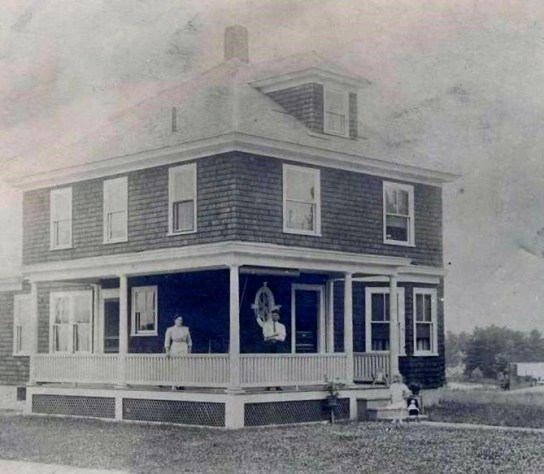
57 Ferry Street C 1912

By 1911 the Hudson bridge area had become an attractive and growing community.  The iron bridge connecting the villages of Hudson and Nashua was recently replaced by a  concrete bridge.  This bridge was sturdy and wide enough to accommodate vehicular traffic plus the increased traffic  from the electric street railroad.  Once the street railroad or “trolley” crossed into Hudson the line split to provide service in three directions:  up Central Street to and down Lowell Road to Lakeview and on to Lowell; a second line went up Ferry Street on to Hudson Center and then to Pelham; a third made a sharp turn onto Webster Street and on to Litchfield, Goffstown, and Manchester.
    In addition to the improved roadways and and trolley service a business and shopping area was developing which included the post office, fire and police a new public school named for Kimball Webster.  Just a few years earlier the town received the gift of permanent public library donated by Dr. Alfred K. Hills in memory of his wife Ida Virginia.  Also, across the way from the library was a public park which included a convenient waiting station for the trolley line on Ferry Street.
This was the community which attracted 54 year old George H. and 52 year old Harriett “Hattie” Skeels.  They selected a lot on the corner of Ferry and First Streets from John A. Robinson in November 1911.  Ten months later their new home was completed and they moved in a few weeks later on  October 12, 1912. Our first photo shows Mr and Mrs Skeels on the porch of their new home and their young daugter, Myrtle, at the walkway.  To the right and down the hill is the Hills Memorial Library.  This photo is from a post card of the private collection of Gerry Winslow.
George was born Feb 1868 in St. Lawrence, NY and Harriet Furman was born in 1870.  They were married in 1892 most likely in NY.  By 1900 they were established in the Nashua community.  He was employed as a brakeman for the B&M Railroad and belonged to fraternal orders including Masons, IOOF, and the Brotherhood of Trainmen.  Both George and Harriet were leaders in Christian Endeaver in Nashua.  He often ministered to his fellow employees.  With the convenience of transportation a move to Hudson would be a relatively easy transition for Mr and Mrs. Skeels.
Their life together in the new Hudson home would be short lived.  On November 23, 1917 George passed away due to traumatic shock resulting from a railroad accident.  He died instantly.  Funeral services were from his home in Hudson.  He was laid to  rest in the family plot in Woodlawn Cemetery.  His father, Herman H. Skeels had predeceased him in 1916.  His parents had moved to Nashua about the same time as George and Harriet,  Aside from his widow, Harriet, he was survived by his mother and Little Myrtle.  This is the only mention, other than the young girl in the photo, of Young Myrtle.  He was remembered as a friend of all – an enemy of none.
Harriet continued to reside in her Hudson home and continued her social and christian crusade activities in Nashua.  I have no further information on Myrtle.
In June 1940 Harriett, widow of George Skeels, married Clarence Paige of Manchester.  Following their wedding trip they resided in Manchester.  In July 1942 Harriett Paige sold her Hudson home to Mr and Mrs Carroll Morse.  In June 1948 Harriett (Furman)(Skeels) Paige of Mancheser, a well known former resident of Nashua and Hudson passed.  She was laid to rest with hr first husband George in Woodlawn Cemetery.
From 1948 to the present time, some 70 years, the house at 57 Ferry Street has been home to 12 different owners; including Francis and Florence Fairfield and their family.  Many  remember Francis from service as a window and distribution clerk in our Hudson Post Office and Florence “Ginger” for her hairdressing salon.
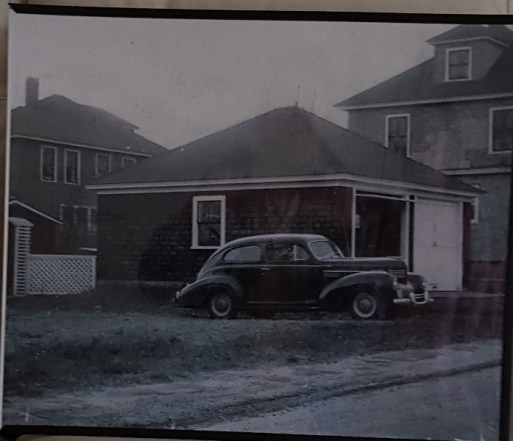
57 Ferry 1945

Garage and House at 57 Ferry C 1945

The present owners are Jaqueline Martone and Michael Euliano.  Although they have lived here only a short time they love the house and appreciate the maintence and upkeep by the previous owners.  The second photo taken C1945 is complements of “Jackie” Martone.  It shows the garage which is at the rear of the house and faces First Street.

Revisit To Hudson Center … House at 238 Central Street

This week we revisit the fifth old residence which faced the Hudson Center Common.  This home between the Baptist Church and the old Town Hall has been replaced by an office building operating as Heritage at Hudson.
238 Central

238 Central Street C1976

The house in this photo dates to at least 1850, perhaps earlier.  It stood for many years between the Baptist Church and the Town House at Hudson Center; and over these years was occupied by many families, including:  Robinson, Chase, Greeley, Hamblett, and Biskaduros. This was home to members of the Noah Robinson Family.  Noah was born in Londonderry and at the age of 22 became  one of the 65 charter members of the Hudson Baptist Church in 1805.  After his death the property was purchased by Benjamin Chase in 1864 who in turn sold it to Mahalia Greeley in 1873.  Mahalia was the widow of John Greeley, MD, a holistic doctor, who spent most of his years in Londonderry.  She lived here until her death in 1913.  From 1926 until 1950 it was owned and occupied by Everett and Ruth Hamblett;were  both were in business in Hudson Center.  He operated a ‘filling station’ and garage; and Ruth a gift shop and diner.  This c1976 photo was taken a short while before the original house was taken down  replaced by the current colonial style office building; doing business as Heritage at Hudson.This building appears as the first on Windham Road; in actuality it has retained the old address of 238 Central Street.  Photo from the Historical Society Collection.

Hudson Furniture and Home Fashions

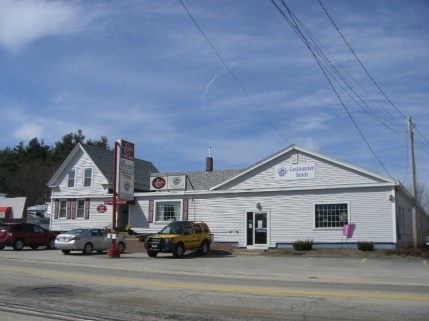
214 Central St 2010 S

214 Central (Formerly Hudson Furniture)


Do your memories of Central Street along Route 111 in Hudson Center include Hudson Furniture and Home Fashions operated by Joseph and Ann Gagnon? Shopping for a dining room set, a sofa for your living room, or a comfortable chair for the den? Hudson Furniture offered a display of options with the convenience of local shopping.

Joseph (Joe) Gagnon purchased the Lester Gove residence in May 1969 and was soon operating Hudson Furniture. A few years later, as the adjacent residential property of Berkley Swinertin at 216 Central became available, Ann and Joe Gagnon made that purchase along with a smaller parcel from a local real estate agent. Gagnon then consolidated the three parcels and subdivided into two parcels. The first contained two plus acres and the preexisting buildings; Hudson Furniture and the dwelling from the Swinertin home. This dwelling would soon become Home Fashions. The second parcel was a small lot adjacent to Merrill Brook; over time this retail lot was used for Parent Farm Stand and other sellers.
216 Central St 2010B S

216 Central (Formerly Home Fashions)

 
    Hudson Furniture and Home Fashions operated until the mid 1990’s.   By1998 ownership transferred to the present owner, Justine Mary Holdings, Inc. who operates them as multiple  unit commercial properties.  These units are now home to a variety of businesses including iRoof, Northern Dynamics, Shattuck Rug and Flooring, Daigle Pools, Home Town Butcher, and a Tattoo Parlor.
216 Central C1955

216 Central C1955

    Looking into the history of this site we find that in 1858 there were two significant land owners on this part of Central Street.  Joseph Merrill, a farmer,  and his wife Nancy (Baldwin) Merrill lived adjacent to the brook which now has his name, Merrill Brook.  Joseph passed in June 1872 and his widow, Nancy resided on the homestead until she passed in 1897 at the age of 87.
     The second landowner, M. Griffin, had a homestead west of the Joseph Merrill home.  The Griffin home was located on what is now 200 Central Street (currently a vacant lot) .  By the early 1870’s  Charles C. Parker, a  bookseller and publisher from Nashua, purchased the Griffin homestead. Charles and his wife Lydia (Batchelder)  Parker moved to Hudson center where they raised their family of 3 sons (Clarence Charles, George Henry, and Ernest) and 1 daughter (Lydia).  By 1897 Charles Parker also purchased the Merrill homestead from the estate of Nancy Merrill.  The Merrill home remained in the Parker family until July 1958; passing from Charles C. to his granddaughters, Florence and Ernestine about 1945. The home was used as a rental unit until about 1955.  The family of Otis and Julia Barr resided there for some years up to 1955.  Julia is remembered today for her hair dressing salon operated in the ell of this home.  In 1955 the home was transferred  to  Raymond Parker, Ernestine’s son, at the time of his marriage to June (Brickett) Parker. At the time Ray was recently discharged from the Army and was working for a car dealership in Nashua.  He was spending spare time remodeling, painting, and wallpapering his future home. Ray and June lived here for the first three years of their married life  before moving to another house in Hudson as their first child Kathy was to be born in February 1958.    From July 1958 until  consolidation by  Joe Gagnon  this parcel was home to and owned by a number of families:  Halthwaite/Stone, McInnis/Sullivan, and Swinerton.
As stated, the Lester Gove residence was purchased by Joe Gagnon and morphed into Hudson Furnatire about 1969.  Mr. Gove and his family had lived there since the early 1940’s; purchasing the home from George H. Parker, Jr a grandson of Charles C. Parker.  This home had been known as the Woods House prior to purchase by Lester Gove.
As we stand across Central Street today and look at the buildings on 216-214  and lean back to get a good look at the old roof line behind the commercial facade, we do see a reminder of the previous residences and history along this section of Central Street.  The 1955 photograph is courtesy of June (Mrs. Raymond) Parker and her daughter, Kathy.  The 2010 photo were taken by the author.


Home of Reuben Greeley now the Parsonage of Baptist Church


As we continue to revisit the homes around the Hudson Center Common we come to the  home of  Reuben Greeley.  One of the more influential  families in Nottingham West (now Hudson) was that of Moses Greeley.  Reuben  (born 1794) was the oldest son of Moses  and his second wife Mary Derby.

Parsonage c1980 S

Baptist Parsonage C1980

Historians date this house to about 1790 when it, and much of Hudson Center,  was a part of the farm of Henry Hale. This became the home of Reuben Greeley about the time of his marriage to Joanna Merrill in 1817.  From that time  until 1962 this home was occupied by Reuben or a member of his family.  After Reuben’s death in 1863 his son Daniel continued to live here with his wife, Joanna, and daughter Edwina.  Edwina married John Wentworth and in time ownership was passed to their son Nathaniel.  Nathaniel married Jesse Gilbert of Windham who resided here until her death in 1962; after which the Baptist Church purchased and remodeled the home  to be used as a parsonage for their pastor and family.  The parsonage has been located here at 234 Central Street some 53 years.  In this c1980 photo church members are washing windows and cleaning exterior of the parsonage.  Photo courtesy of Hudson Baptist Church.

The Walker/Campbell/Crooker Home at 13 Webster

2013043002

Campbell House front view undated

James Gerry “JG” Walker was born in New York, NY October 1842.  He served with Company K, 12th NY Regiment during the Civil War.  By 1870 “JG”, his wife Mary and 5 year old son Gerry, had  moved to Hudson.  Possibly joining them on this move were his parents and a brother.  By 1873 “JG” had purchased a building lot from Kimball Webster and built a single story home on the east side of Webster Street.  “JG” had a long career in the lumber industry as a sawyer and surveyor of lumber.
During their marriage “JG” and Mary had three children.  Gerry born about 1865 in NY and two daughters born in Hudson;  Sadie (born about 1872)  and Grace (born about 1879).
“JG” participated in the affairs of town and of the Methodist Episcopal (M-E) Church.  He served as Town Clerk in the mid 1870’s and as selectman in the mid 1880’s.  For his church he served on various committees; including the parsonage building committee where he served  with the pastor, Rev. Farnsworth, Augustus Blodgett, and Kimball Webster  This is the committee which contracted with Isaac Newton Smith to build the church parsonage at the corner of Highland and Baker Streets.
By 1898 “JG” had enlarged his Webster Street home by adding  second story.  This was done by jacking up the existing home and adding a story underneath.  The previous first floor and porch became the second floor and porch.  This helps to explain why there are identical porches on each story of the house.
“JG” passed in December 1916 at the age of 74 after a 46 year residency on Webster Street.  His funeral  was held  from his home by the Rev. Roy Honneywell of the M-E church.  He was survived by Mary, his wife of 50 years and by Mr and Mrs Jerry Walker, and a daughter Mrs. Grace Schurman.
His widow, Mary continued to live in the Webster Street home until July 1919 when she sold the homestead to Charles Edward Campbell.  Mary rented a home on Pelham Road until she passed in 1928.  She was laid to rest with her husband in the family plot of Hills Farm Cemetery behind the Alvirne Chapel.
Our first photo (undated) shows the Walker/Campbell Home front view.  We get a clear picture of the two story porch and of the barn on the south side of the house.
The history of the Charles Edward Campbell family begins in Bass River, Nova Scotia, Canada with his birth in September 1866.  In 1885 at the age of 19 Charles immigrated to the United States and became a naturalized citizen by 1910.  In June 1893 he married Anne Maria Knight a native of the Boston area.   Soon after their marriage they moved to Nashua and began their large family. They remained in Nashua until about 1904 when they moved to Hudson, possible on or near Lowell Road.  The family moved into their Webster Street home in 1919 after Charles Edward purchased it from Mary Walker.   He was employed clerk in a railroad freight office.  During their marriage I can identify 10 children; 5 of whom were born while they lived in Nashua and 5 after they moved to Hudson.  The children born to Charles Edwad and Anne Maria in Nashua are:  Oscar Joseph (b:1893), Madaline Viola (b:1895), Erma Francis (b:1900), Velma Onaita (b:1901), and Genevieve (b:1904).  Those born after moving to Hudson are Ruth Marion and Ruby Merriam (twins born and died in 1905), Marjorie (b:1907), Everett Cecil (b:1908) and Virginia (b:1913).
Of the 8 surviving children Oscar, Erma Frances, Velma, and Genevieve are the most significant to the ongoing history of the Campbell Home on Webster Street as they lived most, if not all, of their adult life at 13 Webster.
As a 23 year old single man Oscar J. registered for the World War draft in 1917.  At that time he was employed as a machinist in Worcester, MA.  After discharge from the service he continued to work in the mechanical engineering field; often commuting to employment out of the state.  By 1940 Oscar, his wife Mary Kathleen Warton, and 2 children were residing on the second floor of Campbell homestead.  Oscar J passed in December 1970 while a patient at the Veterans Hospital in Manchester.  He was survived by his wife, a son, Charles Bernard, and 2 daughters, Marilyn Louise Lindwell and Judy Fisher.  Charles Bernard resided in China Lake, Ca; Marilyn Louise resided in Fullerton, Ca; and Judy resided in Toledo, OR.
Erma Francis  resided at the Webster Street home from the time of purchase in 1919 until she passed in December 1978 at the age of 78.  After attending schools in Hudson and Nashua High, she was employed for many years as a clerk for an insurance office.  Likewise, Genevieve resided on Webster Street from purchase in 1919 until she passed in 1978 at age 74.  After attending school she worked for years as a school secretary at Nashua High.
Velma Onaita likewise attended Hudson schools and Nashua High.  She worked as a clerk for the street railway as early as age 18.  Velma was a sociable young lady; attending and participating in plays and attending theaters in Nashua.  She used the street railroad for transportation to Nashua and Manchester for both work and pleasure.  By 1925 she had met and became engaged to Jonathan MacIntyre of Nashua.  They were married August 31, 1925 by clergy David MacIntyre, father of the groom.  Following their marriage they lived at or near Arlington Street in Nashua.  They had a son Donald (b:1927), and two daughters; Onaita (b:1929) and Genevieve (b:1930).  Jonathan and Velma Onaita were divorced in 1933.  Following the divorce Velma and her family returned to live at the Campbell house on Webster Street. As time progressed Donald MacIntye married Arlene Gagnon of Hudson and Onaita Macintyre married Hayden Tibbets.
2013043001

Campbell House side view 1920’s

Our second photo shows a side view, looking south, of the Campbell House in the 1920’s.  Webster Street is a dirt road and in the lower right corner we see the street railway tracks for the Manchester Line. Both photos are from the Historical Society collection.
Charles Edward passed March 1938 at the age of 71 following a 45 year career as a railroad worker and 53 years in the  United States.  For the  last 19 years he resided at 13 Webster,   His funeral took place at the Pilgrim Church in Nashua.  He was laid to rest in Woodlawn Cemetery along with his twin daughters Ruth and Ruby.
As administrator of her father’s estate Erma Francis transferred title of all property owned by Charles Edward to her mother, Annie.  In addition to the homestead he purchased from Mary Walker  this included two additional land parcels which Charles had purchased.  Annie retained title of all the real estate until February 1951 when she transferred ownership to her daughter Erma Francis.
Sisters Erma Francs, Velma Onaita  MacIntyre, and Genevieve continued to reside in their Webster Street home.  In 1978, Erma transferred title to the next generation of Campbell’s:  the son and daughter of Velma Onaita:  Donald MacIntye and Onaita Tibbets along with their respective spouses.  Erma and Genevieve passed at different times in 1978; Velma passed in 1979.
In February 1988 ownership of the Campbell home was transferred away from the family.  Following periods of short time ownerships, vacancies,  and mortgage foreclosures the 13 Webster Street home was purchased by the Crooker Family in 1993.  It is presently home to Ann, Jim, and Sam Crooker.  They love their home and cannot imagine living elsewhere at this time even though the maintenance and upkeep on an old house becomes a labor of love.
In 2017 the Historical Society was contacted by Hayden Tibbetts in regard to diaries kept by Velma Campbell and Jonathan MacIntyre for the years 1922 – 1925.  It is interesting that we have a “his” and a “her” diary for the year 1925, the year of their marriage.

The Paul Tenny/Henry Brown House C1895

1987005017

Henry Brown House C 1895

This home was located on Kimball Hill Road adjacent to the Tenny Tomb where members of the Tenny family are laid to rest.  Being a part of Benson’s Wild Animal Farm the site was owned by the State of New Hampshire.  This home was demolished by the state prior the purchase of Benson Park by the town of Hudson.
 This house was a landmark in Hudson Center for many years; standing at  Kimball Hill Road opposite the Hudson Center Common and directly across from the front steps of the Baptist Church.    The first occupant was Dr. Paul Tenny who moved to town about 1791 and later settled here.  The property was sold to Dr James Emery in 1849.  When Dr. Emery retired it was purchased by Henry C. Brown; in 1935 it was purchased by John T. Benson and became part of the Benson’s Wild Animal Farm property.  Vera Lovejoy and her family lived here while she was managing the Benson Farm.  This c1895 photo shows, left to right, Henry C. Brown; Ina Louise Brown, daughter; Clara Bryant Brown, his wife; and John and Eliza Brown the adoptive parents of Henry.  Photo from the Historical Society Collection.

Memories of the 1936 Flood

1978050004

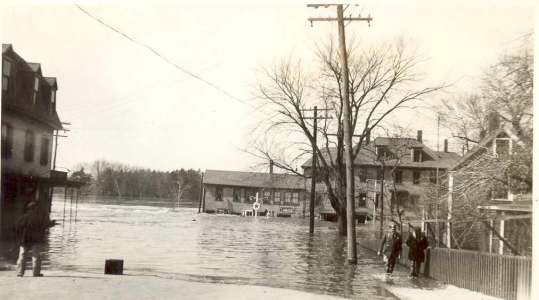
West Hollis and Bridge Streets 1936

The great flood of 1936 struck both the Nashua and the Hudson side of the Taylor Falls Bridge. By mid March the accumulation of winter snow to the north and west along with warmer weather and heavy rains caused the Nashua and Merrimack Rivers to peak beyond flood stage. The rivers were rising fast and carrying large ice cakes. Flood stage on the Nashua side was reached by Sunday, March 15 including flooding along East Hollis and Bridge Streets. For a short time the water receded and the danger seemed to have passed; but by Wednesday, March 18, there were threats of more heavy rain and warmer weather. The Merrimack River was again rising fast at a foot an hour. During the next few days flood conditions existed along Litchfield Road, Webster Street, Post Office Square at the bridge, and south of the square to Maple Avenue and parts of Riverside near Lowell Road. By Saturday, March 21, flooding had peaked, water began to recede and the worst was over. It wold take months to clean up and recover from the damage and debris left behind.

From her home at 1 School Street, atop Campbell Avenue, Hazel Buxton (Mrs. Paul) was able to observe much of the flood activity in Post Office Square and Webster Street. Hazel kept a diary during the three worst days of the flood. This diary was later transcribed and placed on file at the Historical Society. Paul worked for the Public Service Company in Nashua and was stranded on the Nashua side during most of the flood.

On Thursday morning, March 19, the Telegraph reported the bridge was closed to traffic. Bridge and East Hollis Streets (Nashua) had 5 feet of water. On the Hudson side, Paradise Park (aka Paradise on the Merrimack) was flooded and families were being rescued from their homes in boats. The gas supply into Hudson was shut off and the red Cross was “at the ready” to offer help. Hudson pupils were unable to attend Nashua High. There was no gas with which to prepare breakfast. Hazel and her children (Elizabeth age 16 and Robert C age 8) walked from their home, down Campbell Avenue to and across the bridge. They watch as boats were carrying residents from East Hollis Street to dry land. Water had reached the tops of front door steps and beyond. Water was rising rapidly and the reports on the radio were alarming. Families along the Litchfield Road and Webster Street were being evacuated. Our first photo shows West Hollis and Bridge Streets at this time.

When they returned home Hazel placed some potatoes in the coal furnace to bake. By 2:00 pm the power was off. Neighbors were helping each other; sharing extra kerosene and lamps. The power plant off Bridge Street in Nashua was abandoned. The Nashua River was overflowed. Families in Hudson ate supper by lamps or candles. The Hudson fire trucks were used to barricade access to the bridge on Ferry and Central Streets.
2013038017

Flooding at Post Square from Central Street

On Friday morning she learned from neighbors that the bread truck had arrived at Baker’s Store on Central Street. The delivery was made by men wading through water in their rubber boots. By this time the water is pouring over the railings on the bridge. Our second photo was taken from Central Street near Baker’s Store looking down onto the flooding over the bridge and in the square. We see men in the streets wearing rubber boots; perhaps delivering bread and food to Bakers Store.

As Hazel looked down Campbell Avenue she saw a barn sailing from East Hollis Street down river and soon heard a crash as the barn hit the Rochester railroad bridge. Hazel and the children walked around Central Street to Reed Street and could see water had flooded the lower end of Maple Avenue. Water was pouring through the coal cars on the bridge. The old toll house from the Nashua side of the bridge had also gone down river and came to rest near the barn.

There was no phone service. Water from Webster Street was now connected with the flood water in the square. Ferry Street was roped off at Library Street and Central Street was closed at the Odd Fellows Building. Hazel was able to use the police phone to learn that her husband, Paul, was safe in the second floor of the Belvedere School in Nashua (now a small park on Bridge Street). He would be removed as soon as possible; but, as of now the school was surrounded by water from both rivers.

By noon water was rushing across the square from Webster Street and all houses on Webster were flooded, including that of Kimball Webster. Many people were out and about. They watched a large barn come down river, rise and crash into the bridge, splintering in seconds. Debris popped up on the other side of the bridge. All kinds of debris hit the bridge, sucked under by the current and later popped up on the south side of the bridge in pieces. A small building with a stove pipe resembling a person hits. A bunch of railroad ties come down with thuds and loud reports as they hit the bridge.

By early afternoon news arrives that her husband Paul, and other Public Service Company employees are safe at an uptown office. The Hudson Community Church open for shelter, warmth, and food. Meals were served all day. Women used wood fires in the ranges. Donations were accepted for flood relief.

1977002012

Flooding of River onto Litchfield Road

By 5:00pm water was receding. Friends drove them up to Elm Avenue and they found the water up to the front door of the Hardy farm, now home to Bernard and Elaine Brody. The Garrison farm was also flooded. Soon people were beginning to relax as the worst was over. Our third photo shows the flooding of homes along Litchfield Road.

Come Saturday there were many hours and weeks of cleanup before normalcy could be restored. All canned goods and preserved were thrown out after the cellars were pumped out and disinfected. Floors were warped, furniture ruined. Electricity, gas service, and telephone had to be restored. All photos are from the Historical Society Collection.


Eli Hamblet House

Eli Hamblet House
Our next stop on our revisit to Hudson Center is at the home of Eli Hamblet.  Eli and Benjamin Dean were neighbors, both homes facing the common on the east side.  The Historical Society is fortunate to have three original documents written by Eli; a work ledger for years 1840 to 1878; his 1855 and 1857 diaries; and a manuscript detailing Hudson’s contributions to the Civil War.  This was kept by Eli during his tenure as Town Clerk.
Born in 1810 to Tamar and Thomas Hamblet, Eli lived most, if not all, of his adult life in Hudson Center.  Eli’s home and farm was located on Hamblet Avenue facing the Hudson Center Common on the east side. This house was previously owned by John Foster who operated a grocery store there for about 19 years.  Eli married Rebecca Butler of Pelham in 1844.  Their daughters Rebecca Souvina and Arvilla continued to reside in the house after Eli’s death in 1896.  In addition to farming, Eli served his town in many ways; town clerk, selectman, overseer of the poor, and representative to the general court.  He was one of the organizers of the Hudson Center Library and he acted as the librarian when this small library was housed in his home.  He was a member and Deacon of the Baptist Church.  In 1876, when the Hudson Center Post Office was established at the Railroad Station behind the Town Hall, he was appointed postmaster.  He held this office until his death in 1896.  Eli’s entire family, including his parents, are buried in Westview Cemetery.  This house was the home of Robert Thompson, Sr and his family for many years.  After being vacant for an extended time it was demolished a few years ago.

Hudson’s Nick Connell, East of Echo


This week’s Remember Hudson When … article is by Stephen Kopiski.  He has an interest in our town’s history and personalities like Nick Connell.  

 
Nick Connell 1989 S

Nick Connell 1989

Hudson’s Nick Connell, East of Echo

 
          Consider around 1900, the Merrimack River would freeze over and permit winter recreation from NH to MA. Forty years later, with industrial and municipal development, the water warmed and the freeze was only a memory. True except for a nineteen year-old Hudson boy who decided on January 31, 1940, to lace up and skate to Lowell. Despite some harrowing watery encounters, he made it to Pawtucket Falls, 14 miles in a little over two hours. Not to be outdone, six days later, he skated another 14 miles from the Hudson bridge to Manchester. Too tired to skate back, he attempted hitchhiking, but ended up walking 9 of the miles in borrowed galoshes. The young man’s name was David Wesley “Maurice” “Nick” Connell, and he was just getting warmed up.
 
          That’s a lot of names and nicknames. A favored choice was “Nick,” so this story moves forward as such. Born September 21, 1921, Nick Connell was a man who saw goals and drove towards them his way, and with focus. A lot of claims are hard to verify; married 4 times, Nick maintained he’d had over 40 jobs; trapeze artist, elephant handler, policeman, railroad man, stone mason, vaudevillian and more. Fortunately, there’s no shortage of newspaper accounts and first-hand recollections of his exploits, for a glimpse into his extraordinary life.
          Nick joined the Navy in 1943 and served as a corpsman in WWII. Always a fitness enthusiast, the Nashua Telegraph archives offer multiple mentions of weightlifting meets and matches, many featuring his breaking numerous city and state records. One such meet had him breaking every record in the competition for his weight class (181 pounds in this case.) He even bested some of the heavyweights on that particular night. Along the way, Nick won the title of Mr. New Hampshire in 1948. This dominant heyday lasted from the early 1940’s until the mid 1950’s, but he maintained his bodybuilding and strength training discipline all of his life.
 
          A high school dropout, Connell was self-educated with a lifelong interest in the religions of the world. A heavy reader, he wrote and spoke with natural intelligence. In the mid 1950s, he dedicated himself spiritually and joined The Church of Latter Day Saints, The Mormons, and became the church’s State Commander (NH) in 1956. He remained a Mormon for life. Into the 1960s, his vocation had him living in Arizona and Salt Lake City, Utah where he performed his missionary service. Newspaper accounts from this period describe Nick as a researcher, a writer, even a lecturer for the church. But as this decade of cultural change and upheaval began to unfold, not being one to follow any crowd, Nick was headed for his own real-life revolution.
           As the 1970s dawned, Nick took to commuting between Hudson and San Diego, CA with the change of seasons. San Diego’s Torrey Pines State Natural Reserve is a protected environment for rare flora. Hikers and nature lovers are welcome, but only on the permitted trails. Predictably, Connell was far afield when he encountered a sandstone indentation in the cliffs, well off the trails. Here, allegedly in a vision, a white-haired man invited him to dig into the cliff, all the encouragement he needed. So with a Bowie knife and a screwdriver, and later a pickax and hatchet, he fashioned a tidy, comfortable two-room cave complete with carved-in bookshelves, window and sleeping platform. It was here, sheltered from New Hampshire winters, that Nick continued his studies of the world’s religions with the intention to write a book of life’s philosophy. Nick called his excavated refuge “East of Echo.”
          Here, two accounts collide, Nick had claimed that, even as a young boy, he felt the allure of solitary living. Much later, a soon-to-be-former wife suggested he go live in a cave…
          Unfortunately, he was dubbed “The Torrey Pines Hermit” (Nick always welcomed and entertained any visitor who could find him.) Over the years, he adorned the cave interior with impressive paintings and relief sculpture of religious and ancient symbolism. His visitors ventured off the permitted trails in the protected reserve to see the hermit in his unlikely lair. And even though it took 17 years, the park rangers eventually found the cave, and the hermit. There was reluctance on all sides concerning what to do. The cave and the artwork were splendid but even Nick agreed that a lot of laws had been and were being broken. His support reached all the way back to friends and well-wishers in Hudson, but in the end, 1991, East of Echo was filled with concrete and permanently sealed. Characteristically undeterred, Connell pursued various legal and physical means to resurrect his cave and his art. He even started new, more secret cave-carving in the reserve. For a while, the 70 year-old was hard to catch on the sandstone cliffs, but the rangers never gave up and he was repeatedly shooed off. Of note, towards the end of this period, Nick would write an occasional article in what was then known as “The Hudson News” entitled “View from the Cave.”
          Meanwhile back home, apparently restless while away from his cave, we have “1987 – Connell VS. Town of Hudson.” Nick risked arrest for photographing police activity at an automobile accident outside his home. He protested formally and finally received a written apology from the Chief of Police for his treatment at the scene. He sued anyway, and won (One Dollar, plus court costs.)
          With the cave adventure done, and confronting the relentless onslaught of old age, Nick stayed primarily at home in Hudson, but still visited the West Coast when he could. Not driven by material wealth, or notoriety, Nick Connell was an example of singular individuality and effort, even with occasionally dubious accomplishment. It was while in California that David Wesley Connell passed away on December 5, 1994. His remains were returned, here, to his hometown, where he rests. No doubt his gaze and his reach are finally infinite, like the imagination of the boy who braved the ice.