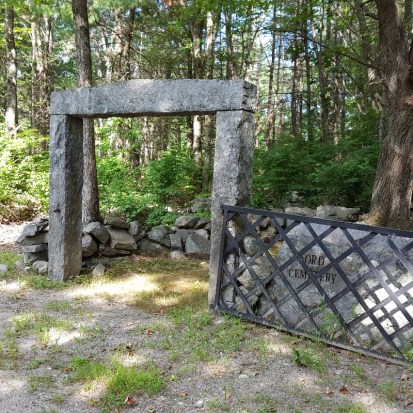
Entrance Gate Ford Cemetery
The Ford cemetery is located on Musquash Road less than 1/4 mile south of the site of the first meetinghouse of Nottingham. and on the same side of the road. The location of the meetinghouse is at the entrance to the Musquash Conservation Area and is identified by a granite marker. This cemetery, also known as the South End cemetery and the Musquash cemetery, was laid out and dedicated as a burial place in 1734, just a short time after the building of the meetinghouse.
The custom of the early settlers in this part of New England was to have a public burying ground, or church yard as often called, connected to and often times surrounding it on three sides of the meeting house.. This was not practical at this location because the land in that vicinity was rocky and ledgy, not suitable as a place for the internment of the dead. The selected site is as near the church as as a suitable plot of ground could be found.
To locate this cemetery one needs only to travel south on Musquash from the conservation area less that 1/4 mile. On your left you will find a gravel driveway; the cemetery will be found a short distance in on this driveway. Be careful as the cemetery cannot be easily seen from Musquash Road. This burying ground contains about 1/4 acre, enclosed by a stone wall with an iron gate. Above the iron gate is perched a long granite post laying horizontal with the ground and supported on each side buy a similar granite post. You walk under this post as you open the gate to enter the cemetery.
The most frequent names found within this yard are Snow, Merrill, Ford, Fuller, Gowing, Barron, Wilson, and Connell.
There is no debate as to the antiquity of this place; in fact some historians have claimed that it is the most ancient of all Hudson;s cemeteries. The earliest date found in this yard is that on the headstone of Ensigh John Snow, “who departed this life March the 28th, A.D., 1735. Aged 68 years, 4 month, and 3 days. This headstone is a very thick, wide and heavy one and not very high. This is the most ancient inscription of any, not only in this yard, it also predates the earliest date of 1738 found in Hills Farm cemetery or any other cemetery in town. Ensign John Snow resided nearly on Musquash Road. The first town meeting of Nottingham, MA was held at his house on May 1, 1733.
This yard is the final resting place of Rev. Nathaniel Merrill, the first minister settled in this town. and his wife Betsey. He preached here for more than 50 years.
Without a doubt the most intriguing headstone within this yard is the double stone indicating the death of Capt. Thomas Colburn, age 63, and his 3 year old son, Thomas. Both were killed on August 30, 1765 while asleep in their bed by a single flash of lightening.
The most recent, and I believe the last, internment to be made in this place, were those of Leslie Shunaman (died 2005) and his wife Leslie (dield 2004). Louise and Leslie were well known residents of Hudson and life members of the Historical Society.
I have a mystery concerning this cemetery and perhaps some of our readers can help! Allen Morgan grew up in South Hudson and recalls visiting this cemetery with some of his ‘buddies’. He recalls an inscription within this cemetery which reads “here lies the body of x who was lost at sea and never found”. I have searched the cemetery and the inscriptions printed in 1908 by Kimball Webster and can find no reference to this!! If anyone has an idea they can sent email to Ruth at HudsonHistorical@live.com or leave a message at 880-2020.
 Remember Hudson NH When...
My great grandmother Fannie Cullen Hoffman wife of George Hoffman is buried in south end Ford Cemetery beside her infant son. She died in childbirth on 25 May 1873 age leaving behind her three surviving children John Onslow Hoffman age 6, William James Hoffman age 4 and Sarah Jane age 2 and her grieving husband George Hoffman. Her parents were Michael and Sarah Cullen (nee Harding) who are buried in Salem Rockingham. The original Cullen homestead in Salem, Rockingham still stands today. In May 1866 George Hoffman and his father in-law Michael Cullen purchased between them a 57 acre homestead on Gowing Road from Elisha Grant, which later became the homestead of George and Fannie Hoffman and their children. In February 1876 great grandfather George Hoffman and his three children left Hudson for the Port of San Francisco and on 7 February boarded the ship Granada bound for Sydney, Australia. After living and working in Maryborough, Australia; great grandfather left Sydney on 14 May 1881 with his three John Onslow age 14, William James age 11 and Sarah Jane age 9 on the ship SS Hero to settle in New Zealand. Great grandfather never re-married and brought up his three children to be law abiding citizens, who never forgot their American homeland of Hudson, New Hampshire. He died in Te Kuiti, New Zealand in 1916 still grieving for his wife Fannie.
by Tania Macdonald (nee Hoffman) grandaughter of John Onslow Hoffman
LikeLike