Home » 2015 (Page 3)
Yearly Archives: 2015
Ferry Boats Across The Cross The Merrimack River
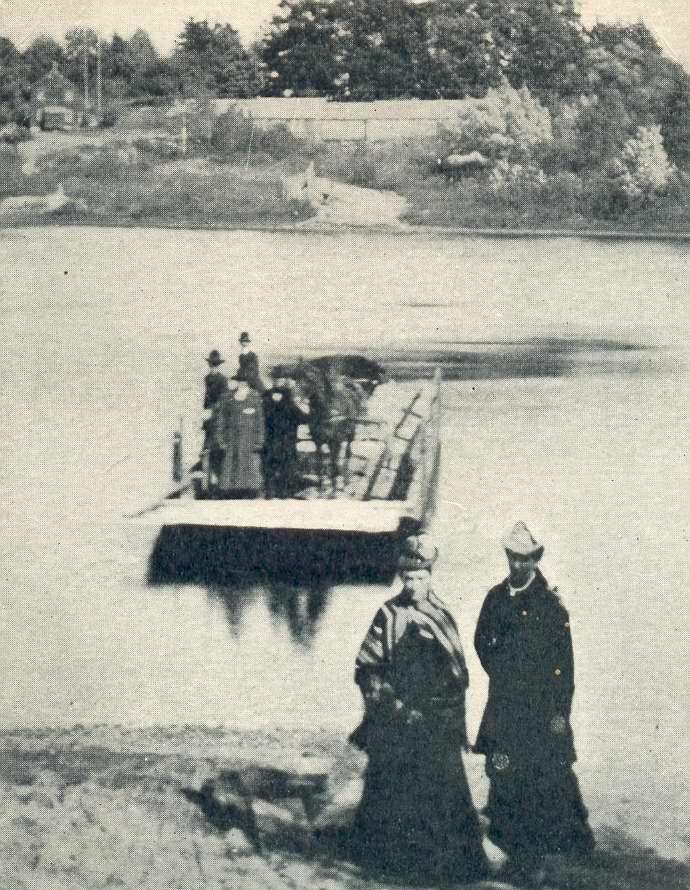
Ferry Boat across Merrimack
In the early history of our town, up until 1826, there were no bridges across the Merrimack River between Lowell and Manchester. River crossings between Hudson (then called Nottingham West) and Nashua were made by ferry boats similar to the one shown in this week’s photo. During these early years there were no less than three ferries operating between the two communities.
The earliest ferry was operated by Eleazor Cummings. His ferry left the east shore of the river a short distance north of the Veterans Memorial Bridge. It landed on the west side just south of the mouth of the Nashua River. Operation of this ferry continued until 1742, at which time Mr. Cummings relinquished his rights to another person who established Dutton’s Ferry just below the Taylor Falls Bridge.
A second ferry, called Hardy Ferry, operated from Lowell Road near the Hardy Farm. A Third ferry, Hills Ferry, was operated on Hills land just south of the town line into Litchfield. This was started by Nathaniel Hills and was continued by later generations of his family.
The first bridge between Nashua and Hudson was built in 1826. Even after it’s construction some of these ferries continued to operate. Photo from the Historical Society Collection.
Twin Span Bridge Across the Merrimack C1975

Twin Span Bridge C 1975
The challenge of crossing the river between the communities of Hudson and Nashua has been a re-occurring one since the beginning of our town’s history. The twin span bridge shown in this C 1975 photo, is the result of such a challenge which began in the early 1960’s and extended for a decade or more. This photo was taken from the Hudson side at Ferry Street. These spans, constructed at separate times, now provide for traffic between the communities of Hudson and Nashua.
First to be completed was The Veteran’s Memorial Bridge (northern span). This span was constructed along side and parallel to the aging concrete Taylor Falls Bridge. Following 15 months of construction this span was opened in September 1970. Emergency repairs had been necessary to “shore-up” the deteriorating Taylor Falls Bridge; load limits and height restrictions were imposed to postpone its demise. State officials made the decision to permanently close the old bridge once the new span opened in September 1970. This set the stage for the construction of the southern span shown in this photo.The old bridge was demolished in the spring of 1973 and The Taylor Falls Replacement bridge opened in December 1974.
First to be completed was The Veteran’s Memorial Bridge (northern span). This span was constructed along side and parallel to the aging concrete Taylor Falls Bridge. Following 15 months of construction this span was opened in September 1970. Emergency repairs had been necessary to “shore-up” the deteriorating Taylor Falls Bridge; load limits and height restrictions were imposed to postpone its demise. State officials made the decision to permanently close the old bridge once the new span opened in September 1970. This set the stage for the construction of the southern span shown in this photo.The old bridge was demolished in the spring of 1973 and The Taylor Falls Replacement bridge opened in December 1974.
As necessary as these bridges were, their construction and the access roads required for their use completely eliminated the general business area which had developed at the bridge near Central and Ferry Streets. Photo from the Historical Society collection.
Presentation of Mary C 1975
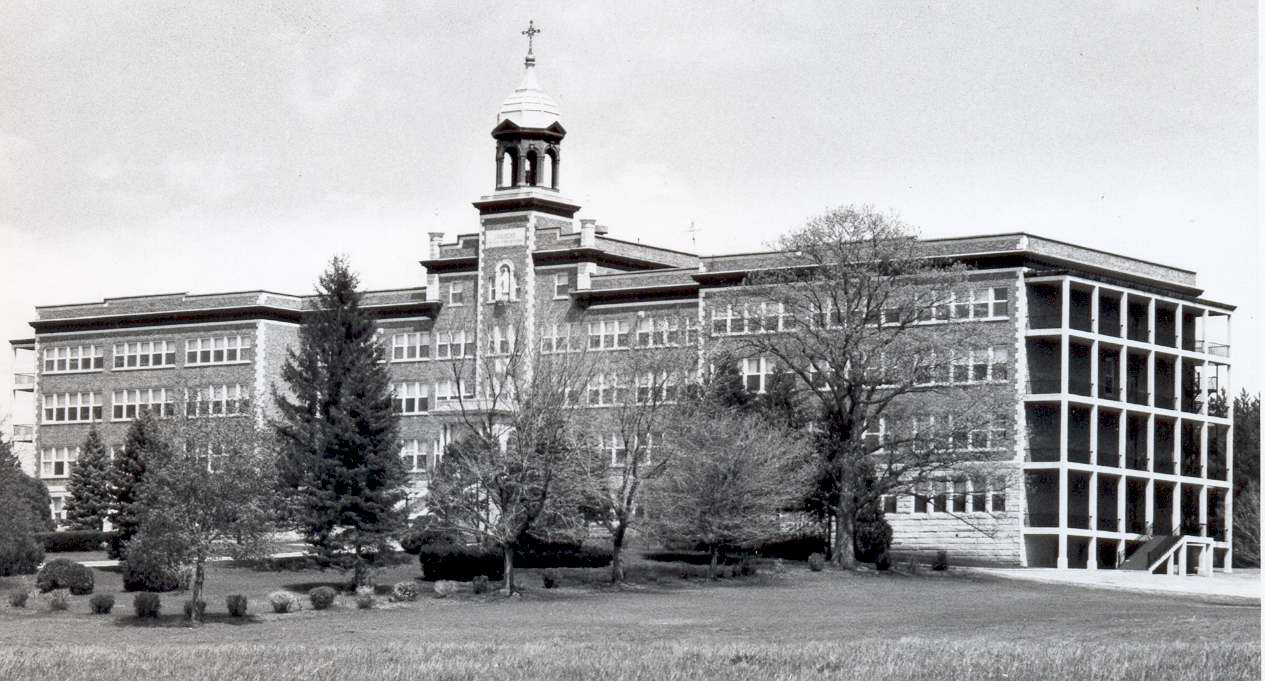
Presentation of Mary C 1975
In July 1924 representatives of The Congegation of the Presentation of Mary in Canada were invited by Bishop Guerton of Manchester to choose a site for this school. Bishop Guerton wished to have a bi-lingual boarding school in his diocese which served the franco-american population. By August of that year Alexander McDonald sold 128 acres to the community. The Presentation of Mary was incorporated by the State of New Hampshire and construction began. By September 1926 the building was blessed and the first school year began with 114 students – 70 of which were boarders.
In 1933 the first class of advanced studies began and by 1935 Governor Styles Bridges signed the charter authorizing Rivier College to grant bachelors degrees. Rivier remained at this Hudson location until 1941 when it moved to the former Shea property on South Main Street in Nashua.
Today’s photo was taken in 1975 in preparation for publication of “Town in Transition” the updated history of Hudson 1913 – 1977 and is a part of the photo collection at the Hudson Historical Society. Today The Presentation is a day school with students from pre-school through junior high school attending from Hudson, Nashua, and surrounding areas in both NH and Mass.
Baker Office Building and Nashua Trust
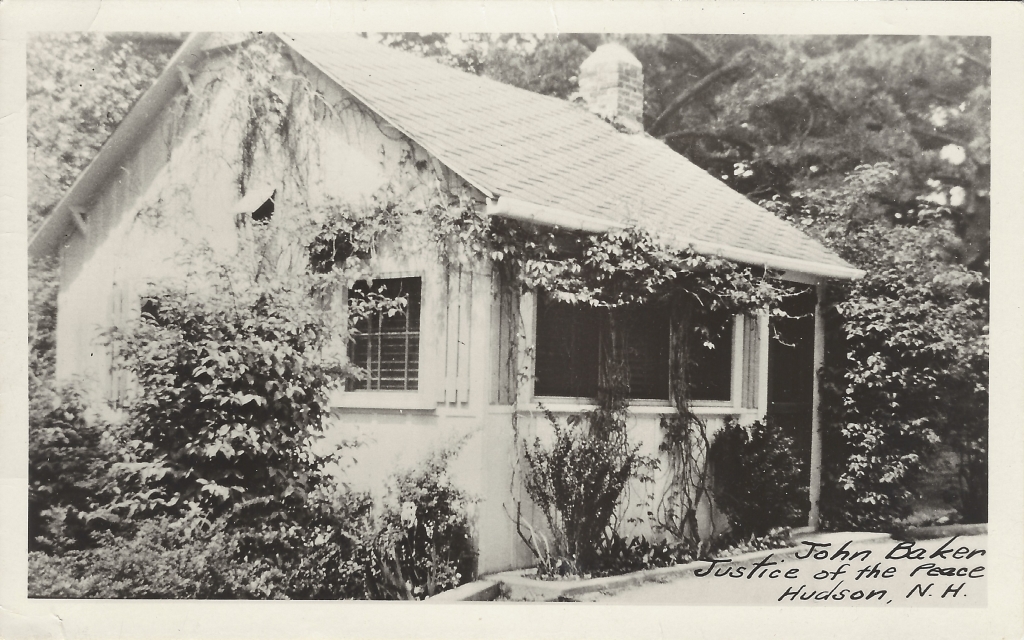
Baker Office Building
This popular photo of The Baker Office Building is on display in the Foyer at the Hills House on Derry Road. Visitors touring the Historical Society will often comment “This is where we got our marriage license”! John E. Baker served as Town Clerk and Treasurer from 1940-1965. At first he conducted his town business within the Baker Brothers’ Store on Central Street. By 1944 this privately owned office building was built on part of the old Kendrick property at the point of land between Derry Road and Baker Street. From this building Mr. Baker conducted his town responsibilities along with his private business as a John Hancock Insurance Agent and Justice of the Peace until the present Town Hall was completed in 1965. At that time the town office was moved to Town Hall on School Street.

Nashua Trust Building Derry Road
When the access to the newly constructed Veterans’ Memorial Bridge were designed Baker Street became a dead end street at Ferry Street. This small office building was moved to a private residence on Ledge Road.
The Nashua Trust Company had established a temporary branch office in the Morey Building on Ferry Street and opened for business by the end of August 1964. By March 1967 the bank moved into this brick building on Derry Road opposite Library Park and near the site of the earlier Baker Office Building. By August 1980 the Nashua Trust expanded it’s operation and relocated to 77 Lowell Road, occupying a portion of the former Piggly Wiggly Building. After a series of bank mergers and buy-outs the Lowell Road site is now occupied by Citizens Bank. This photo shows the Nashua Trust Derry Road building C1976. The building still stands and has been used by a real estate firm and a loan company. It is currently vacant. Photos from the Historical Society Collection.
Robinson Road Looking West c1935

Robinson Road Looking West C 1935
In this C 1935 photo we are standing near 99 Robinson Road looking west C. 1930. At that time Robinson was pretty much a single lane roadway unless you happened to meet a car from the opposite direction. In that case the car coming east would ‘scoot’ off to the right until the oncoming car was passed. The utility pole seen here provided telephone service from the central at Hudson Center. Electricity was not available in this part of town until about 1946. Beyond the utility pole we see the barn which once stood at what is now 104 Robinson Road. Photo from the Parker/Robinson Family and now a part of the Historical Society Collection. (Published HLN July 10, 2015)
Camp Cayuga c1956

Camp Cayuga Lowell Road
As early as 1956 boys and girls between the ages of 7 and 14 were bused, transported by car, or walked to Camp Cayuga on the Lowell Road in Hudson. Camp Cayuga, a summer day camp, was operated by John S. Groves on his family’s 265 acre farm. The camp activities started at 9 am and ended at 4 pm. Each camper brought their own lunch except on Thursdays when there was a noonday cookout. The camping season was 8 weeks, during the months of July and August. As many as 125 plus children came from towns like Milford, Amherst, Merrimack. Lowell, Chelmsford, Nashua and Hudson. Camp facilities included a large barn for a place of assembly, a swimming pond on the property which was recently dug by a bulldozer along a brook which ran thru the property, bath houses, Indian camps where campers divided into tribes, playing fields, horseback riding rinks, and woods for nature study. Horse back riding was one of the more popular events. special events,such as horse shows, carnivals, and fishing derbys, were often held.
The Groves farm was located on the western side of Lowell Road and extended to the Merrimack River. Until 1955 Mr. Groves had farmed the land and operated an automobile sales agency on the premises. He then turned from auto sales to teaching school. The idea of using the farm as a summer camp was suggested to him by a friend a few years earlier. The possibilities for expansion were considered as tremendous as within a 15 mile area there were 200,000 people and only 2 other day camps in the area.
Within a few years growth came to Lowell Road and with it an increase in property values. The State of New Hampshire had plans for a Circumferential Highway. By the early 1970’s the northern portion of this farm was used for the access road to the Sagamore Bridge. Of the remaining acres, the part abutting Lowell Road is the location of Sam’s Club; the back portion toward the river is part of The Green Meadows Golf Course, Photo courtesy of Leo Demers and now a part of the Historical Society Collection. (Published HLN June 26, 2015)
St, Anthony’s Friary

St. Anthony’s Friary
On a beautiful fall day in October 1956 Saint Anthon’y Friary on the Lowell Road was dedicated. By that time the building was complete, landscaped, and the access road from Lowell Road paved. Bishop Brady of Manchester was the celebrant. Of the many sites considered in 1954, this 148 acre property with 2,700 feet on the banks of the Merrimack River far excelled others. It was 3 miles from the Nashua train station with 10 trains to and from Boston on weekdays, 6 on Sundays. The property was purchased from Laurette Jacques, The site was blessed and groundbreaking began March 26, 1954. Careful and professional design resulted in a 3 storey quadrangular building with 115 private rooms plus rooms for visitors, suites for staff, an infirmary, a 2 story choir, and a library on the third floor. The Province received much professional help for which they were grateful.
For nearly 25 years The Friary served to educate young men for the priesthood. By 1979 the Friary building and then 172 acres was put on the market and the Town of Hudson was offered first refusal. After 25 years of landscaping by the Capuchin monks the property had pine and fir forests, red and white oaks, maple, birch, ash, hickory, and other trees. There were also handball courts, tennis courts, a swimming pool, and self contained water ans septic systems.The 3 story building was served by 4 stairways and an elevator.
The town received permission for a special town meeting on October 19, 1979 in order to decide on the acquisition of the Friary at a cost of $2.8 million. Many were in favor and many were opposed. A majority of the voters favored the the purchase but; a 2/3 vote was needed. The purchase was defeated by 22 votes.
Moving forward to present time, a part of the site has been commercially developed by extending Executative Drive. The Lowell Road frontage at 161 Lowell Road has not been developed. Information and photo courtesy of Brother Roger and now a part of the Historical Society collection. (Published HLN June 19, 2015)
Oblate Retreat House on Lowell Road C. 1976
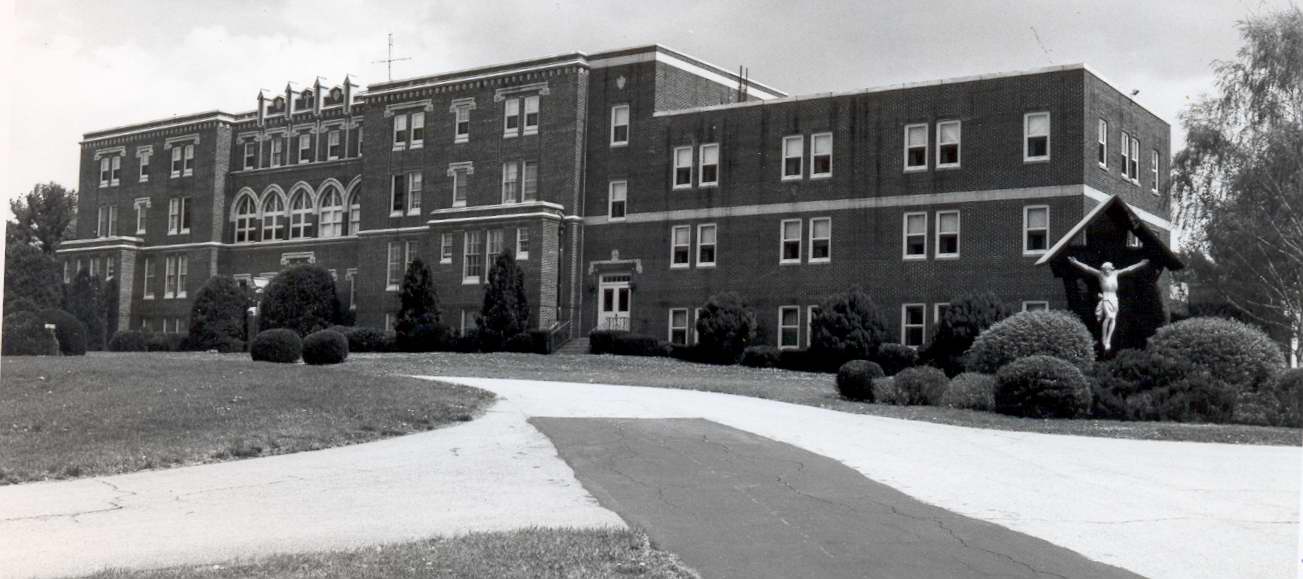
OMI Retreat House C. 1976
The Oblates purchased the Wilson Farm on the Lowell Road in 1922 and established a novitiate for young men entering the priest hood. The initial wooden building burned in 1935 and was replaced by this brick building in 1936. The novitiate closed and the building was used as a retreat house beginning about 1941. Many religious based retreats were held here for religious leaders, lay persons, teens, and individuals with special needs. A large lecture hall and chapel were added later. In the first photo we see the Oblate Retreat House as it appeared in 1976.

OMI Retreat House C. 1955
Some of our readers may recall attending a weekly or weekend retreat at the OMI (Oblates of Mary Immaculate) Retreat House; many more will remember the magnificent display of Christmas lights as early as 1952. In 1960 as many as 300,000 lights were used in the special display which caused a glow in the sky for many to see! Travelers were lined up and down Lowell Road to catch a look at the display which was visible from the road. The second photo shows one of these exhibits. These exhibits left fond memories with many residents; the magnificent displays on the building and grounds and the enchanted village inside. All open to the public.
Local residents remember, and miss, the friendly, welcoming atmosphere extended by the brothers of OMI to the kids and families living in the area. Hudson resident Leo Demers and his childhood friend Fran would spend summer/winter days helping the resident brothers and priests with chores such as weeding, raking and general clean-up, decorating for Christmas. For this they were paid a dish of ice-cream!!
After the retreat house closed the property was placed in a holding company and purchased by Etchstone Properties in 2005. This building and the acres around it are now the location of Mission Pointe, residences for age 60+, at 200 Lowell Road.
The Oblate of Mary Immaculate were one of 3 religious organizations who purchased large pieces of farmland along Lowell Road; using the property in their own mission, keeping fields/forests maintained and unused for commercial purposes. Photo from the collection of the Hudson Historical Society. Published HLN June 12, 2015.
Home of Mr. and Mrs. Harold Johnson on Ferry Street

The bungalow style home, shown in the first picture, on Ferry Street was built of stone blocks with a metal roof after the previous family home was destroyed by fire in 1913. A careful look will show the electric car tracks on Ferry Street. The previous home, in the same location, was a two story clapboard house. It is shown here in 1913 fire as the firemen from

Hudson men battling an active fire at the Bassett Home on Ferry Street – 1913
Hudson were battling the blaze which destroyed the house. We see the men on the porch roof with hoses in an attempt to contain the fire. These houses were the home of the Bassett/Johnson family from about 1890 until the mid 1970’s. The first Indian Head bank building in Hudson which opened in November 1965 was to the right of this home. By the mid 1970’s the bank had expansion plans and this property was purchased, the building razed, and the enlarged bank building constructed by 1976. The original bank building was moved to the corner of Ferry and Library Streets and is now in use by the Hudson Fire Department.
Almeda (Bassett) Johnson was a Hudson native. She married Charles Harold Johnson of Portsmouth in 1925. They spent most, if not all of their married life in the bungalow on 15 Ferry Street. He worked as a foreman in Nashua. Almeda was active in the Community Church, women’s organizations, and in the mid to late 1950 was the proprietor of Wee Wisdom Kindergarten which she operated from her home. Almeda’s father, Joseph Bassett was a painter of high end carriages and automobiles.
This location is now the site of Sandander bank. The photos were a donation to the Hudson Historical Society from Mrs. Almeda (Bassett) Johnson. (Published HLN June 5, 2015)
Indian Head Bank C1977

Indian Head Bank Ferry Street C 1977
The first bank in Hudson was a branch of the Indian Head Bank. The bank established temporary quarters in October 1963 at the corner of Ferry Street and Campbell Avenue. A permanent brick building was soon completed at the same location and was opened in March 1964. By November 1976 the bank purchased the former home of Mr. and Mrs. Harold Johnson and built a more spacious office with ample parking. The original, and smaller, building was removed from the lot onto the site of the former Bradley’s Market at 39 Ferry Street on the corner of Library Street. The first photo, taken C1977, shows the Indian Head building. As a result of bank mergers it is now Santander Bank.

39 Ferry – HFD Office Building
The second photo shows the office of the Hudson Fire Department at 39 Ferry Street. This building was the former Indian Head Branch building at the corner of Ferry and Campbell in 1964 and removed in 1976. Photos from the Historical Society Collection.
 Remember Hudson NH When...